
The Voters Have Repudiated Trump: Will He Finally Listen?
It’s hard not to read an architectural message in American voters’ stunning repudiation of Donald Trump: No more gilded, Mar-a-Lago excess in the Oval Office. We elected you to make our lives better, not to build monuments to yourself.
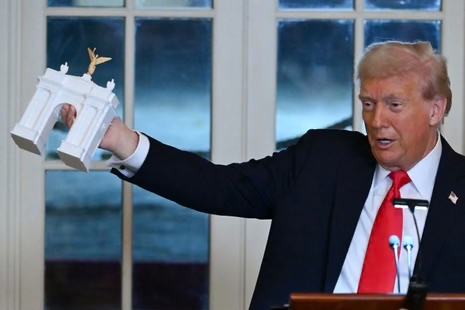
To be sure, soaring gas and diesel prices, the Iran quagmire, and the shameless self-dealing of Trump and his family were the main factors driving Tuesday’s Republican rout. But it can be argued that Trump’s preoccupation with his pet projects—the grotesquely oversized White House ballroom, the gargantuan arch, the troubled Reflecting Pool—played a small but significant role in his comeuppance.
Months of headline-generating controversy over the vanity projects surely cemented the impression that the president was needlessly focused on constructing a pharaonic legacy, though his penchant for gilded garishness makes the pharaohs look like paragons of tasteful understatement.
Former President Obama crystalized that view last week when he joked that Trump’s White House makeover looked “like Saddam Hussein opened a Cheesecake Factory. Just gold everywhere.”
Polls showed that a wide majority of American adults didn’t buy Trump’s rhetoric about beautifying the nation’s capital, concluding instead that his projects were ego trips. By making his closing arguments at the Reflecting Pool, where he rambled on about pipes instead of addressing affordability and other kitchen-table issues that were topmost on voters’ minds, Trump drove the final nails into the Republicans’ political coffin.
So much for his notoriously effective political slogan from the 2024 campaign: “Kamala is for they/them. President Trump is for you.” No. With Trump, it’s all “me,” not “we.”
To longtime Trump watchers who’ve critiqued his habit of plastering his name on anything he builds, including the giant “TRUMP” sign with which he marred his mostly handsome Chicago skyscraper, none of the president’s monument-building behavior has come as a surprise. The rest of the country was simply catching up. Now that it has, though, the question is whether Trump and his yes-men will get the message and halt their assault on Washington.
Don’t bet on it.
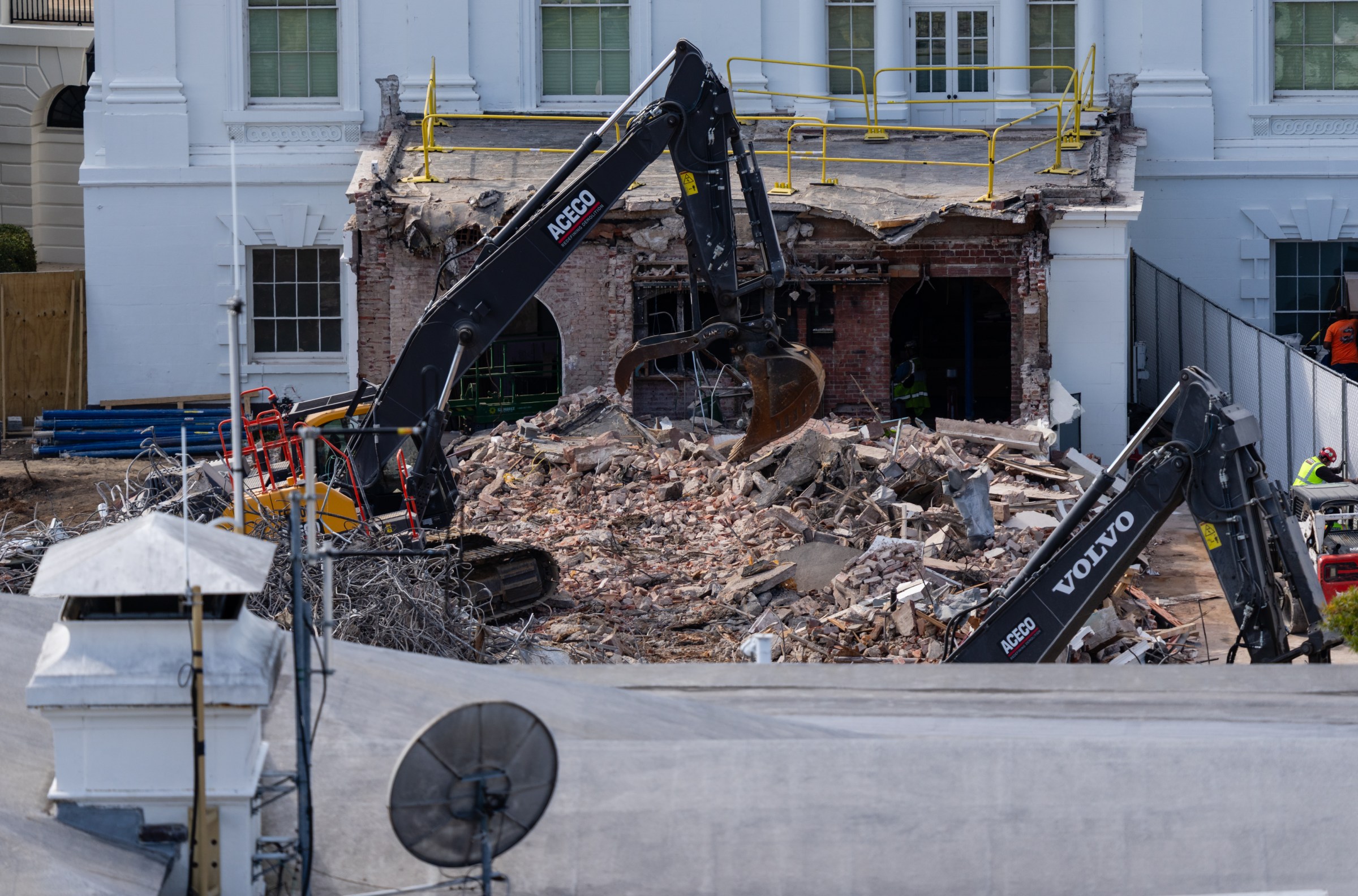
On the day after his drubbing, an unrepentant Trump showed up at the White House ballroom construction site to sign the structure’s final steel beam. A more substantive indication will come Thursday when the National Capitol Planning Commission, which is stacked with Trump allies, is expected to grant final approval to Trump’s plan for a 250-foot-tall triumphal arch that would be built in a traffic circle across the Potomac River from the Lincoln Memorial. Administration officials have indicated that construction could start immediately after the commission votes.
As historic preservationists have argued, the planned arch and its statue of a winged Lady Liberty would loom over the 99-foot-tall Lincoln Memorial. As a New York Times analysis has shown, it also would disrupt the historic reciprocal sightline between the memorial and the Arlington National Cemetery from key vantage points. During a trip to Washington last week, the warnings struck me as prescient.
As I walked across the neoclassical Memorial Bridge that links the National Mall to the cemetery, the significance of that threatened sightline quickly became apparent: Architects McKim, Mead & White designed the bridge as a symbol of post–Civil War national unity. It also physically connects the Lincoln Memorial and the white-columned Arlington House, once the home of Confederal General Robert E. Lee. Trump’s arch, whose overwhelming height he justifies by evoking the nation’s semiquincentennial, would needlessly obstruct that sightline, and, with it, an essential part of the capital’s architectural narrative.
Walking through the cemetery, it was hard not to see its moving hillside rows of white tombstones as emblems of self-sacrifice—the very opposite of Trump, who got a medical deferment to avoid serving in Vietnam and who U.S. Sen. Tammy Duckworth, a double-amputee veteran and Illinois Democrat, famously dubbed “Cadet Bone Spurs.”
U.S. District Judge Tanya Chutkan, who is overseeing lawsuits challenging the arch plan, could block construction. And the new political order could undermine other Trump projects. As the Washington Post reported on Wednesday, the “new Democratic-led House and Senate could file suit to block Trump’s most controversial building projects, such as his in-progress White House ballroom, arguing that they have not been authorized by Congress and are illegal.” Whatever the judge and Congress do, a decisive majority of voters have rendered their own verdict: No more vanity building, Mr. President.
Feature image via the Guardian.