
America’s Oldest Airport Gets an Upgrade
Usually, before you go up and down, you have to go up and down. You go up from street level to the people mover. You go down from the people mover to ticketing. Then you go up to security, down into a tunnel, and up again to enter the concourse. You might go down again, to the tarmac, if you have to take a bus. Or, if you’re flying on an Airbus A380, you might walk up stairs to find your seat. Then you do it all over again when you land.
I just flew out of New York City’s gorgeously redeveloped and redesigned LaGuardia Airport and probably took eight escalators between the shuttle bus and the jetway. A long time ago, airports entailed no such topographical intrigue. Rick did not bid Ilsa farewell on an escalator, and neither do parting soulmates at the new Hollywood Burbank Airport.
Burbank’s Art Deco terminal, opened in 1930 and painted in WPA-era beige, felt more like an overcrowded high school than a major airport terminal. But, dang, if it wasn’t convenient. Between the curb and the tarmac, travelers’ elevation never changed. No stairs, escalators, or elevators. You got out of the car, walked in the door, and were at your gate in probably the shortest distance of any major airport. This is one reason why Burbank Airport, run by the Burbank-Glendale-Pasadena Airport Authority, has been a beloved throwback for so long.
Unlike the global entrepot across town (run by an entirely different airport authority), Burbank prided itself on its intimacy, even while serving over 5 million passengers a year. At least two generations of airports have come and gone since Burbank opened. In the 1960s, the aboriginal makeshift airfields became major institutions, serving jet planes and accommodating millions of passengers. More recently, airports that were once jewels of the Jet Age have been deemed obsolete: too cramped, drab, inefficient, and uncomfortable. Airport authorities have stopped patching and retrofitting and turned to completely replacing outdated buildings.
Until its closure on October 12, the old Burbank terminal was assumed to be the oldest continuously operating passenger terminal in the U.S., if not the world. Its replacement—which opened on October 13, after some 20 years of planning and two years of construction—fast-forwards through 95 years of aviation history. It will take some getting used to. One thing it will not require: extra leg strength.
Like their kindred public facilities, arenas and stadiums, airports have gotten larger: broader footprints; supersized buildings; more gates, flights, and passengers. And, almost as an obligation, more luxury. Premium lounges have proliferated, as have high-end stores.
The new Burbank, however, maintains a commitment to smallness. It’s either the country’s biggest small airport or its smallest big airport. The new terminal is built on the site of Lockheed’s original factory and headquarters. For decades, P-38s, B-17s, and numerous other aircraft rolled off the company’s assembly line and took flight via BUR’s runways. Lockheed is long gone, as are most of the other aerospace firms that contributed to Los Angeles’s 20th century economic boom—and, indeed, the terminal was partially financed by the sale of surplus Lockheed land for the development of an office park.
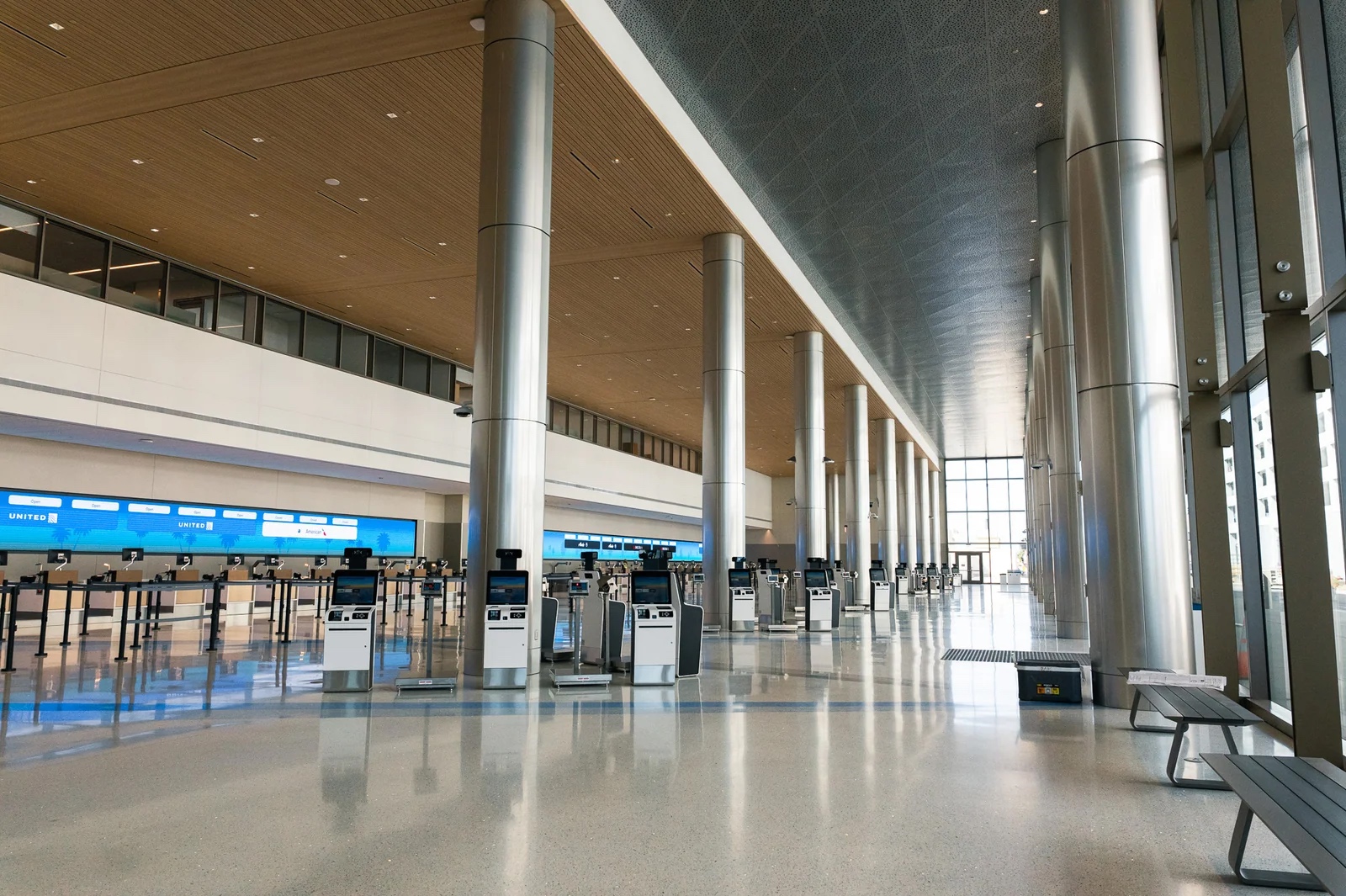
The new terminal encompasses 355,000 square feet, compared to the old terminal’s 232,000. Its layout is essentially a pair of enormous parallel corridors. Landside, the ticketing area, main entry hall and security area, and baggage claim form a continuous space, bounded by a monumental glass curtain wall spanning the entire length of the terminal, along the roadway where passengers are dropped off. Airside, the terminal’s 14 gates line up on one side of a linear concourse. The layout is about as straightforward as it gets. And the entire passenger experience is at grade.
As a condition imposed by the airport’s neighbors, who don’t want more noise from aircraft or traffic from passengers, the otherwise thoroughly modern terminal was required to maintain tarmac boarding, using movable stairways and ramps that passengers alight rather than the jet bridges that are standard at all but the world’s smallest or most rugged facilities. What would be considered an indignity at other airports is an endearing quirk at Burbank. Though more of a policy choice than a design choice, it gives Burbank a degree of distinctiveness—and convenience—that is unlikely to be emulated anywhere else, especially not in places with less perfect weather than the San Fernando Valley.
Essentially every airport that has expanded in recent memory has opted for increased volume: bigger floorplates; stratospheric ceilings; additional elbow and headroom. More space for amenities, for moving passengers along, for separating airplanes and, perhaps most of all, for expressing the grandeur of air travel. They trade on big gestures—atriums, sky bridges, gardens, and broad, soaring concourses—but also on small ones, like branded furniture in the gate areas.
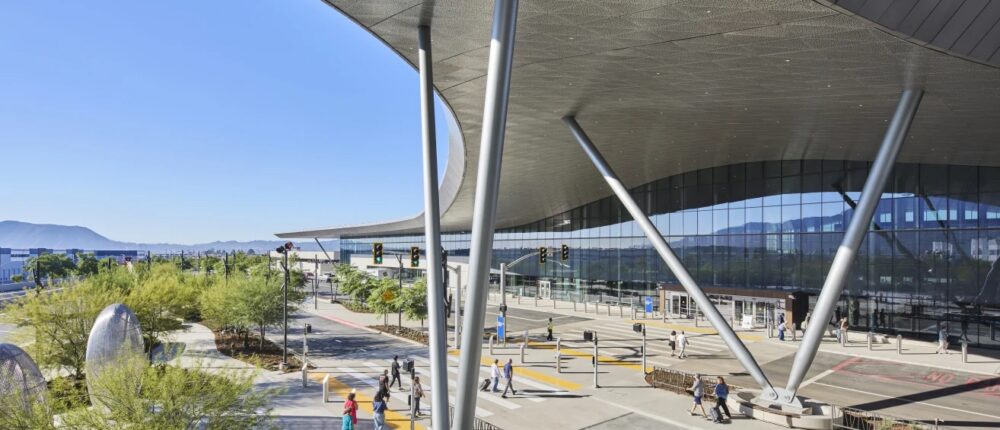
Burbank’s design reflects the workmanlike nature of the design-build contract, executed by a consortium of design, engineering, and construction firms, including Holder, Pankow, TEC, Joint Venture (HPTJV), and Corgan. It’s not a starchitectural showpiece that reflects the creativity of a single person or an elite firm. Instead, it’s practical to a fault. Even its signature design gesture, the swooping canopy over the driveway, serves a purpose: to keep rain (or, more often, sun) off of passengers.
The steel support beams that hold up the canopies are paired, attached to concrete bases from which they rise and splay out at roughly right angles to each other. Painted white, the metallic beams are meant to evoke the klieg lights that advertise Hollywood movie premiers and other Tinseltown events. The Hollywood that Burbank Airport—and, indeed, the entire city of Burbank—evokes is not that of red carpet glamour and premium lounges-within-lounges. The Burbank area is home to studios and sound stages, which are essentially industrial operations that produce fiction rather than widgets. Many “below the line” workers, craftspeople, and union members avail themselves of the valley’s lower housing costs, compared to L.A.’s pricey Westside.
The absence of premium lounges does not reflect a design choice per se. But it has a significant effect on design and on how passengers will experience the airport. It’s an egalitarian space and meant to be efficient. Travelers will have plenty of elbow room, but they’re not meant to linger. And they won’t be changing planes: Burbank has essentially no connecting flights.
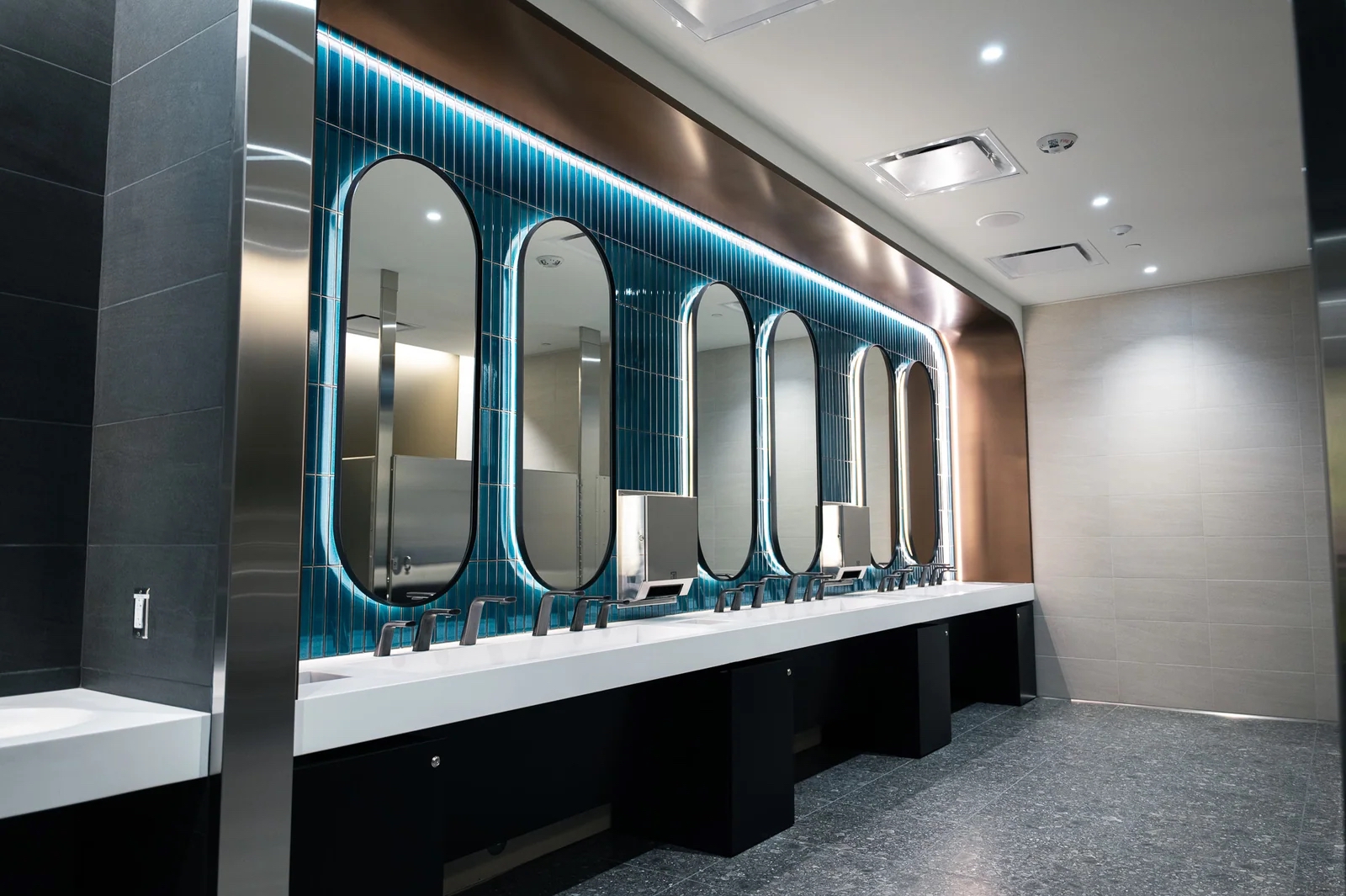
This is why the small gestures matter. In the absence of major structural flourishes that might be costly—or, worse, inefficient—BUR’s most striking design element is found in the restrooms. You read that correctly. BUR’s restrooms forgo bland tiles and wall-sized picture mirrors for rich cobalt-blue subway tiles and individual portrait-sized mirrors above each sink. Add a fun terrazzo floor and, though they might not make you wish for a flight delay, they delight in ways that few other institutional restrooms do.
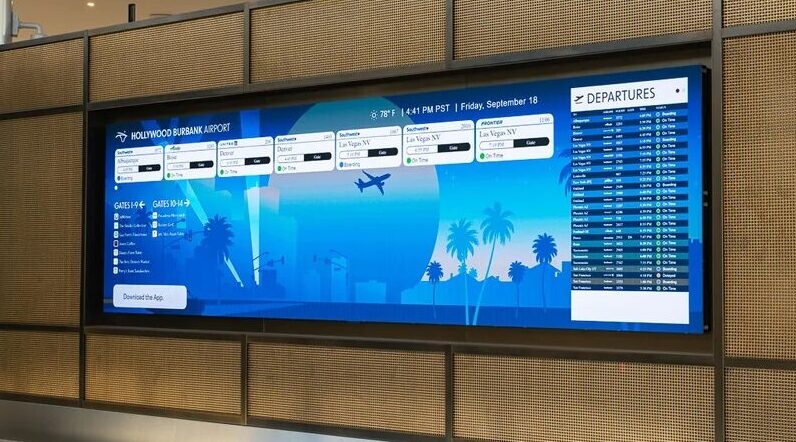
The video monitors forgo the horizontal lines that make flight information look like a spreadsheet in favor of tiles inspired by smartphone tiles. BUR’s screens include appealing animated images of Los Angeles— hillsides, palm trees, sunsets—in the background. They are easier to read and far more attractive. Furniture at gates, consisting of standing workstations and plenty of conventional seats, is clean and inviting. What the structure itself lacks in details, the design team has made up for in decor.
Mother Nature plays her part, too. Picture windows face westward and don’t look down at the planes so much as they look out across the tarmac and to the distant ridgeline of the Santa Monica Mountains. Sunsets will be spectacular.
For all its nostalgia, the old terminal was anything but spectacular. In addition to being dingy and uncomfortable, it was also too close to the airfield for the FAA’s liking. It will be demolished in order to expand the airfield’s taxiways. The FAA’s requirements essentially make preservation or adaptive reuse impossible.
Most recent airport upgrades—including those in Salt Lake City, Kansas City, and Los Angeles—have accompanied operational expansions: more gates and capacity for more flights and passengers. BUR’s physical expansion comes with no intended increases in traffic. The number of gates, the allowable number of flights, and the expected number of passengers will not change, despite the significant increase in square footage and the attraction of a glimmering facility. It’s not for lack of demand. The San Fernando Valley—which includes a large portion of the City of Los Angeles, plus independent cities like Glendale, Calabasas, Pasadena, and Burbank itself—is home to 1.8 million people, all of whom live over an hour from LAX, if their flight leaves at the wrong time of day.
In a perfect world, the larger BUR would serve more flights, not just so that more passengers could enjoy it but also to take pressure off the region’s other airports (though I happen to be optimistic about massive renovations taking place at LAX) and make the region operate more efficiently. And yet, unlike many other airports, Burbank belongs to an urban fabric. Along with Chicago’s Midway, it’s the most confined commercial airport in the country. What’s an amenity to people 10–60 minutes away is a nuisance and, possibly, a safety hazard to people within 10 minutes.
What commercial aviation will look like in 2122 is anyone’s guess, as will the number of times Burbank Airport will be rebuilt. As long as jet planes are still flying, though, fliers will surely want to climb the stairs before heading into the sky.
Featured image: Hollywood Burbank Airport, via Corgan Architects. All other photos courtesy of Hollywood Burbank Airport.