
Can Circularity Break the Cycle of Architectural Waste?
Single-use plastic bags are the urban tumbleweed of many cities around the world. They clog storm drains, whirl in the wind, and get caught in branches like dystopian ornaments. On Amazon, $20 buys you a thousand (or one for every year it takes a plastic bag to decompose). Until then, they endure in massive garbage dumps like the infamous Stung Meanchey landfill in Phnom Penh, Cambodia, which I’ve visited. (I remember distinctly how unsteady the ground felt, the effect of untold plastic bags shifting together like gooey, tectonic plates).
Equally pervasive, in their own way, are the “single-use” buildings dotting skylines and streetscapes across the country. Like New York’s favorite bodega bag, these buildings are made with materials that are inexpensive and convenient. They are designed for a single purpose—office complex, condominium, data center—and then, after several years, they are no longer considered “best in class.” Demolition follows, and a new generation of mediocrity rises from the rubble. The result is that many modern buildings have become the architectural equivalent of a plastic bag: cheap and disposable.
How might sustainable buildings become as common as the Trader Joe’s tote, the reusable alternative to the plastic bag? Circular economic models offer some solutions. Circularity invites us to consider a building’s life cycle not as a linear timeline from construction to demolition, but as a closed loop in which a building’s material and cultural investment is renewed through each generation. It’s an ambitious framework, one that widens the aperture of urban and environmental stewardship beyond the lens of sustainability. For professionals working in the built environment, a sector responsible for roughly 40% of global carbon emissions, circularity is an operational, ethical, and moral imperative.
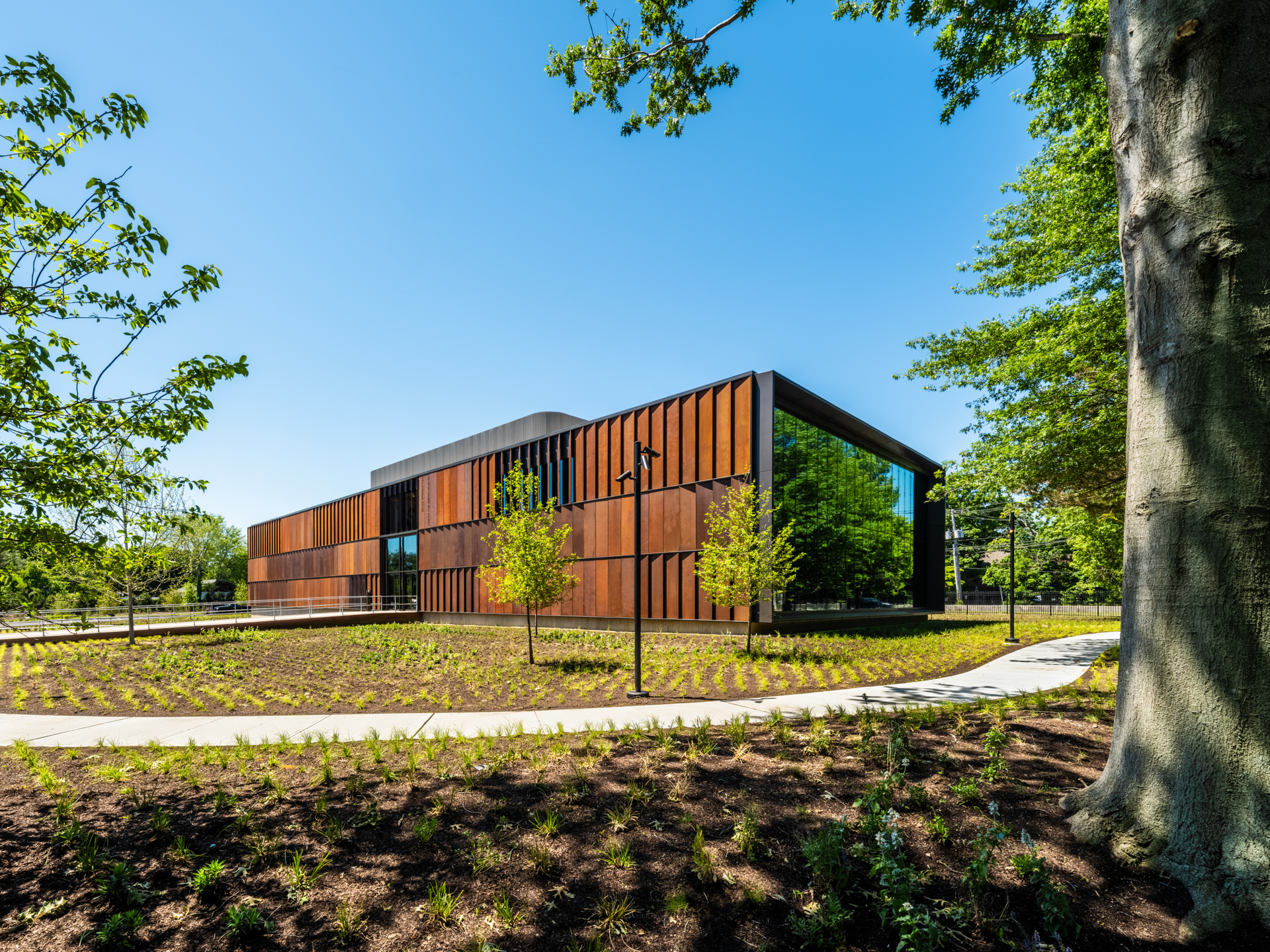 The Bruce Springsteen Center for American Music’s facade of weathering steel is made of American steel, which is majority recycled, and assembled with fasteners, enabling a potential deconstruction at the building’s end-of-life instead of demolition. Photo by Alex Ferrec, COOKFOX Architects.
Adaptive reuse is one design strategy that adheres to the principles of circularity. As I’ve argued on Common Edge before, local governments should incentivize adaptive reuse because it preserves materials and reduces unnecessary construction. The greenest building, it is often said, is the one already built. What’s more, the preservation inherent to adaptive reuse keeps history alive and accessible, something our country desperately needs right now.
Design for disassembly, or reversible architecture as it is also known, is another strategy that reimagines a building’s end of life. As the name implies, designing for disassembly requires making a gameplan for dismantling a building that has run its course. Using fasteners instead of adhesives and opting for minimally processed materials allows for building components to be disassembled and then reused or recycled. With the right strategies, we can remove demolition from the equation altogether.
Universeine, an office complex in Paris, is a recent project that employs both adaptive reuse and disassembly strategies. A collaboration among several architecture studios to house athletes for the 2024 Summer Olympics, the design anticipated the building’s future conversion to an office and retail complex. This foresight was a welcome change of precedent. Global sporting events like the Olympics and the World Cup are often the biggest offenders when it comes to catalyzing massive construction projects that fulfill short-term needs. Having designed several adaptive reuse developments in New York City, I have learned that a building’s intended purpose can change drastically over the years, or as in the case of Universeine, in a matter of months.
The most adaptable building is only as sustainable as its parts. When done strategically, material specification can help propel the goals of the circular economy. This brings us back to plastic, which is produced through the extraction of fossil fuels. While it’s theoretically possible to construct a building without plastic, the market’s entrenched reliance on the material makes doing so difficult. In order to roll back that dependence, stakeholders need to be proactive and aspirational. Our firm, COOKFOX, maintains a “switch list” of materials it is working to divest from, adapted in part from Living Future’s Red List. Take polyvinyl chloride, for example. Also known as PVC or vinyl, it’s used everywhere in buildings, from flooring and roofing to windows and plumbing. Vinyl is dangerous to human and environmental health, both through manufacturing and occupant exposure, with known links to cancer and liver damage. While vinyl-free options like flaxseed-derived linoleum flooring are available on the market, many building components lack Red List–free alternatives. In the U.S., building with healthy materials remains a challenge.
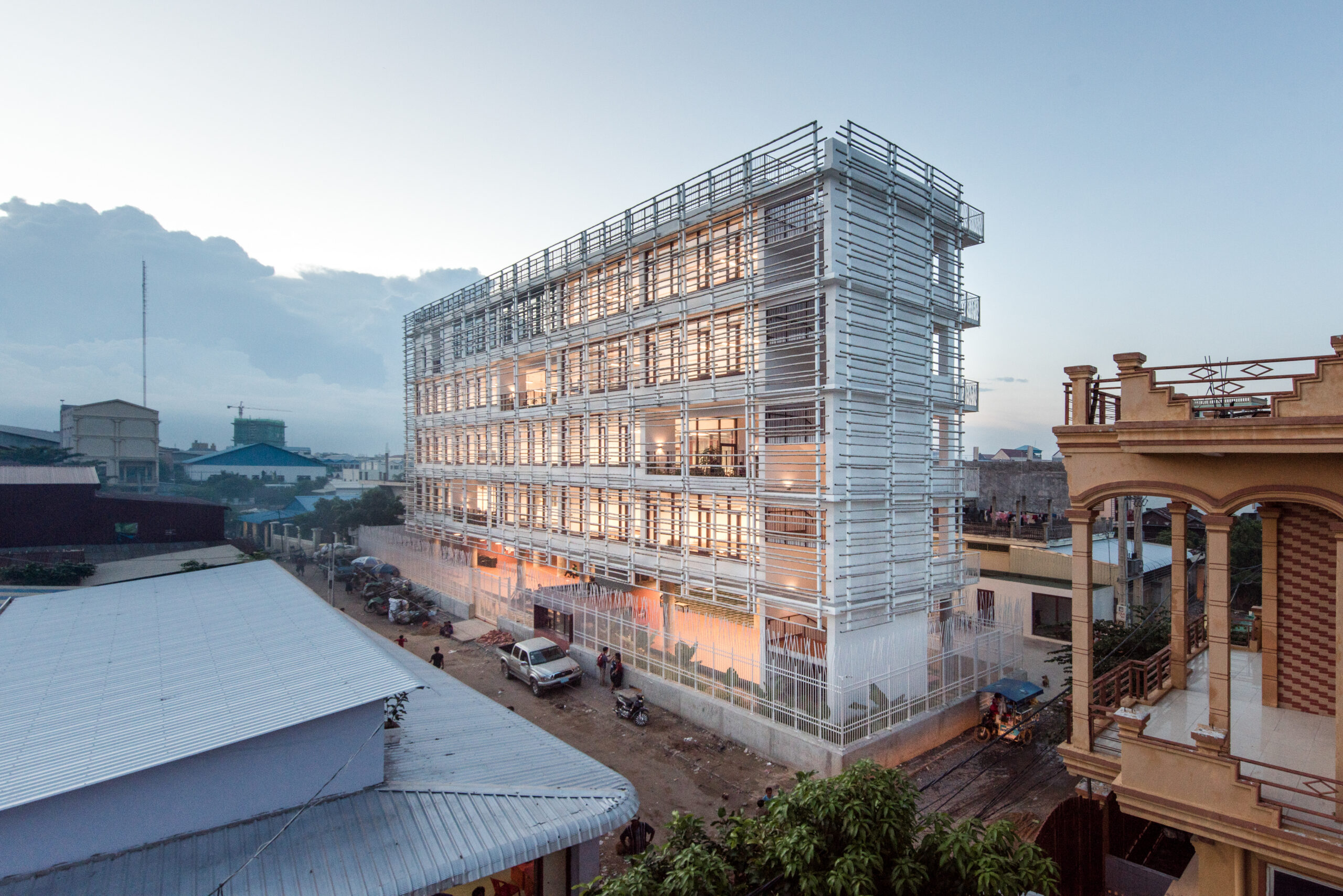 Designed by COOKFOX Architects, Neeson Cripps Academy is a secondary school near the Steung Meanchey garbage dump in Phnom Penh, Cambodia, providing high-quality education to some of the city’s poorest children. Photo: David Yeow.
Yet these materials exist and are popular in other parts of the world. Hempcrete is made from mixing hemp fibers with a lime-based binder and water. It has several applications, but is most commonly used as insulation, filling the gap typically occupied by extruded polystyrene foam (that pink stuff in your your attic walls). Because of its agricultural origins, hempcrete functions as a carbon sink, sequestering harmful emissions. Though widely used in Europe, we’ve yet to see hempcrete’s mass adoption in the U.S., thanks in part to outdated anti-cannabis laws. While that’s starting to change, other promising developments—such as mycelium-based concrete—are primarily used in small-scale, case study projects that often come out of academia. (The Yale Center for Ecosystems and Architecture, led by Anna Dyson, has done incredible research in this field.) Innovative materials need to be produced at scale in order for the circular economy to thrive. Even if you were to verify that every brick, bolt, and nail in a building was recycled, reused, and otherwise petrol-free, the origins of those materials would often remain shrouded in mystery.
Forced labor in the supply chain is yet another inconvenient truth of the trade. It’s estimated that roughly 30% of building materials are touched by hands of people whose labor is exploited. While certifications like LEED and WELL have established standards for environmental sustainability, there is far less regulation when it comes to social sustainability. Local sourcing is one way to radically shorten supply chains while increasing their transparency. It’s effectively impossible to verify the labor practices of a steel mill halfway across the globe; sourcing from local vendors makes it feasible to uphold rigorous social equity standards.
For architects racing to meet a deadline, it’s easy for circularity to remain stuck in the realm of concepts, a term, like sustainability, that is offered up in meetings, lectures, and indeed op-eds, but that is never fully realized through actionable steps. We can’t afford to continue down that path. The stakes are simply too high, a lesson I learned at the Stung Meanchey landfill. If we want our buildings, cities, and planet to truly be sustainable—that is to say, healthy, adaptable, and equitable—then we’ll need to rise to the aspirational challenges that circularity poses. Maybe then our buildings will age with dignity and grace—less like a plastic bag and more like a favorite, well-worn tote.
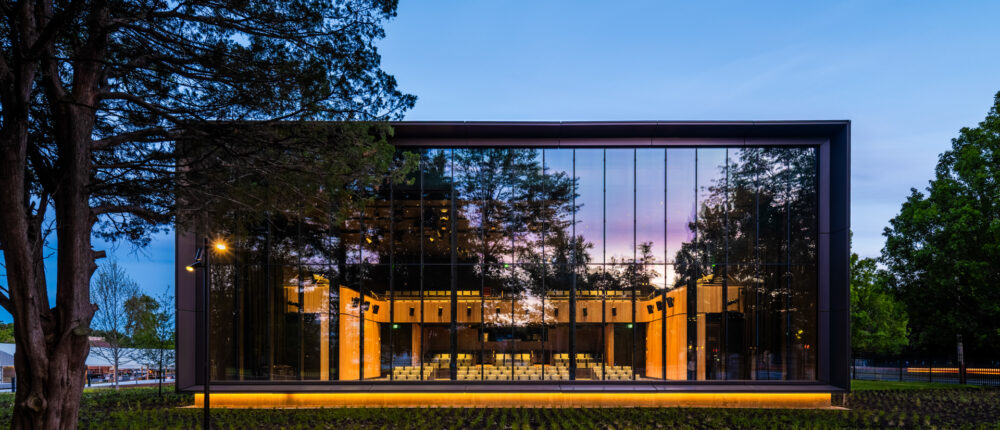
Featured image: The Bruce Springsteen Center for American Music. Photo by Alex Ferrec, COOKFOX Architects.