
Can Mom & Pop Stores Survive NYC’s Economic Realities?
The little record store fills up fast as the “Listening Party” sign goes on the door. Shopkeeper Hunter Brammer checks names off the preregistered list of ticketholders, while his wife, Wrenne Bartlett, sets up drinks and snacks. Record bins have been rolled from the middle of the room to the outer edges. About two dozen visitors, mostly in their 20s and 30s, settle into couches and chairs arranged in a horseshoe around the center of the action: the turntable. Next to it is the cover of tonight’s featured album: You Seem Pretty Sad for a Girl So in Love, by Olivia Rodrigo.
Bartlett serves as emcee, asking attendees to go around the room and share their names and planned halloween costumes. Talk turns to the album—selected by an online poll among the store’s email base—and how it continues Rodrigo’s commercial hot streak while also reflecting an artistic maturation (the former teen TV star is all of 23). Bartlett leads the discussion with lawyerly objectivity and a fan girl’s enthusiasm—though she notes that, being over 30, she’s almost aged out of Rodrigo’s fan base. Then the visitors are asked to be quiet for the keynote moment: the drop of the needle.
Plugging Into the Community
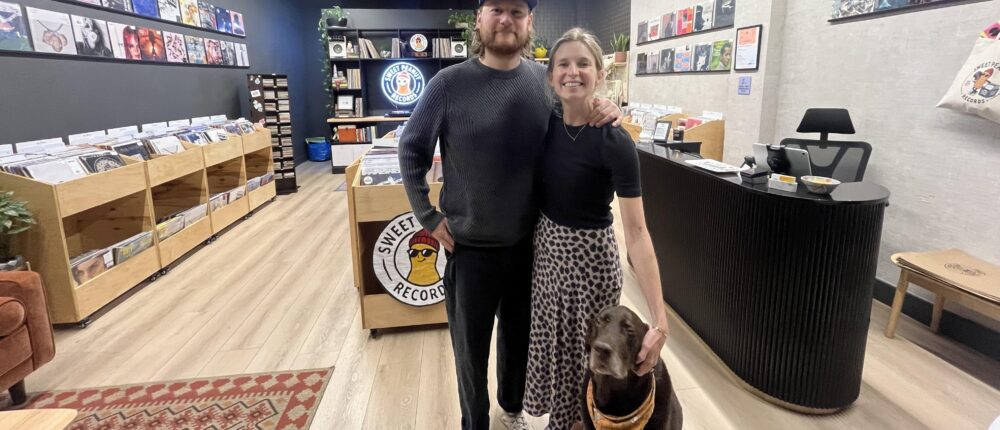
“This is all part of public outreach,” Brammer later explains, “to help us get to know our neighbors and vice versa.” Brammer and Bartlett leased the storefront shop in June and in late July they opened their new Upper West Side record store—Sweet Peanut Records, at 82nd Street and Amsterdam Avenue—with a line around the block waiting to enter, even though it was a rainy day. (They attribute the name to their chocolate labrador, Charlie Brown, who serves as part-time mascot.)
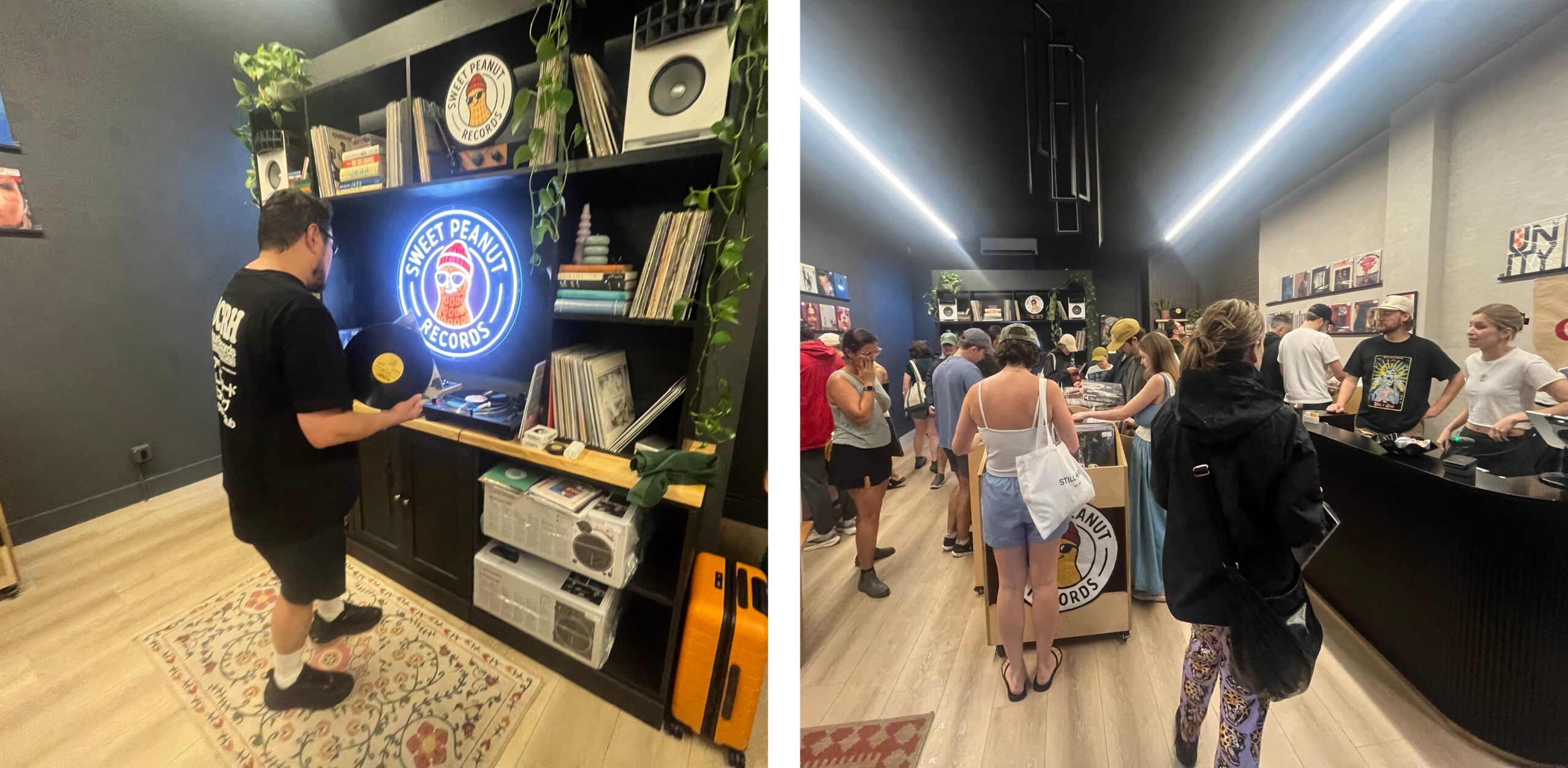
The shopkeepers have been hosting a few listening parties, record releases, film screenings, and other events each month, as a combo of public service and PR—and as a way to attract attention during evening hours, when the area’s retail shops close and the restaurant-and-bar traffic picks up. While much of the neighborhood still suffers from storefront vacancies, in recent years the stretch of Amsterdam Avenue between 79th and 86th streets has emerged from its post-pandemic doldrums into a bustling commercial scene, especially at night.
Amid the noise and haste, Sweet Peanut Records is a retail experiment: a throwback business in an ever-changing digital world, a small mom and pop shop in the urban maelstrom of NYC. The store was born of a passion for music on vinyl, a desire to connect with the community, and a sense of carpe diem in the face of personal loss.
Change of Scene
Brammer says he had an Is This It? moment when his sister passed away in 2025. A year and a half older than Hunter, she was just 32 when she succumbed to a brain tumor. “That’s when you really take into account what matters,” he says. “What’s the point of life? What do I want to spend my days doing? Why are you just sitting behind a computer all day every day?”
Brammer had worked for years as a financial analyst for bank companies, much of that time—during and after the pandemic—remotely. He gave up a lucrative post to hang out a shingle. “There’s a lot about the corporate job analytically that I really enjoyed,” he notes. “I was a portfolio manager for a team of financial advisers. So I was watching the markets and doing research on companies and talking to fund managers about their strategies, how we can implement it into our client portfolios.”
A world away from rock and roll records? “Yes and no, right?” he says with a grin. “When it comes to selling music, there’s value in trying to find artists that might be on the up and up, similar to a stock or a company, and saying, ‘I think I should I probably buy some of their stuff because they’re about to blow up, about to get a lot more recognition, so there’s going to be more demand for it.’ That’s what’s fun about it—but, obviously, it’s different.”
Another thing that’s different these days is the family budget. “Luckily, we had some money saved, so we have a nest egg of funds that are set aside to do this startup, and we won’t starve in the meantime,” says Bartlett, who works full-time as an attorney for a downtown firm. “So we have a ramp: This will keep us going for a certain amount of time, and once that money is gone, we’ll have to reevaluate,” she adds, noting that the storefront lease is for two years.
Tweak and Learn
“Well, they’re a mom-and-pop without any children yet,” says George Beane, the proprietor who’s leasing space to Sweet Peanut Records. Beane is a veteran landlord with seven multiunit properties across the Upper West Side. (His son, George Beane Jr., is an urban planner now living in Amsterdam and a contributor to Common Edge.) “Here’s the thing about mom and pops versus larger stores: They can tweak, learn what the customers want,” the elder Beane says.
Beane notes that commercial chain stores are often required to fit a formula designed for a national brand identity. “I had a store called Johnny Was, and it was a California higher-end women’s fashion shop,” Beane says. “But California fashion is not the same as the Upper West Side. The store manager had to make it look like all the other stores, and not what would appeal particularly to the local clientele. And, ultimately, they closed. They didn’t do as well as they wanted. But for a mom-and-pop, if it’s not quite working, they can fix it.”
For his part, Beane seeks to foster diversity among tenants. “This part of Amsterdam Avenue is a food corridor, and I wanted to change it to give opportunities to some strong, different, unique stores,” he says. “That makes the neighborhood much nicer and more responsive, especially today, when everything’s online and/or a chain.”
This approach informs Beane’s rental price points: “My theory is that I’m in partnership with my tenants. If they do well, I do well. So it’s not that I unilaterally set the price; I work with them on it. As a single owner, I have more latitude than a lot of owners do if they have financial partners and stuff. Since the rise of e-commerce, retail’s been really bad, and it has come nowhere near full recovery. Even adjusted for inflation, it’s way down. That said, I try to find the best tenant that will pay the highest price—and that does not mean I will just rent to the highest bidder.”
Trendy Neighbors
On the corner next to Sweet Peanut is another artsy business run by the spouse of an attorney: Runaway Poppy, which sells art, books, ceramics, gifts, and other decorative items curated by owner Cara Milling. “We were outgrowing our other space,” Milling says, recounting how her shop moved from a smaller storefront on Broadway and 81st in late 2025. “George was so smart about it. Right before Christmas, he had this vacancy on Amsterdam Avenue, and he said, ‘Would you want to try it as a pop-up?’”
It was a shrewd move for the whole building, which features five storefronts (including Tree House Dentistry and Playday crafts shop for kids). “To have a corner spot empty at the holiday time is not good for any of the other businesses,” Milling says. “He is thinking about the entirety, not just the one space.”
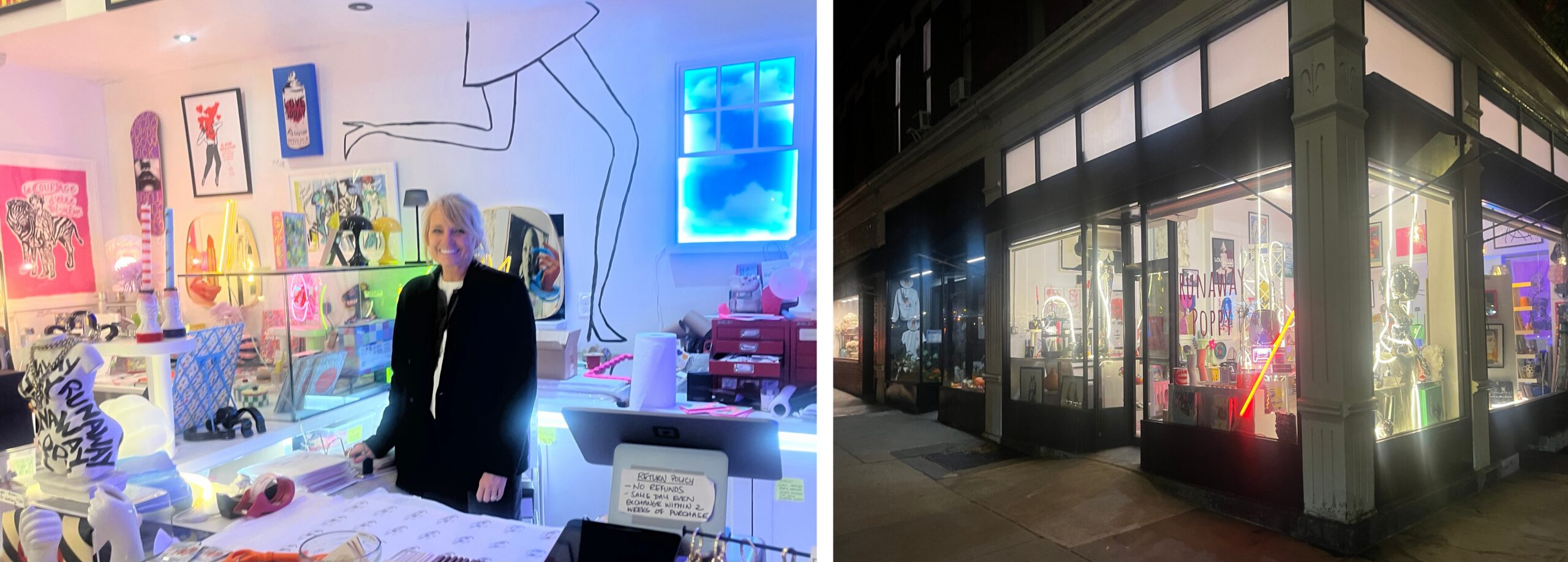
After a few months of straddling two locations, Runaway Poppy did well enough in the new space for Milling to relocate. “This is a bigger square with more windows, so you can see the art and all the stuff a lot better,” she says. The corner is dominated by the store’s colorful, brightly lit window displays. “From a ConEd perspective, those bills add up at night,” Milling says with a laugh, “but in this neighborhood people are walking around after dinner, and oftentimes we’ll have somebody say, ‘Oh, I saw this in the window and decided to come back in,’ because they have more time to stroll at night.” Milling welcomes her new musical neighbor. “I’m delighted with Sweet Peanut moving in, because something attractive going in next door definitely helps both of us.”
The Flip Side
The scenarios are not always so rosy. On the other side of Sweet Peanut is another art boutique, Happy Kangaroo, featuring high-end tabletop ware, luxury gifts, and other home decor items curated by owner Rhonda Stober. “There’s an interesting story to tell about this stretch of Amsterdam, but I’m not sure I would characterize it as a return of mom and pop retail,” Stober notes. “I actually think independent retail has become very difficult to sustain.”
After opening in 2019 and enduring the Covid downturn, Stober is planning to relocate her shop to the Upper East Side after her lease is up in spring 2027. “The Happy Kangaroo has survived because of our website, which essentially sustains our physical retail store,” she says. “Our store itself operates at a significant loss. Without the online business supporting it, we could not afford to maintain the storefront.”
Stober notes that much of the foot traffic in the area occurs after business hours, centered on Amsterdam’s restaurant and bar scene. “We have found that Upper West Siders simply don’t shop in stores,” she says. “I don’’t want to discourage independent retail, but I also don’t think the reality should be sugarcoated: Unless the rent is extremely low or the business has another revenue stream supporting the storefront, it is very hard for retail to work today.”
Beane is philosophical about losing the Happy Kangaroo as a tenant. “They did very well when Rhonda opened the store in 2019. She had a loyal clientele, both from the neighborhood and elsewhere,” he says. “Amsterdam Avenue has shifted more to food than hard-goods retail. As Rhonda says, her business is probably better suited to the Upper East Side right now.”
Even as she plans to relocate, Stober gives credit to Beane: “I think the story on this particular block has a lot to do with having a very kind and supportive landlord who would rather offer spaces for next to nothing than have them sit empty.”
Destination Retail
Ten blocks south of Sweet Peanut is the neighborhood’s venerable mainstay for vinyl fare: Westsider Records, the music arm of Westsider Books, which has been in its current location since 1997. “More power to them,” says manager Bruce Eder of the new record store. “We can coexist. I wish there were more—it would give people an incentive to come to this neighborhood for records.”
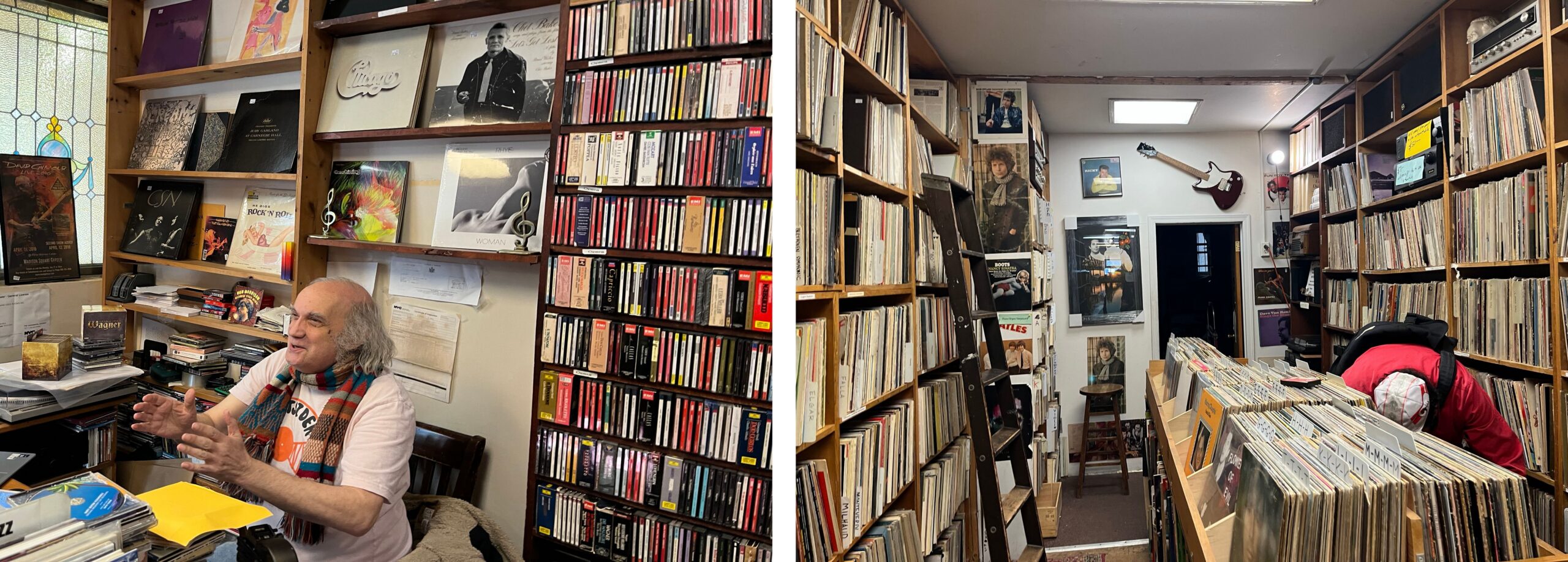
Eder has managed Westsider Records since 2010. He attributes the decline of independent record stores to the rise and fall of retail chains such as Tower Records—which dominated the music market from the late 1980s until 2006, when it folded after a period of overexpansion and the digital shift to streaming services like Napster, iTunes, and Spotify. “The big-box stores took all the oxygen out of the marketplace, until they got so big that they failed,” he says.
Eder—a local legend for his encyclopedic knowledge of music and his journalism career with the Village Voice, AllMusic, and other publications—is friendly with Brammer, and in fact helped him build his collection. “I’ve been to Westsider countless times and spent countless amounts of money there,” Brammer says. “I always talk with Bruce, and it’s always lovely. When we went to open up, my thought was, ‘There’s a store that I admire and enjoy going to.’”
Brammer envisions a symbiosis between Upper West Side record shops. “I know personally if there’s a cluster of two or three record stores in a city that I’m going to visit, I’ll go to all of them and probably buy something from all of them. Having them clustered together is mutually beneficial. But what we provide is very different from what they provide. They have a smaller selection of new vinyl, and they have a much larger collection of used stuff.”
By contrast, Barnes & Noble, the chain retailer at 83rd and Broadway, features new vinyl at bulk-rate prices. “They’re subsidized by this big corporation that is able to move costs around and all that kind of stuff,” Brammer says of the store. “They have what’s new and generic—but they don’t have the collectibles.”
One Giant Lot
Brammer’s own record collection grew over the past decade, to the point where it was taking over his apartment he shares with Bartlett on West 82nd, just around the corner from his new shop. A major catalyst was a single purchase Brammer made four years ago. “I bought a collection at auction online, sight unseen, from an auction house in Queens. It was 3,500 records for around $300,” Brammer recalls. “They had multiple collections that they just piled together and sold as one giant lot. A lot of it was in such bad condition you had to throw it out, or it had water damage, or whatever. But there were a lot of cool pieces in there. So, then, imagine me rolling up—in a SUV packed to the absolute top—to our little apartment here in New York, and her being like, What did you do?”
Bartlett laughs and rolls her eyes. “I told him it was too much. He should try to sell this stuff.”
Brammer commenced to weed out and organize his collection and started selling pieces online, but soon felt the call of a family tradition. “My family is all small business owners,” he says. “They run a dry cleaning business down south, and further back, my great grandparents owned and ran furniture businesses in High Point, North Carolina, where I grew up. So I think the idea of being your own boss and being the direct driver of your own success was appealing to me.”
Brammer also values the human contact of one-to-one retail. “I still think the local store experience matters,” he says. “The reason records are coming back is the same reason you need a record store. People are craving authenticity and tactile things in this ever increasing digital world that we’re all somehow forced into, and people are starting to wake up and realize that maybe that’s not the path that we should go down as human beings. Trying to have that community aspect is consistent with the ethos of all of it.”
Sense of Belonging
When Brammer saw the vacant storefront and noted that “it has good bones,” he reached out to Beane and found a kindred spirit. “Neighborhoods always evolve, up and down—they’re not static,” Beane says. “I’ve owned apartment/retail buildings on the Upper West Side since 1977 and have seen huge changes, most of which have been better for the city and for our neighborhood.”
Beane cites a passage from Fareed Zakaria’s 2024 book, Age of Revolutions. “He writes about the closure of factories in upstate New York and Pennsylvania and the Midwest, and he said it’s not just that it’s damaged the economy—because the people who worked in the factories found other jobs, and so it’s not so much a financial problem—but they lost their sense of community,” Beane says. “People didn’t go to the bars that they would frequent with their friends after work, and then came e-commerce, so they stopped going to the stores. Big-box businesses were sucking the towns dry. When people shop online and do everything else online and don’t have a human community that’s the same, what happens is depression.”
Beane continues on a high note. “We don’t really have that in New York, because people still go to their coffee shops—where they sit even if they’re not talking to anybody, but using their computers—where at least the barista knows what they want. In little shops, they still hang out together. That’s important, for it makes New York City the small town that the small towns used to be. And that’s one of the reasons I prefer mom and pops.”
Featured image: Sweet Peanut Records partners Hunter Brammer and Wrenne Bartlett with store mascot Charlie Brown. All photos by the author.