
How Does Architectural Knowledge Get Passed On in the AI Office?
Recently, I sat through three training sessions and software demonstrations focused on bringing AI into architectural practice. It was a bit frustrating. We were looking at tools intended to produce graphics for feasibility studies, program layouts, and adjacencies.The software didn’t do what I wanted, and the demonstrations were somewhat precooked for success.
Real feasibility work is messier. It begins with incomplete programs, changing assumptions, inconsistent information, competing priorities, and clients who may not yet know what they need. The tools could produce material, but they couldn’t determine whether it was useful or whether its assumptions could be trusted.
It would be easy to dismiss the concern as premature. But the most revealing part of the demonstrations was not what the tools could accomplish today. It was the workflow they anticipated.
Early project work often requires an experienced professional to define the problem, explain it to someone with less experience, review the study, and send it back for correction. If software can move more directly from project criteria to a usable layout or graphic, the office may reach the same point with fewer production and supervisory hours. The appeal is obvious. But this efficiency changes more than workload. It may remove less-experienced professionals from the exchange.
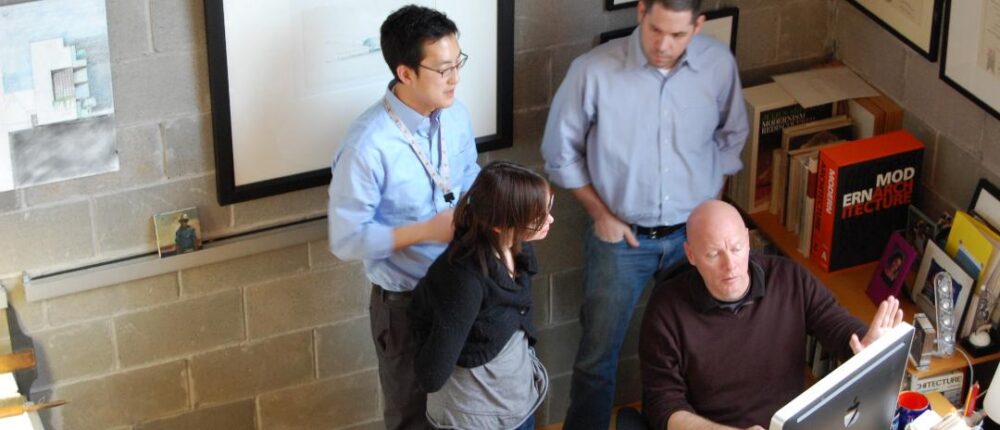
Delegation and correction were never only means for producing a drawing, analysis, or presentation—they were also how knowledge moved through an office. An experienced designer explained what mattered. A younger one attempted the work. The senior identified what was missing, misunderstood, or insufficiently resolved. Through repetition, the younger professional learned to recognize such problems independently.
AI promises to shorten this loop by connecting an experienced designer more directly to the output. What it does not automatically replace is the learning that can occur between assignment and correction. AI may remove some junior professionals from the office. And even where it doesn’t, it may remove them from the learning loop.
Much of the conversation about AI has focused on education. The harder question may begin after graduation, inside the firms, agencies, and institutions where professional knowledge is expected to mature.
The workplace has never been solely an environment for applied knowledge. It’s one of the places where knowledge is formed. The design professions have long depended on imperfect apprenticeship systems embedded within project work. Emerging professionals researched, drafted, modeled, documented, revised, and coordinated under the review of people with more experience.
This arrangement could be inefficient—and, sometimes, exploitative. It often confused long hours with commitment and repetition with education. The task mattered, however, because it brought the person performing it into contact with some of the project’s crucial decisions. Education occurred when someone explained why the first answer was incomplete, another discipline identified a conflict, or a technically defensible decision failed in practice.
Information becomes knowledge when someone learns how it behaves under pressure from cost, regulation, construction, maintenance, politics, use, and time. An answer that appears complete on a screen often becomes less certain when it meets the world.
There is no reason to preserve unnecessary labor merely because previous generations learned through it. If AI can reduce time spent searching for information, formatting documents, producing repetitive graphics, compiling data, or generating preliminary studies, the design professions should welcome these gains. But repetitive work and meaningful experience are not always easy to separate. When an organization removes a task, it must ask what the person performing it encountered along the way.
Adoption remains uneven, but the direction is clear. A 2025 AIA study found that only 8% of U.S. firms had implemented AI, with another 20% in the process of doing so, while 84% of respondents recognized its potential to automate manual work. RIBA’s surveys show how quickly that can change: reported use among British practices increased from 41% in 2024 to 74% in 2026.
The most disruptive possibility is also the most obvious: Firms may decide they need far fewer junior professionals—or none at all. We cannot dismiss this outcome simply because widespread losses have not yet appeared in the data. If AI can produce much of the preliminary analysis, drafting, modeling, documentation, and coordination assigned to entry-level staff, the economic rationale for hiring them will weaken.
This would create more than a basic employment problem—it would sever the profession’s succession pipeline. Senior designers do not appear fully formed; they develop by assuming progressively greater responsibility across years of work. A profession that eliminates its entry-level positions may lower costs in the present while failing to produce the people capable of leading projects, exercising judgment, and accepting liability in the future. Even where junior positions remain, their number and developmental content may shrink.
The structural problem beneath both outcomes is that the old learning loop was partly funded by production. If AI reduces those production hours, it also reduces the economic space that supported the exchange. This creates a choice about what happens to the time AI returns. If every saved hour becomes a tighter fee, shorter schedule, larger workload, or reduction in staff, little time will remain for the higher-value work automation is supposed to enable. The professions cannot promise that AI will free designers to exercise greater judgment while allowing every efficiency to disappear into fee compression and increased production.
Some of that capacity must be reinvested in professional formation. Organizations already support quality control, continuing education, research, and leadership development because those activities maintain future capacity. Developing the people who will eventually assume professional and public responsibility belongs in the same category. It must become part of quality control and succession planning, not an optional benefit when schedules permit.
As AI enables experienced professionals to generate more of the initial work directly, organizations can use the same efficiency to bring emerging practitioners into consequential conversations earlier. If AI produces the first draft, they can be asked to interrogate it: What assumptions shaped the result? What information was excluded? Which relationships were treated as fixed? What appears resolved only because the graphic is persuasive? An experienced designer can review this analysis, explain where the reasoning remains incomplete, and connect the decision to later consequences.
In this new learning loop, emerging professionals may spend less time producing initial material but more time validating, challenging, and following it through research, design, implementation, and use. The objective is to keep the reasoning visible after the production surrounding it has been compressed. Whether emerging professionals become more capable or more peripheral is not determined by the technology, but by current leadership.
Who receives access to this new learning loop will also matter. If fewer people participate in consequential decisions, advancement may depend increasingly on who receives direct exposure to senior judgment. The informal apprenticeship system was never equitable or consistently effective, but removing it without a replacement could make the design professions more difficult to enter and even less representative of the communities they affect.
The consequences extend beyond employment. The public will increasingly encounter proposals carrying more data, more alternatives, and more visual authority. People asked to evaluate them will still need professionals capable of explaining which assumptions shaped the result, what was excluded, which tradeoffs remain, and who is responsible for the decision.
The question is not whether offices should preserve inefficient production so that junior staff have something to do. It’s whether they can remove the labor surrounding a decision without removing emerging professionals from the process of understanding it. After the AI studio comes the AI office. What happens there will determine not only how quickly the built environment is produced, but whether the professions shaping it continue to produce people capable of accepting responsibility for it.
Featured image: photo by Dr. Bill Carpenter from Lightroom Studio, LLC.