
NYC Needs a Different Public Engagement Model: Can Mamdani Make It Happen?
The auditorium at the CUNY School of Law was packed. More than 100 Long Island City residents—concerned with public school capacity and playground space, with pedestrian safety, artist and small business displacement, and ghastly chronic flooding—had turned up on a Wednesday night to hold government accountable. City officials—representing a slew of entities including the School Construction Authority, the Department of Cultural Affairs, and the Department of Environmental Protection—appeared on stage to describe projects aimed at responding to the dire needs (and a few outright emergencies) confronting the neighborhood. Questions and comments from the audience and from the evening’s convener, City Councilmember Julie Won, made it plain that the neighborhood was determined to see the city fulfill the terms of the deal the City Council hammered out with the administration of Mayor Eric Adams in fall 2025. The message: We will hold your feet to the fire until you make good on the 44 “points of agreement” negotiated in conjunction with the OneLIC neighborhood rezoning.
Seen in a certain light, this was public engagement in action. Residents and their elected leadership were taking the opportunity of a spotlight shining on their community—in the form of a newly approved plan to add zoning capacity for 14,000 new housing units—to insist that the city address longstanding infrastructural and services deficits. With up to 50,000 new residents projected to move in over the next two decades, residents are adamant that the city prepare the area for incoming stresses. If schools are overcrowded now, how does the city intend to accommodate new families with school-aged children? If raw sewage backs up in buildings’ basements and standing water accumulates in their lobbies during rainstorms today, what environmental disasters might accompany new demands on stormwater and wastewater infrastructure? New affordable housing, generated as a byproduct of market-rate development, is a city priority, but what about the urgent need to keep a critical existing affordable housing infrastructure—NYCHA’s Queensbridge Houses—in livable condition? The OneLIC Oversight Task Force, convened by Councilmember Won, is a structure of accountability designed to ensure that mayoral agencies keep their promises. If they do, Long Island City’s current residents will succeed in maintaining their quality of life as new development delivers benefits to the neighborhood and improves the city.
The dynamics of the OneLIC Oversight Task Force exemplify a dysfunctional planning and engagement model. It’s a bargaining-based model that began under Mayor Bloomberg and continued through the DeBlasio and Adams mayoralties.
Seen through a different lens, however, the dynamics of the OneLIC Oversight Task Force exemplify a dysfunctional planning and engagement model. It’s a bargaining-based model that began under Mayor Bloomberg and continued through the DeBlasio and Adams mayoralties. Here’s how it works: Officials propose an upzoning in a historically underinvested neighborhood, identifying “soft sites” for new private sector-led development. In forums and “listening” sessions, community members articulate concerns. Some are receptive to densification while others question it, but everyone agrees that to accommodate more buildings and more people, the neighborhood needs fixes: new school seats and sidewalks, parks and resiliency investments, protections from displacement, housing that’s affordable to households at the neighborhood’s actual income median. A negotiation ensues, in the waning days of ULURP (Uniform Land Use Review Procedure), during which the councilmember uses the leverage of a possible “no” vote to secure pledges from the administration to provide these fixes. Then the rezoning passes, and the councilmember, along with local (unpaid) advocates, has the unenviable task of holding the city to account.
This ritual, which satisfies no one, has persisted for more than two decades. The city promised Greenpoint-Williamsburg residents affordable units and tenant services when that neighborhood was dramatically upzoned in 2005. A few years later, residents of East New York won commitments for a new school and open space upgrades along with city capital for below-market housing. The points of agreement for the 2016 Jerome Avenue rezoning area in the Bronx included a “right to counsel” provision designed to help tenants facing eviction and harassment. Sometimes the city has followed through on these commitments; sometimes it has not. Many commitments are still pending, as advocates continue reminding the city of things it agreed to do.
Meanwhile, commentators accuse councilmembers and their constituents of manipulating the land use review process to win “goodies” for their neighborhoods, while neighborhood groups respond that they have no other avenue for obtaining the basic infrastructure improvements their communities need. For the Gowanus rezoning in 2021, advocates created a formal oversight body for the first time, drawing on philanthropic funding to hire a consulting firm, which is tracking progress in collaboration with Councilmember Shahana Hanif’s office. Similarly, in Long Island City, Councilmember Won and local groups have put the current Oversight Task Force in place, again with philanthropic support.
This is deeply illogical. Why should philanthropic dollars be needed to accomplish what the city should be doing as a matter of course?
This is deeply illogical. Why should philanthropic dollars be needed to accomplish what the city should be doing as a matter of course? Shouldn’t the mayor and city planners consider what is needed to support a neighborhood’s carrying capacity before proposing an upzoning, or in the context of enacting one? Shouldn’t they bring agencies together to forecast the impact of new residents and workers—and then direct the Mayor’s Office of Management and Budget to authorize capital projects that will support new development? Somehow, the city is enacting transformative neighborhood-level changes without doing meaningful infrastructure planning. Then it falls to volunteers to identify and advocate for investments that are critical to community resiliency and livability. The current process also leaves out consideration of existing community proposals for neighborhood amenities and infrastructures, proposals into which neighborhood-based groups and their professional consultants have put hundreds of hours of work.
In Long Island City, such proposals included the Long Island City Coalition’s Hunter’s Point North Vision Plan for Resiliency and the Western Queens Community Land Trust’s blueprint for desperately needed affordable workspace for small businesses and working artists. City planning officials considered neither of these proposals during environmental impact review, despite being asked to do so.
The ballot measures that city voters ratified in November 2025, along with recent changes to state environmental review, are shifting the development landscape, facilitating faster-moving projects that proponents say will benefit neighborhoods. But it’s irresponsible to accelerate new development before reforming a broken planning model. New land use review norms present the Mamdani administration with an opportunity to disrupt a dysfunctional pattern that has typified city-sponsored upzonings for decades: a developer-friendly densification plan that is treated as a foregone conclusion from the moment it is proposed; a ritualistic community engagement process; 11th hour pledges to a hamstrung councilmember; and frustrated community members left to absorb the byproducts of growth while chasing city agencies to remind them of their commitments.
In their first six months, Mayor Mamdani and his team have managed to upend business-as-usual policymaking in worker rights, public transportation, and renter protection. As they tackle an ambitious housing construction agenda, they should now be preparing to adopt planning reforms that center neighborhood needs and facilitate authentic community engagement. When residents and councilmembers articulate longstanding infrastructure needs, or explain what investments are necessary to accommodate new growth, the administration should respond by working to synchronize zoning changes with specific—fast-tracked—capital budget line items. A citywide plan to guide infrastructure and land use decisions, advocated by multiple good government groups for many years, is long overdue. Moreover, when communities come forward with neighborhood-generated proposals for improving resiliency or growing an equitable economy, the administration should take them seriously and see them for what they are: evidence of New Yorkers’ passion for building a more affordable and livable city.
New York City’s neighborhood planning process is in need of major change. If Mayor Mamdani is ready to abandon the tired patterns followed by his predecessors, he will find a critical mass of engaged residents excited to work with him.
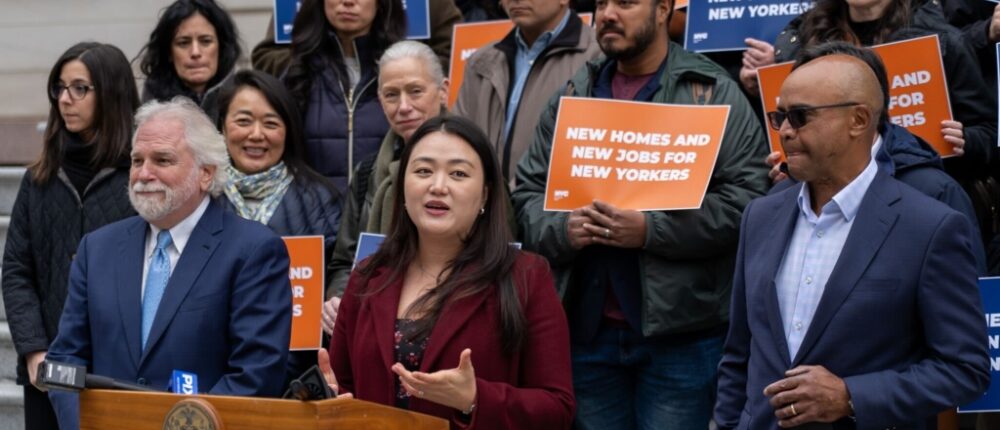
Featured image: Julie Won, city council member from Long Island City. Photo by Mackey Landy.