
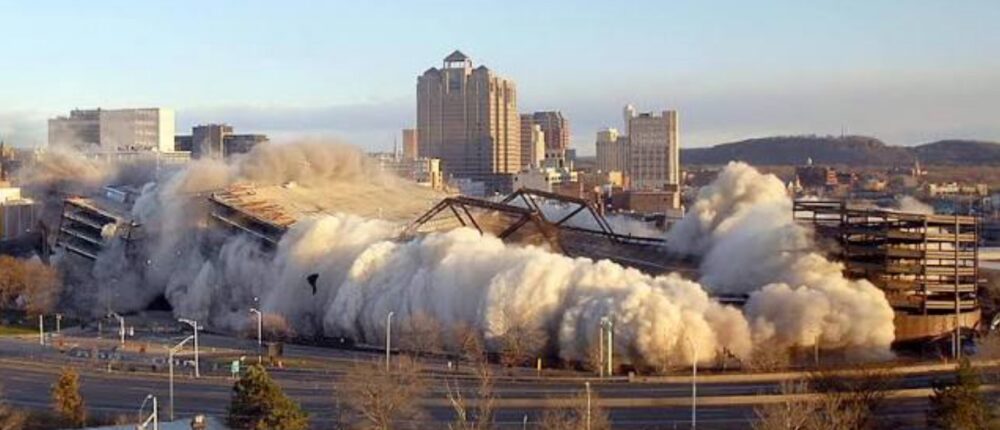
Undoing the Devastation of “Urban Renewal” in New Haven
At some point in the 1980s, following three decades of planned destruction, the term “urban renewal” became a slur, an indictment. Just as the U.S. lost “the war on poverty” over the same period, those 30 years brought very little “renewal” to our cities. The poster child for this destruction, a nationwide effort, was, of course, Robert Moses in New York City. In New Haven, Connecticut, however, a much lesser known planner, Maurice Rotival, may have engineered more damage per capita than occurred in any other city.
Rotival had a small canvas but an outsize impact as an urban planner. When he created his master plan for New Haven in the early 1940s (it was formally adopted in 1944), the city had 195,000 people and housed 92% of the county’s population in dense, low-rise neighborhoods that were built around the 1638 Master Plan Nine Square layout of John Davenport and Theosophilus Eaton. This mega-square scheme had a central green with churches as its civic, historic, and cultural core, and Yale University set snugly up against its western edge.
Rotival had studied in Paris, before and after World War I, when the urban ideas of Le Corbusier were in ascendancy (and, like Moses’, later discredited). He arrived at Yale from Venezuela in 1939 to do research in urban planning, and later helped create the school’s first urban planning program. As Yale led the thought leadership in its hometown, Rotival’s impact was such that New Haven commissioned him to create a master plan.
Even as he proposed the mass demolition of existing buildings, professor Rotival based his designs on an intellectual foundation, applicable to all urban design, which he described in 1947 as the “organic planning doctrine.” This intellectual faith in the power of ideas was implemented using “computational planning,” in which statistics were collected, analyzed, and then used to create the New City.
Ideas and papers and academia do not tear down cities. In the wake of World War II, the federal government enacted the Federal Housing Acts of 1949 and 1954, and President Eisenhower signed the Federal-Aid Highway Act of 1956. The new roadways allowed suburbia to explode into areas where land and home ownership were affordable. Simultaneously, the demographics of urban America after World War II were changing as radically as the Federal Highway System changed the nation. Reflecting the huge migrations out of and into U.S. cities, the federal housing acts were used in New Haven as part of Rotival’s vision to replace smaller-scale neighborhoods with housing projects, many of which were eventually demolished.
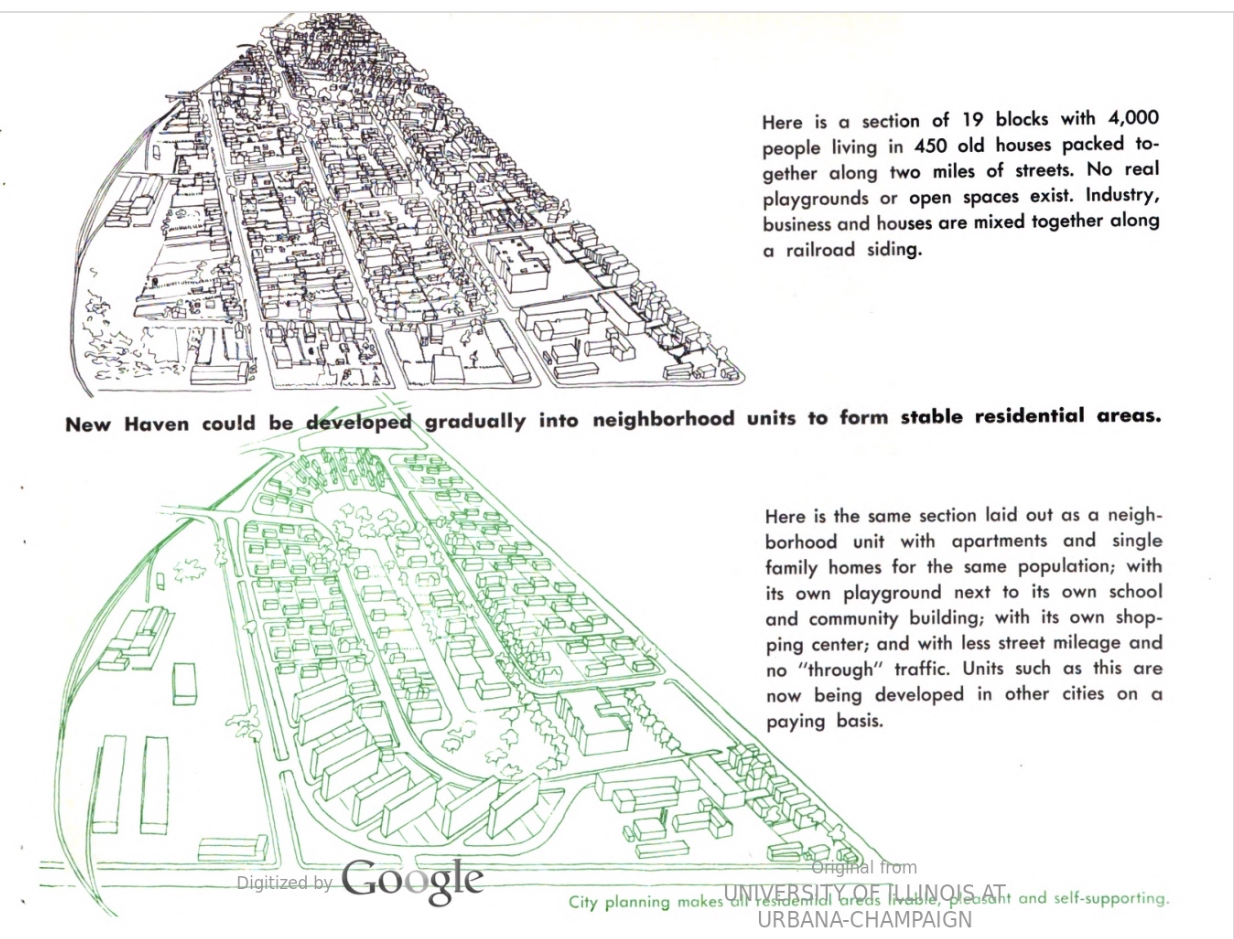
Part of Rotival’s 1944 master plan, “Tomorrow Is Here,” for the City of New Haven. Source: New Haven Free Library.
In 1954, planner Ed Logue was appointed head of New Haven’s Redevelopment Authority by 38-year-old Mayor Richard Lee, the youngest person ever elected to the office. Using Rotival’s vision, they leapt upon the federal “Model City” program, which netted New Haven over $1 billion (in 2020s dollars) to build things the private sector wouldn’t. As the suburbs boomed, there was not enough private investment in cities to create housing, business, or institutions. Those federal funds, combined with the massive highway creation envisioned in Rotival’s master plan, helped devastate much of the city.
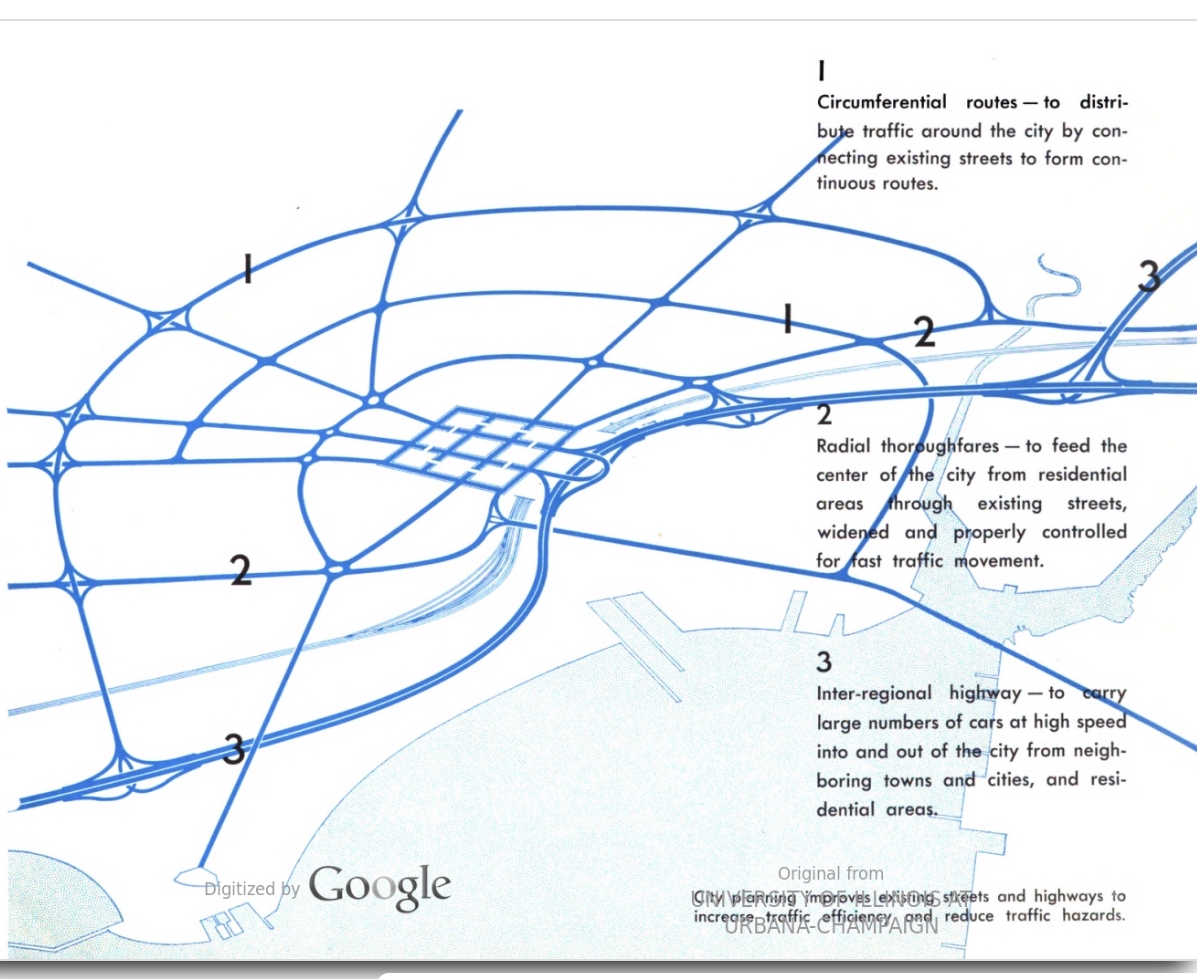
Part of Rotival’s 1944 master plan, “Tomorrow Is Here,” for the City of New Haven. Source: New Haven Free Library.
Lee was mayor until 1970. When New York Governor Nelson Rockefeller created the Urban Development Corporation (UDC), he appointed Ed Logue as its chair in 1968. Logue was intimately aware of the “opportunities” for redevelopment in New Haven. The resulting information on the federal money Logue went after at the New York UDC became part of New Haven’s “renewal” strategy. The connection between New Haven and federal funding was further solidified when Mayor Lee left office and the planner’s brother, Frank Logue, was elected mayor.
“We thought we were doing everything right then,” former Mayor Lee told the New York Times in 1981, “but now we realize a lot of it came out wrong.” As per the Times, “Lee, who was hailed in such national magazines as Newsweek, Fortune and Architectural Forum for his renewal programs, served an unprecedented 16 years and was one of the most respected and most powerful mayors in the country. Even now, high-ranking federal officials remember him as the mayor who—through his charm, dynamic plans and national recognition—gained more Federal dollars per capita for his city than any other mayor in the country.” What resulted was 30 years of removal and construction that shredded huge areas of New Haven. The city was ultimately the victim of the famous dictum, “To make an omelet, you have to break some eggs.”
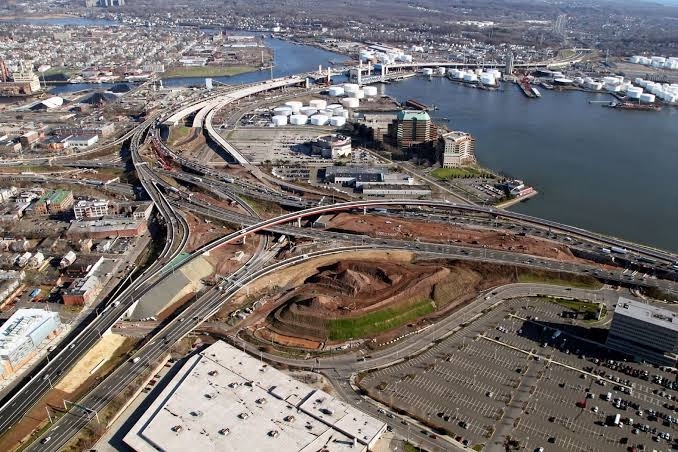
Interstates 1-95 and I-91 have permanently walled off New Haven from its waterfront. Huge landfill developments to the south of the great wall were attempted; most failed. The quiet Cedar Hill neighborhood was ripped into isolated sections. Source: H.W. Lochner.
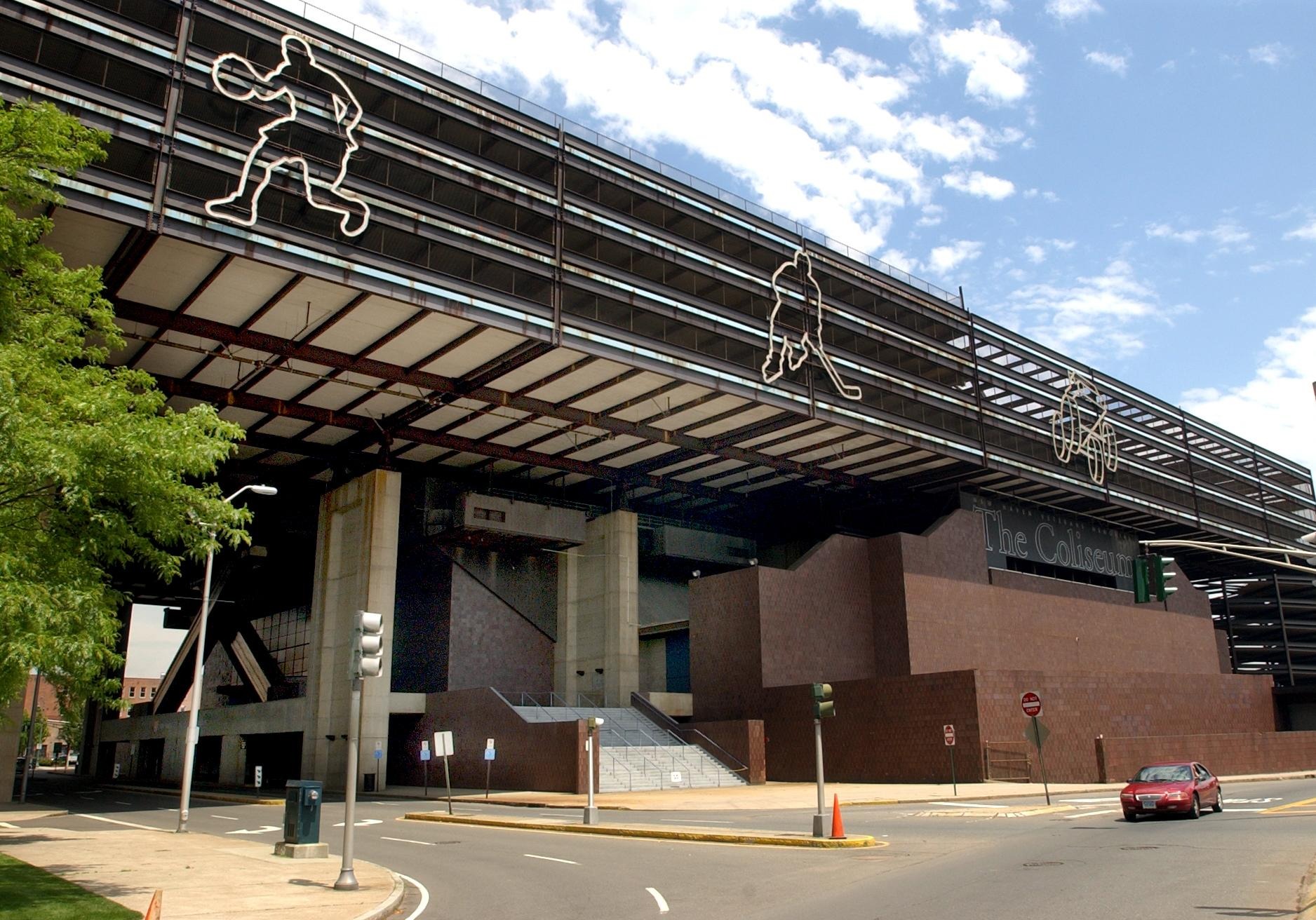
Downtown blocks were removed in the 1960s to build the Kevin Roche–designed New Haven Coliseum (shown), which was demolished in 2007. The site sat fallow for over a decade. Market-rate “6-over-2” housing is now under construction. Source: New Haven Register.
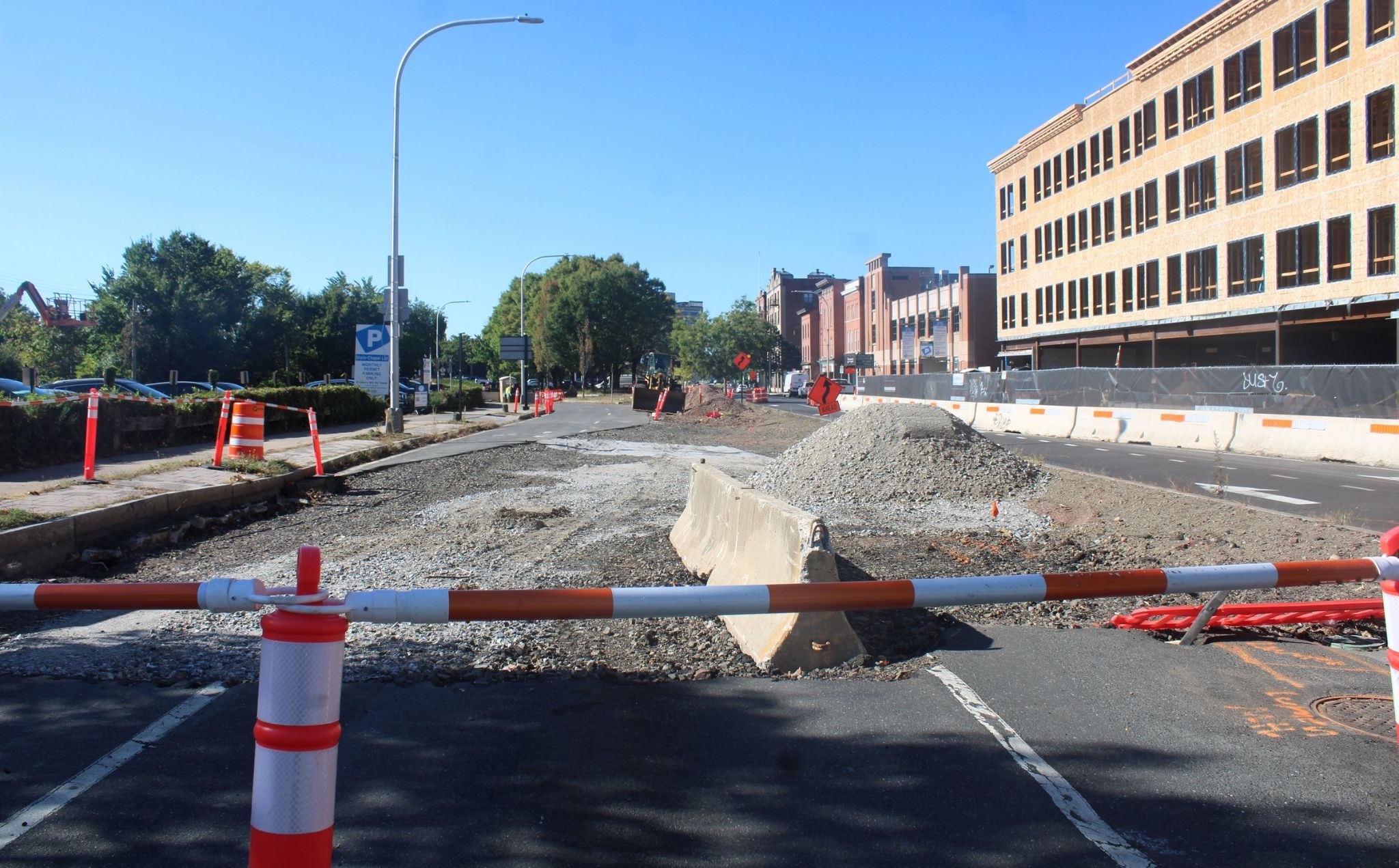
Rotival’s vision of an “Urban Axis” gutted State Street, the east edge of the Eaton/Davenport Nine Squares, and was left open until last year, when construction on new housing began. Source: New Haven Independent.
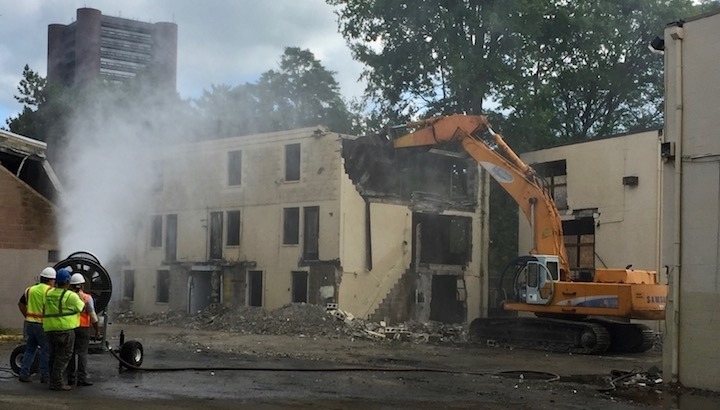
The central Union Station blocks were torn down for the Charles Moore–designed Church Street South Housing, which fell into disrepair and was torn down a few years ago. It will be replaced by market-rate housing and a reinstituted street grid. Source: New Haven Independent.
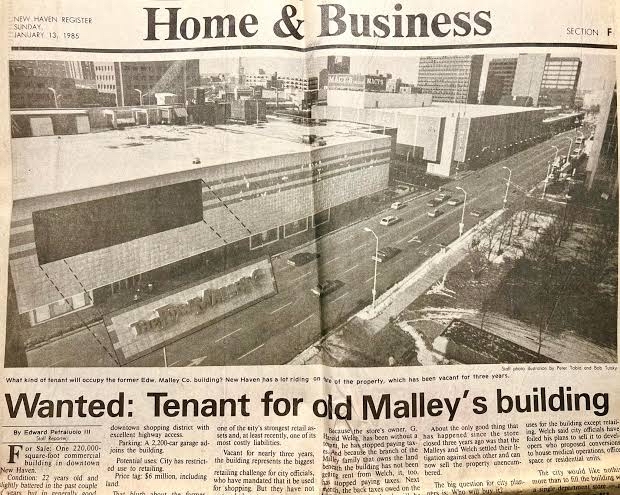
Next to the New Haven Green, many blocks of older buildings were removed to create commercial developments, which all failed and were removed for a new central building of Gateway Community College and street-facing retail.
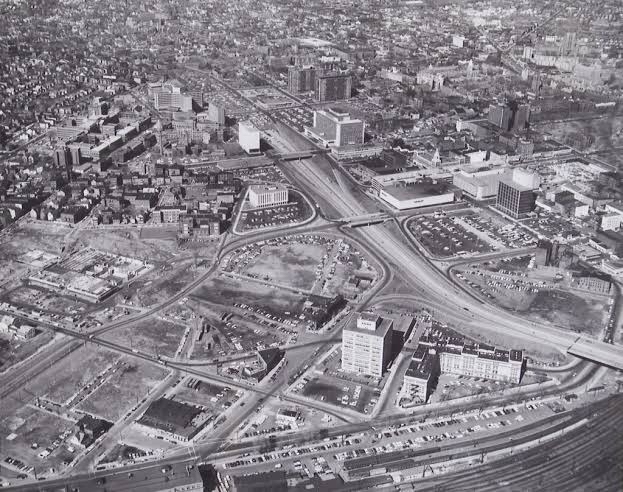
Most dramatically, Rotival envisioned, and Logue executed, the wholesale removal of the entire Oak Street neighborhood for a highway to nearby Derby that was never built (Derby’s industrial base moved south, then overseas.) A huge parking garage was built over its lowered path, which remains unused. The urban void beyond that garage has been slowly filling in: first with parking lots, then buildings over the last 20 years, as Yale’s hospital began its explosive growth. Additionally, away from the hospital, where the clear cutting ended at a wetland, new “traditional” subsidized row houses have been built in the last two years. Source: New Haven Free Library.
It is noteworthy that in all this rampaging “renewal,” Yale was left untouched. The one positive outcome of “urban renewal” was yet another unintended consequence. Just like the Oak Street neighborhood, which had been deemed a “slum” and cleared, much of the beautiful Wooster Square neighborhood was slated for removal, to facilitate I-91’s connection to I-95. That threat did for New Haven what Penn Station did for New York City: it ignited a groundswell of outrage that created an active historic preservation power base. That group of citizens halted many subsequent efforts to erase history, saving much of the city’s fabric.
This lust for the new did create some significant architecture: Paul Rudolph’s Temple Street Garage, Marcel Breuer’s Armstrong Rubber Headquarters (now a hotel), and Kevin Roche’s Knights of Columbus Tower are signature buildings that resulted from all the broken eggs of a largely unrealized urban omelet. New Haven lost nearly a quarter of its population between 1950 and 1980. Douglas Rae, a Yale political scientist and former New Haven chief administrator, once said (via Governing Magazine), “Urban renewal, inextricably intertwined with a program of highway construction, did more to change the built city than had any single intervention in New Haven’s three centuries of history.”
We took less than 20 years to lay down an entire federal highway system across a huge country—eventually, 41,000 miles of it. We traveled to the moon, helped rebuild war-torn Europe, defined and controlled electronic media, and, yes, unleashed “urban renewal” upon our cities. Beyond that infrastructural vision, we came to believe that local problems had national solutions, so we created institutions to direct education, energy use, medical care, even the arts. Some reforms created immense social benefits, but “urban renewal” arguably created more problems than it solved.
Rotival died in 1980, at 88, in Paris, far from the wreckage he helped to create. As New Haven slowly repairs its torn urban fabric, it might be a good idea to see the value of history that he never learned. Huge economic and political forces co-opted the good intentions of a designer who assumed he had the answers to the future. When a lack of understanding is paired with power, arrogance becomes authority. And New Haven suffered.
Today, it’s easy to second-guess 70-year-old decisions that have been proven to be failures. But can we learn from both the mistakes we’ve made—and the ones we’re making now?
Featured image: The demolition of the New Haven Coliseum, in 2007, via the New Haven Register.