
When Authentic Public Engagement, Political Will, and Good Design Come Together
One of the more promising shifts in the discourse in recent years is a larger critique of the economic systems that architecture and design operate under. In other words: Who sets the agenda? Who defines the perimeters? Who makes the early decisions—the ones that often determine final outcomes long before the designers are brought to the table? And how do you engage the public to become part of that process? These are inherently political questions.
Landscape architect Billy Fleming—an assistant professor of landscape architecture at Temple University in the Tyler School of Art and Architecture and a co-founder of the Climate and Community Institute—has been grappling with these questions for more than a decade. He served as a policy adviser in the Obama White House and was active in the formation of the Green New Deal. A designer, educator, and writer, he’s a leading voice on the role that the design of our cities, communities, and landscapes plays in responding to the climate crisis. His new book, Building Postcarbon Futures: Land, Justice, and Energy Transitions (Lincoln Institute of Land Policy) is a kind of case study, illustrating the immense power of authentic public engagement, when it’s fused with political will and finally good design. I recently talked to Fleming about the flawed nature of “sustainable” design projects, why the term “citizen planner” can sound paternalistic, and the importance of planning now, in this fraught political moment, for a fundamentally different future.
MCP: Martin C. Pedersen
BF: Billy Fleming
What’s the origin story of the book?
In some ways, this book grew out of a frustration with the planning, design, and climate policy professions’ tendency to look in all the wrong places for exemplary models of what it takes to build a more just, abundant, and decarbonized world. So much of what passes for sustainable, resilient, or climate-positive in professional design often amounts to little more than a branding exercise. This led our field to rely on a small set of incredibly flawed projects that, if we’re all honest with each other, often contribute far more to increasing carbon emissions and growing ecological gentrification than we care to admit. This isn’t the fault of anyone or any firm in particular, it’s the system in which contemporary design and planning operate: bound by markets, beholden to clients, competing with one another for commissions tied to high-end real estate development with increasingly exaggerated claims of impact.
I quickly realized my frustration was a collective one and that there was a need for something like a new case study library. The book is my way of showing that there’s a much wider range of places, projects, and people to learn from when it comes to designing more just, postcarbon communities. Many of the projects in it have been planned, designed, and maintained by people without professional credentials in planning or design: Indigenous land stewards, housing and environmental activists, folk practitioners and family farmers.
I call them “citizen planners.” It’s a more publicly engaged, less checklist-driven approach.
Sure, but even “citizen planner” can feel paternalistic at times. They’re just planners or designers or whatever field we’re talking about. Two of the many problems that professionalization and the fetishization of licensure gave us were (1) drawing a very narrow boundary around what counts as planning or design, who counts as a planner or designer, and, as a result, which projects become central to the way that we think about producing and managing space; and (2) it drove us toward our disciplinary silos, making it harder than ever to learn from those outside our field of view.
I know many of the folks involved in the genesis or operation of credentialing systems like LEED and SITES in practice, and risk and resilience certificates in the academy. They’re all quite clear in the way they frame these certifications: as a way to work within the status quo to inflect a project toward, say, lower-carbon building and paving materials or living shorelines. It’s a way to make a project nominally better without addressing any of the underlying systems that produce vulnerability to the climate crisis.
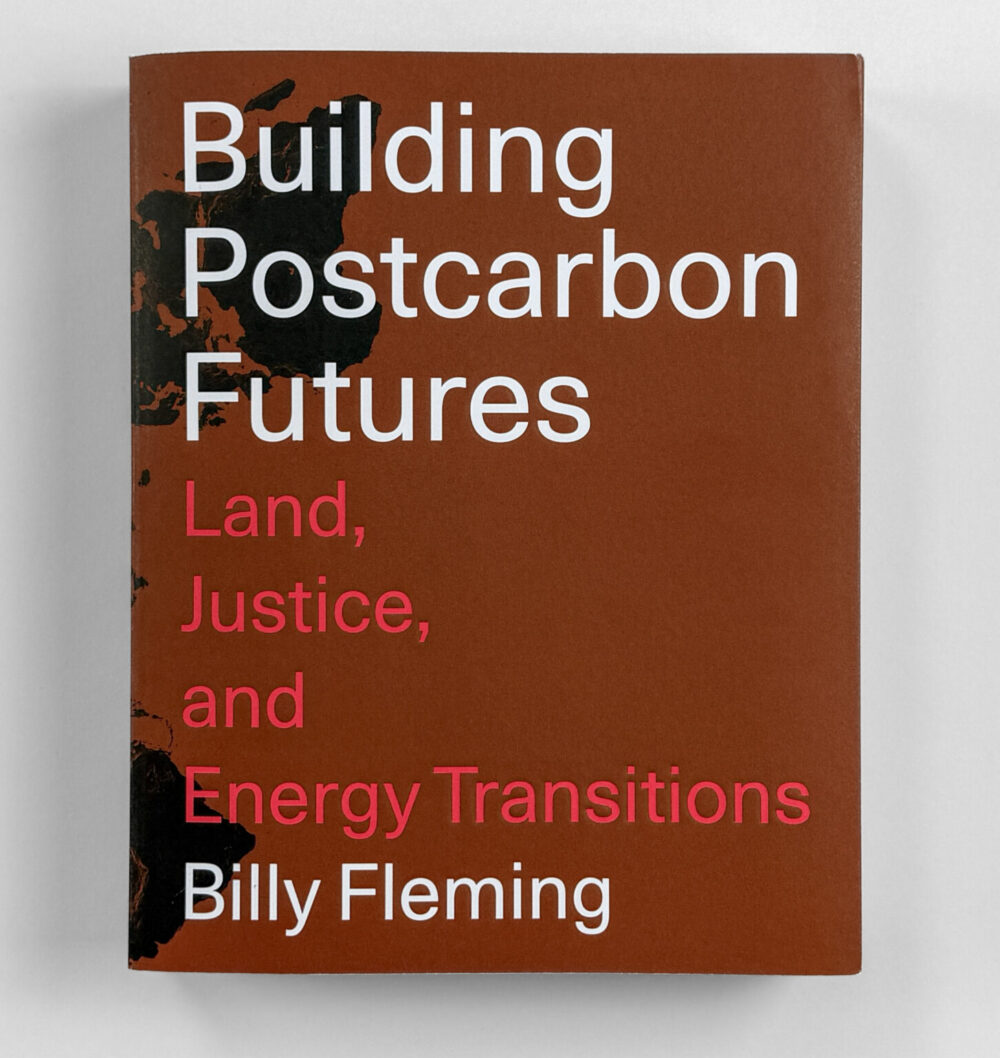
Building Postcarbon Futures: Land, Justice, and Energy Transitions, by Billy Fleming, edited by Jennifer Sigler. designed by Cristian Ordóñez. Published by the Lincoln Institute of Land Policy. Distributed by Columbia University Press.
So what makes the projects in the book different?
The planners and designers at the core of this book are coming at these challenges through those systems. Yes, they’re also upgrading informal housing settlements in areas of flood risk, building clean energy generation projects, remediating and restoring land obliterated by extractive industries, and so on. But their tools, tactics, and methods are far more expansive in scale, changing local and national laws, driving multinational coordination at unprecedented scale, and ensuring that the wealth created by investments in particular sites are collectively owned and shared by those who already live there. They’re doing all of the things that professional planners and designers have claimed are outside the scope of a project or their fields for decades.
Which projects in the book seem most capable of being scaled up, of withstanding political friction or fiscal constraints? Which ones hold the most promise?
I feel like you’re asking me to pick a favorite child! One of the reasons there are so many projects in this book that I could highlight here is that nearly all of them are replicable in some form. There isn’t anything particularly novel about the technologies, formal or aesthetic aspects, or financial models employed to build the projects. The most innovative aspects of the case studies in Building Postcarbon Futures are their investments in collective ownership, social movements and organizing, and changes in local and national law that are required to build and sustain works of climate justice at a meaningful scale.
One that I would encourage readers to spend more time with is the Tu Deh-Kah Geothermal Power Plant, in British Columbia. It’s obviously using a very mature form of technology, though the siting decision—the reuse of an abandoned gas well—is creative. But the real innovation in it is as a part of the first wave of Truth and Reconciliation projects to come online in Canada, where, in this case, reconciliation is coming in the form of direct ownership of the geothermal power plant by the Fort Nelson First Nation.
Paid for through provincial and national funding and financing programs, their full ownership of the project allows them to control their own heat and electricity and, crucially, to sell the excess power that they create back to the British Columbian grid, creating a massive new revenue source to manage. Whether it’s used to invest in more quality-of-life improvements, the reacquisition and remediation of stolen land, the conservation of cultural practices, or other forms of economic development, it’s one of the clearest examples of reparations through climate and energy policy in operation today.
There are many other projects in the book that do their own version of this kind of work. The West Arnhem Land Fire Abatement (WALFA) initiative is an Aboriginal land stewardship project in the top end of Australia. There, they’ve blended traditional methods of ecological management and restoration with contemporary surveillance and monitoring technology to transform one of the most fire-prone landscapes in the world into a thriving example of what it looks like to manage wildfire, ecosystems, and carbon sequestration in a warming world. Their work has been so successful that it has expanded four times since its inception and has become a crucial training ground for firefighters throughout Australia.
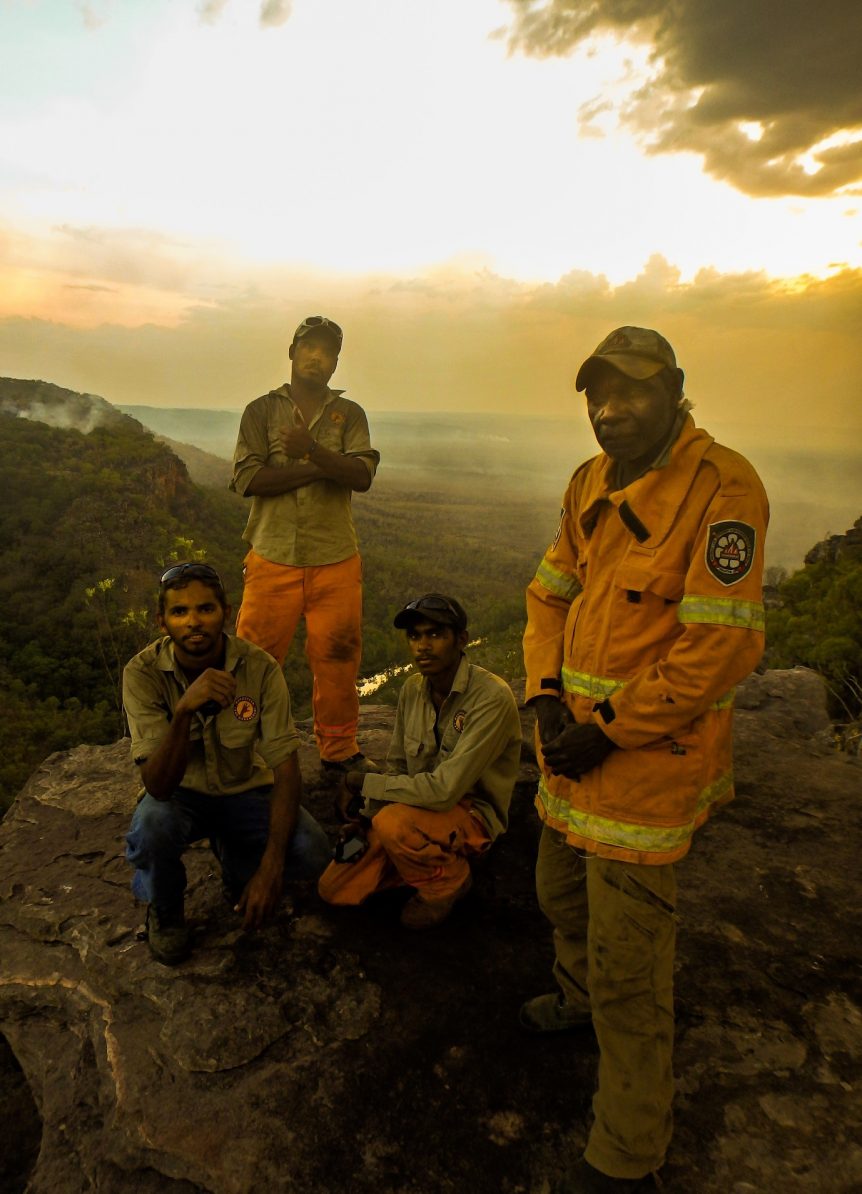
Indigenous fire managers and their partners in Arnhem Land successfully reinstated customary burning practices producing significant social, cultural, environmental and economic benefits for Indigenous landowners. Photo via the Carbon Market Institute.
The book sounds to me to be as much about public and political engagement as it does design.
It is. Part of that stems from my view of design as the end result of much longer and complex political and economic processes. Our fields are the last ones to touch a place or project, and we’re usually brought in toward the end of years or decades of work in which all of the most important decisions have already been made.
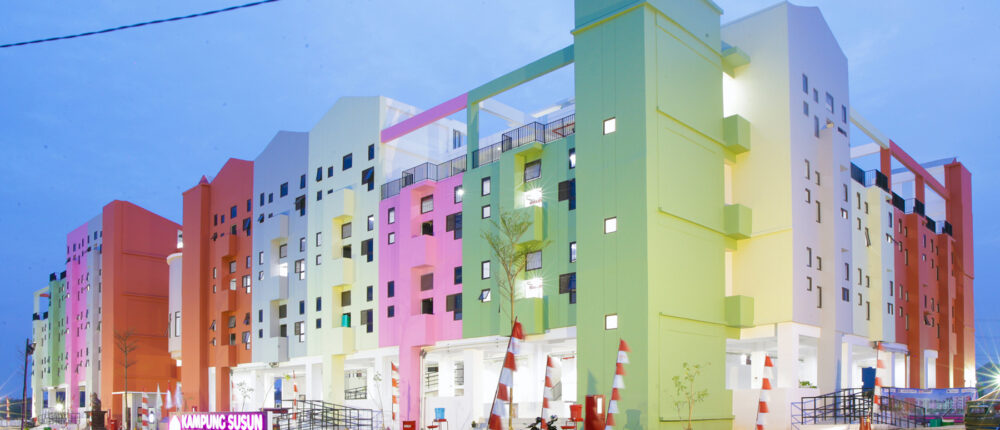
You could look at some of the other projects in this book that did include contributions from professional architects and landscape architects and tell a very familiar story about the heroic or transformative power of design—especially social housing projects like Proyecto ENLACE, in San Juan, Cantinho do Ceu, in Sao Paolo, and Kampung Susun Cakung, in Jakarta.
In San Juan, that project only became possible after decades of organizing that changed Puerto Rican law and established the first community land trust in the Caribbean. Those steps ensured that the residents of this neighborhood controlled the land, managed its redevelopment, avoided the risks of displacement, and directly shared in the wealth it created. The design teams came in after all of that work was complete.
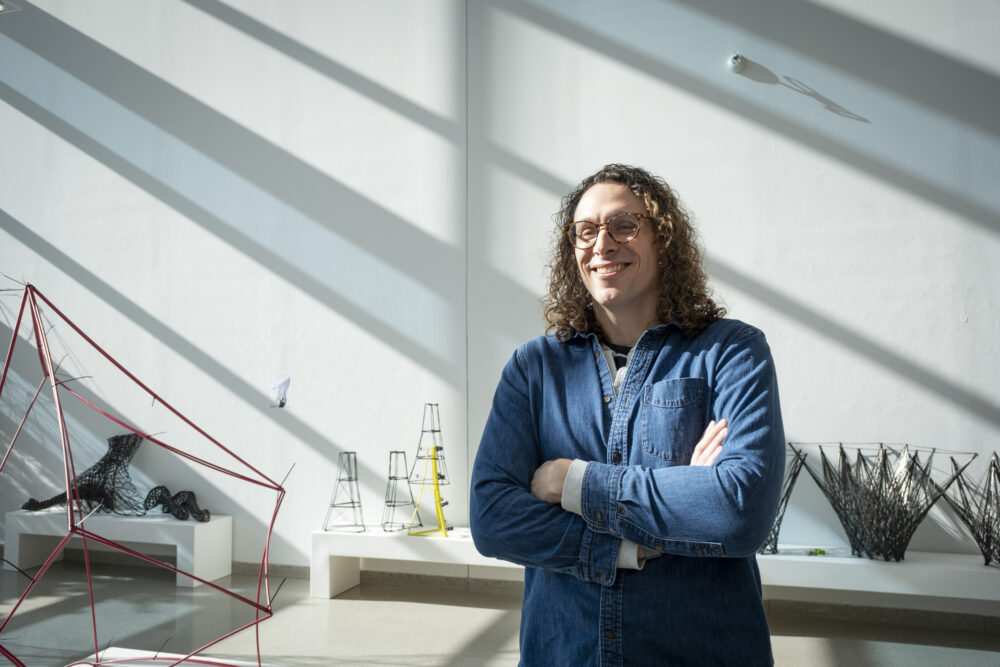
Photo by Joseph V. Labolito.
We talk about how we have to somehow get past this political moment and center our ideas around what we would do when we got a more progressive administration. If you were planning out a policy for three or four years from now, where would you put your energies and thoughts?
This is really the question we have to ask ourselves. When the levers of government are unavailable to us, we have to think about how to prepare for the next moment that they are—to think big, and pragmatically, about how to push as many good ideas through a window as possible.
I think back to 2017, at the start of the first Trump administration, and 2021, as Joe Biden prepared to assume office. In the former and very bleak period, I got to be part of a small group of activists, scholars, and policy wonks that built out one of the most ambitious climate and economic programs ever developed in this country: the Green New Deal. In the latter and much more hopeful one, I got to work with a group that would largely become the Climate and Community Institute, a think tank focused on green economic populism research that I co-founded with Daniel Aldana Cohen, to develop a few proposals for the incoming Biden administration to consider.
One idea we put forward that has only become more relevant was simply to staff the federal government at its full, intended capacity. Even in 2021, the government was staffed at something like 1987 levels due both to a decades-long campaign to shrink government and obliterate the state, and to an acute push by the Trump administration to fire federal employees and dissolve entire agencies. This matters for all kinds of reasons that have to do with managing huge sums of money, complex infrastructure projects, and delivering the kinds of public goods and services that government is supposed to provide. But when it comes to climate and energy policy, it’s also essential to any discussion of permitting reform and the need to expedite new clean energy projects. Permitting reform is often framed as an issue of red tape alone. But the primary bottleneck for building new generation, storage, and grid projects comes from a lack of bodies: we simply do not have enough people to manage the review process. We’re going to have to rebuild faith in civic institutions and one of the best ways to do that is to hire enough people to ensure that government agencies are able to function as intended.
Beyond that, there are so many other built environment priorities, it’s hard to say. We have to reindustrialize and build the kind of capacity required to power the energy transition in the U.S. We have to find a way to improve the quality of life for everyday people through investments in buildings, landscapes, and infrastructural systems as quickly as possible. And we have to find a way to address generations of harm and neglect in our big cities and small towns.
This can all feel overwhelming and impossible to begin. But I sometimes think about the fact that the Department of Homeland Security was created while I was in high school—a $100 billion instrument of pain and oppression, conjured in the fog of a crisis, deployed today to destroy lives and communities. And while it’s a deplorable federal agency that should be dissolved, it reminds me that, even in the U.S., we can do very big things, very quickly, with the right leadership in place. We might also have to think about what a new federal agency, tailored to the realities of our climate and economic crises, focused on integrating and coordinating planning place-based investments across a range of sectors, and dedicated to the proposition that something like “homeland security” comes from investing in systems and services that allow all of us to flourish.
This book doesn’t try to do all—or even any—of that work. But it is trying to shift the way we think about designing and planning through systems and sites, all at once, as we prepare to try and push something big and transformative through the next window that opens.
Featured image: About 70 families were displaced by a flood mitigation project on the Ciliwung River in Jakarta. Evicted residents took action in the courts. Kampung Susun Cakung, designed by Akanoma Studio, is the housing project where they were ultimately relocated to. Photo via Project M/Adrian Mulya.