
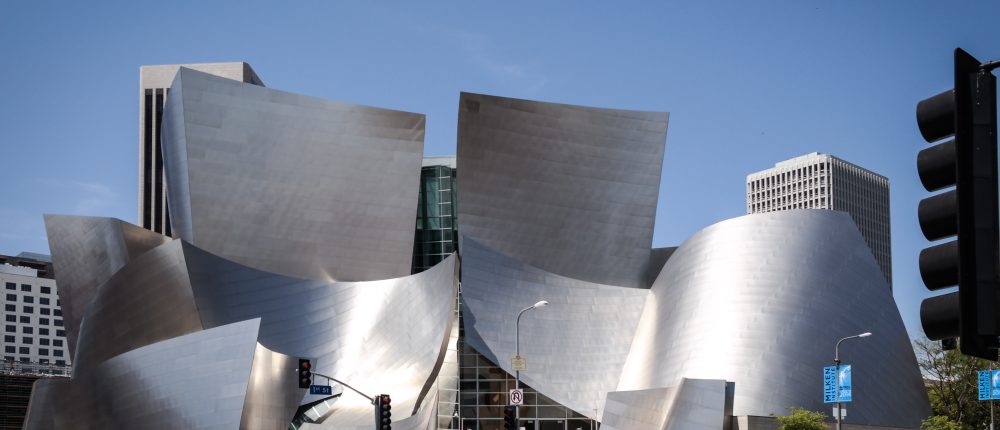
As Disney Hall Showed, Frank Gehry’s Los Angeles Was Urban, but Not Urbanist
To be honest, I never really believed that the Walt Disney Concert Hall would ever actually get built. It was the most important major architectural icon in Los Angeles designed by starchitect Frank Gehry, who died earlier this month.
But it was so expensive, so complicated, and so rooted in an ongoing battle over who controlled prime real estate in downtown L.A. that I once wrote it off. In fact, in The Reluctant Metropolis, my 1990s book about L.A., I predicted that the underground parking garage built by Los Angeles County would stand as a lonely reminder of this longstanding real estate battle between the county government and the city’s cultural elite, with the foundation of Disney Hall sticking embarrassingly out of the ground forever.
I was wrong, of course. Even as the cost of the project ballooned from $50 million to more than $200 million and beyond (in 1990s dollars; double the amount for today’s value), and even as Gehry’s design vastly increased the complexity of the project, it got built. Mostly it got built because Eli Broad, one of the city’s great boosters and philanthropists, led a fundraising effort to come up with however much money was required to finish it. In the end, Los Angeles’ cultural elite came through.
Good for them—not only for getting Disney Hall built, but for creating a district of high culture that includes not only Disney Hall but also the 1960s Los Angeles Music Center, the Museum of Contemporary Art, designed by Arata Isosaki, and Broad’s own museum, The Broad, designed by Diller Scofidio + Renfro.
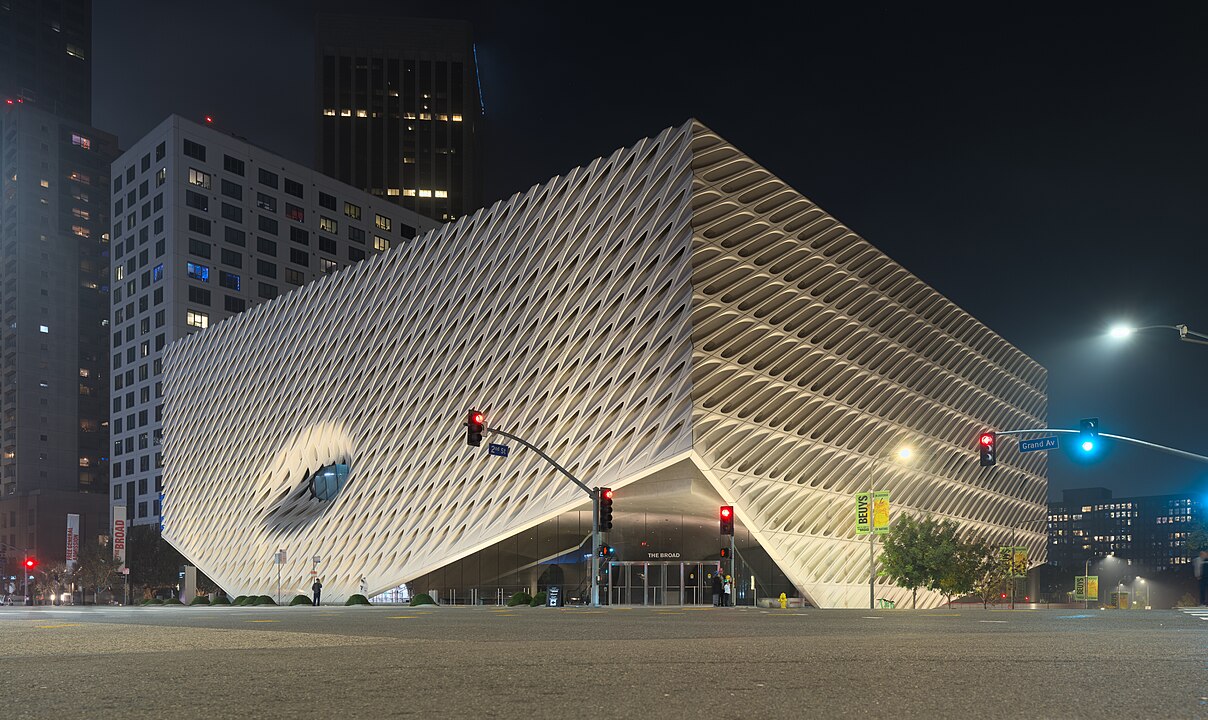
I use the term “district” loosely, because even though all of these distinguished cultural institutions line up along Grand Avenue on top of L.A.’s Bunker Hill, they don’t really add up to a place. Grand Avenue is more like a museum itself, featuring a series of freestanding and very separate monuments that don’t have a whole lot to do with each other.
Which kind of highlights the problem Los Angeles has always faced in trying to become a major urban center. There’s no question it’s a great city, which is part of the reason I have spent most of my career studying it, writing about it, and celebrating it. But, auto-oriented and prone to the monument syndrome as it is, L.A. doesn’t hang together. And Grand Avenue is maybe the best example in the whole city of this failure.
Bunker Hill is a unique place, a large hill in the middle of a major downtown, and it has always been hard to connect it to the rest of L.A.’s urban fabric. It’s still connected by a historic funicular called Angels Flight. (For more, you might want to try reading Michael Connelly’s novel Angels Flight, which uses the funicular as the scene of the murder at the center of the book.) It was once a rundown boarding house district, then cleared in urban renewal days, and then reborn as a gleaming skyscraper district. As I wrote in The Reluctant Metropolis:
Though it has a sordid past, Bunker Hill has always been surrounded by monuments to L.A.’s urban pretensions. At the north end lies the Civic Center Mall, where the county government offices are located, as well as the Los Angeles Music Center, downtown’s major nod to the cultural elite. At the south end stand those twin icons of 1920s Los Angeles, the Central Library and the Biltmore Hotel. On the east side are the shabby remains of the city’s magnificent office and retailing districts from the 1910s and 1920s; on the west side are their pale, overgrown counterparts from the 1970s.
And in the middle, straddling Bunker Hill, runs Grand Avenue, the greatest urban street Los Angeles has never quite figured out how to build. Grand Avenue was once the colorful locale of shabby boarding houses and sleazy novels—the kind of place where hotels were “built on a hillside in reverse, there on the crest of Bunker Hill,” as novelist john Fante once described it, “built against the decline of the hill, so that the main floor was on the level with the street but the tenth floor was downstairs ten levels.” These days, however, Grand Avenue is the boulevard of blueblood dreams in Los Angeles: the Park Avenue, the Michigan Avenue, the Champs-Elysees wannabe that is supposed to silence those joking urbanists from the East Coast and Europe once and for all.
Sometimes, while up on Bunker Hill, you can see L.A.’s missing urbanism. I remember one rainy winter day walking down Grand Avenue feeling like I was in Chicago. In the days before Uber, it was one of the only places in L.A. you could actually hail a taxi because they were always roaming around, waiting to take lawyers to the courthouse. And when you come up Angels Flight—from the undeniably pedestrian-oriented Hill Street below, near the venerable Grand Central Market—you are presented with a pretty nicely designed pedestrian plaza that isn’t overrun by the parking garage ramps endemic to other parts of downtown L.A.
But urban it is not. And the reason is the monuments, all designed by starchitects, all lined up in a row along Grand Avenue, from Angels Flight north to the Music Center. Like so many major streets in L.A., Grand Avenue is wide but not really … well, not really grand.
L.A. had the opportunity to create a truly magnificent pedestrian street because the city scraped the entire top of Bunker Hill during urban renewal days, and even in the ’90s the county owned three critical pieces of land at the north end of the hill.
But back in the day, the Los Angeles Community Redevelopment Agency chose what it thought was financial stability over vision in selecting a master developer for Bunker Hill, the result being tall office buildings with lifeless plazas at the south end. And even though the county government wanted to develop the critical parcel at the top of the hill with offices, apartments, and other things, the cultural elite outmaneuvered the county in order to grab the best site for Disney Hall. (That’s why I titled one Reluctant Metropolis chapter “The Taking of Parcel K.”)
Yes, across the street from Disney Hall, one of the parcels owned by the county, a mixed-use project has been built (the apartments are called “The Gehry at Grand”), but one block does not an urban district make.
So often in L.A., historically the capital of cultural artifice, architects use the urban fabric not as a tapestry but simply as a backdrop. Cesar Pelli did this with the Pacific Design Center; Jon Jerde did this with University CityWalk, even replicating certain urban locations to create a kind of a joke version of a shopping mall. And Gehry and the other starchitects did it on Grand Avenue. As my colleague Josh Stephens wrote in California Planning & Development Report the other day (it’s in front of the paywall and worth a read), Gehry was urban, but not an urbanist. Even in 2025, I guess you could say the same about Grand Avenue—and, by extension, all of Los Angeles.
Featured image of Disney Concert Hall via Wikipedia. To read more of this author, visit his substack: The Future of Where.