
What Exactly Does It Mean to Be an “AI-Powered” Architecture Firm?
In the course of reporting an essay on AI and the future of architecture—at the advice of my favorite AI expert, Eric J. Cesal—I interviewed Patrick Chopson, co-founder of Cove Architecture, an Atlanta-based business that calls itself the “first AI-powered architecture firm.” This claim is obviously open to debate and part marketing spin, but Chopson and his team have fully committed to using AI at virtually every step of the design process.
It’s very much a work in progress. Chopson and co-founder Sandeep Ahuja met at Georgia Tech and started Cove in 2017 as a software company, successfully raising more than $36 million in venture capital. Two years ago, the firm transitioned from creating and marketing AI-powered software to using AI-powered software to design buildings. Whether that pivot was driven by necessity (architecture firms are notoriously stingy about investing in new technology) or a business opportunity (the profession is ripe for reinvention) is a question only time will answer. Since we’re at the start of this revolution and the ways forward still seem fuzzy, unformed, and uncertain, my interest in Cove is based on its role as an explorer.
MCP: Martin C. Pedersen
PC: Patrick Chopson
Give me a brief background on the firm.
We call ourselves the first AI-powered architecture firm. We’ve built our technology from the ground up, with a BIM application that has AI at its core. So we’re able to “talk” to our projects and design using a process where we have AI helping us draw and make decisions. We started off doing software, and then transitioned over the last couple of years into architecture. As technology has evolved, two key advancements emerged. One is the ability to trace back your answer. That’s why you didn’t see a lot of movement on this problem, because if you can’t validate where you got an answer from, then it’s hard to integrate that with buildings. The other key thing is the ability to understand intent better. Models have advanced enough that they can understand what it is that you want them to do.
Cove describes itself as an “AI-powered firm.” What does that mean in practical terms?
We’ve built the software that’s part of our core delivery. If we’re making drawings, we’re making them in our own software. That allows us to map out how we make a project. We call that the “ontology of design.“ For example, how do you design a five-story, garden-style apartment building? We’ve mapped it out. It has about 87 steps from concept to construction drawings. Then you apply AI at every step. But we also emphasize that we’re AI-powered, but human-centered. What we mean by that is that there isn’t any part of the process that’s automated. We have people working with machines together. A human is always providing the design, the vision. We want people to be able to make unique and interesting things, whereas if you have AI generate something that’s based on the statistically most likely outcome, then, if you only use AI, everything will look the same.
How does AI avoid that?
The most important thing is that you intentionally design a system where you prioritize people’s thoughts and what they’re trying to accomplish, trying to reduce the friction between what they’re thinking versus what they’re seeing.
Give me a specific example of that.
If I’m thinking about a facade and sketching some ideas, it would be ideal if I could sketch those ideas by hand, then show them to a computer, and then the AI would respond, “Well, I can tell from these five images, plus the inspiration images that you provided, that it’s likely you’re looking for windows that are roughly a 2-to-1 ratio vertical slot windows.”
Most firms have, for different building types, a particular aesthetic that’s an important part of their brand, or a culture that produces a certain appearance or set of details. So, as architects, when we’re thinking about AI, we can’t just press a button and use an image-generation tool, because how buildings look is derived from a vast number of those details. But if you can combine the details with what the architects are sketching, then you’re better able to achieve the look and feel that you’re looking for. You’re not just being shunted into a particular workflow by an AI image generator that might be trained on the “average” building of that type. We’re designing the process of design using AI. We’re not trying to make an outcome. We’re thinking about the specific steps of design, mapping those out, and then determining what percentage of those steps are done by a person, what percentage is done by the machine, and always keep both things happening at the same time.

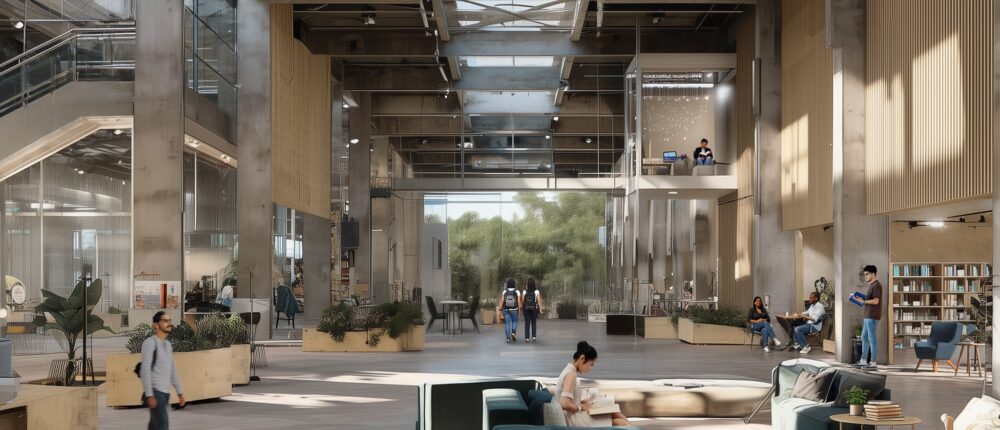
Conceptual rendering from an adaptive reuse feasibility study exploring mixed-use possibilities within an existing industrial context.
What’s the percentage with the current technology?
For some tasks, like ideation, it’s 90% person, 10% machine. It’s different when you get to creating a valid floor plan. Let’s say it’s an apartment. There’s a certain spec for apartments, in a particular location with a particular market study. They have specific room sizes and dimensions and specs. You want AI to handle a lot of that detail: how many outlets you need, what the finished baseboard is, etc. Those things can be almost 100% AI-generated, translating the creative vision into a finished product. The quantifiable stuff is what we want the machines to think about, and the nonquantifiable things—beauty, design excellence—are what we want humans to think about.
Can AI currently create a valid, credible floor plan?
For certain building types, it’s easy to do that. But if you look at a lot of the previous efforts, they tried to generate floor plans, 100% with the machine, assuming that the design and all available options are just a math problem. We focus on each step in the process and continually ask: What is it that I need to decide here?
So you try to do a lot of the design work ahead of feeding it into AI?
We have to create standards, and then we have to update them every time we do a project. Emory University, for example, has this document called the Blue Book. It’s a giant book of all their building standards. As architects, we have to create a similar thing for ourselves, for each building type, so that our AI has the correct assumptions. If we define those ahead of time, then the AI can say, “OK, we’re doing a kitchen, so it’s got to have 3.5 feet minimum between the island and the refrigerator.” Those are constraints that you can easily code into the data structure of a building.
What doesn’t AI do well at this point in time?
The thing I’m working on right now is being able to combine all of the documents that someone might have that inform the context of the problem—emails, phone calls, texts, notes—getting all of that information into the model. This is where we still have to rely quite a bit on people, to remember that the owner asks for X. That input is something that AI won’t be aware of. If you don’t put it in the model, it won’t respond properly. So it’s about creating an interface between human knowledge and what the machine knows. We have to merge those things.
Where does AI evolve into?
Nicholas Negroponte’s 1970 book, The Architecture Machine, is to me the original concept for how humans and machines could work together. It was fairly accurate, there just wasn’t enough computing power in the ’70s to make AI happen. But now that it’s possible and we have LLMs [large language models] that can understand what we’re saying and trigger the right responses, we will get to a point where we’ll feel comfortable having a machine that’s well adapted to a firm. Once you get it personalized to a firm, then you can personalize it to specific individuals on the team, so it becomes an extension of your thoughts. That’s what excites me.
Will current LLMs ever be capable of doing that?
We don’t believe that a generalized LLM is capable of thinking about the problem the right way, because it’s based on previous knowledge. That’s why only about 10% of our system uses LLMs; the rest of it is code that we’ve written ourselves. We also have our custom algorithm. It’s a patented application that allows us to balance all the different competing objectives and costs against each other. Our tech allows us to do optimizations that used to take about 80 hours in about two minutes.
AI will streamline the process of creating drawings, which traditionally architects were paid for. How do you envision AI impacting the business model of architects?
One of the things we’ve learned from the owners that we work with is how they view paying the architect. Of course it’s about providing drawings. But they’re also hiring us to manage the risk of designing and constructing the building. They want reassurance that the design is a solvable task, so that they can match their pro forma to their spreadsheets and make the project happen. So what we’ve learned is that the more you can deliver on “de-risking” their investment, probably the more they’re willing to pay.
Right now, they have to hire so many different consultants to validate all the assumptions and hope that the architect will pay attention to all those inputs and get it right, so they don’t have code violations, units of the wrong size, amenities that don’t work right, shoddy construction, leaks. That’s the risk architects essentially take on and, from the owner’s perspective, what they really want to pay us for. The more we can deliver on that promise, the more people are willing to pay the architecture firm.
Speed is also an essential function of how much they’re willing to pay. Developers often take on big construction loans that have high interest rates. The cost of holding the land while the design process is happening is pretty substantial. For a $50 million– or $100 million–dollar project, it dwarfs the architecture fee. So you can essentially pay for yourself and more, if you’re able to execute the job a month or two faster. We find most people don’t want to pay less—they want to pay to control the cost and reduce risk.
Does your firm bill differently than traditional hours-for-hire firms?
Currently, we find that most people want to pay exactly the same way they were paying before. They don’t want to change that, because their spreadsheets are written in a particular way, and financial institutions that loan to developers want to see overhead and cost. All of the line items in that pro forma need to look exactly the way that they need to look from a banking perspective. They don’t want to pay in a different way, don’t want to deviate too much from what they currently pay, because that could signal to the people that they’re beholden to that they’re not doing proper due diligence, or hiring a lower quality firm.

Patrick Chopson, co-founder and chief product officer of Cove Architecture.
What’s the makeup of your firm? Do you have a coding department and an architecture department?
We have a software team of 10 that builds models all the time. And the architecture team works directly with them. Every time the architects have a problem—“Oh, the software doesn’t do X or Y”—we build a feature for them. As a technical founder and architect, I help translate between the two.
Every major tool that’s been introduced into architecture has promoted some degree of fear that it would eliminate jobs, or even eliminate the human agency of architects. Where do you stand on AI reshaping the workforce?
We’re recruiting heavily right now, hiring architects. One of the things that resonates with the designers we’re hiring is, because we have a whole sales team that does business development, they don’t have to do business development. This is music to almost every architect’s ears. They don’t have to go out and do all the annoying things that they’re not good at.
AI creates more time for design and more time for mentorship, because we use a 2-to-1 ratio between the principal or project architect and the junior staff. So we have a lot more opportunities for junior staff to have someone really look at the drawings and train them, because every single junior person on the team has to learn how to put a building together from day zero. With this much horsepower that they’re sitting on top of, we can’t just throw them out on the racetrack. They’ve got to have some training first. I do think AI reduces the amount of time that we’re spending on construction drawings, but net-net it will probably stay the same number of people. We’re just spending more time on design. The actual overall coordination and design quality ends up being higher, I would say.
A number of people have pointed out that AI is exceptionally efficient at doing the grunt work that entry-level people used to do. Is that a concern for you?
I would really like to eliminate that entry-level grunt work, to be honest. I would rather have people that think about beauty and design and details and how the building fits together—the things that we learned in school. I would rather our job look a lot more like school and a lot less like “I’m drawing bathroom details for the one millionth time.”
My focus is on creating whole architects. They don’t need to be focused on little tiny parts of a process. They need to think about: Is this beautiful? Does it relate to the street? How does the building meet the ground? How do the corner details work? Everyone needs to be able to visualize and understand the building in its entirety. I feel like, with AI, we can restore the soul of architecture and bring back the master apprentice model from the late 1800s and early 1900s. That’s my goal.
But isn’t it going to be easy for firms to say, especially in tight economies, we don’t need this junior person because the AI is picking up the tasks that they used to do?
I don’t know. I don’t think that we’ll have fewer people. We’ll have fewer people doing CAD, for sure, but there will be more opportunities. There are so many buildings in our world today that aren’t designed by architects, because no one can afford them. If we can make it so it’s easier to create well-designed buildings, we’ll be able to impact a much wider range of projects, as a profession.
The final question concerns the whole question of human agency. I’m guessing you’re a digital utopian and believe all this is leading to a better world. Can you see any dark clouds on the horizon?
The real dark cloud is that Autodesk has announced that they own all of your data, so you can’t use any of the drawings that you’ve made inside their platform to make AI tools. That’s a shame, because a lot of firms are going to wait for Autodesk to make something, and it will be a long time before anything becomes available, and by that time, firms like us who are building our own tools may have emerged and acquired a lot of other firms. That technological advantage may be too large for traditional firms to overcome. There will likely be a reorganization of the architectural world, in terms of which firms are the larger and smaller ones. It will be quite dramatic. When AutoCAD first came out, we saw a lot of firms that took advantage of certain ones that didn’t. It will be a similarly rocky transition. But from a design side, I think we’ll end up with a more beautiful world.
Featured image: Interior concept from an early test-fit study examining adaptive reuse scenarios within an existing warehouse structure. All photos courtesy of cove.