
The Passion to Build: Three Architects, Three First Structures
Humans go to extreme effort to build things. The monumentality of the Pyramids, the complexity of Stonehenge, the glories of Rome—all of these are timeless manifestations of our fundamental need to build beyond shelter and commerce.
The act of building fascinates architects and, for many of us, becomes a mission. Doctors and engineers can have value and earn a good living protecting life and limb. But “starving artists” are victims of the human passion to create. Art itself only has value if it has a deep meaning to those experiencing it. Somewhere between necessity and desire, architects live in devotion to beauty and the value of providing useful safety in our lives. Architects desperately want to build, but—unlike a painting, a poem, or a song—what we design is costly, affects our communities, and directly impacts the users of our art.
But we want to build beyond safe utility. Architects want to express possibilities; as with artists, these opportunities are aesthetic, but opportunities can be found in building beyond artistic expression. The impact of the social context can be both reflected and reinvented in construction. The use of materials to expand the possibilities beyond what is generic can revolutionize building. Creatively applying the regulations that buildings must follow can change the way buildings are made.
These possibilities can make extraordinary buildings, but innovation requires confidence and expertise. We usually equate those qualities with experience, but enthusiasm in pursuit of a mission can overcome ignorance, if the designer listens to the wisdom of the others involved in building their insight.
I personally experienced this “sick fever” to build. I still live it every day, and that reality was made fresh to me in recent weeks. More than 40 years ago, three architects in their 20s each made an incredible structure, despite it being their first freestanding building. Two were students and were hands-on, while the other was an architect (me) designing a home for his wife and himself.
These stories are the stuff of humanity; our raw desire to live our passion can find a unique expression in building. It is why such constructions happened in spite of logic.
The Christopher Alexander Center for Environmental Structure Archive was recently opened to the public, and I was able to meander through its amazing contents and discover a fascinating project. Alexander died four years ago after more than a half-century of teaching, writing, speaking, and creating architecture. In all of his carefully wrought intellectual sharing and teaching, making and building was central to Alexander’s life. That core dedication has a start as described in The Nature of Order Book 3, A Vision of a Living World:
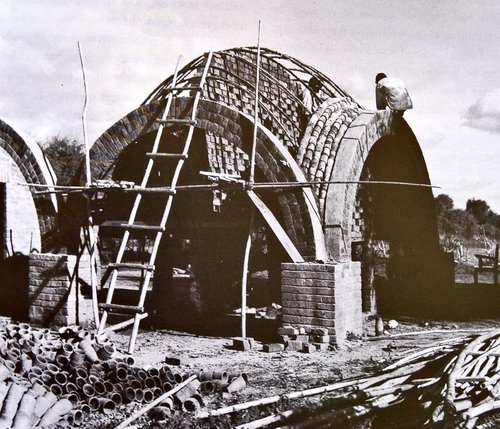
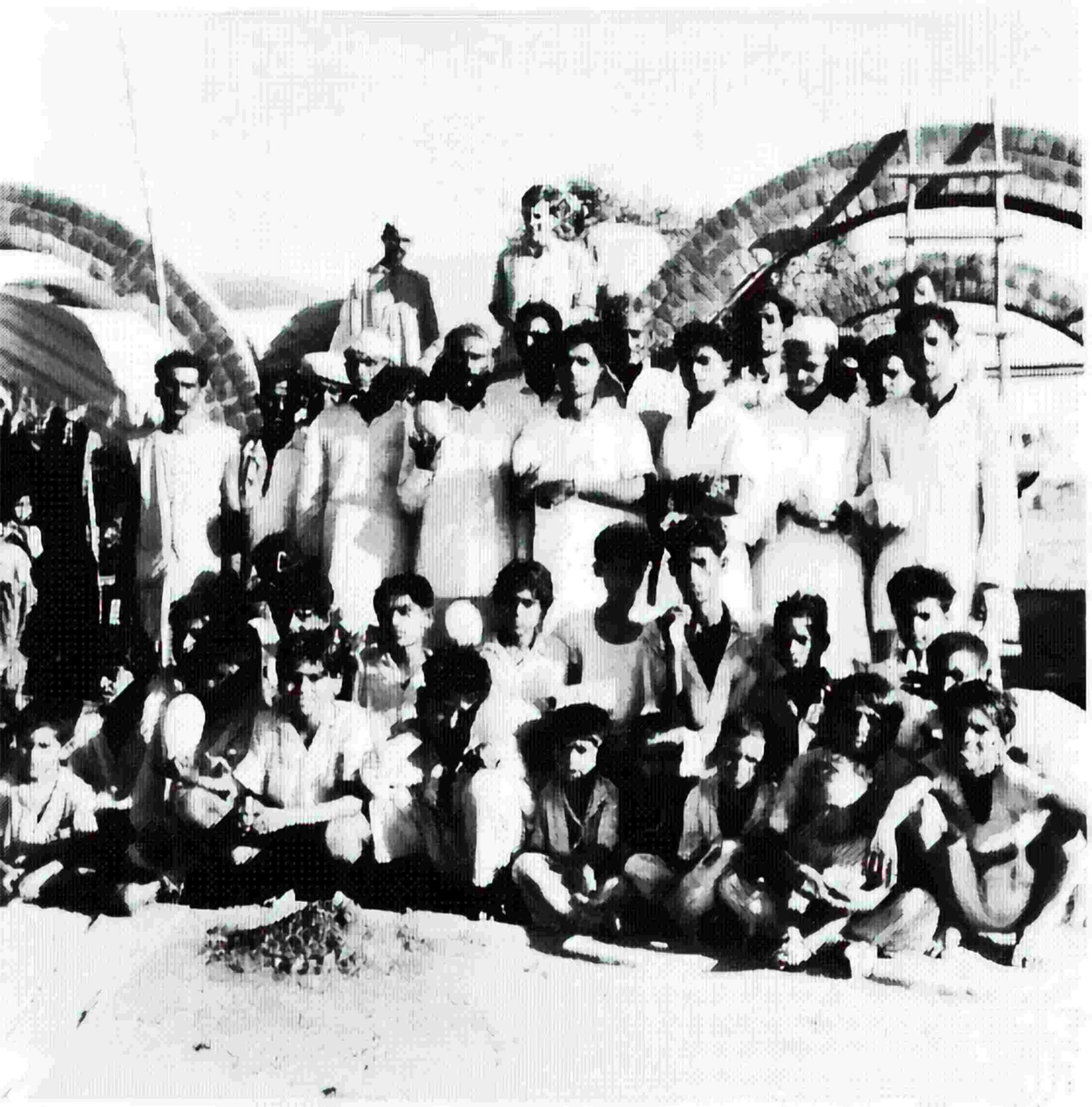
In 1961, at the age of 24, I lived in a village in Gujarat, India, for seven months. While I was living there, I felt I must be useful and after discussing with the villagers, we decided that a school would help them most. The four-room building is very basic. I did nothing except to try and make something useful that had a feeling like the village. This was my start in architecture. It was the first building I ever made and the first time I invented anything in construction. I had 5000 rupees (less than 1000 dollars) to build the school. Couldn’t import materials. No wood to speak of available. The village was five miles from the nearest road. What to do?
I asked the village potter what he could do. He showed me something he was used to making in the course of making roof tiles, a thing called a “guna” tile—a hollow truncated cylindrical tile with one end smaller than the other, about 16 inches long with a six-inch diameter at the base and a four-inch diameter at the top. In the normal course of events, it was split in two, down the middle, to form two roof tiles.
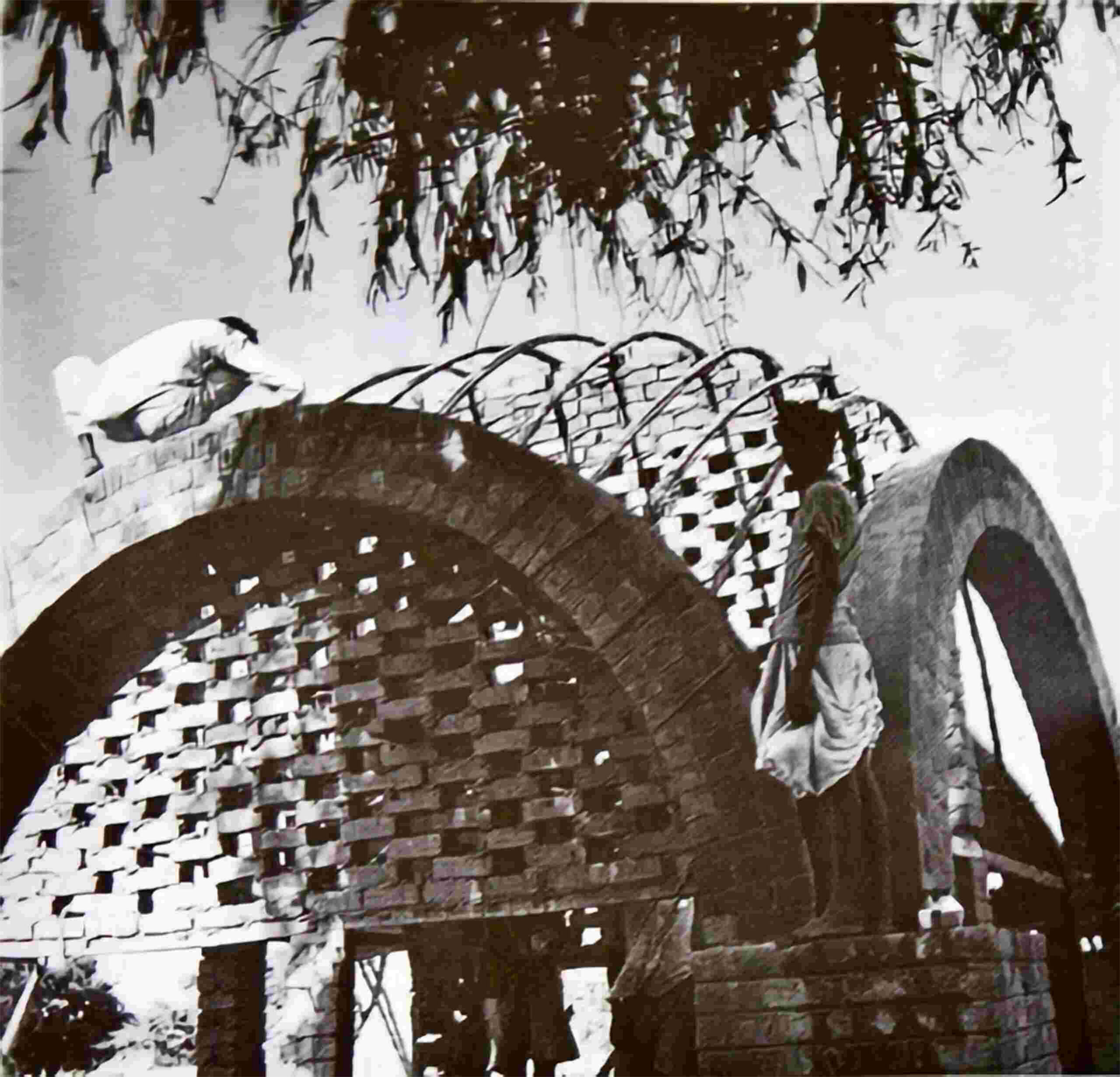
This fit perfectly into the situation. Mud and clay were abundant. There was virtually no wood available but small sticks and twigs sufficient for firing a rudimentary kiln were available in the scrubland around the village. I asked Shankarial, the potter, to make 3000 of these conical tiles for me just using mud from the village and then baking them but leaving them as cones, not splitting them down the middle.
Then I made the domes for the village school like this. Each dome had four brick arches on its four sides. Now imagine riffling these stacked tiles like a deck of cards, to get a curve. That is how we made the near-spherical vault. We laid one row of these next to the brick arch. Then the next one on the front row of tiles, and the next row on those. Because of the other brick arch, the riffled tiles rose higher and higher as they followed the curve. In those places where there was too much pressure, we filled them with earth so they didn’t crack under their own weight.
Finally we plastered the whole thing. And, to make a tension tie that would resist outward thrust in the dome, I used cotton-bailing strap—a thin tensile steel strap used for tying up cotton bales and something we could get for nothing in the cotton-producing fields. Then plaster over the cotton-bailing strap. That was all.
Even then, at the very beginning of my life as an architect, I knew instinctively that to build a building, one has to invent ways of making. And, throughout my life I have always tried to invent ways of building which could easily, cheaply, make life and living centers in building forms. This was one of the first things I ever invented.
A few years later and half a world away, students were studying architecture at Yale. One of them was Turner Brooks, who would eventually become an incredible teacher, writer, and architect. His enthusiasm for creation was insuppressible, despite his tender years, and in school, there were opportunities to actually make things, and in direct concert with material experimentation and academic zeal, amazing things happened. Last year, Brooks told me about his first project:
Recently, by chance, the ruins of the foam house that I had designed with some fellow students in 1967 were discovered by a recently graduated Yale architecture major Will Suzuki, a student in my design studio, while taking a hike in the woods off the Yale Golf Course in West Haven.
The “foam house” project was a wacko, spontaneous part of the second-year curriculum at the architecture school in 1968, then under the deanship of Charles Moore. Bill Grover, a student a year ahead of me, had seen a TV commercial by Union Carbide that showed the construction of a tiny igloo-like form, made out of the newly invented “urethane foam” sprayed on an inflated dome. The foam coming from two cannisters, a resin and activator, mixed in a hand-held nozzle and was sprayed onto a little inflated balloon. The urethane expanded 30 times its liquid volume as it solidified on whatever it was sprayed on. The foam once it had hardened had structural properties and was a super insulation. Bill persuaded Union Carbide to donate enough free foam to enable the students to construct some experimental structures.
He had also been able to acquire an enormous quantity of a burlap fabric laminated to polyethylene (developed for making “sand bags” for use in Vietnam) that could be tailored into inflatable forms. After a casual competition, three of the student projects were selected to be built at full scale.
The Yale Golf Course in Westville had agreed, somewhat paradoxically it seemed, to allow some forested land just off the course for the constructions of what were bound to be very weird things. To inflate we used electric fans, and later on the site, noisy leaf blowers, inserted into one end of an “umbilical” cord attached to the flanks of the various sized balloon-like forms.
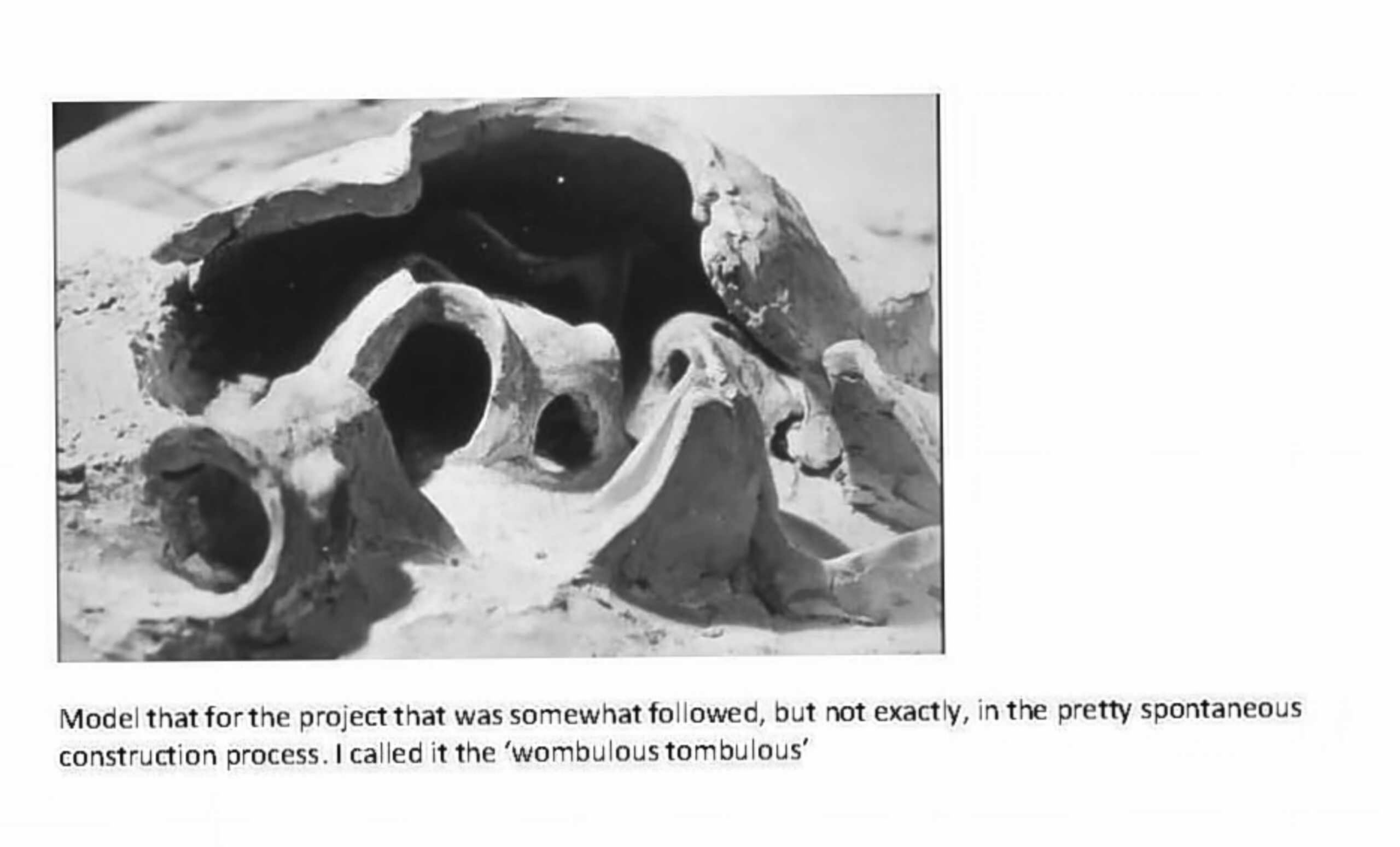
The idea that inspired us “idealistic” students was to arrive at a site in bad need of quick housing with a package of folded up balloons and canisters of urethane foam, a high density and tiny volume package (maybe dropped by parachute), and have it reversed into a high-volume, low-density alternative, as the balloons were inflated and the sprayed foam expanded 30 times its liquid volume.
The dwelling I designed was built on top of a rocky wooded knoll and consisted of a central dome surrounded by a series of smaller intersecting domes and a curved tubular entryway. After inflating and foaming the main dome, I entered the space through the umbilical cord with a hand saw. With this saw I cut out an ark of wall from within that measured, more-or-less the diameter of a smaller balloon that was inflated and inserted into the opening and then sprayed in place. The arc of intersection between the two domes became a structural transition between the two of them. Another smaller dome was foamed into this second dome. Then another larger secondary dome was attached to engage some of the section of the cliff dropping down in elevation. Finally the entrance tube was foamed in place. I think it was all done in one day.
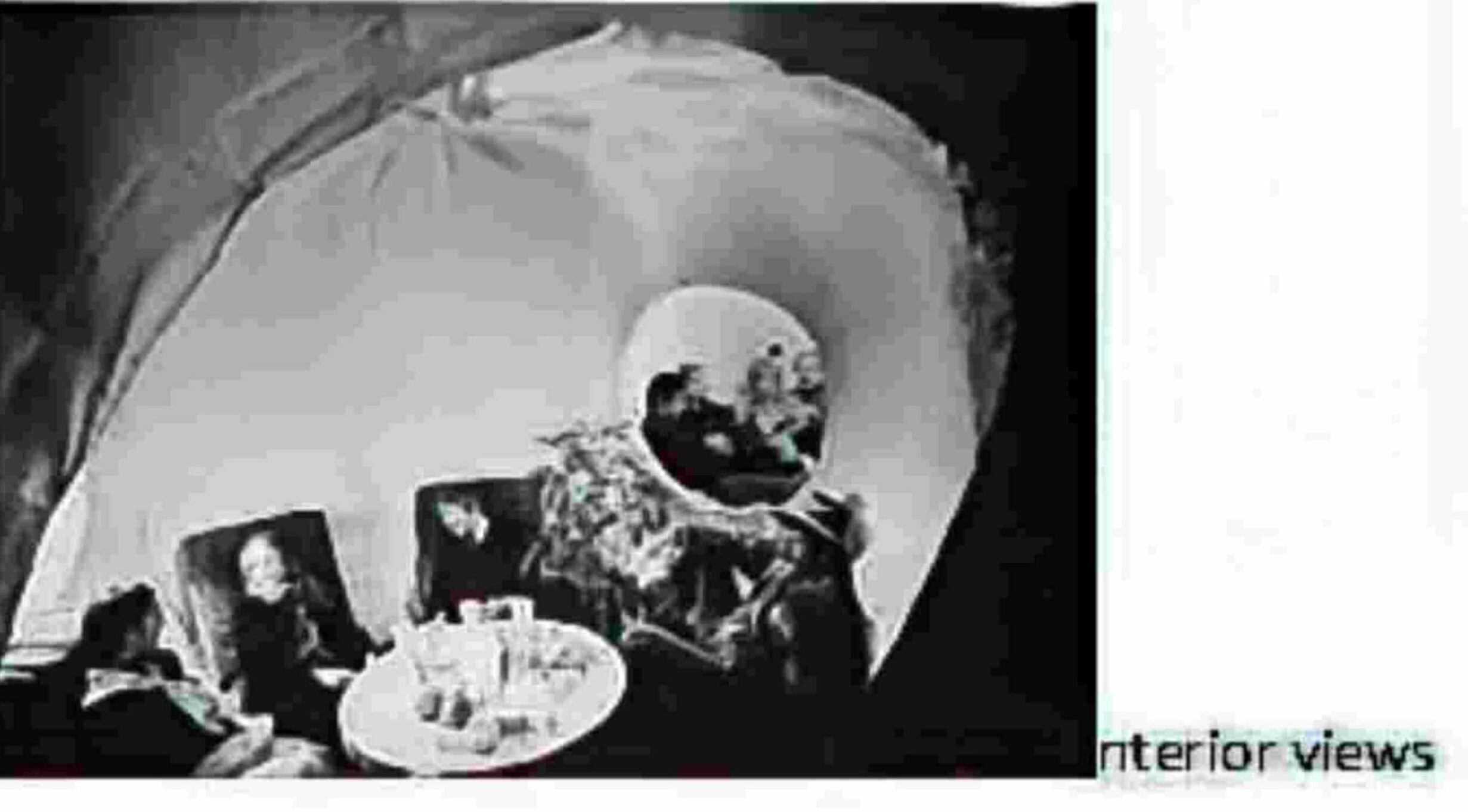
It was about a month later Vogue magazine found out about the project and wanted to photograph it with a party going on inside it. That happened on a freezing winter evening. But the foam was such an amazing insulation that soon just the heat from the many bodies warmed it up to a very comfortable degree and the party became very cheery.
About a month ago I went to see the 56-year-old ruins, and I was quite amazed. I thought the ruins were much more beautiful in all ways than the original domicile. Certainly the aspect of architecture having an effervescence, evolving into a ruin, has a great legitimacy of its own. I have always loved Piranesi’s views of Rome, such as the forum full of vegetation and grazing sheep. Or the Colosseum with medieval housing grown into the arched openings of its perimeter walls creating a wonderful juxtaposition of scales—probably preferring those occupied ruins more than I might have the original in Roman times, with senators pompously strutting around in their white robes.
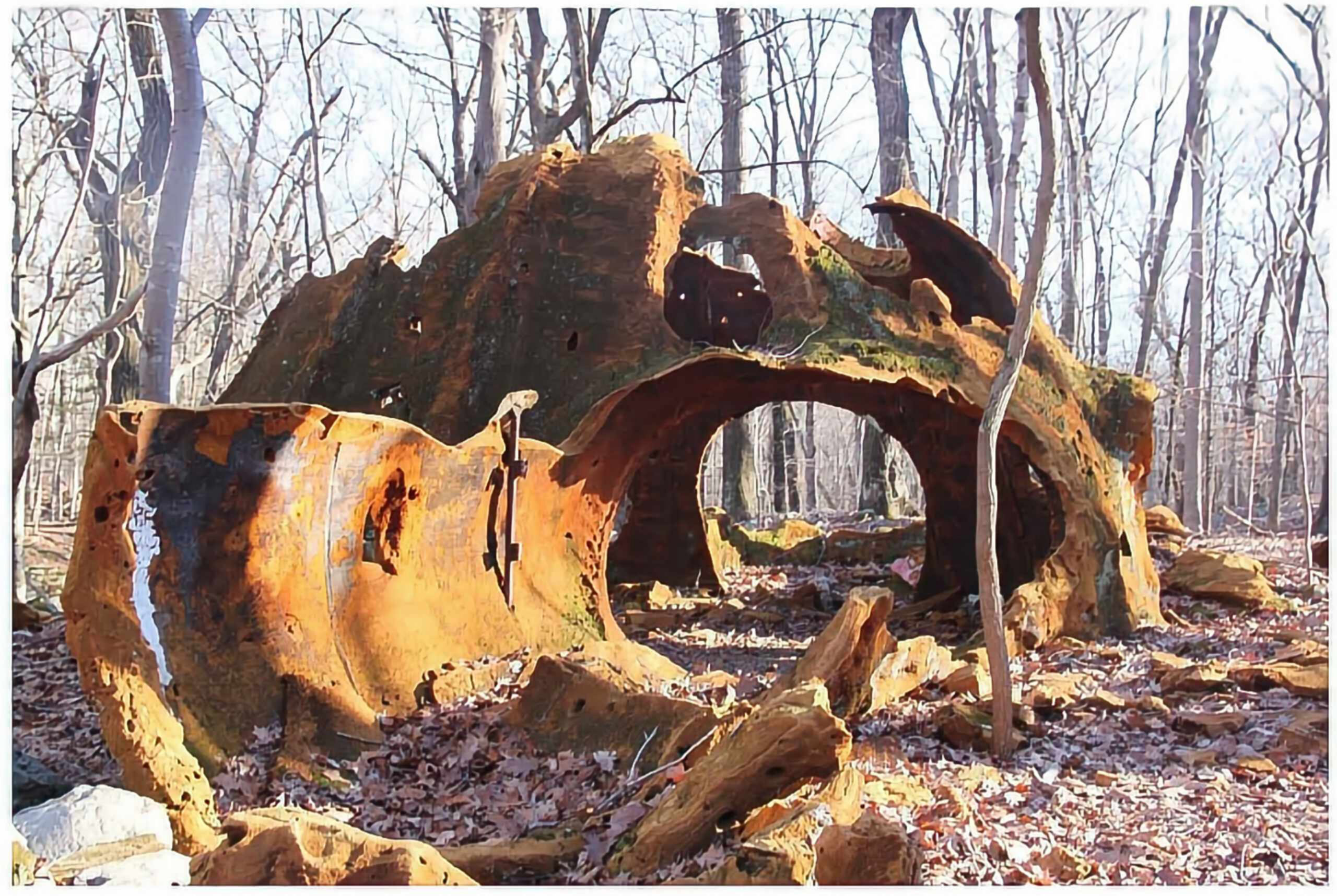
The foam house had become so much more spatially engaging as a ruin, not only now looking like a piece of the natural world, something like a gigantic piece of bark with lichen and moss growing all over its flanks, but also by performing a kind of choreographed rhythmic dance sequence as it folds and unfolds its way through this wooded site.
I suspect Yale golfers would sometimes drive their balls into the edge of the forest, and probably already grumpy at their bad shot, were made more angry finding these enormous golf ball like things looming in the forest. Adding to their distaste they may have been occupied by “hippies.” On a visit a year or so after construction, I walked down the curving entrance tube and heard yells and screams and glimpsed five or six naked bodies exiting out the back door into the woods. Probably not exactly what the average alumni Yale golfer would choose to confront.
The archeology of foam experimentation had turned nominal architecture into literal art. Time can seem ancient or instant. This year, four decades ago seems like an instant to me. As with Alexander and Brooks, my 20s was a decade of relentless searching for built expression. But designing is not making, and I got licensed as quickly as possible, so I was ready to go, in 1982, and looked for a site. My wife, Liz, and I had house sat for five years to save money. We managed to find a neglected site for $28,500.
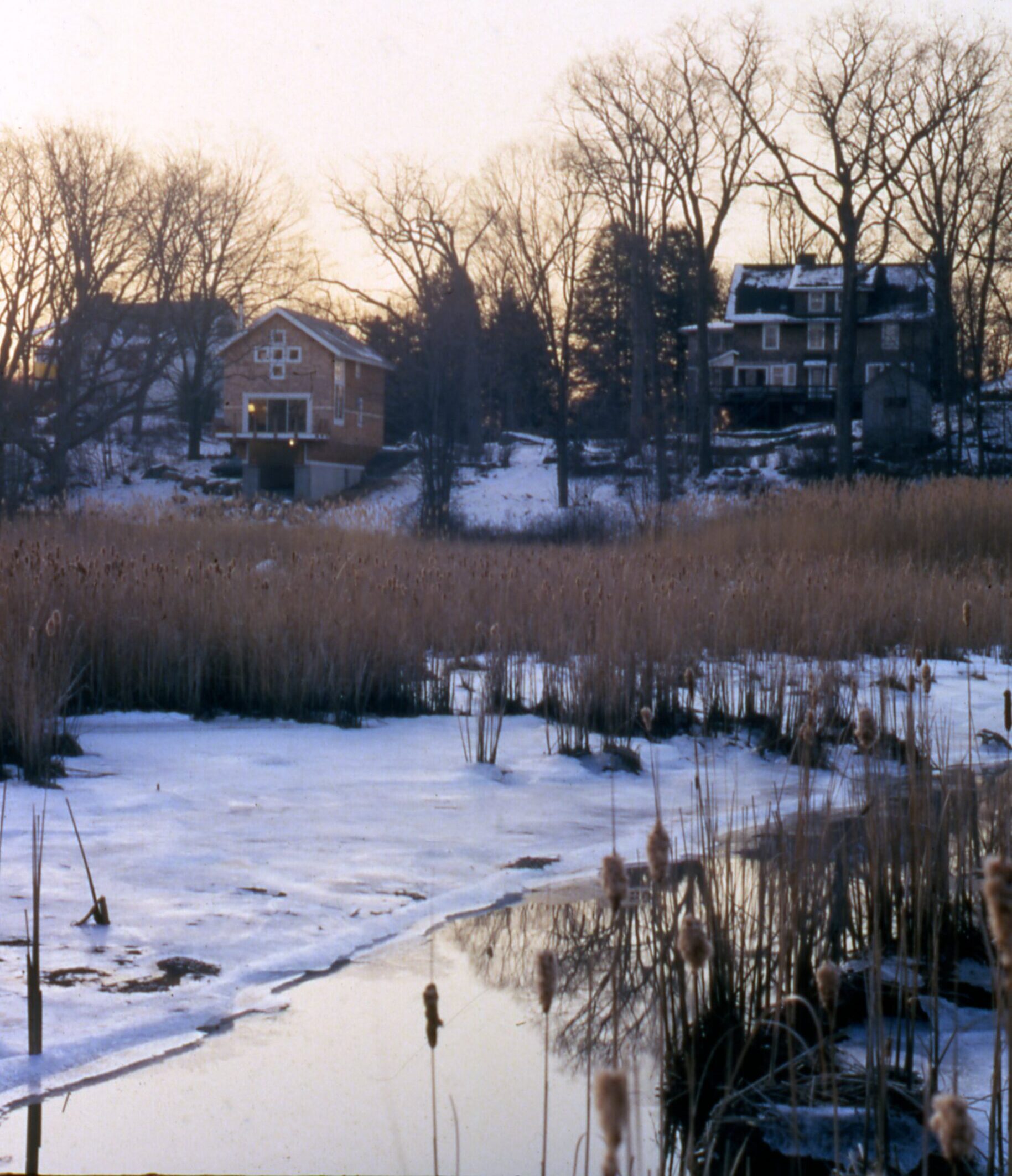
No one wanted our 1.25-acre site. It was dim, filled with bull briars, poison ivy, and salt water, all insinuated around glacial moraine rock. Located in a flood plain, the house would have to be elevated and designed with a tricky, code-compliant septic system—which, ironically, is now illegal, though it has never failed in 40 years (20 of them with growing children).
We were to build a house for ourselves: the rest of the cost was funded by a construction mortgage. The project was shepherded by a builder who could work with and around our financial limitations (a wise, kind, and generous man named Joe Blaha). Like Alexander’s potter and Brooks’ professors, my ignorance was not a threat to him, but a springboard of enthusiasm for an older, wiser, head.
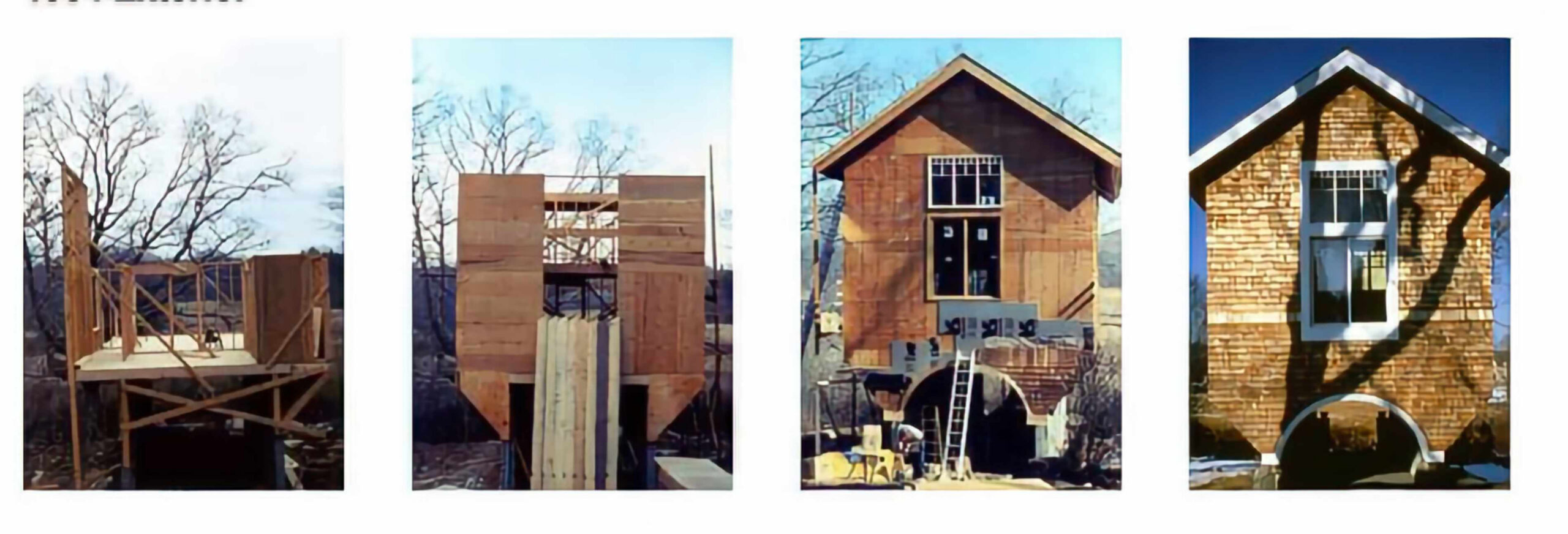
Twenty-foot uncut 2×10 joists set the width of the house, and the idea of double plywood-covered shear walls was explored. A young engineer friend of equal immaturity to me screamed that I needed a couple of foundation buttresses, so we added them. But my seat-of-the-pants engineering (like Brooks and Alexander) had a validation: The home was published in Architectural Record’s 1985 Record Houses. Later a Syracuse University engineering student had the assignment to engineer a published building and called me to get construction drawings. She analyzed the home for her statics course, and my guesses passed calculation.
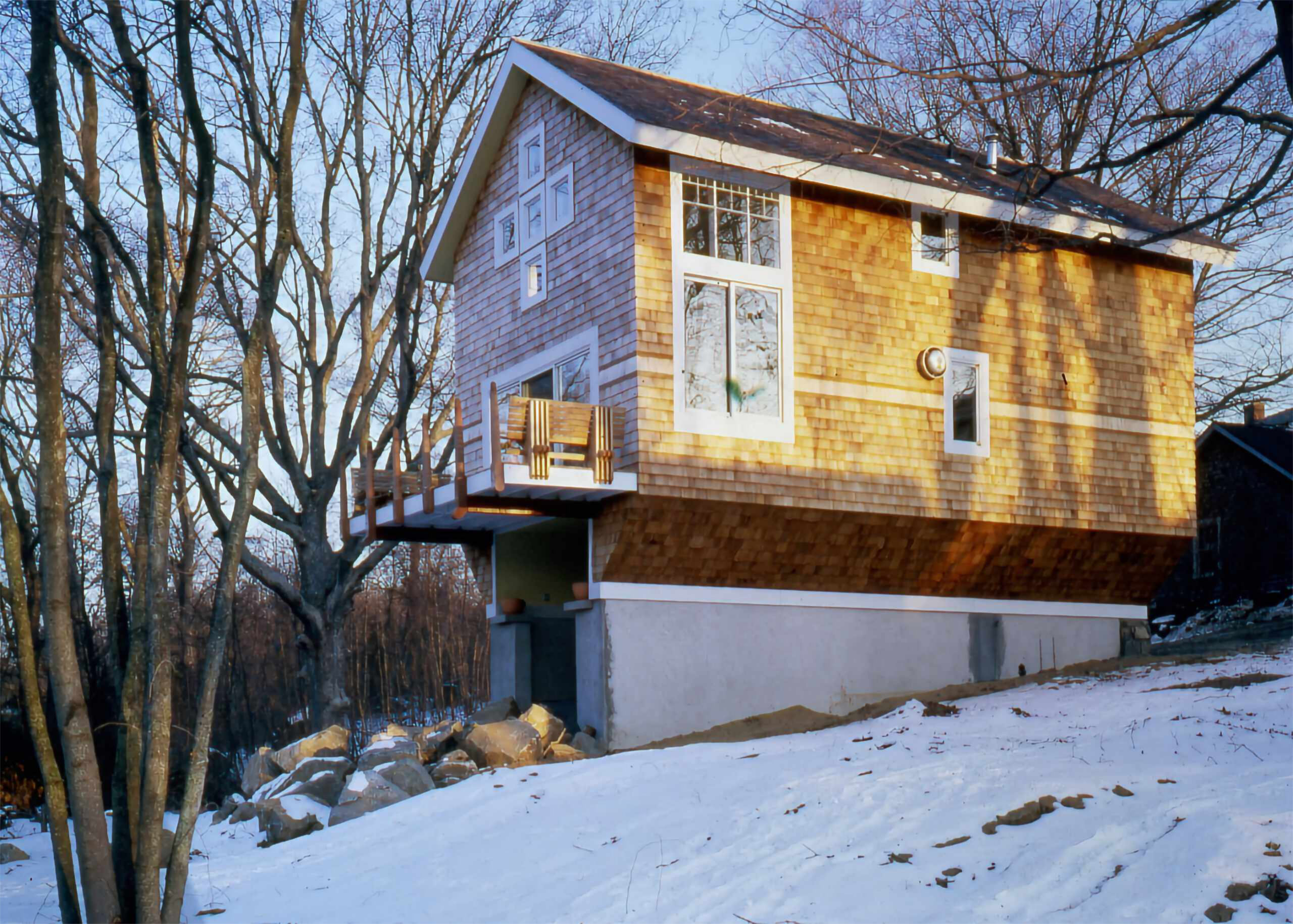
The house was built for something over $100,000 in 1984 and was cheaper than the condos across town. We built a one-bedroom, 1,100-square-foot home that was capable of expanding to three bedrooms (and, ultimately, a barn/guest house has a fourth). The home is as fresh to live in now as it was in four decades ago.
There is no genius in any of this, just inspiration. Any luck we had was as real as all the failed options we explored before we found our site. But there was, for Alexander, Brooks, and me, one indispensable necessity: our complete devotion to building.
Humans want validation of their passions, proof of their hopes, justification of their faith. But life does not grade us on the correctness of our aspirations. Time simply reveals what is already there: our humanity, in our absurdly illogical courage, in our delusional hubris and doubt. Architects may leave tangible legacies in what is built, but the buildings of our youth are born of a wild and innocent belief in the meaning of making.
Featured construction photo courtesy of the Christopher Alexander Center for Environmental Structure Archive.