

Losing Friends to the American Dream: Homeownership
When the pandemic ended and people were freer to move about, a lot of what people around us did was literally move. In fact, everyone in our social bubble fled the coop and bought a house. I remember returning from a visit to a friend’s new house, stepping back into our 350-square-foot fourplex apartment, and—for one of the first times in recent memory—thinking, Are we doing something wrong? A question notable to me only because up until that point, I had thought our setup was pretty good.
We have good light, neighbors, a walkable neighborhood, a garden, restaurants, grocery stores, and BART a mere two blocks away. Our driveway doubles as a plaza and hangout spot, as, per the terms of the lease, no one can park in it. On a fair evening we’ll park out there with a table and chairs and suddenly find ourselves chit-chatting with all sorts of passersby, some of whom we know, some of whom we don’t.
A good friend who at that time was running a very public-facing art space out of her and her husband’s live/work space but who was shutting it down and moving back to England said when I brought up my sudden non-homeowner misgivings, “Well, no one around you is reinforcing the life you guys lead.”
I started running through in my mind who in our immediate friend circle also rented, who didn’t see renting as a mere stepping stone to homeownership, and who led a life where creativity, connection, and walkability were the priority, and a home with a large number of bedrooms and bathrooms was not. Nary a few could I count.
Fast forward to the present, and home prices have not gone down but up, and people are still desperate to own one, making serious compromises on location simply to snag that most coveted of American prizes. Farther and farther out people go, saying goodbye to long-forged social bonds, sidewalks, and the corner store in the process.
From the Pilgrims to the cowboy to the astronaut, American symbols of individualism—free of the shackles of close-knit communities, with ample space around you—abound and embed into our minds an aspiration that is hard to shrug off. It doesn’t help that we have whole industries and accompanying imagery devoted to promoting this aspiration, or that we have an urban public education system of “good schools” and “bad ones,” with most falling into the latter category.
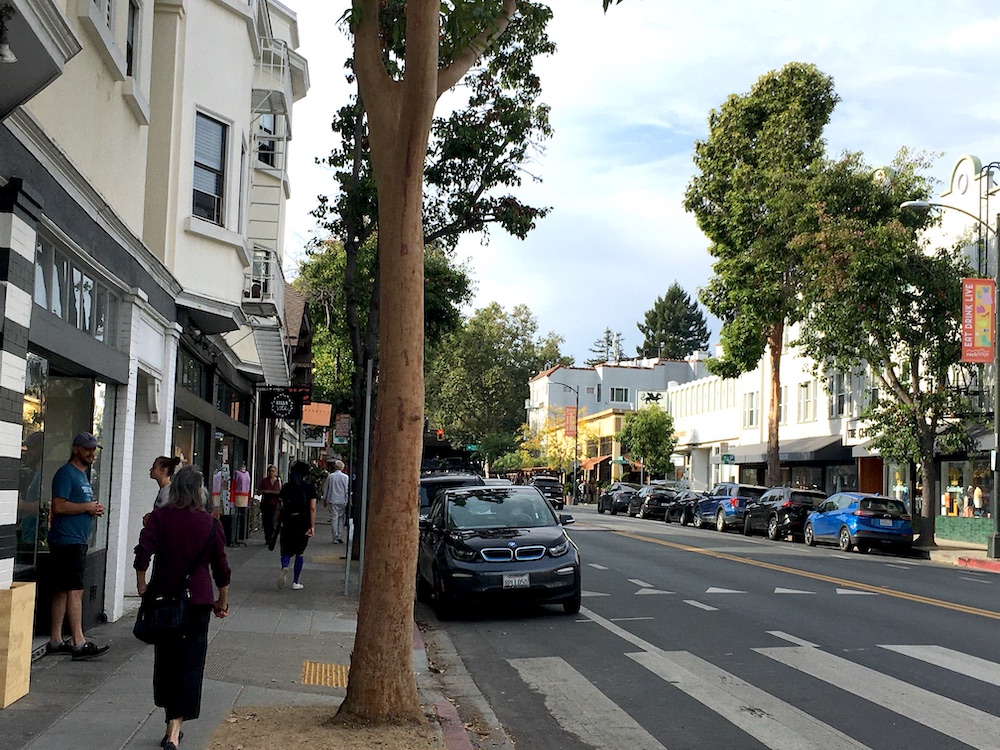
It also doesn’t help that in a country that prides itself to the nth degree on consumer choice, we provide almost no choice when it comes to housing. There are increasingly expensive—and, in some places, unattainable—single-family houses, there are apartments, and there are condos. A few ADUs, maybe, but not much else. This despite the fact that the average family size is shrinking and single-person households are increasing. Instead of the market responding to these demographic changes by providing smaller-footprint homes, rowhouses, microunits, co-housing arrangements that allow for aging in place, and options that are mixed-in with retail and places we can walk to, we get three-bedroom (minimum), 2,300-square-foot (average) new-build homes built in places where housing is separate from retail and amenities and driving everywhere is simply baked in to the design.
Loneliness is at an all-time high, membership in clubs and organizations is way down, people are spending more time indoors and in rooms by themselves, and there is increasing evidence that America’s ongoing spike in obesity has been fueled as much by diet as it has by people moving to houses in far-flung locations where they can’t walk anywhere.
“And yet, despite its deleterious effect on health, loneliness is one of the first things ordinary Americans spend their money achieving,” writes Stephen Marche in The Atlantic’s “Is Facebook Making Us Lonely?” It turns out that there is a longstanding history in this country of residents moving up the class ladder, and, in the process, simultaneously isolating themselves more and more from others. The front stoop and street and all their messiness but also their socialness get replaced by a respectable driveway, a lawn, and a social life that happens in the back yard—if it happens at all.
Just the other week, another set of neighborhood friends announced that they were purchasing a house and moving out to the suburbs. They were the kind of friends we could text on a weeknight and say, “Hey, up for a movie? Your place or ours?” And we would walk up to theirs or they would walk down to ours. It felt casual but familiar, spontaneous but also meaningful in the sense that we had enough friendship history that such spontaneity was possible.
But it had been a lifelong dream of one of them to own a home and have a back yard. Never one to rain on someone’s parade or dream, I have been encouraging, but I have also found my mind wandering to the reality that we have lost another set of friends to a house. Indeed, we will see them still, but the spontaneity that characterized the friendship, and the urban form that made it possible, can’t realistically live on.
There is so much in this country that pushes us toward wanting things that might not always be good for us: fast food, social media, driving, Amazon, binge-watching. Yet rarely, if ever, do we put the drive to own an increasingly unattainable single-family home into this category. The house is still considered that golden end point, your ticket to a life of comfort and being able to say this new you—now with four walls, a yard, and a driveway of your own—has arrived as a real American.
But at a time of high interest rates, skyrocketing prices, longer and longer commutes, loneliness, and all the other aforementioned woes, we might want to rethink the list of what ails us and welcome in new tickets to another kind of good life.
The underlying assumption is that the renter life my husband and I lead here in our 350-square-foot apartment must be one rooted in resigning ourselves to second best, that we’re perhaps monkishly sacrificing for a cause. The reality, however, is that we lead a rich life in this neighborhood of walking and happenstance gatherings and sure I can meet you for a beer, or we could take the train into San Francisco. This too is a good life, and it doesn’t require having to say goodbye to friends.
All photos courtesy of the author.