
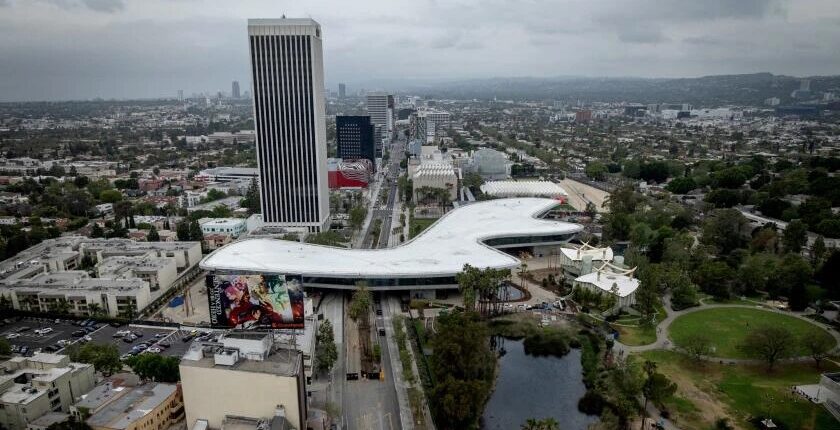
A Transformational Building for LACMA
Opened at last after 20 trying years, the David Geffen Galleries at the Los Angeles County Museum of Art (LACMA) dramatically transform what was a fractured, prosaic institution into a global cultural landmark. With its sprawling, biomorphic design and reorganized curatorial displays, the galleries are engrossing—as they should be, given the staggering $724 million construction cost for 110,000 square feet of display space.
Designed by the Swiss firm of Peter Zumthor, with an assist by Skidmore, Owings and Merrill, and orchestrated by indefatigable LACMA CEO and Wallis Annenberg Director Michael Govan, it is an imposing raw concrete and glass amoeba emerging from the city’s singular La Brea Tar Pits to seemingly levitate 30 feet above Wilshire Boulevard and environs, not unlike a Jetson cartoon spaceship. Whether the architecture is a step back or forward in time is arguable, but however it is labeled, it is inviting.
The elevated single floor is particularly welcomed by senior visitors, such as myself, who are mobility challenged. However, a few more leather padded benches to sit on, for resting and viewing, would be appreciated. One also would hope, given the private contributions the project attracted, that admission would soon be free, as is the case at other Los Angeles art museums, or at least pay as you wish. Perhaps this should be Govan’s next challenge to attract donors.
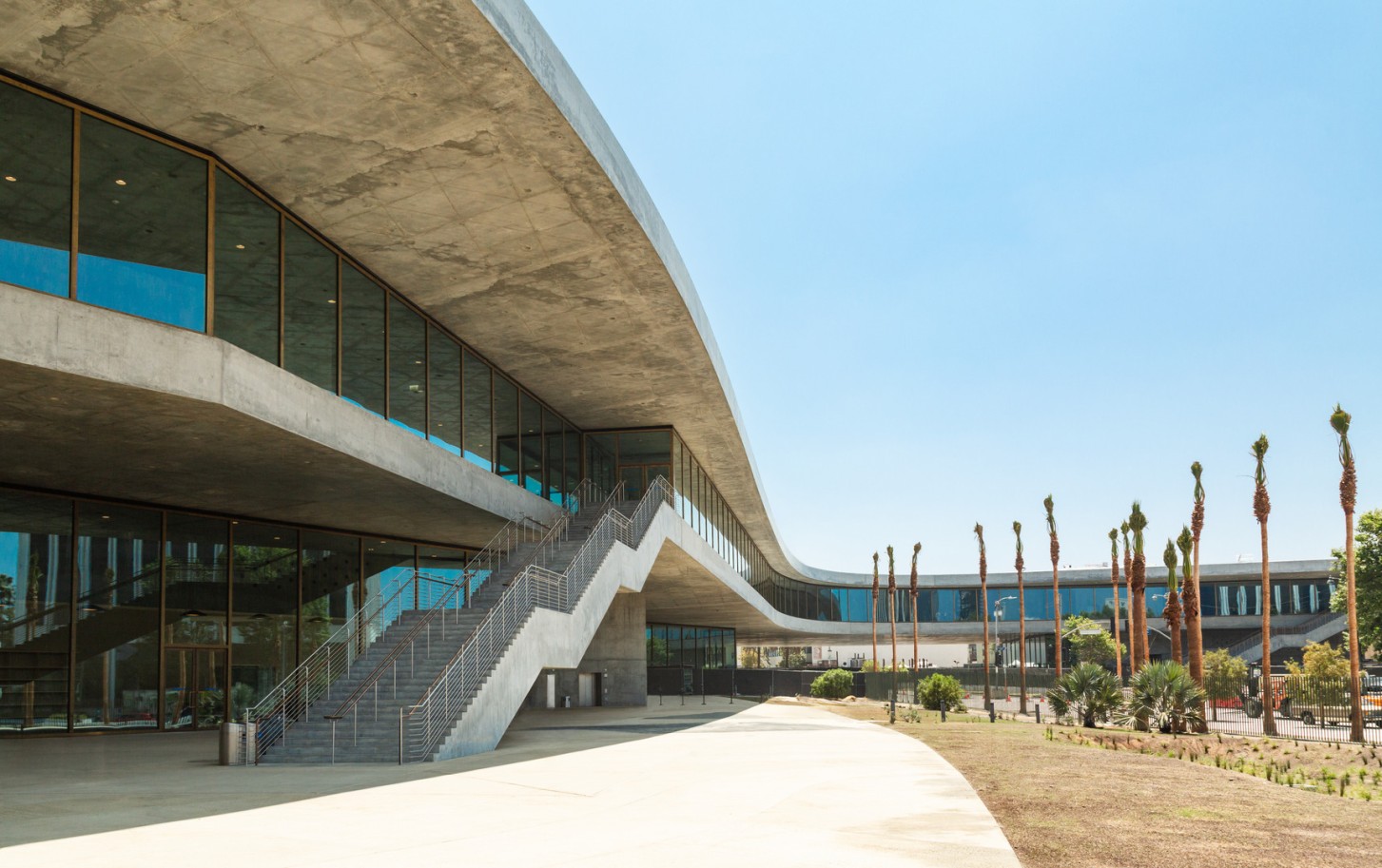
Sprawling across three and a half acres and the length of three football fields, the viewing floor can be reached by two daunting exterior stairways (and, thankfully, a host of elevator banks) and offers numerous views of Los Angeles, near and far. Created below on the ground floor is a shaded public space, not incidentally in need of more seating and some sensitive landscaping.
But what distinguishes this conscious conceit of a museum, and makes it both aesthetically interesting and welcoming to viewers, are the 80 or so interior galleries. They form a maze not dissimilar to an inviting dense urban neighborhood of pedestrian streets, alleys, courtyards, plazas, and, yes, dead ends, in which imaginatively displayed is LACMA’s treasury of art, of paintings, photography, sculpture, ceramics, weavings, and jewelry.
Critically important, the art in the galleries is not installed geographically or in a straightforward historical chronology, as is typical in encyclopedic museums. This is the so-called Cartesian space-time grid, which allows “colonialism to map and conquer the world,” according to a disdainful Govan. He has declared in interviews that this is a cultural vanity that needs to be broken, “reimagined and reshuffled,” if human creativity is to be honestly and accurately displayed. It’s a posture that, unsurprisingly, has riled select curators, prompting a few at LACMA to resign.
Govan has obviously prevailed, with the art in the galleries not presented on fixed paths or with a prescribed narrative, but instead clearly and didactically identified, inviting visitors to wander “as one might meander through a park, choosing their own paths and engaging their own interests.” Whether one criticizes or commends the gutsy Govan (I commend him), gone are the procession of correspondingly dated artifacts in a procession of designated rooms, such as I was weaned on in art appreciation courses in college and later when haunting the world’s great museums.
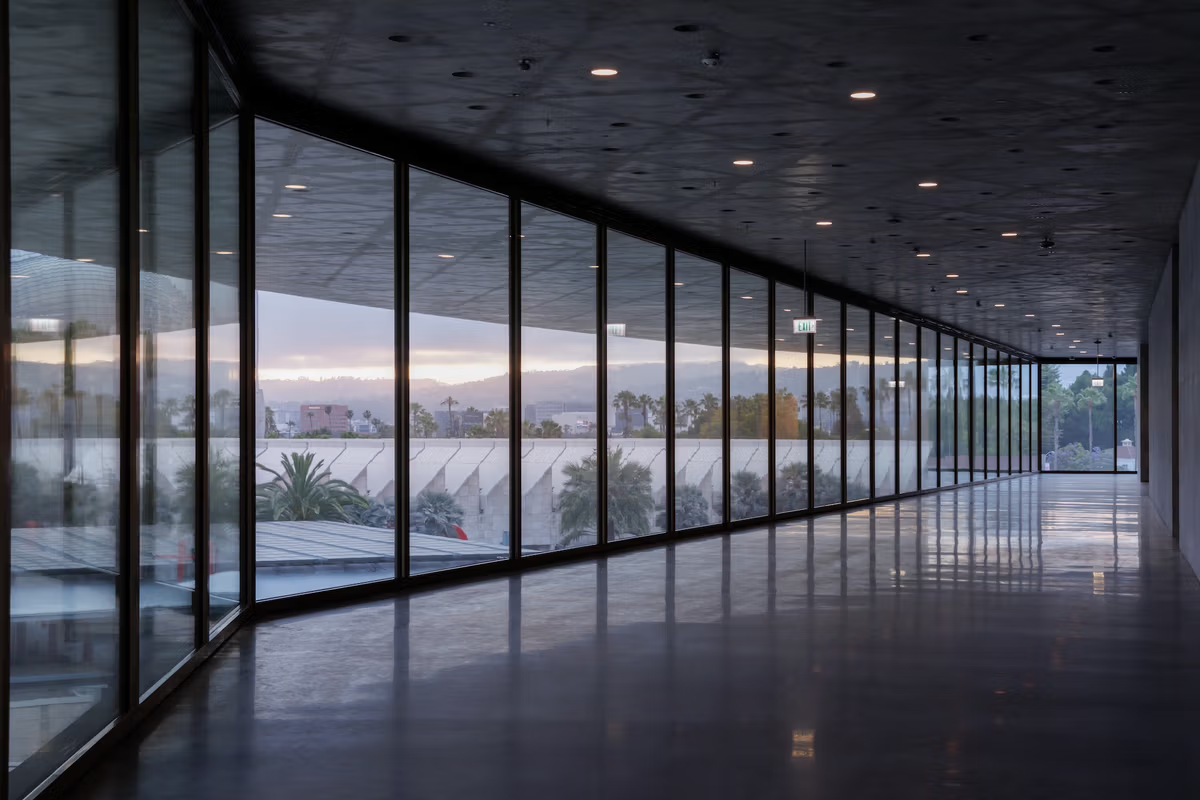
The Geffen Galleries are refreshingly, if heretically, organized around four bodies of water—the Atlantic, Pacific, and Indian oceans and the Mediterranean Sea—“revealing networks of exchange, migration, and influence that span continents and centuries,” according to LACMA’s lucidly written and designed guide.
Aptly entitled “Wander,” its back cover proclaims, “Whether you follow the oceanic framework or chart your own course though the galleries, ‘Wander’ invites you to discover the works of art spanning diverse histories and geographies—each encounter an opportunity for new perspectives on creative expression from around the world.” Given Los Angeles’ deep Latino roots, there is a particular focus on LACMA’s rich Spanish American collection.
Designing and developing public architecture can be a marathon, especially when substantial private funding is also needed, which for the galleries came to nearly $600 million, with an additional $125 million provided by L.A. County. As for LACMA, it also was a steeplechase, given the city’s patrons and politicians, spiced further by the ego-encrusted entertainment industry and a zealous media.
Then again, perhaps, Govan truly felt the Cartesian grid no longer was the best template to decode artifacts, in particular for current and future museumgoers, and something more was needed to explain their place in art history, something that would go beyond AI to celebrate their creation and constancy. Whatever. LACMA has a new and revitalized museum, and Los Angeles has become a more inviting and interesting city because of it.
Featured image via Los Angeles Times.