

Back to Earth: The Case for Lowering Speculative Land Values
The inflation-adjusted price of residential land in the U.S. quadrupled between 1975 and 2006. By 2025, New York City’s land values were estimated at $2.84 trillion. Manhattan’s land alone is valued at approximately $3,500 per square foot. Urban land, in other words, is increasingly valuable. But how “natural” is this growth? What are the effects of this seemingly unending rise in urban land values on our economy and society? And if the effects are potentially perilous, what, if anything, could we do about them?
Those with large investments in high land values—real estate investment trusts (REITs), banks, insurance companies, local governments hoping to tax a bit off the top—don’t believe anything is wrong. These values, they claim, are nothing more than market signals that “naturally” occur in the context of a high demand for a limited supply of central-city parcels. Provided a few regulations are in place, the growth of urban land values is both desirable and sustainable.
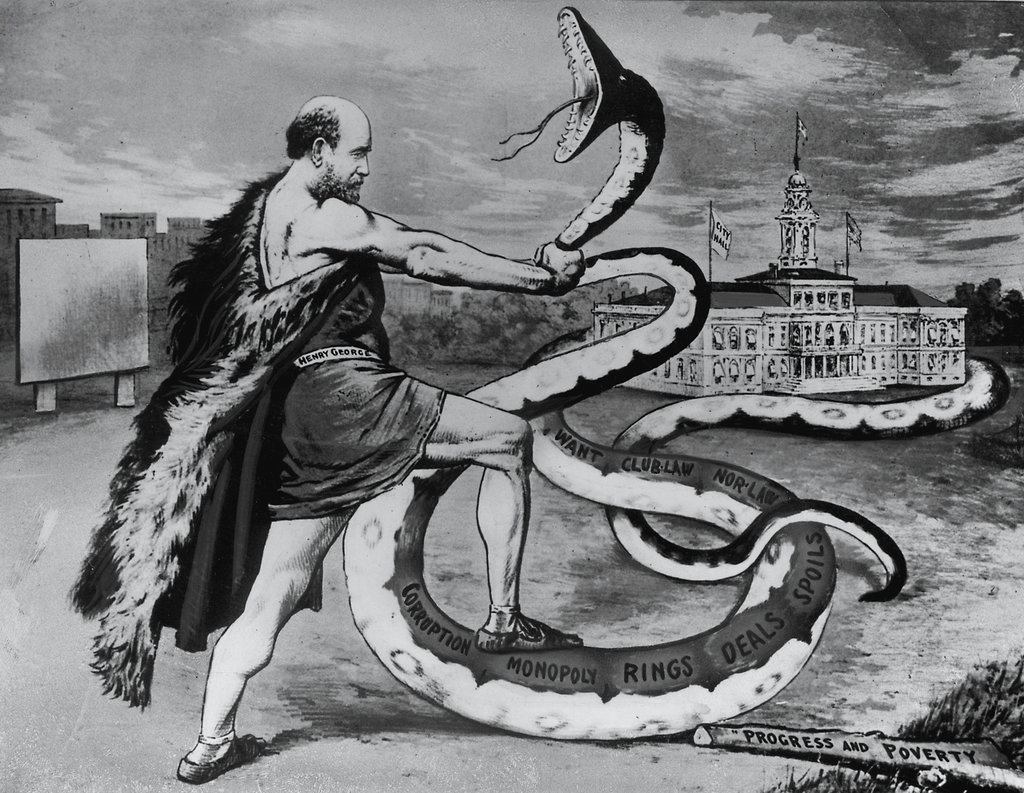
But there’s another perspective. Many economists in New York’s history have seen the rapid capitalization of urban real estate as neither natural nor benign. People like Henry George, the 19th century political economist, social philosopher, and journalist, argued that high urban land values were often the product of financial speculation and the public policies that empowered them: speculation that eroded economies, corrupted politics, and exploited people. Only by deflating the burden of artificially high land values, George and others argued, could New York and other cities reach their economic and social potential. And in the wake of New York’s fiscal crises of the 1870s and 1930s, these figures attempted to do just that, with a surprising degree of success.
Today, as Gotham’s fiscal strains and rising land values once again claim headlines, we should learn from these past efforts to tame financialized growth. Three sets of policies in particular are needed: (1) reducing the future income streams land can command through taxation; (2) placing more land away from speculative circuits and into the hands of public or community ownership; and (3) targeting the financial loopholes that make real estate a speculative asset class in the first place.
All of these strategies will be difficult to carry out, given the amount of public and private wealth currently tied up in land. But the question isn’t whether this landed wealth will dissipate—it will. The only question is whether this wealth will be gradually reallocated to safe and productive channels through the policies noted above, or if it will vanish catastrophically through crisis. The choice is ours.
A Symptom, Not a Signal
The value of land does not just reflect existing demand from potential residents or businesses. It also reflects long-entrenched political decisions and policies. Some of these values come from public investments (subways, parks, etc.) in ways that reflect the values and power of different actors. But it also reflects rules that enable some actors—particularly financial actors—to bid up the price of land. Institutional investors, REITs, private equity, pension funds, endowments, “financialized” private property developers—all of these see urban land as a desirable asset and investment. Their access to larger capital pools enables them to outbid smaller buyers; their competition helps push prices further up; and their expectations of capital gains leads them either to hold land for appreciation rather than productive use, or to convert land into its “highest and best” uses (i.e., luxury) in order to recoup their investments and pay out dividends. And all of this is enabled by incentives in our current regulatory and legal structure.
One possible response to this condition is simple: “claw back” the values generated through public investments and rules by levying higher taxes on land. This makes some sense and has been the dominant approach by well-meaning progressives toward rising land values. If land values make housing more expensive—well, tax the real estate and put up affordable housing with it. But the issue with rising land values isn’t just the rise, it’s the causes of those rises, causes that often flow back to financialized speculation. Simply taxing such speculation might not make up for the damage it causes in the first place. To get a broader sense of this, we can look to history and the consequences of previous periods of real estate booms and busts.
Revolution in Land
George led a popular insurgency for mayor of New York City in 1886 and, in books like Progress and Poverty, argued that high land values repelled manufacturing and commercial firms from cities, weakening their economies. When landlords offered use of their property to income-generating enterprises, landlords demanded an “unearned increment” of the income in return (rent), which cut into the incomes of businesses and workers alike. Matters were made even more precarious when banks and other investors spent capital and debt on behalf of promoting land values, hoping that future growth would recoup their investments. Such speculation, as well as the boom-and-bust economic cycles they unleashed, wrecked the investments of institutions and individuals alike while undermining local economies more broadly.
While George’s critique attracted a broad swath of artisans and homeseekers to his banner during his lifetime, it was actually the Great Depression several decades later that marked the widest and deepest uptake of his ideas. All through the 1920s, a broad swath of actors had developed what housing reformer Frederick Ackerman called “a stake in congestion”—meaning, higher land values. Then came the crash. Chicago’s land values fell by 50% between 1928 and 1932, while those of Manhattan fell by 75%. With this collapse came financial ruin to the economy, for when those values collapsed, so, too, did the realty investments of banks. And with the banking collapse came a broader economic meltdown in the finances of all the businesses, governments, and individuals who relied on financial institutions for loans or bond purchases.
This led to a dramatic and still little-understood debate over the trajectory and desirability of land as a source of public and private profit. Some banks and their political allies maintained that land values needed to be restored to their former heights. Other reformers argued not only that land deflation was both economically desirable and politically possible, but that, going forward, credit should not be allowed to pyramid so intensely in real estate.
From this perspective, unrealistically high land values caused several problems. First, they gave false signals to investors, bottling up the nation’s credit in risky investments whose only purpose was future sale rather than production or employment. While rapidly growing urban land values might look good on paper, these values were growing not based on the actual economic productivity or value of cities, but on flimsy and irrational hopes for future growth that proved to be unsustainable. And with the collapse of those values came the collapse of banks, with ripple effects that shattered the economy and caused the Great Depression. As Herbert Simpson wrote in the American Economic Review, it was “real estate, real estate securities, and real estate affiliations in some form have been the largest single factor in the failure of the 4,800 banks that have closed their doors during the past three years.” The growth of financially augmented land values, in other words, was a risk to the entire economy.
Second, speculative land values were distorting urban economies. Fictional dreams of endless demand for elite offices and residences led landlords and city assessors to maintain high land values, but this made it more difficult for those parcels to be used for profitable use by actual urban residents and business owners. Stanley Miller, the president of New York’s Tax Department, noted the self-destructive consequence of this policy in 1938, arguing that “valuations on land [had] reached a point where the owners could not develop the property successfully, and builders would not buy the land because of their inability to produce a revenue from the intended improvements on such high–priced land.” The Saint Louis Star-Times wrote that “item no. 1” for the businessman was for “low land prices—for the destruction of speculative land prices.” Catering to fictional demand was crowding out the need to support actual demand.
Finally, high land values were causing blight and the social costs that came with it. All through the 1920s, institutional investors had bought land and property in districts they believed were ripe for future development. These absentee owners forwent maintenance and improvements on their properties, while “soaking” tenants with high rents and waiting to sell their land for future profit. The result was decaying housing stock, the costs of poor health conditions, unaffordable housing, and, ultimately, an outflow of population and investments. Even the realty-friendly Urban Land Institute complained in 1940 that “excessively high land values are … a cause of blight in central districts.”
Deflating Land
The solution, for opponents of speculative land values, was to somehow reduce the forces bidding up the price of land while siphoning off the speculative value of land, leaving only “real” market value as the basis of its value.
Historian and sociologist Lewis Mumford made this case most forcibly in The Culture of Cities: “The accretion of the debt structure in the great metropolises, the toppling pyramid of land values, make economic life precarious and effective social planning and impossibility. Hence the real need to deflate this burdensome structure as a deliberate public policy and to set up a responsible public body capable of directing the flow of investment into social channels and to liquidate with the least possible hiatus the present speculative structure.”
And they were surprisingly successful. During the 1930s, for example, groups from housing advocates to the National Association of Real Estate Brokers argued that the value of land needed to be realistically reappraised based on the possible income that could come from its use, and not just its resale value. By the postwar period, these calls for assessment reform helped place urban land values on a reduced but more solid footing. Groups advocated for public and cooperative housing measures that, by meeting an existing demand for working-class groups with a new form of collective ownership, stabilized values rather than inflating them to unrealistic levels. Of course, policies like the GI Bill and the Highway Act helped deflate land values in cities, perhaps excessively in many cases. But we should also remember that this deflation was also seen as a necessary corrective to the speculatively high values that had preceded the crash.
Banking reforms similarly helped prevent a postwar pyramiding of high land values. After the 1929 crash, many understood that credit institutions themselves had been instrumental in the bidding up of unsustainably high values. Robert Hoguet, president of the Emigrant Savings Bank, wrote in 1934, “We cannot … expect real estate to be carried by financial institutions as extensively as it has been in the past. This will tend to stabilize real estate values and we may, as a result of this process, have in the future less dazzling peaks in the real estate market, but also fewer valleys of desolation.” And while the postwar period did see an enormous growth in the volume of realty loans, the percentage of such loans within national banks’ portfolios remained quite stable from 1949 to 1970. Depression-era reforms helped lead a chastened bank industry to focus more on lending than speculative investments. Not until the late 1970s would another boom-and-bust cycle afflict the American real estate market as a whole.
And that’s where we are now. Between 1977 and 1988, Manhattan’s land values grew more than thirteenfold, from roughly $48 to $644 per square foot. To the extent this growth is the result of a natural demand for central-city living, this is nothing to lament. But it isn’t just that. Since the 1970s, land has increasingly been used as an asset for security and an anchor for expanding credit, as described by Mike Bird in his recent book The Land Trap: A New History of the World’s Oldest Asset. The entwining of America’s growing financial industry with the real estate market has accelerated the growth of urban land values beyond what they would “naturally” attain, and this has led to deep problems.
Cities with higher land values witness greater wealth inequalities, bigger barriers to homeownership, and less affordable housing. From 1950 to 2012, 84% of the rise in house prices can be attributed to rising land prices. We see workers and small businesses forced out of cities, contributing to narrower, more fragile economic grounds for cities and their governments. We see the fiscal fate of communities tied up in the powerful and speculative hands of financial institutions. And we see a ceding of political control as the interests empowered by rising land values, from homeowners to financial institutions, use their fiscal leverage to dominate local planning agendas, a process well described by Samuel Stein in his book The Real Estate State.
One could look at these developments and still argue that they are worth it for the sake of higher property tax revenue for cities. But for an opposing perspective, we could look no further than Jane Jacobs. A healthy urban economy, Jacobs wrote in The Death and Life of Great American Cities, consisted of a diverse mix of firms and enterprises, of varying sizes and functions, that collectively generated the innovation and employment cities needed to thrive. But homogeneously high land values prevented such a mixture from occurring, forcing land uses to cater only to a small minority of wealthy individuals and resulting in the “great blight of dullness” that posed both a social and economic threat to cities. “Premium land and building prices” and policies toward those ends, she argued, are “associated with the self-destruction of diversity,” a dynamic she termed “Cataclysmic Money.”
With this in mind, the goal of planners and municipal finance officials should not be to attain a uniformly high level of rent and land values and tax the result, as this would exclude the lower-equity firms and lower-income residents that are essential for a truly diverse economy. The short-term fiscal benefits are not worth the economic costs. As Jacobs argued, “The way to raise the tax base of a city is not at all to exploit to the limit the short-term tax potential of every site.” Rather, a “certain amount of close-grained, deliberate, calculated variation in localized tax yields” could help “anchor diversity and forestall its self-destruction.”
Policies
So, what is to be done? How can we begin to responsibly unravel decades of pyramiding land values and restore true diversity and resiliency to our cities?
Three sets of policies can help us siphon speculation out of urban land values. The first set would be to reduce the future income streams land can command. This would include some combination of rent controls, vacancy taxes, well-designed land value taxes, and higher transfer taxes on short-term flips. By limiting the rents that can be extracted or the speed with which property can be resold for gain, these measures would reduce the present value of land as a financial asset.
A second set of interventions would target the financial structures that transform housing into a globally traded asset class. Over the past half-century, regulatory changes have enabled institutional investors—private equity firms, REITs, asset managers—to treat urban land as a low-risk, yield-generating instrument. Reversing this process requires legal constraints on speculative ownership itself: higher capital requirements for real estate holdings, limits on investor-owned residential units, restrictions on dividend extraction, and robust transparency around beneficial ownership. These curb the legal privileges that allow financial actors to outbid residents and municipalities alike.
A third approach would remove land from speculative circuits altogether. Community land trusts, limited-equity cooperatives, social housing, and municipal acquisition funds break the link between land ownership and windfall appreciation. In these models, land is governed as a public good rather than investment. There are surprising precedents for this: public housing and urban renewal programs were premised on the public sector buying out expensive urban land and turning them over to developers who would actually use the land, such as for affordable or middle-income housing, rather than idly hold on to land in the hope of a windfall. And while we might (and should) disparage many of the effects this policy had on cities and their inhabitants, this shouldn’t be an excuse for letting speculators conduct similar types of “urban renewal” on our cities through financialized speculation.
Taken together, these strategies share a common aim: reshaping the legal conditions under which land is owned, financed, taxed, and exchanged. Accomplishing this, however, will not be easy. To make land “worth less” is to threaten a dense web of legally protected claims—mortgage-backed securities, pension fund investments, municipal revenue projections, and speculative balance sheets—that depend on future high land values. ”Once you end up in a political economy where land is very important in one way or another,” Bird says, “it’s very difficult to pivot your way out.”
Nonetheless, history shows that this resistance can be overcome. In the past this was accomplished partly through the Great Depression itself, which helped convince even financial actors that speculating in land values could be costly. But we can’t wait or even rely on such a catastrophe serving our purposes today. As 2008 showed, absent outside pressure, the federal government is more likely to restore than to reform large financial institutions in the wake of another crash.
This is why we need to start developing and building out policies and coalitions now. The reforms of the 1930s were enabled by a broad progressive coalition and mayors willing to leverage public policies and spending toward an alternative model of urban economics. In New York, we have the chance to recreate those conditions today. By redirecting public moneys toward community land trusts and social housing, by using the powers of mass engagement and political education to point out the costs of our current real estate system, and by encouraging alternative and less risky financial institutions like public and cooperative banks, Mayor Mamdani can begin moving New York’s economy to a less speculative and extractive basis. It will take both dedicated reformers from within and dedicated activist pressure from without. But it can be done.
The Political Realities
The effort toward land value stabilization will encounter a broad set of entrenched interests, ranging from individual homeowners, to landlords, to institutional investors. But we literally cannot afford to delay this work. Not only have financialized land values made the city inaccessible for working-class residents, they have historically contributed to eventual instability and crisis. The real risk, then, is not from pursuing an aggressive policy program to curb speculation and land as an asset class, but rather from the consequences from assuming that land values can rise forever. Changing this mentality, and the policies which flow from it, will be difficult. But it’s happened in the past, and it can happen again today. Together, the mayor and his coalition can help create a new “real estate state” that makes land work for the 99% and not the 1%.
Featured image: photo by Jakub Gorajek, via Wikipedia.