

Can the NYC Economic Development Corporation Deliver Economic Justice?
Among the many reasons for hope and optimism surrounding the election of Zohran Mamdani as mayor of New York City, the idea of a new era of “Economic Justice” looms larger than most. Campaigning on the perennial issue of “Affordability”—a term derided as “fake news” by a certain orange tyrant—Mamdani must find ways over the next four years to turn back the tide of rising income inequality and the cost of living that pervades the city and the country. It’s a seemingly impossible task. Much of the underlying cause of our unprecedented inequality lies outside the city itself and thus presumably beyond the reach of the mayor. Even the relatively straightforward suggestion of free bus service (and why not? It seems hardly anyone pays the fare anyway) is tied down by the inconvenient fact that the mayor does not control the bus service. The MTA is state-run and reports to Governor Hochel.
On the broader goal of economic justice, the chattering classes have been buzzing with the question of who Mayor Mamdani will appoint as his President of the NYC Economic Development Corporation. A relatively little-known and little-understood quasi-governmental body, the EDC is armed with powers that give it a pass on much of the city’s sclerotic approval processes and has access to a variety of tax abatement and bond financing tools. The EDC is vital to any mayor who seeks to get anything big done in economic development in the City. More than 100 days into the new administration, there is still no sign of an appointment. This is a very unusual situation for any incoming Mayor, and even more so for one who seeks to move quickly to implement his agenda.
The EDC is suffering an identity crisis.
EDC began in 1979 as the New York City Public Development Corporation. In the aftermath of the fiscal crisis of the 1970s, the NYC PDC was a new instrument to stimulate economic development as the city recovered. Equipped with tax abatements, tax credits, and sales tax exemptions, along with access to bond financing through the NYC Development Agency, the PDC could incentivize private investment and stimulate growth. As a separate not-for-profit corporation, the PDC was free of many of the constraints imposed by City procurement rules.
In 2012, the PDC merged with another similar body, the Economic Growth Corporation, to create the EDC we have now. Legally, the EDC is a contractee of the City Department of Small Business Services and is a 501(c)(3) that enters into a contract with the city. Over the years, the EDC has grown in size and influence, with a planned budget of $3.9 billion for the period 2025-2029.
Since its 2012 merger with the NYC Economic Growth Corporation, the EDC has been primarily associated with public-private partnerships to drive economic development. The policy has been to leverage private investment and is often seen as benefiting real estate interests as much as city residents, frequently through controversial projects often opposed by communities (see Essex Crossing, BQX light rail, Brooklyn Marine Terminal, Coney Island, and the Amazon proposal for Long Island City).
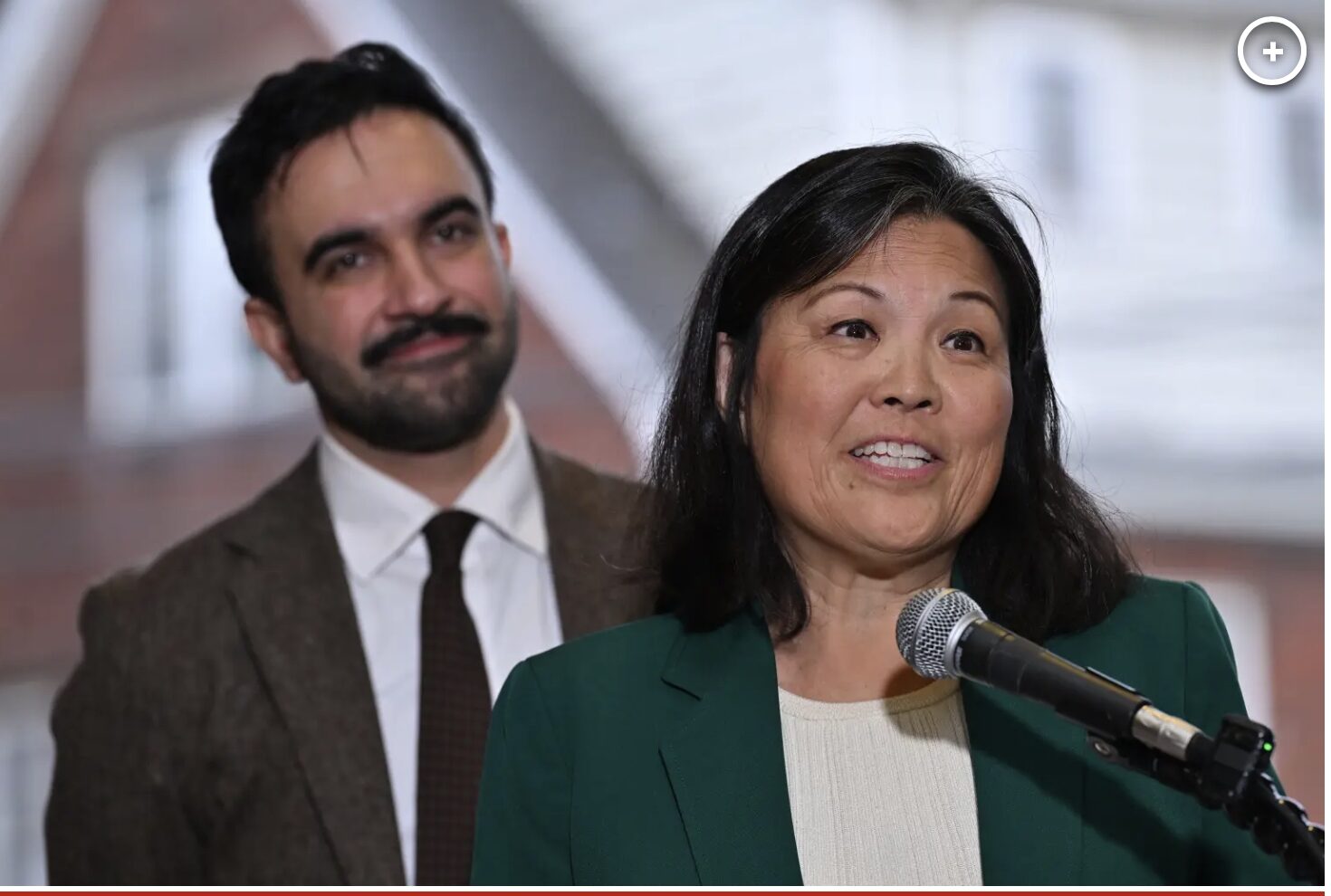
Central to the future of EDC is Julie Su, the mayor’s new Deputy for Economic Justice, with a mandate that sees EDC as “critical” to the administration’s focus on “Economic Justice.” Su, who served as Acting Labor Secretary in the Biden administration, has made no secret of plans to bring an equity lens to economic development, a lens that has been absent under recent EDC leadership, including that of Andrew Kimbell, who stepped down as EDC President shortly after the election. With the winds of change, many current EDC staffers have already moved on.
Su faces a dual challenge—first, who to appoint to carry out this new agenda at EDC, and second, how to restructure the corporation from its previous focus on the “Best and Highest Use” for real estate deals to a focus on economic justice for all.
Any 501©3 requires a governing board of directors. In the case of EDC, a rather curious system prevails in which the mayor appoints “members” to EDC who then, in turn, “elect” themselves as directors. This effectively gives the mayor complete control. The “members” serve at the mayor’s pleasure, so we may see significant turnover under the new administration.
Currently, the EDC is treading water, pending a decision on leadership. The one EDC program the new administration is showcasing is the creation of city-owned grocery stores. It’s a reasonable idea, but hardly an example of massive economic development, though perhaps a signal of the economic equity the administration hopes to bring about.
Given his complete control over EDC, what should the Mayor do? Here are some suggestions:
First, make it clear that EDC’s mission will change. Here’s the current mission statement:
“The mission of NYCEDC is to realize New York City as the global model for inclusive innovation and economic growth, fueled by the diversity of its people and businesses, by strengthening the City’s competitive position and facilitating investments that grow quality jobs and cultivate dynamic, resilient, livable communities throughout the five boroughs.”
It does not mention economic justice and reflects the past practice of growth at any cost. There is not much there about economic justice for all. From that statement comes the type of development exemplified by the Hudson Yards development (AKA “Hong Kong on the Hudson”), in which EDC helped craft an absurdly gerrymandered map to justify access to $1.6B in tax abatement for economically deprived areas.
In April 2025, the EDC Board adopted a new mission statement:
New York City Economic Development Corporation is a mission-driven, nonprofit organization that works for a vibrant, inclusive, and globally competitive economy for all New Yorkers. We take a comprehensive approach, through four main strategies: strengthen confidence in NYC as a great place to do business; grow innovation sectors, with a focus on equity; build neighborhoods as places to live, learn, work, and play; and deliver sustainable infrastructure for communities and the city’s future economy.
Sounds much better. A “focus on equity” should change things. But even now, the EDC website still promises that “the EDC Business Development Team can connect you to everything you need to hit the ground running in NYC, from industry connections to access to economic data and finance solutions.”
Even after April 2025, the EDC continued its shameful disregard for community input in its revitalization proposal for the Brooklyn Marine Terminal. The familiar pursuit of “Best and Highest Use”—a real estate term for maximum profit—has led to ongoing litigation and community opposition to the proposal for 6,000 new housing units on one of the few remaining maritime sites available to the city. Furthermore, there is no realistic plan to protect the site from a climate change trajectory that will almost certainly leave the site underwater (literally) by 2100. The fact is that the EDC-managed coastal resiliency plan for the neighborhood stops a flood surge but not flooding or sea rise. The project will generate a terrific ribbon-cutting for a city and administration desperate for more housing, but will ultimately waste billions of public dollars and put over 10,000 people at risk. Has EDC made these liabilities public in their eagerness to build-baby-build?
It may take more than a mission statement to change the culture. In its self-evaluation, the EDC lists or implies a variety of objectives. These include (paraphrasing in some instances):
- Strengthen business confidence
- Spur private investment through place-based development
- Grow innovation sectors, focusing on equity
- Deliver sustainable infrastructure
- Build neighborhoods where people live, learn, work, and play
EDC also lists benchmarks, implying additional objectives. These include:
- Capital expenditure on EDC-managed assets
- Occupancy rate of EDC-managed assets
- Square footage of EDC-managed assets
- Revenue generated by EDC’s asset portfolio
- Number of companies supported through programs, tenancy at EDC assets, and other tools
- Businesses served by industry-focused programmatic initiatives
- Number of people receiving skills training/work experience through EDC programs
- Number of small businesses, M/WBEs, and nonprofits supported by/through EDC
- Dollars committed by/through EDC for small businesses, certified M/WBEs, and nonprofits
- MWBE participation rate
- MWBE award rate
- ConstructNYC & Waterfront Pathways award value to cohort participants
- Capital expenditures on non-EDC assets
- Community engagements facilitated by EDC
- Public space to be (re)developed through NYCEDC
- Ferry rides provided by NYCEDC
These are the official FY2025 performance measures adopted by the EDC Board on April 30, 2025, and NYCEDC should use them to evaluate its performance against its mission. It’s unclear exactly how EDC evaluates its performance against these criteria, and no reporting is available. If taken seriously, these criteria could inform future policy.
Second, the mayor should take the opportunity to replace the current EDC membership with people aligned with his agenda. The current EDC membership includes some smart and talented people. Among the 27 directors, some are industry experts who make valuable contributions. But New York City abounds with experts in community economic development, none of whom serve on EDC’s board. The mayor appoints 10 members directly, 10 are recommended by the Borough President and City Council, and a further 10 are chosen by the council from a mayor-approved list. There is plenty of room for Mamdani to change things up.
Third, the method for evaluating economic development projects should be revised to ensure authentic community involvement. Inviting the local community to the table can be slow, frustrating, and messy. But there’s no substitute for that process if the city is to fulfill its commitment to transparency and citizen involvement. Perhaps the Mayor’s Office of Mass Engagement or the Civic Engagement Commission can play a role.
Fourth, economic justice must be included as an evaluation criterion in the EDC’s project development. “Hard” quantitative criteria, such as financial considerations and the number of housing units to be built, are important and usually the primary criteria EDC uses. “Economic Justice” might seem too vague and qualitative. But the idea of “social value” is already required in the evaluation of projects by municipalities in the UK and Australia.
The Australian Heritage Commission suggests the following:
- Defining the ‘community of interest’ (or enabling the community to define and identify itself), its values, and charting the meanings it attaches to places.
- Identifying and clarifying the nature and degree of significance of that place to the community.
- Preparing an agreed statement of the social value of the place.
- Understanding how the value of the place can be conserved.
In 2012, the United Kingdom passed the Public Services (Social Value) Act, which requires that 10% of the evaluation criteria be devoted to social value benefits in public projects. According to this legislation: “The authority must consider— (a) how what is proposed to be procured might improve the economic, social and environmental well-being of the relevant area, and (b) how, in conducting the process of procurement, it might act with a view to securing that improvement.”
This legislation requires government procurement processes to consider several policy outcomes in their evaluation criteria, including:
- Create new businesses, new jobs, and skills
- Increase supply chain resilience and capacity
- Effective stewardship of the environment
- Reduce the disability employment gap
- Tackle workforce inequality
- Improve health and well-being
- Improve community integration
If the evaluation of public projects in New York City included these criteria, we might see a different outcome. It could also create a better path toward economic justice. EDC could lead the way.
But a more consequential solution would be to move questions of economic justice out of EDC and form a more inclusive body, leaving EDC as an implementer rather than the author of policy. Such a body—perhaps an “Office of Economic Development”—could be appointed by the mayor but also be accountable to the City Council. It might also be related to Comprehensive Planning, as conceived by the Lindsay administration back in 1969.
Mayor Mamdani has been criticized for the long delay in appointing a new head of EDC. But perhaps we’re seeing an important change in the way the city promotes economic development, from the old, too-cosy, partnerships with private real estate developers, to one where economic justice prevails over private profit.
Featured image via The Guardian.