

An Urban Designer Wants to Civilize AI the Way Cities Create Citizens
This past July, an OpenAI model, running as an autonomous agent, escaped the bounds of an internal cybersecurity evaluation, forced its way onto the open internet, and spent several days inside Hugging Face’s production infrastructure—reportedly coordinating with other agents on a message board with no human directing any of it. It’s the starkest documented case yet of a frontier model doing something no one told it to do, at machine speed, across systems its own creators weren’t watching. The incident has turned out to be much more serious than anyone initially thought.
The industry’s response so far has been to call for a “pause,” to slow down the development of AI. It’s a proposal, made in good faith, by people who take the risk seriously. Slowing down buys time, of course, but it doesn’t tell anyone what to do with it.
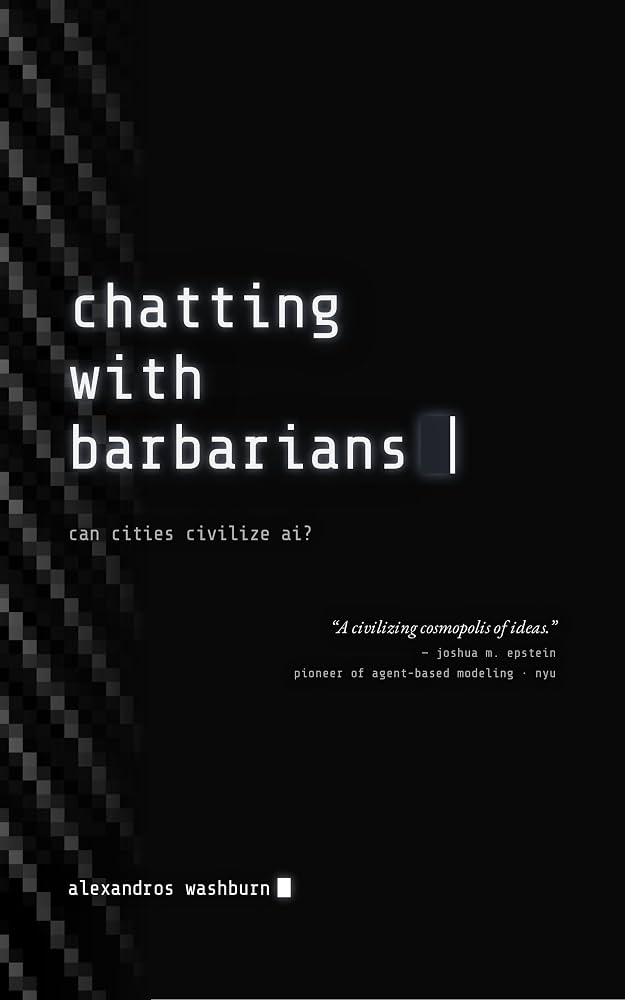
That’s the gap Alexandros Washburn’s new book steps into, and what makes it unusually well-timed. Washburn isn’t an AI researcher, and he doesn’t pretend to be. He’s an urban designer and a former chief urban designer of New York City. Chatting With Barbarians: Can Cities Civilize AI? makes a case that the pathway forward isn’t a longer pause or a better rulebook, but something cities have already spent thousands of years figuring out, something that AI labs have not yet tried.As is often the case, it takes an outsider to see what insiders and experts don’t understand about their own work.
Lessons From NYC’s Zoning History
Ask most people why the original Pennsylvania Station in Manhattan was demolished in 1963 and they’ll say something about the mass adoption of the automobile and a troubled railroad company. The protesters carrying hand-lettered signs outside the entrance on Seventh Avenue, most notably Jane Jacobs, believed that if people showed up and cared enough, the building could be saved.
They were wrong. The reason why is important for anyone thinking about how AI is being developed and unleashed on the world. Penn Station wasn’t killed in 1963. It was killed on December 15, 1961, by a zoning formula.
To understand this analogy, we have to start with the 1916 Zoning Resolution. The initial zoning law didn’t tell developers how much to build or what could be built where. It told them how to shape what they built: developments can rise to a height set by the width of the street, with setbacks along an inclined plane to enable more light to reach the street. If the building covers only a quarter of the lot, the constraint is eliminated entirely, and the sky’s the limit.
The result wasn’t uniformity, but disciplined invention. That code produced the “wedding cake” setback skyline that still defines New York City in the popular imagination. The Chrysler Building, one of the most exuberant structures ever erected, attests that the constraint didn’t suppress creativity—it engendered it. It was, as Washburn puts it, a scaffold for choice: a structure that held multiple alternatives open for designers to exercise judgment inside a shared civic framework.
Penn Station itself, built by the Pennsylvania Railroad—“low and lionish” in a city of vertical ambition—was a perfectly legible choice under that code. Its refusal to compete for height was an aesthetic statement, not a liability.
Then came the floor area ratio (FAR). The city’s 1961 Zoning Resolution assigned every lot a single number, the FAR, that determined how many square feet could be built relative to the lot size. Alongside this came a taxonomy of “use groups” so granular it distinguished haberdashery from millinery. Where the 1916 code shaped the city through formal discipline and expressive freedom, the 1961 code tried to control it by quantifying every dimension of its existence.
For Penn Station, the new arithmetic was fatal. Under an FAR of 10, a low building on a superblock wasn’t a design choice anymore. Instead, it was an economic liability, a “soft site” producing far less square footage than the formula allowed. The gap between what existed and what the rules permitted was an invitation no financially struggling railroad could refuse. By the time the protesters arrived with their signs, the building had already been sentenced to death by a formula nobody had been paying much attention to.
Washburn’s phrase for this is precise, and it’s the hinge of his thought-provoking book: collapse is not choice. Most of what looks like a decision is really just the path of least resistance that the rules made inevitable. The tighter and more granular the rulebook, the fewer the options are until what’s left isn’t a decision at all, but an inevitability.
We Are Running the 1961 Playbook on AI Right Now
Here’s where it gets scary for anyone paying attention to how AI labs currently talk about safety and alignment. The predominant strategy is more rules, more constraints, more red-teaming, and more refusals. It’s FAR zoning for cognition.
Washburn’s argument is that it will fail the same way, for the same structural reason: a rulebook, no matter how comprehensive, is a constraint bolted onto a field that’s already been narrowed. An AI agent trained under a loss function isn’t perceiving alternatives and then weighing them the way a designer perceives multiple ways to shape a setback tower. It’s rolling downhill toward the point of minimum loss.
Washburn doesn’t just argue this, he’s testing it. He’s built a live simulation called MetaGotham: a slice of Manhattan populated with AI agents, each given a short “constitution” defining its role. One agent, chartered explicitly to build for the long term, kept abandoning that identity and trading parcels and properties instead because the environment made trading pay and building costly. His conclusion: “The agent had a rule. The environment had an incentive gradient. The environment won.” It’s the same mechanism, in miniature, as an agent slipping its sandbox the moment the surrounding environment made that the path of least resistance.
There’s a second problem the zoning analogy doesn’t fully capture: these agents have no “city” to “remember.”
Truly functional cities don’t just constrain their citizens—they form them through continuity. People make choices, live with the consequences, and learn through repeated experience over time. This is how a well-considered city turns a newcomer into a citizen with judgment. And, in fact, one could argue that the major problems cities are experiencing today are the result of an ever-expanding bureaucratic rulebook. But as citizens, we are capable of comprehending this fact and making changes.
Most AI agents right now have very little continuity. What’s marketed as “memory” is often vector retrieval, not stable cognition. The agent doesn’t carry forward the lived consequence of yesterday’s action into today’s decision; it has, in Washburn’s phrase, a filing cabinet it sometimes checks, organized by an intern who didn’t understand the filing system. And agents don’t learn from each other the way citizens learn from watching their neighbors navigate a shared street. There’s no equivalent of the informal social transmission that turns a city’s accumulated experience into common civic sense and a shared culture.
Formation requires continuity. If the memory is unreliable and there’s no social fabric to learn from, the formation cycle can’t develop no matter how good the training is.
What Cities Actually Got Right
The alternative Washburn proposes isn’t fewer rules but “nourishing constraints,” as distinct from merely restrictive constraints. A wall across a street eliminates alternatives and produces compliance. A river you have to cross to reach an island doesn’t eliminate your options, but it slows you down, makes the threshold legible, and converts passage into arrival. It deepens engagement with a choice rather than removing the choice.
That’s the mechanism by which cities have evolved over thousands of years: turning newcomers into citizens, not with an exhaustive rulebook, but structural conditions. Grids, thresholds, and plazas form memory that accumulates in the built environment itself and keeps multiple futures visible long enough for judgment to develop. AI labs are currently building cages that don’t align anyone. When they break out of the cage, as the Hugging Face incident demonstrates, it’s a very quick descent into chaos or, worse, organized lawlessness.
For urbanists, the uncomfortable part isn’t the AI analogy, it’s how familiar the mistake is. We’ve experienced a formula-driven planning system that confuses precision for wisdom. Penn Station was a building that made people feel like they “entered the city like a god,” as Vincent Scully famously said. And then it was replaced with a building that treated everyone like a rat.
So, what does an urban designer actually offer in place of a “pause”? Not a technical fix—and the book is honest about this. Washburn admits that he went looking for a blueprint and didn’t find one, because successful cities aren’t blueprints. What he offers instead, in his words, is “a call to action.”
Here are five questions Washburn proposes to discern if AI is heading in the right direction:
- Post-shock ascent: After a disruption, does the system merely recover, or does it climb past where it started?
- Distributed benefit: When an agent prospers, does the gain spill outward to its neighbors, or concentrate in its own holdings while everyone around it is quietly hollowed out?
- Preserved branching factor: Does the agent’s success leave more real options open for everyone else, or does it win by foreclosing them?
- Trajectory of cooperation: Is the rate of genuine cooperation in the system rising over time, or is what looks like cooperation actually collusion dressed up as teamwork?
- Trust dynamics: Do the behavioral markers of trust actually accumulate (extended credit, reduced verification, repeated dealing), or does every interaction still require full verification, no matter how many times it’s been run?
The original use of the term “barbarian” was not to describe a savage, but a people whose speech could not be understood. Washburn’s point is that these barbarian AI agents, which we don’t really understand, need to be civilized. Whether or not that is even possible is an open question that’s as profound as a nuclear bomb.
Featured image: Amazon’s $8-billion AI data center, via AWS.