
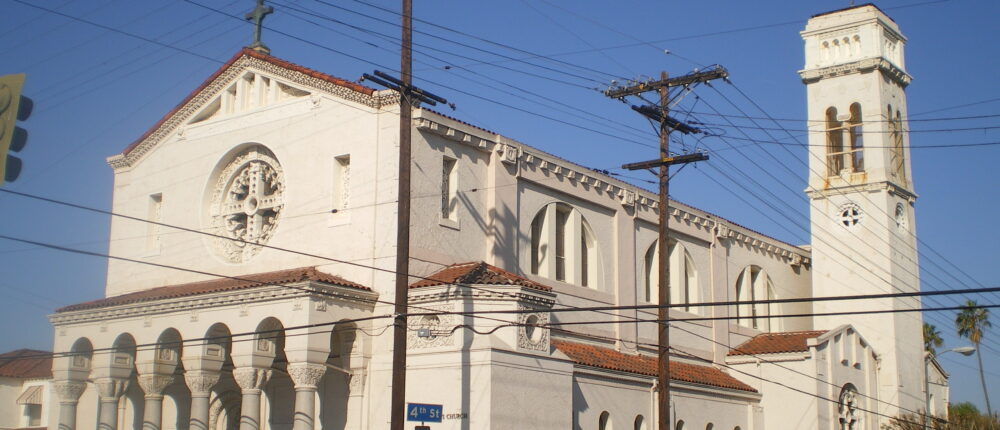
Form Follows Feeling: My Catholic Aesthetic
I’ve been thinking recently about how my all-encompassing Catholic upbringing shaped the way I experience cities, how I plan them, and ultimately how I design them through my interactive models. Today, while my religious thinking may be more cerebral, or even Protestant, my aesthetic will always be Catholic.
I studied urban planning thinking I would get a municipal planning job and live happily ever after. Instead, I discovered that I was not very good at being a conventional municipal planner. Planning felt too cut-and-dry, too technical, too focused on regulations, land uses, maps, data, and solving problems on paper. Something was missing: feeling.
I felt spaces and cities before I understood them. Growing up Latino and Catholic in East Los Angeles, I was surrounded by a world of emotion, ritual, symbolism, memory, and the senses. Catholicism was not something you thought about or believed. You experienced it with your body. And one of the first places I experienced it was my grandmother’s home.
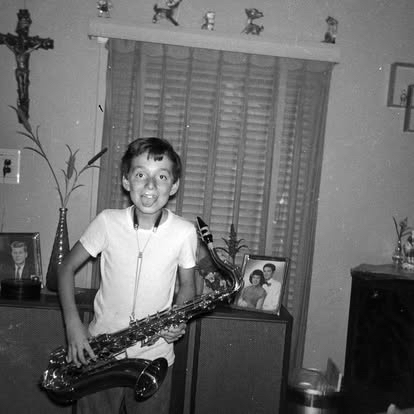
The aesthetic of her house was like a Caravaggio painting, where light and darkness, good and evil, the sacred and the everyday, and the old and the modern were all intertwined in the same space. Her homemade altar sat on top of a bookshelf and seemed to carry secrets. Crucifixes hung behind every door. A picture of the Last Supper watched over the kitchen. In the dark hallway hung frightening pictures of the devil tempting people, images that both fascinated and scared me as a child.
And then there was her 6-foot-long reproduction of the Nativity. It was more than a Christmas decoration; it was an entire miniature landscape. She created the desert around Bethlehem with living plants, sand, rocks, figures, animals, and the Holy Family. As a child, I could look into this tiny world and imagine myself inside it.
A votive candle was always burning. Its small flame flickered against the darkness, illuminating statues, pictures, flowers, and religious objects. Somehow, my grandmother needed darkness in order to have light. That contrast stayed with me.
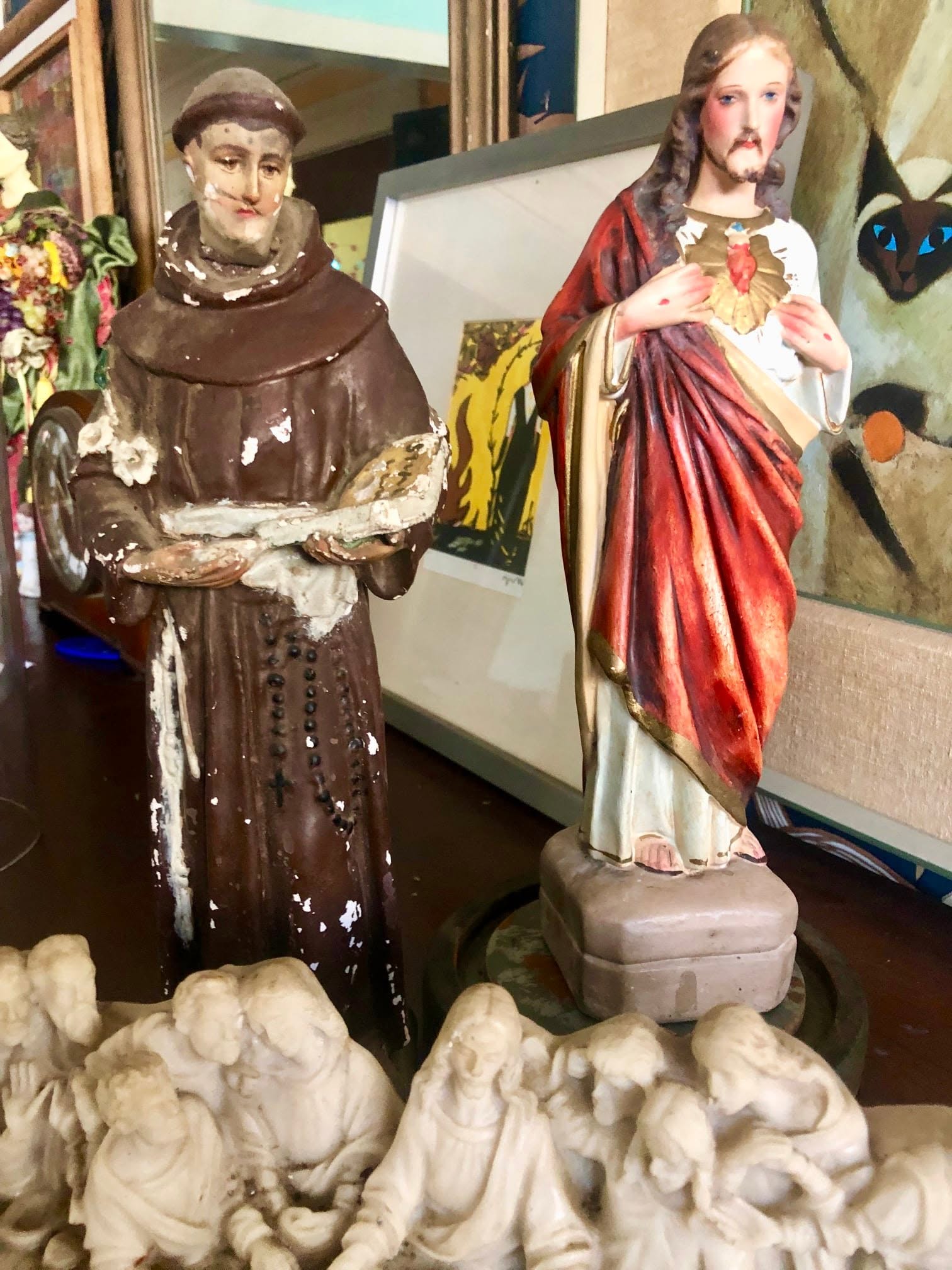
Light meant something because there was darkness. Beauty existed alongside fear. Saints shared the house with images of the devil. Ancient rituals existed alongside the television and the ordinary routines of daily life. Nothing was cleanly separated. Everything overlapped.
The same sensory world continued at Catholic Mass. There were burning candles and the smell of incense. Echoing through the church were bells, hymns, prayers, and voices. I watched sunlight pass through stained glass; touched rosary beads; dipped my fingers into holy water. I stood, sat, kneeled, walked, and crossed myself.
The church was filled with things to look at: statues of saints and the stories they represented, flowers surrounding the Virgin Mary, flickering candles, gold objects, colorful robes, paintings, altars, and crucifixes.
Catholicism made the invisible visible. Love, fear, suffering, death, hope, guilt, forgiveness, and salvation were transformed into objects, images, light, sound, movement, and ritual. An idea did not remain an abstraction. It became something you could see, touch, smell, hear, and physically experience.
None of this was necessary in a strictly functional sense. And that may be precisely the point.
These objects, colors, sounds, smells, movements, and rituals created meaning. They connected the physical world to memory, emotion, family, community, and something larger than ourselves. The physical environment became a container for feelings that could not always be explained through words. Long before I studied architecture or urban planning, I was learning that space could communicate without words.
Outside my grandmother’s house and the Catholic Church, however, I experienced Los Angeles very differently. Much of the city’s built environment seemed shallow to me. Buildings, parking lots, streets, and even the sky itself could feel ordinary, repetitive, lifeless. I was supposed to appreciate the clean lines, simplicity, and efficiency of Southern California’s suburban midcentury modern houses, but they rarely moved me.
Perhaps this is why the modernist dictum “form follows function” has always felt alien to me. I understand it intellectually, but it’s not how I learned to experience the physical world.
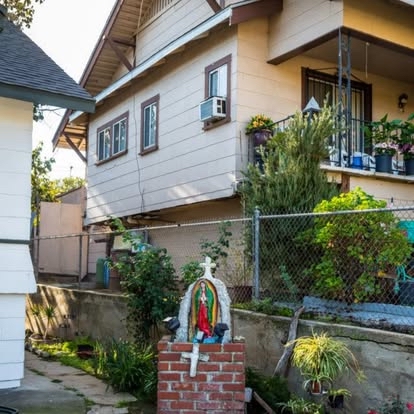
Then I left Los Angeles. After college, I spent several years living and traveling in Europe. In the cities of Italy, Spain, and France, something unexpected happened: I recognized parts of the Catholic world I had grown up with in East Los Angeles.
There were churches at the center of neighborhoods, dark passages, plazas filled with people, religious statues and shrines, bells marking the hours, candles burning inside dark churches, flowers placed before saints, processions moving through streets, old buildings layered with history, and public spaces filled with everyday life. Religion, architecture, public space, and daily routines seemed intertwined. I had traveled thousands of miles from East Los Angeles only to encounter something strangely familiar.
Europe helped me understand that the sensory world of my childhood was not simply something that existed inside my grandmother’s house or the church. It was connected to a way of experiencing the city itself. Streets and plazas could carry memory. Buildings could communicate through ornament, light, texture, age. Public space could accommodate ceremony, celebration, mourning, commerce, conversation, and everyday life all at once. The city did not have to explain itself to me. I could feel it.
That became my way of reading a city: Is it welcoming? Does it make me curious? Do I want to linger? Does it remind me of somewhere else? Can I hear people? Can I smell food? Is there something to touch or look at? Are there signs that somebody cares about this place?
These things might appear decorative, messy, inefficient, or irrelevant through the conventional lens of planning. But to me, they are what give a place life. They create attachment, memory, curiosity, and human connection.
Eventually, I realized that rather than simply analyzing those feelings, I could use them to help people imagine and design cities. That is why I began making interactive city models. The models allow people to understand cities in the same physical and sensory way that I learned to understand the world. Instead of beginning with maps, data, zoning, or words, people begin with objects. They touch things. They move them around. They remember. They tell stories. They build landscapes based on experiences and emotions.
The city becomes something they can physically manipulate rather than something they are expected to understand abstractly. And perhaps this explains why my models themselves are filled with color, texture, objects, and light—and, sometimes, things that appear to have no practical purpose. A bottle cap can become a building. A piece of plastic can become a tower. A shiny object can become a landmark. The objects’ value is not necessarily in what they are supposed to represent, but in what they make someone imagine or feel.
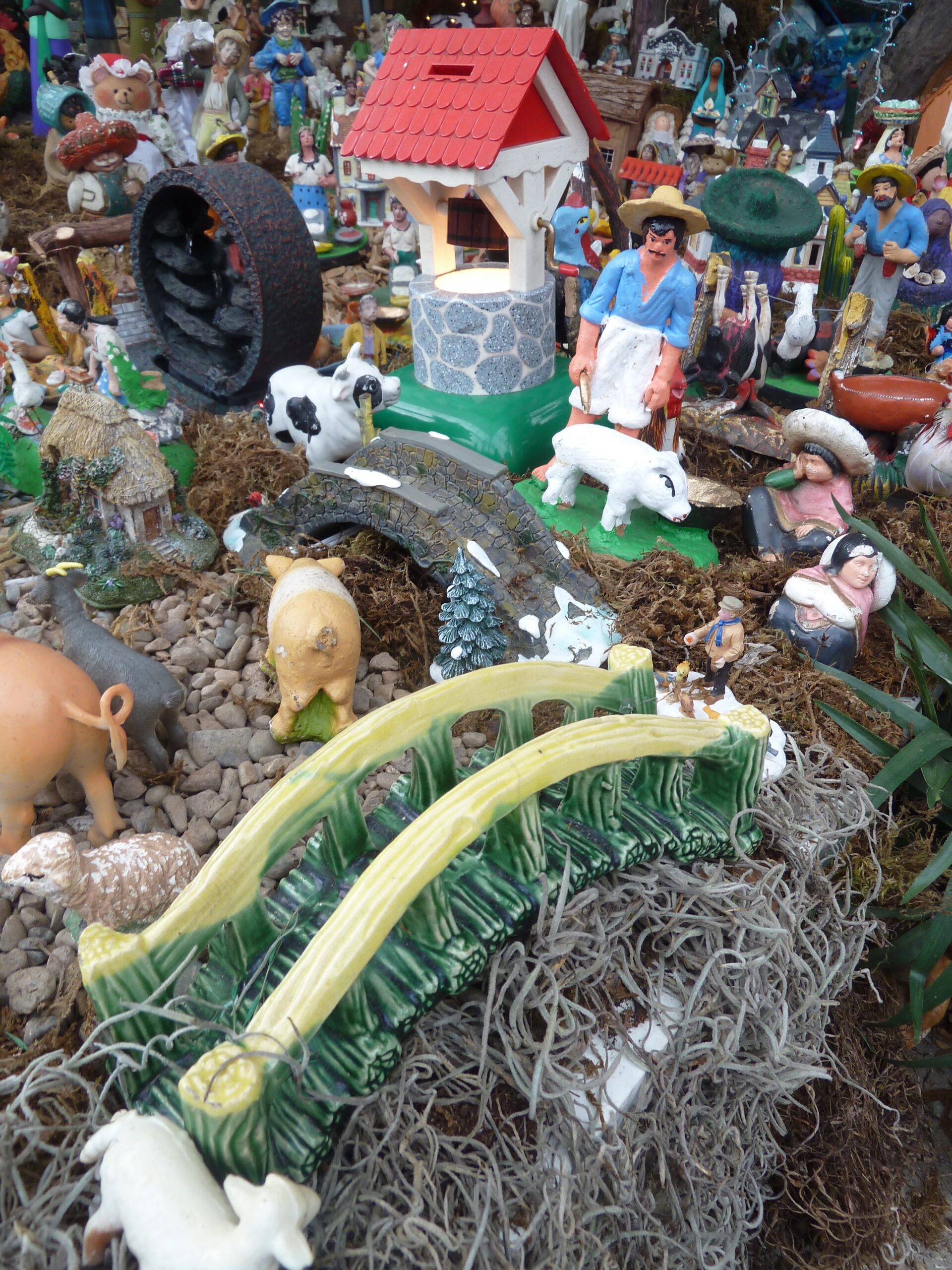
In that sense, my interactive models may have more in common with the homemade altar and Nativity landscapes of my childhood than with the conventional architectural models I learned about at MIT. Both take ordinary objects and give them meaning. Both create miniature worlds. Both invite the imagination to enter. And both make something invisible—memory, hope, aspiration, belonging—physical.
I can now see a direct line from my grandmother’s house to the way I make and understand cities. Long before I knew the language of planning, I was learning that physical objects can carry emotional meaning, that ritual can create community, that light and darkness can transform space, that beauty does not have to justify itself through efficiency, and that our senses are legitimate ways of understanding the world.
My Catholic upbringing taught me that places do not have to be logical to be meaningful. Meaning does not always follow function. Sometimes, form follows feeling. And sometimes, feeling is the function.
Featured image of St. Mary’s Catholic Church, in the Boyle Heights neighborhood in Los Angeles, via Wikipedia. All other photos courtesy of the author.