
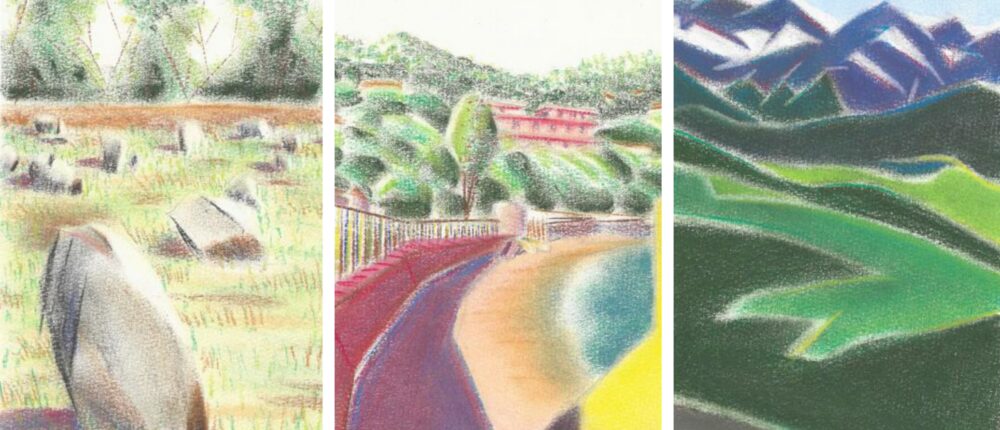
The Joys and Raptures of Drawing
Drawing is deeply intimate, a personal relationship one forms with the “subject.” By working the matter—inscribing the line that marks the contour, rubbing pastel or charcoal into the paper to denote light and form, removing darkness with erasure—one is immediately in the medium, inhabiting its emerging spaces, transfixed in the actions of seeing life come into being on paper. The texture of the paper felt under point of pencil or with charcoal dust pressed upon the tip of finger, the smell of chalk and eraser residue, all contribute to the visceral experience of drawing.
When I draw, I am in a trance, released from all other considerations. The world closes in to focus on the paper before me and my actions. But as I look at what I’m drawing, the world opens back up. The act of drawing is a constant dance between the macro and the micro, a push and pull between what I want to draw and what I see. My partner is the action: the millisecond decisions in the head, the minute moves of the hand, and the scanning of one’s eye traces the dance whose overall grace is not evident until one steps back to view it. So, to stop drawing is part of the action too; observing where to go next is critical to the act.
Drawing is an editing process. It first occurs in my mind’s eye and may start at the edge, determining where the frame is. Do I want a flatter image that has little to no foreground, or one with deep space? Once the frame is established, I determine what will be included within it. The more items included, the more active the drawing may seem; the less, the calmer. These decisions transform what I see into what I want to see. I am seeing through the reality to create a new reality. But sometimes the drawing runs beyond my initial sense of the frame. The drawing wants to be free, and I let it—for this is a sure sign that this new reality has gained a life of its own, an independence.
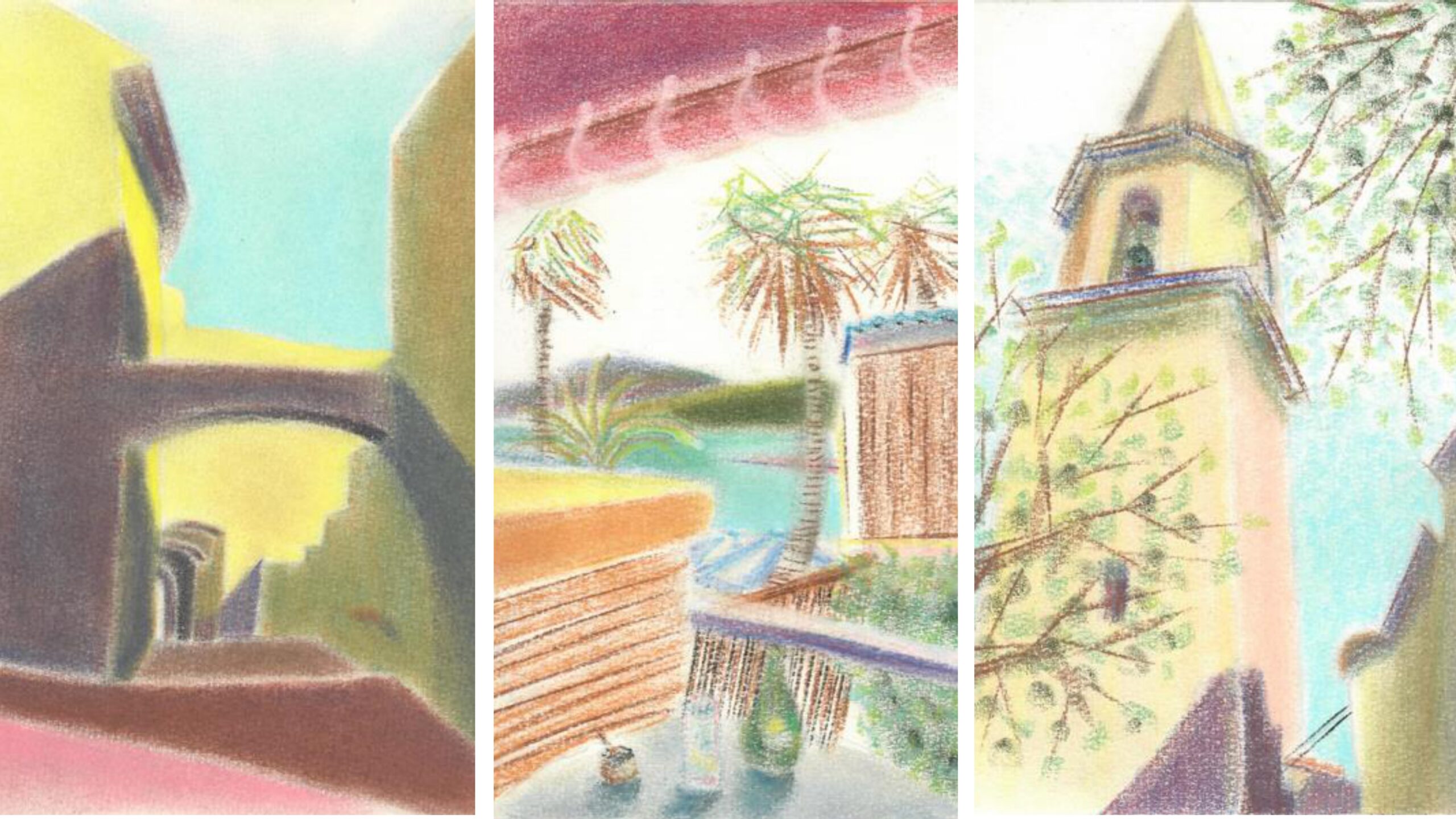
Editing is also reflected in the selection of tools. I have found that the finer the tool—a sharpened pencil, perhaps—begs more detail, more refinement in the drawing for it beckons a level of accuracy commensurate with the tool’s ability to be precise. This can lead to the trap of drawing too much, but I try to resist that, recalling the editing questions that come with the frame. A blunter instrument, like a pastel stick, suggests broader strokes, ones that will leave out many details in the pursuit of a hidden underlying spirit. This may lead to the trap of drawing too little, but I have learned to resist that too; spirits are not simplistic. I remind myself that Vermeer and Rothko painted with radically different brushes, but the paintings of the latter hold no less expression than those of the former.
I have been drawing for as long as I can remember. Feeling isolated and being shy and quiet as a child, I suppose it was my way of accessing the world. But I doubt I was conscious of that; I just enjoyed drawing. Also, my English was not good; my acceptance to college was predicated on my taking an expository writing class freshman year. Through all those struggles with language, drawing was how I communicated best. That I feel confident to write today is only the result of many years of writing: university newspaper articles, personal letters, lectures, communiques to clients and colleagues. Writing was a learned skill. Drawing came naturally. And, thus, it was not only my primary way to engage with the world, but it also formed my refuge from it; when the world became seemingly too complicated, drawing allowed me to re-see life in its essence, serving as a reset. I was also fortunate for it to be the basis from which I made my living, unlocking for me ideas about the environment, business, culture, and society at large. It’s amazing to me how what started as simply putting marks on paper led to all this.
Drawing also taught me a sense of humor. The first type of drawings that attracted me were cartoons. Copying Peanuts and other strips as a kid led to my taking a cartooning class in high school, taught by someone who had enjoyed an extensive career at Disney. He introduced me to the art of caricature, showing me how to observe and distill the most distinctive features of a face, body, and behavior for comedic exaggeration. In college, while doing editorial drawings for the student paper, I entertained the idea of becoming a political cartoonist; the challenge for me, however, wasn’t the churn of the daily drawing, it was coming up with punch lines. But it left me with an indelible lesson on how to simply represent peoples’ forms and movements, which would help me animate spaces with their presence in my architectural drawings years later.
The beginning of my architectural drafting also started in high school, in my mechanical drawing classes. Drawing nuts and bolts in measured three dimensions with the appropriate line weights was a pointed contrast to my cartooning. Here, I enjoyed the whole ritual of taping a sheet of paper, attaching each corner diagonal from the other to stretch it tightly on my drafting table, keeping the paper clean with a drafting bag. Using my lead holder to sharpen graphite to a crisp point, rotating it while drawing to maintain a consistent line weight, hearing the snapping sound of my triangle against the parallel rule, smelling the paper, the particles and graphite dust, moving my body with the drawing strokes, all contributed to an immersive, hypnotic experience. This was not just drafting, it was drawing, and as the methods and subject matter became more complex, the opportunity to lift architectural drawing to an art form became evident. And the history of architectural drawing provided plenty of precedents for inspiration—my copies of 200 Years of American Architectural Drawing and Delirious New York are well worn, as are my books on Boullée, Scarpa, Rudolph, and Archigram. Learning techniques for the shading of shadows, composing the projections on a sheet of paper, revealing space by erasing, constructing perspectives, enhancing depth through color—all were part of this glorious process. When inking rapidiographs became the prevalent tool for even more precision, some of these senses were dulled, but the ability to bring artistry remained by integrating methods of collage and airbrushing into drawings. It was still a joy to draw, to envision architecture.
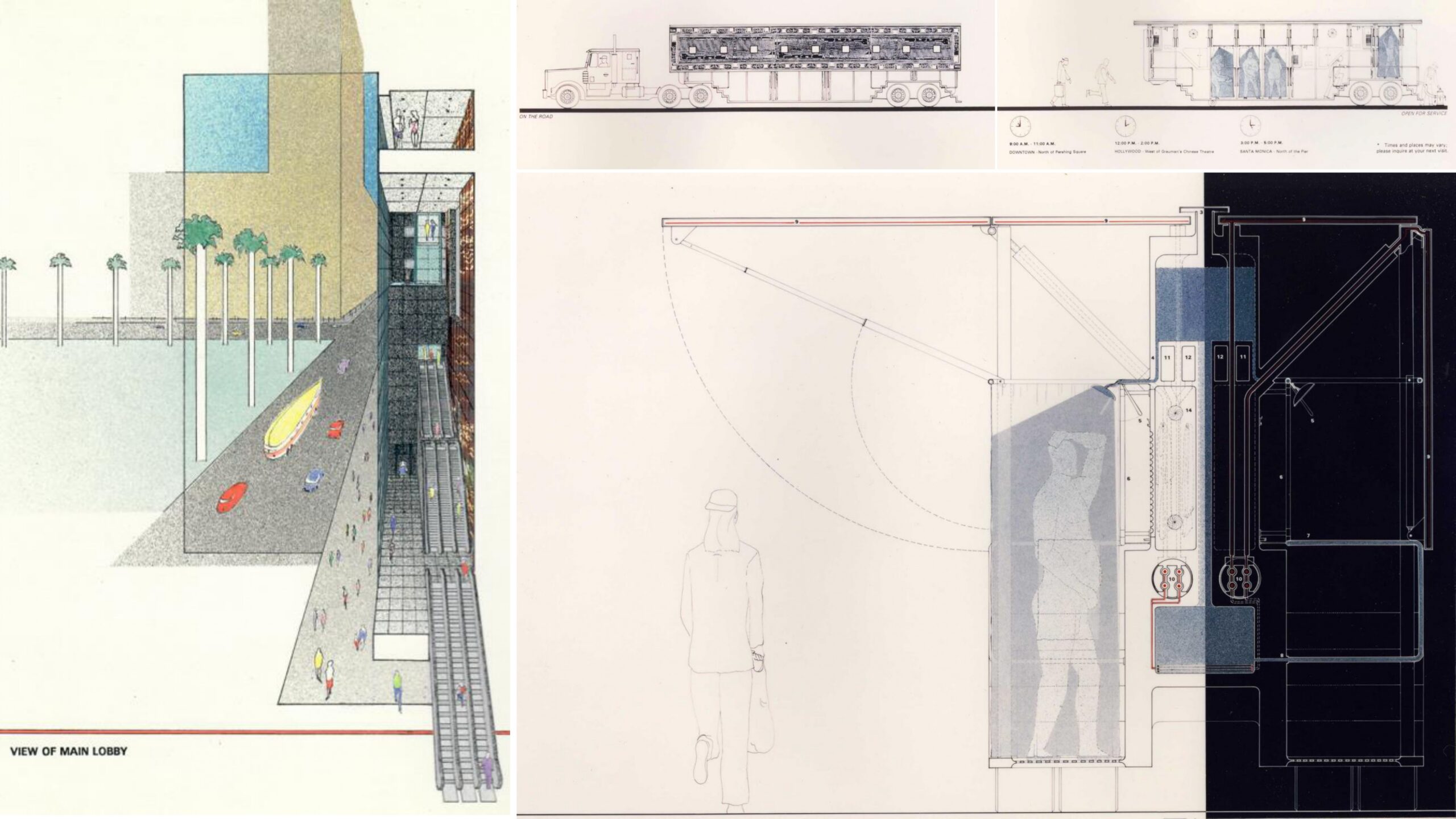
But as my professional responsibilities advanced, everyday office life became more transactional, and my primal need to draw became increasingly cossetted by its inherent constraints. Eventually, architectural drawing became more computerized. I have accepted and understood this transition as the evolution of modernity, just like I’ve accepted AI as a continuation of that development, though my professional exit preceded its emergence. But the tapping of keys and the movement of a mouse, or the glide of a drawing stylus on a neutral screen surface, was a poor substitute for the haptic experience of drawing, severing my senses with the “subject.” One could still capture design ideas in one’s sketchbook, but the exercise to draw whole new worlds beyond the idea had been taken over. I could have been stubborn, continuing to try and hand-draw documents, carefully considering the layout of each sheet for clarity of coordination and construction, or outsourced to rendering consultants whose role is to represent what the design will look like, not draw what the architecture wants to be. But that romantic notion would have only emphasized the split that had occurred in my profession between drawing and design, not to mention the seeming irresponsibility that such action would have on the efficiency of production and, thus, the bottom line. The profession of architecture as I knew it, as I had enjoyed it, had passed. The result of all this was that my drawing ceased to be part of the process and became a destination apart from it—and, even then, one that I struggled to find time for. Drawing wants to be free, as the inspiration can happen anytime, anywhere. It was no longer possible for me to be true to where the architecture profession was going and where my drawing wanted to be.
We all have a desire to tell stories. A picture, as they famously say, tells a thousand words. A drawing can tell even more. Before I left Los Angeles, my friend David gave me a going-away gift, a small portable drawing kit with paper, sharpener, eraser, and a selection of pencils, commenting, “You said you wanted to spend more time drawing.” Yes, indeed. For me, my drawings express what my words can’t. They complete my stories.
All images courtesy of the author.