
A Broadway Bathroom Soliloquy
To be honest, all of my distinct memories of seeing a Broadway show have cohered into a general feeling of unease. It’s not the tweaky anxiety of opening night—a familiar friend after several years as a professional actor—but a foreboding malaise. It’s the preemptive fatigue induced by not knowing if the production I’m about to see will be good, bad, or terribly mediocre, and by definitely knowing that the subway train will be making all local stops by the time I’m headed home. The first wave of disquiet hits as I emerge from the station, right into Times Square. I pass pedicab drivers, offering seats on their rickshaws in the same way Goethe’s Mephistopheles offered Faust magic-powered rizz and Melissa McCarthy offered Halle Bailey a pair of legs. I dodge life-sized Minnie Mouses who may or may not be wearing their heads. Most of all, I fail to hear my own thoughts over the sound of at least three different speakers playing New York City’s municipal anthem (“Concrete jungle where dreams are made of!”). Then I get to the theater.
If I’m lucky, I have an orchestra seat, and the remaining challenges are that the seats are narrow and the leg room is minimal. If I’m less lucky, I’m up in the mezzanine. In that case, I embark on a quest up an indeterminate number of stairs before reaching a different narrow seat with no leg room. On the ascent, I usually encounter a women’s restroom. I wonder what I would do if I were physically unable to traverse all these steps. Or if the time it would take me to do so, plus the time it takes to wait in the serpentine queue that accessorizes seemingly every women’s restroom in the world, exceeded the allotted intermission. As I climb, I ask myself: Is it even legal to make a hero’s journey out of going to the restroom? Is it “a privilege to pee,” as Mark Hollmann and Greg Kotis opine in the Tony Award–winning musical Urinetown? As with any great bureaucratic quandary, the answer is unclear.

The accessibility of Broadway’s infamous bathrooms is chiefly governed by the Americans With Disabilities Act of 1990—an advancement for disability rights, but not a panacea for ableism. For one, some scholars have argued that the ADA’s true purpose wasn’t to eradicate disability-based discrimination, but to preserve government coffers by making more employees out of people with disabilities, thereby reducing folks’ interest and/or eligibility for public benefits. According to this line of thinking, discrimination towards disabled consumers sits outside of the ADA’s purview.
There’s also the matter of implementation. The ADA is largely enforced via lawsuit or complaint. Any entity providing a “public accommodation” can shirk its legally mandated responsibility for as long as it takes for someone litigious to report the violation. And if they do, there’s no guarantee that their efforts will be successful, in no small part due to Colorado Cross Disability v. Hermanson Family. In 2001, the U.S. Court of Appeals for the Tenth Circuit found that the plaintiff bears the initial responsibility to demonstrate that accessibility-related modifications are plausible, rather than the defendant to demonstrate that they aren’t.
The question of theater bathroom accessibility is further complicated by the ADA’s varying levels of leniency based on the age and identified historical value of the building in question. Only new buildings—those that have arisen since the ADA’s passage—are on the hook for manifesting its provisions to their fullest extent. And only one Broadway theater, the Lyric, even kind of fits in this category (see the note at the end of this essay).
Existing buildings get a bit of a push to “do your best.” They’re required to attempt compliance, but only insofar as the requisite alterations are “readily achievable.” This phrase is defined as “easily accomplishable and able to be carried out without much difficulty or expense.” One can appreciate how the meanings of “accomplishable” “difficulty,” and “expense” are all in the eye of the beholder. Just under a third of Broadway theaters fall into this category.
The majority of Broadway enjoys historic status, as national and/or local authorities have officially deemed them as such. Here, historical significance usurps accessibility: no theater shall be compelled to make an alteration that “threaten[s] or destroy[s] the historic significance of the building.”
Because of this status-contingent hodgepodge of expectations, reality is a mixed bag, even though the brass tacks of the ADA’s design standards are pretty clear. Current standards dictate that a multi-user restroom must have at least one wheelchair-accessible stall and one wheelchair-accessible lavatory. If the restroom has two or more urinals, at least one must be accessible. And if the total number of toilets and urinals is equal to or greater than six, then there must be at least two accessible stalls: one wheelchair accessible and one ambulatory accessible.
In the real world, the most prevalent accessibility intervention is the installation of one single-use accessible restroom on the street-level floor of the theater. Then, there are outliers in both directions. Setting the curve are buildings such as the Palace Theatre, which has accessible restrooms on the second, third, fourth, fifth, and sixth floors.
And then there’s the Shubert, current home of the Alicia Keys jukebox musical Hell’s Kitchen. It does not have a wheelchair accessible restroom at all. If you need one, an attendant will have to guide you out of the theater, across the street, and up to the fourth floor of the Sardi’s Building. Both the theater and Sardi’s are in the middle of the block, so I imagine that one would either make a giant U in order to cross legally, or attempt the jaywalk and hope that a massive truck isn’t parked in precisely the right spot to keep you from seeing oncoming traffic. (I speak from experience.)
Broadway’s current accessibility levels, as uneven as they are, are largely the result of legal battles. The U.S. Attorney’s Office for the Southern District of New York has filed and simultaneously settled lawsuits against the “Big Three” of Broadway’s theater owners: the Shubert Organization in 2003, the Nederlander Organization in 2014, and Jujamcyn Theaters in 2021. Each bout of litigation brought sweeping renovations and cumulatively mandated the removal of hundreds of “individual barriers to accessibility in theater restrooms, concession counters, waiting areas, and box offices.”
On one level, Broadway’s glacial, semi-coerced movement with respect to accessibility matches its similarly slow movements on a great many other things. Historically speaking, the industry has made its money prioritizing known quantities such as adaptations of existing intellectual property over original stories or the “universal” over the “specific.” (Not for nothing, these patterns inspire pushback, whether it be the informal critiques of cantankerous internet commentators or the anonymous watchdog group We See You, White American Theatre.)
But on the other hand, these patterns arise precisely in order to entice money out of another known quantity: their patrons. Theatre owners know that nearly two-thirds of audience members are coming from outside of the New York Metropolitan Area. They know that the average household income of a Broadway theatregoer is $276,465. They know that audience members of color make up 34% of all attendees. And they know that the plurality of Broadway attendees are fifty years of age or older.
Despite the dramatics of the previous sentence, the role of age in Broadway audiences is nuanced. For instance, during the 2022-23 season, the first full season after pandemic-related lockdown, the most disproportionately represented demographic relative to their numbers in the general American population was the 25-34 year-old crowd. And during that same season, the average age of a Broadway audience member was a record-low 40.4 years of age. It should be noted though, that the 2022-23 audience’s relative youth was more a consequence of a decline in older attendees than a surge in younger ones. Perhaps, as Broadway News hypothesized, the decline was COVID- (and therefore accessibility-) related; older people were disinclined to go sit in a theatre at a time when mask mandates had already become an artifact of yore.
It’s here that I also admit that I’m playing a bit of a correlation game. Age and disability are related; according to the CDC, 28.7% of Americans have a disability, and that figure increases to 43.9% when those Americans are 65 years of age or older. Additionally, census data demonstrates that the incidence of disability increases with age in general. However, being elderly does not necessarily indicate disability, and being young doesn’t exempt a person from being disabled.

But caveating aside, the Broadway business model has always included older adults, and a business model that involves older adults also entails a rigorous relationship with access—above and beyond that which ought to already exist in a society where 25% people are living with a disability. Yet the architecture of these theaters often does not reflect this, and never really has; these theaters, flaws and all, are as accessible or inaccessible as they’ve ever been.
So how does the model survive?
The response-by-circumnavigation is that the architecture of a Broadway theater tacitly excludes audience members with a disability. Much like how the stereotypical Broadway musical posits a platonic physical ideal—the slim young adult who can kick really high and doesn’t need to wear glasses—the ideal audience is perpetually non-disabled.
This exclusion is something that disability activists have commented on before. In a personal essay for the Theatre Development Fund, lifelong theater fan Ronni Krasnow, who has cerebral palsy, commented that she was unable to see the 2019 revival of Oklahoma!, particularly notable for featuring the first wheelchair user to win a Tony Award in Ali Stroker, because she finds the “accessibility experience at the Circle in the Square Theatre particularly degrading.” In 2022, Samantha Coleman, a New York–based actor who self-identified as a deafblind person, posted on social media after attending a performance of Hadestown and getting repeatedly reprimanded for alleged phone use by an onstage actor—the “phone” was a theater-provided captioning device. (Both Hadestown’s producers and Jujamcyn Theaters later apologized.) And though it was produced off Broadway, 2023’s Dark Disabled Stories, by and starring Ryan J. Haddad, can be considered a dramatic response to the lack of access he experiences as a disabled person and theater worker.

Another thought I have about this tension is that people with disabilities are just dealing with it. If you’re a tourist from out of state or out of the country, if this is the one time you’re going to go see a Broadway show, you probably don’t want to put together an accessibility treatise for a building you’ll visit only one time. Maybe, instead, you just swallow a less-than-dignified experience. You account for it in your personal price of admission.
Which is sad to me, for two reasons. One, if I could be so naive as to cite the law, the rights of patrons with disabilities are ostensibly enshrined in the ADA and further reiterated by the New York State Human Rights Law. And, two, theater as an artform asks its audience members to think expansively. We enter this dark space to believe in a world which doesn’t actually exist, in the hopes of manifesting some kind of “different” and hopefully “better” in our current reality.
Echoing the speakers outside their doors, the hip-hoppity company of Hell’s Kitchen audaciously sings, “In New York / Concrete jungle where dreams are made of! / There’s nothin’ you can’t do …” And it feels true in the moment: I, you, we can do anything. But making all local stops gives a person time to think, and then the sheen wears off. I begin to suspect that the imagination of the space binds the imagination of the patron, regardless of what the actors have to say onstage. And a world in which that patron can’t even use the restroom without having to leave the theater is a finite world, indeed.
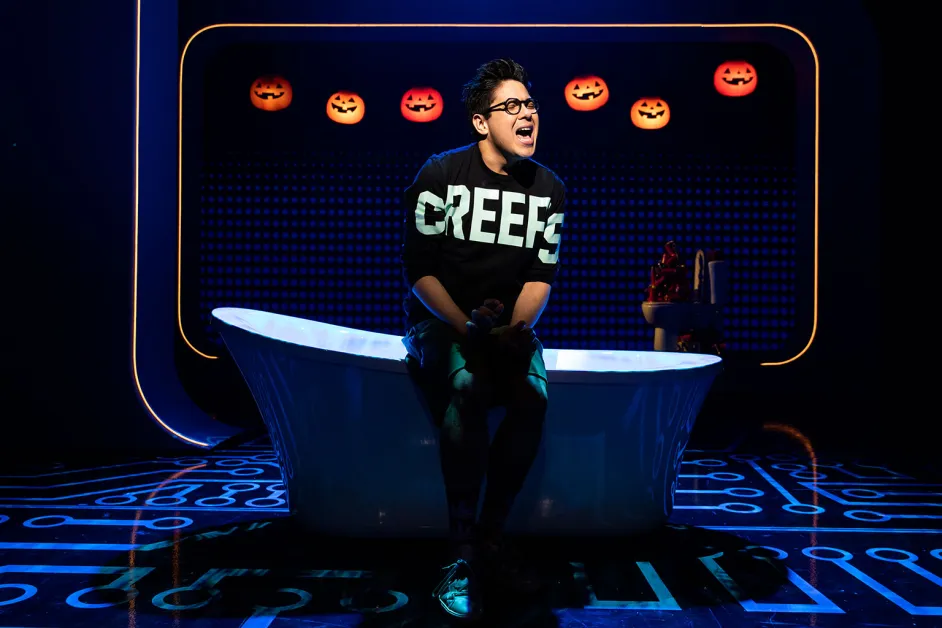
Featured image: George Salazar performs the song “Michael in the Bathroom” from the 2019 Broadway production of Be More Chill. Photo by Maria Baranova.
Note: Since the Lyric was built between 1996 and 1997, it’s considered new by the original ADA standards and was subject to the 1991 Standards for Accessible Design. However, in the context of the updated 2010 Standards, the Lyric is an existing building. This fact in of itself would lower the expectations for the Lyric’s accessibility with respect to any standard that was new to the 2010 edition. To take it one step further, these updated standards include an element-by-element “safe harbor” clause, meaning:
- If a building was constructed or altered in accordance with the 1991 standards by March 15, 2012, each individual element of access is exempt from further mandatory alteration to reach the generally stricter 2010 standards.
- If voluntary alteration were to occur, any altered element must now adhere to the 2010 Standards.
- Voluntary alteration of one element doesn’t trigger the mandatory alteration of another (ex. if the sinks in a restroom are altered, you aren’t mandated to also alter the stalls).
As a result, the Lyric was grandfathered in to being considered fully compliant as far as any court of law would be concerned. Nonetheless, the Lyric underwent an extensive 10-month renovation—which included a bathroom rejuvenation—and reopened in 2018.