
A New Chapter for Urbanism in Middle America
When people think about forward-thinking approaches to public space and landscape architecture, the Midwest and the Rust Belt are not often the first places that come to mind. More familiar images of Middle America tend to be flyover landscapes, farmland, and hollowed-out, post-industrial Appalachian cities.
But imagine efforts to transform Indianapolis’ most trafficked and iconic roundabout, Monument Circle, into a true civic public space. Or reimagining the edges of one of Pittsburgh’s iconic bridges—flanked by multiple freeways—as a new park space. Or plans to convert the catacombs beneath Indianapolis’ 19th century social hall into a public garden. These are all examples of what we like to think of as a new chapter for Middle American urbanism—with place-specific investments in public space that are reshaping heartland cities from car-centric and post-industrial landscapes into thriving, human-scaled environments with a distinctly post-coastal identity.
Across the region, a growing movement is elevating more diverse stories and nuanced perspectives. Residents, advocates, and political leaders are reclaiming the narrative of Middle America, acknowledging the region’s contemporary challenges while advancing hopeful visions for its future. Designers, particularly landscape architects, are working alongside communities, civic leaders, funders, and allied professionals to help shape and implement regionally specific futures rooted in local culture, ecology, and identity.
A New Chapter for Public and Civic Landscapes in Middle America
Post-industrialization led many Middle American cities to abandon the very infrastructure and assets that once made them economic engines: waterfronts, rail corridors, industrial sites, and civic spaces. In the 1980s and 1990s, many cities turned toward large-scale sports, shopping, and entertainment districts often dominated by parking infrastructure and designed primarily around the automobile. By the early 2000s, a copy-paste approach to landscape architecture and urban design had also taken hold, importing ideas that had been successful elsewhere with little regard for local context and culture.
The legacy of these decisions can still be seen today in parks, plazas, and public spaces across the region that often feel dated, underutilized, disconnected, or placeless. All of it reinforced a cycle of lowered expectations and continued investment in the status quo.
But over the past decade, a different approach to public space has begun to emerge across the Midwest, the Rust Belt, and Appalachia. The region is regaining confidence and embracing experimentation, with growing excitement around new approaches to spatial design and civic investment. Increasingly, strong ideas are being matched by the political will, institutional support, and public energy needed to bring them to life.
These efforts are being championed by forward-thinking civic leaders like Cleveland’s Mayor Justin Bibb, institutions such as The Kresge Foundation, The Cleveland Foundation, The Cummins Foundation, and The Heinz Endowments, and nonprofits like Landmark Columbus Foundation, LAND Studio,, and Riverlife that are helping build broader coalitions committed to the future of public space in the region.
At the same time, many designers—including firms like ours, Merritt Chase, TEN x TEN, and Mend Collaborative—have returned to the cities and regions they care deeply about to address a longstanding lack of forward-looking, contextually grounded public projects. Together, they’re helping reshape the culture of design and planning in Middle America.
What is emerging is what we see as a new vision for the region, with public spaces rooted in regional identity and responsive to local social dynamics, cultural significance, historic context, ecological systems, and infrastructure. Rather than replicating models from elsewhere, these projects are deeply tied to the places they serve.
So what does this look like in practice?
Creating a Culture of Public Space and Walkability
In many cities across Middle America, a typical evening or weekend outing often looks the same: get in the car, drive downtown or to another neighborhood, park, walk directly to a sporting event, concert, or restaurant, and then leave the same way—never lingering, wandering, or engaging with the city along the way.
But new public space projects are beginning to shift how people experience and use the public realm. These projects are rethinking oversized, auto-oriented environments at a more human scale—creating reasons to visit beyond nights and weekends, encouraging people to gather and linger, and fostering the kind of meandering that supports local businesses and street life. The goal is to create urban experiences where people want to walk between destinations rather than drive.
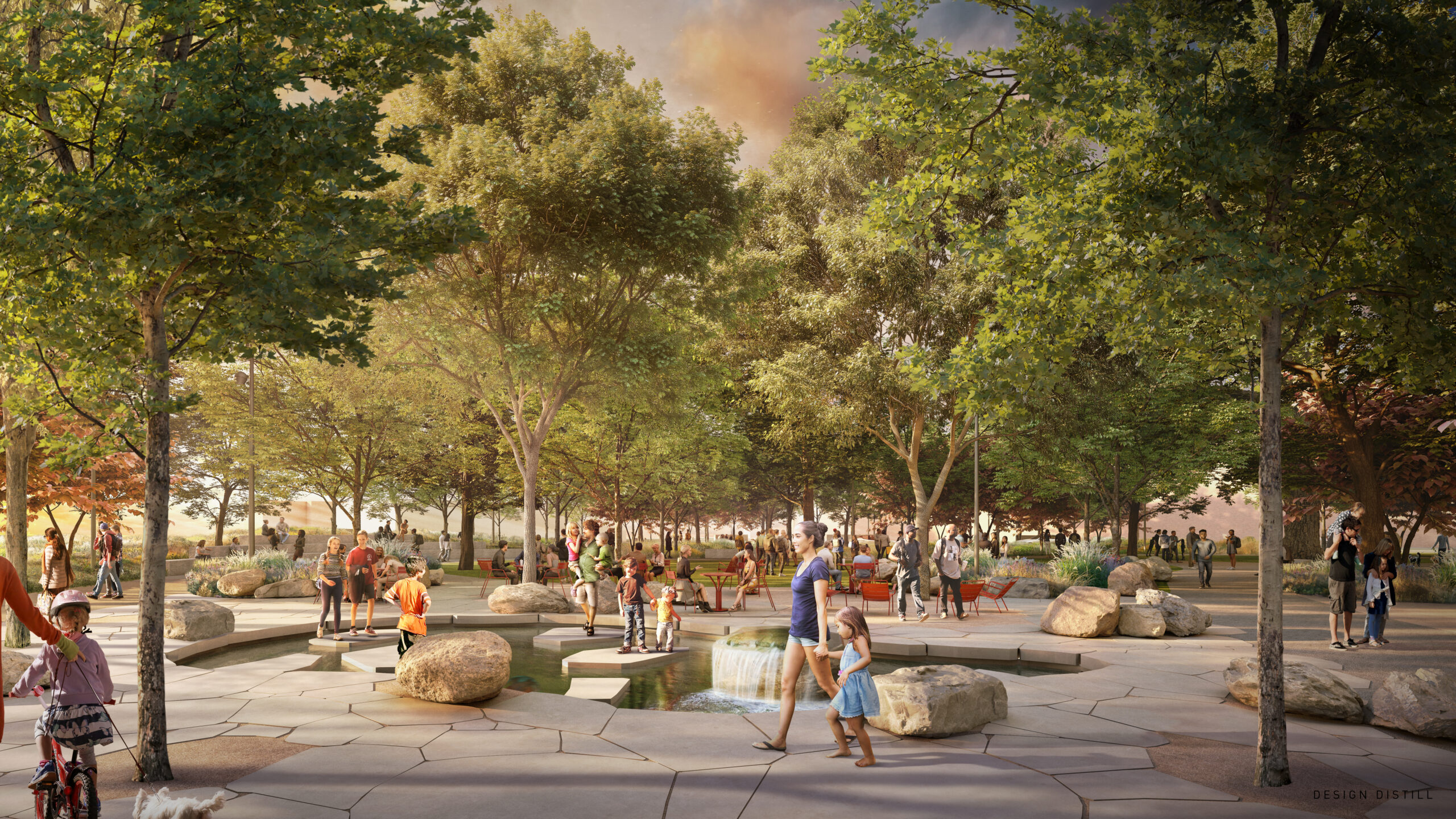
Columbus, Indiana park plaza, via Merritt Chase.
In some cases, this means redesigning existing plazas and streetscapes to make them genuinely comfortable and welcoming places. That includes adding shade, seating, gardens, wider sidewalks, safer crossings, and road diets that prioritize pedestrians over cars. We’re seeing this in downtown Columbus, Indiana, one of America’s most design-centric small cities. Despite its celebrated architectural legacy, the city’s primary downtown gateway—a 2.25-acre plaza originally designed by Michael Van Valkenburgh Associates in 2000—has struggled to function as a true community gathering space because it is surrounded by multilane traffic. The site is now being reimagined as a signature civic green space that builds on Columbus’ design legacy while connecting to broader riverfront and downtown redevelopment efforts.
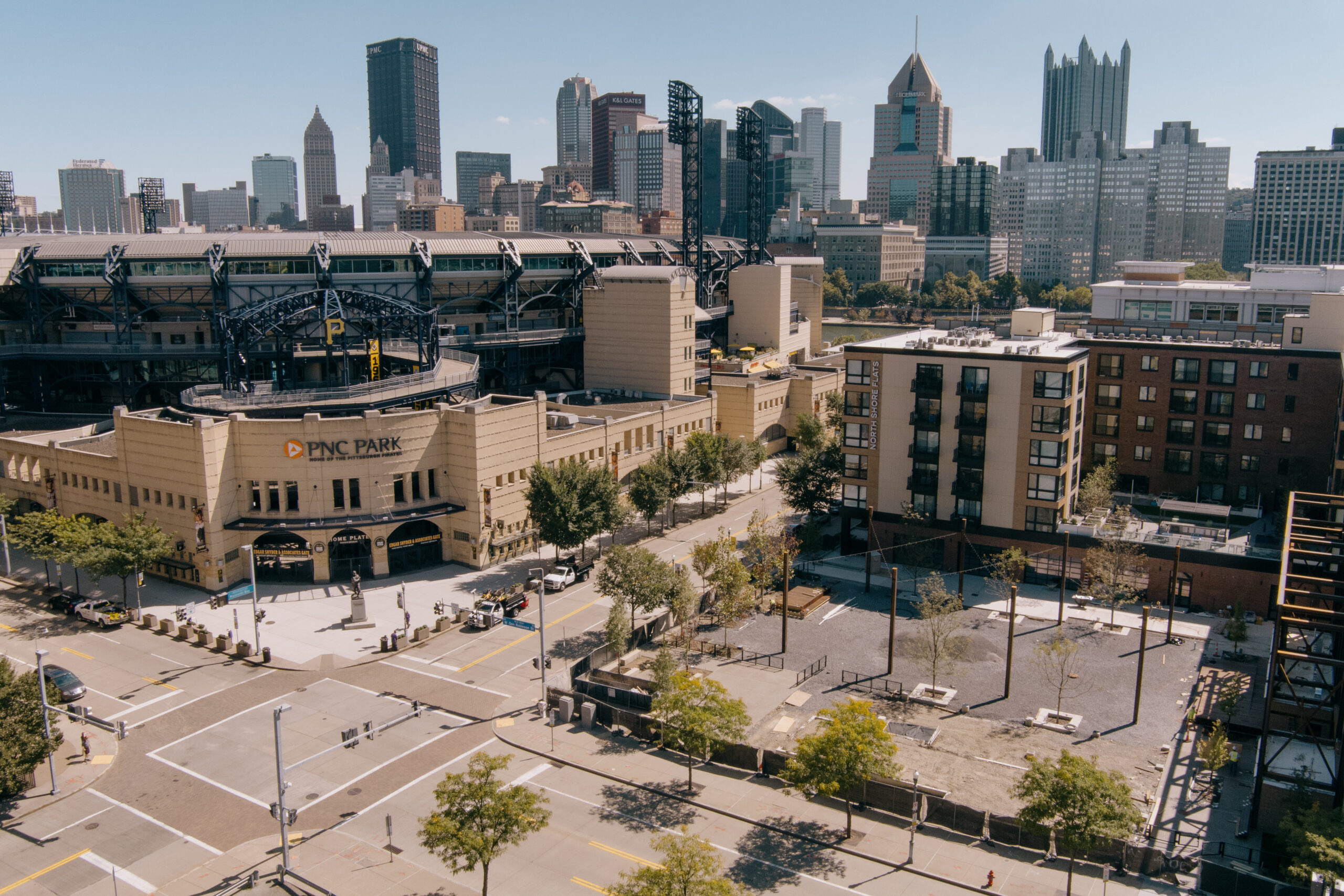
The Plaza at North Shore, under construction in Pittsburgh. Photo by Kristian Thacker.
In other places, the opportunity lies in creating entirely new public spaces, including in neighborhoods that previously lacked meaningful gathering places. In Pittsburgh, this includes transforming more than 30,000 square feet of surface parking in the North Shore sports and entertainment district into the Plaza at North Shore. The project introduces an outdoor music venue, a flexible public plaza for both everyday and event-day use, and new restaurants that activate the surrounding streets and public realm.
This new urbanism is also about reconnecting cities through trails, sidewalks, and public infrastructure that knit neighborhoods and public spaces back together. Cities like Pittsburgh and Cleveland are investing in projects that reconnect residents to their riverfronts—not only as civic destinations, but also as part of broader active transportation networks that make it possible to walk, bike, and run between places that once required driving. In many cases, these efforts are helping repair neighborhoods that were historically divided by highway infrastructure.
The City of Pittsburgh’s Comprehensive Plan, for example, prioritizes connecting the city’s 90 neighborhoods to its three riverfronts through a network of trails and green infrastructure corridors that also address stormwater management and landslides. In Cleveland, the Midline project proposes a new linear greenway and industrial district that will reconnect residents to jobs and opportunities while creating a much-needed southeast-to-northwest connection across the city’s east side.
Integrating Local Culture and Community Values
Rather than replicating national design trends or coastal precedents, cities across Middle America are increasingly leaning into the qualities that make them distinct. This includes embracing their quirks, eccentricities, industrial legacies, and overlooked landscapes—the very things many cities once tried to hide or move beyond. In doing so, a more regionally grounded approach to landscape architecture, urban planning, and public space design is beginning to emerge, one that celebrates what’s unique about each place while thoughtfully reimagining the systems and spaces that no longer serve communities well.
For our practice, this means working across scales and formats: constructing permanent public landscapes, developing long-range master plans, creating temporary installations, and leading research and engagement efforts that build momentum for long-term transformation of the public realm. Based in the Midwest and Appalachia, our work is shaped by the people, histories, and cultural figures that have defined the region—from Fred Rogers’ neighborliness, Roberto Clemente’s humanitarianism, and Jens Jensen’s Midwestern regionalism, to Rachel Carson’s environmental advocacy, August Wilson’s powerful storytelling about identity, Andy Warhol’s eccentricity, and Kurt Vonnegut’s wit and humanism.
At the same time, we recognize that Middle America is not a monolith. College towns face affordability pressures and rapid growth. Rust Belt cities continue to grapple with aging industrial infrastructure and the environmental impacts of pollution. Appalachian communities contend with steep topography, disinvestment, and increasingly severe flash flooding. Across the Great Plains, agricultural monocultures have reshaped both economies and ecosystems. Each of these places requires a different design response rooted in local realities.
Designing for these cities means working in close partnership with the people already shaping culture and civic life on the ground: artists, organizers, advocates, educators, business owners, environmental stewards, and community leaders who are helping build more accessible, inclusive, and locally rooted futures.
Our approach to community engagement is centered on uncovering and elevating local culture, values, and lived experience. Rather than treating engagement as a box to check, we see it as an ongoing process of listening, relationship-building, and co-creation. We use workshops, temporary installations, public programming, storytelling, and on-site experimentation to better understand how communities already use and value their public spaces. Often, these efforts help reveal overlooked histories, cultural rituals, neighborhood identities, and everyday patterns that can meaningfully shape design outcomes.
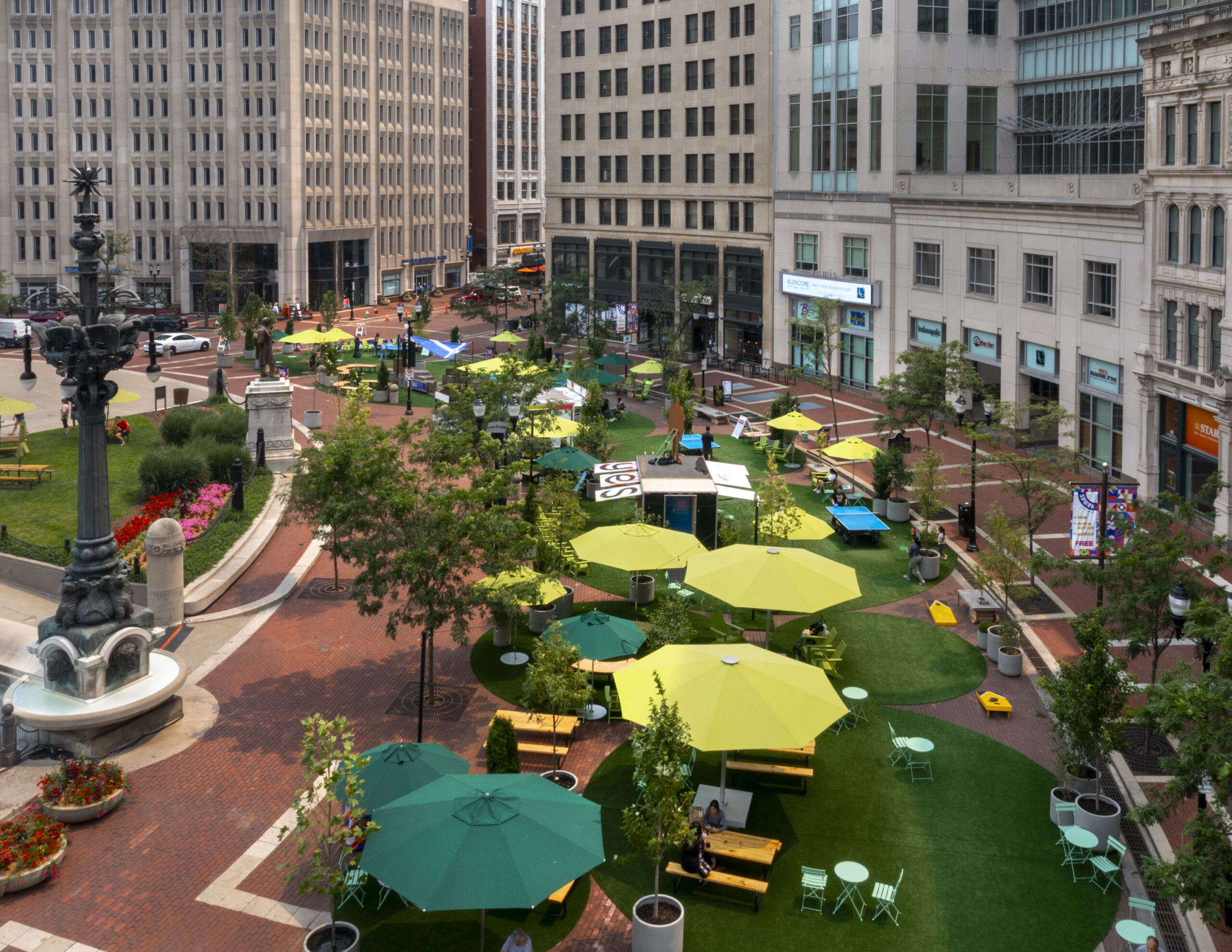
Monument Circle, Indianapolis. Photo by Hadley Fruits.
In Indianapolis, for example, a temporary park installation at Monument Circle has demonstrated how public space can be reimagined through programming and community partnership. Over the last four summers, the project’s success has been driven not only by the physical transformation of the space, but by the work of the city’s Department of Metropolitan Development, Downtown Indy Alliance, and Big Car Collaborative, whose programming has turned a traffic circle many residents once simply drove past into a multicultural, multigenerational civic gathering space. Through performances, events, food, art, and everyday use, the installation has helped people imagine Monument Circle—and downtown itself—in a new way.
Culturally, this work is also about elevating the people and organizations reshaping the region from within. By supporting and collaborating with local creatives, advocates, and civic leaders, public space projects can help shift perceptions of Middle America: not as a place defined by decline or nostalgia, but as a region actively inventing new models for community life, culture, and urbanism.
Embracing Regional Ecology, Aesthetics, and History
Much of the public space design across Middle America has historically relied on generic material and planting palettes that could exist almost anywhere in the country. But this kind of placeless design is a major missed opportunity. Integrating native and regionally appropriate planting palettes—such as Midwestern prairies, Appalachian woodlands, Great Lakes coastal ecologies, and river corridor habitats—can deeply connect public spaces to their local environments. The same is true for material choices. Indiana limestone, Pittsburgh’s distinctive yellow brick, weathered steel, industrial artifacts, timber, and locally sourced stone all help ground projects within their regional and cultural context. Even something as seemingly ordinary as paving can contribute to a stronger sense of place through thoughtful choices about material, texture, color, and pattern.
For decades, many cities across the Midwest, Rust Belt, and Appalachia have turned their backs on the infrastructure that once powered them—treating bridges, tunnels, rail corridors, industrial waterfronts, inclines, and aging civic structures as liabilities or uncomfortable reminders of a bygone era. But this infrastructure can become one of the region’s greatest public assets when it is creatively reimagined and reintegrated into civic life.
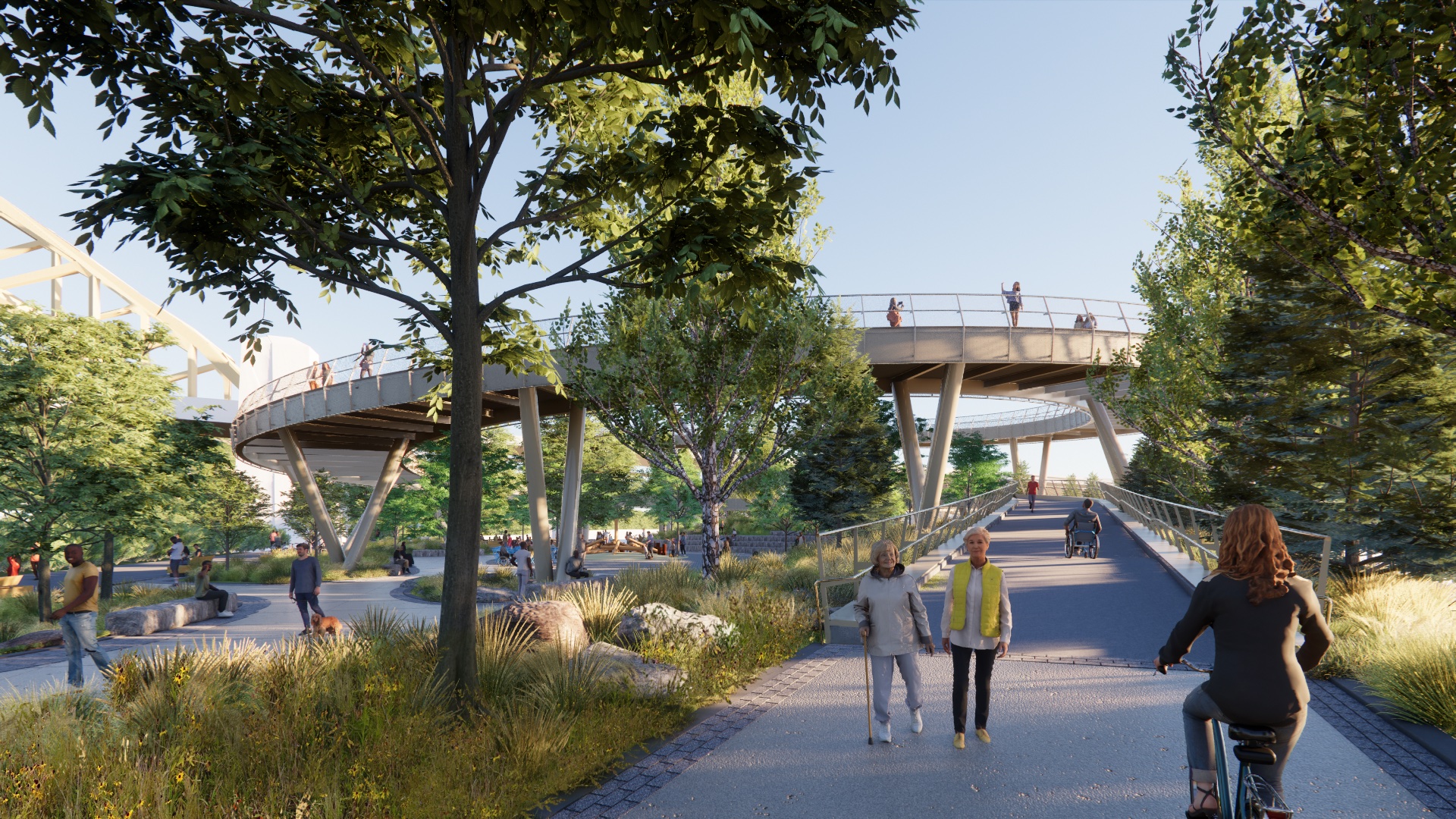
West End Bridge Connectors, Pittsburgh, via Merritt Chase.
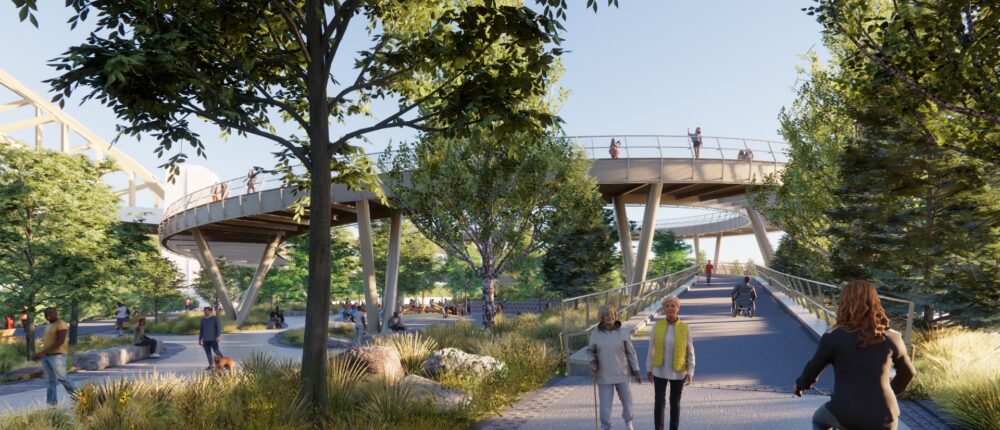
In Pittsburgh, projects like the West End Bridge Connectors aim to reconnect neighborhoods, trails, and riverfronts to one of the city’s most iconic pieces of infrastructure—transforming the bridge from a barrier into a civic connector. At Point State Park, ongoing conversations about the future of the public realm seek to strengthen connections between downtown and the riverfronts, while reasserting the park’s role as both a national historic landmark and an everyday civic space.
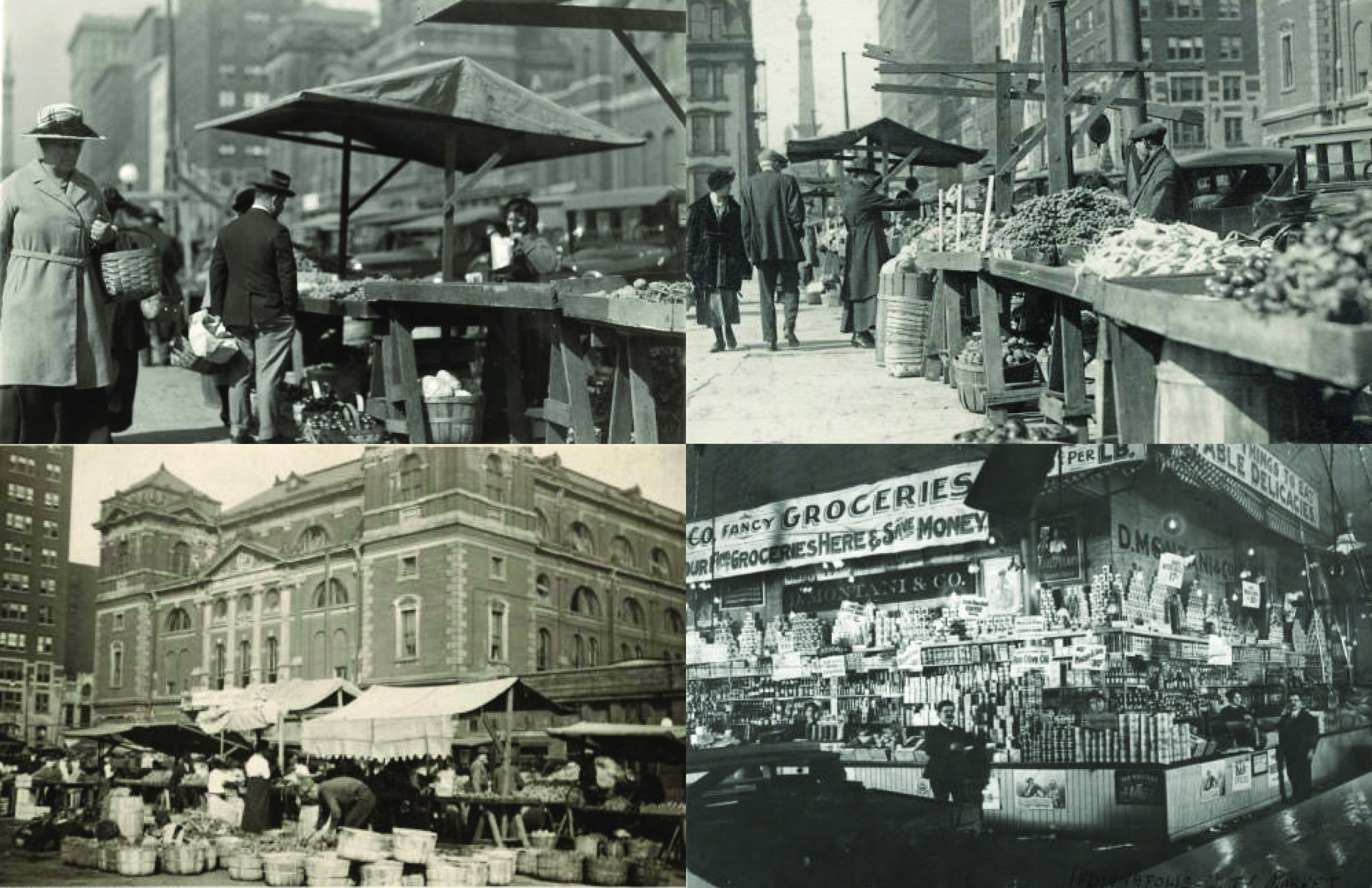
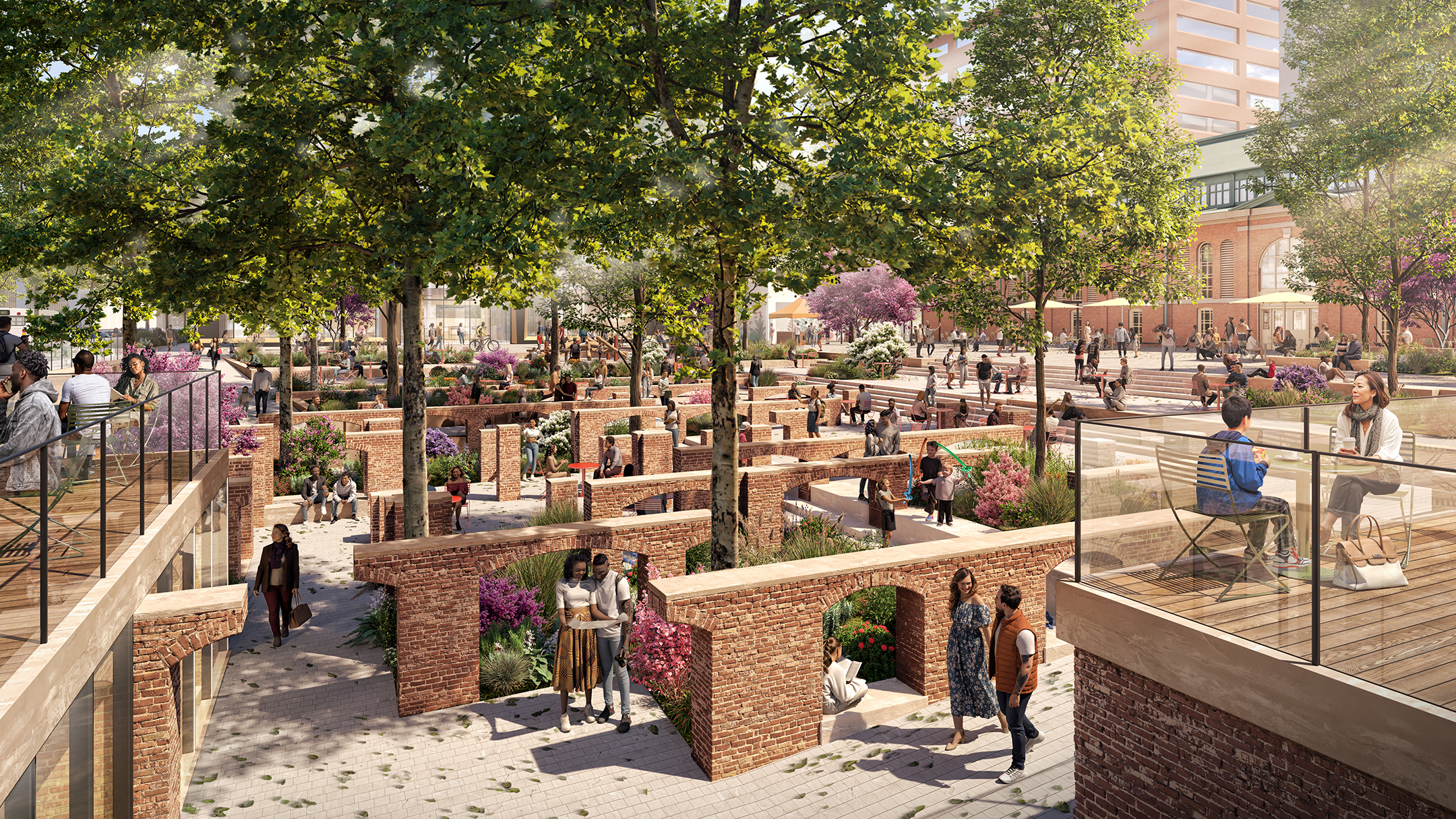
Top: Indianapolis’ City Market. Above: a rendering of a proposal that would transform it into pubic space, via Merritt Chase
In newer Middle American cities, where industrial history may be less visible in the urban fabric, designers are increasingly using archival research and storytelling to uncover overlooked social and cultural histories. In Indianapolis, for example, future plans surrounding City Market are exploring how the catacombs beneath a 19th century social hall can be transformed into a new public garden and cultural destination as part of a broader mixed-use redevelopment and historic preservation effort. Rather than erasing the past, projects like these use design to surface hidden histories and create new forms of civic memory.
Middle America’s subregions also possess distinct ecologies shaped by rivers, forests, prairies, hillsides, watersheds, and the Great Lakes. These landscapes should not be flattened, avoided, or disguised—they should be embraced and amplified through design. In Pittsburgh, for example, the city’s dramatic topography has often been treated as a constraint rather than an asset. As part of the first comprehensive plan in Pittsburgh’s history, Toni L. Griffin and Urban American City, alongside a multidisciplinary team including HR&A Advisors, Merritt Chase, Buro Happold, Cityfi, Sasaki, Grayscale Collaborative, and 1Hood Media, are developing a topography-informed land use framework that leans into the city’s steep slopes and river valleys rather than trying to overcome them.
Embracing regional ecology also means understanding and responding to the environmental histories embedded within these places. Many of the defining figures and movements of the American environmental movement emerged from the Midwest, Rust Belt, and Appalachia. Rachel Carson, who spent much of her life in and around Pittsburgh, helped spark the modern environmental movement through her writing and advocacy. In Cleveland, the pollution and repeated fires on the Cuyahoga River became a national symbol of industrial environmental degradation and helped catalyze the creation of the Environmental Protection Agency and modern environmental regulation in the U.S.
Today, new public space projects across the region have the opportunity—and responsibility—to acknowledge and repair these environmental legacies. At the same time, they must respond to contemporary climate realities by mitigating future harm, restoring biodiversity, and designing for resilience. In the Midwest and Rust Belt, this increasingly means designing for heat, high winds, severe rain events, flooding, and aging infrastructure systems.
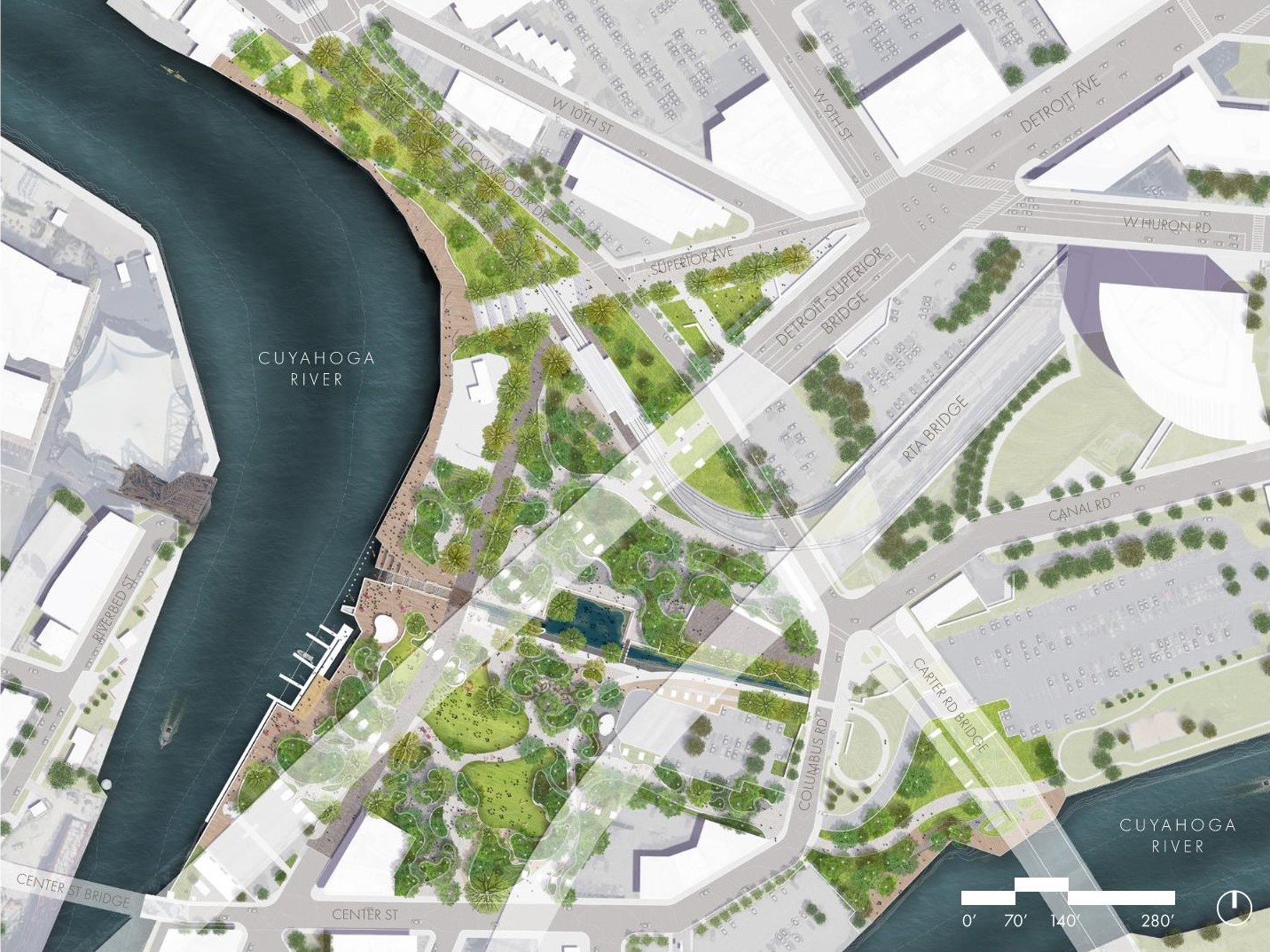
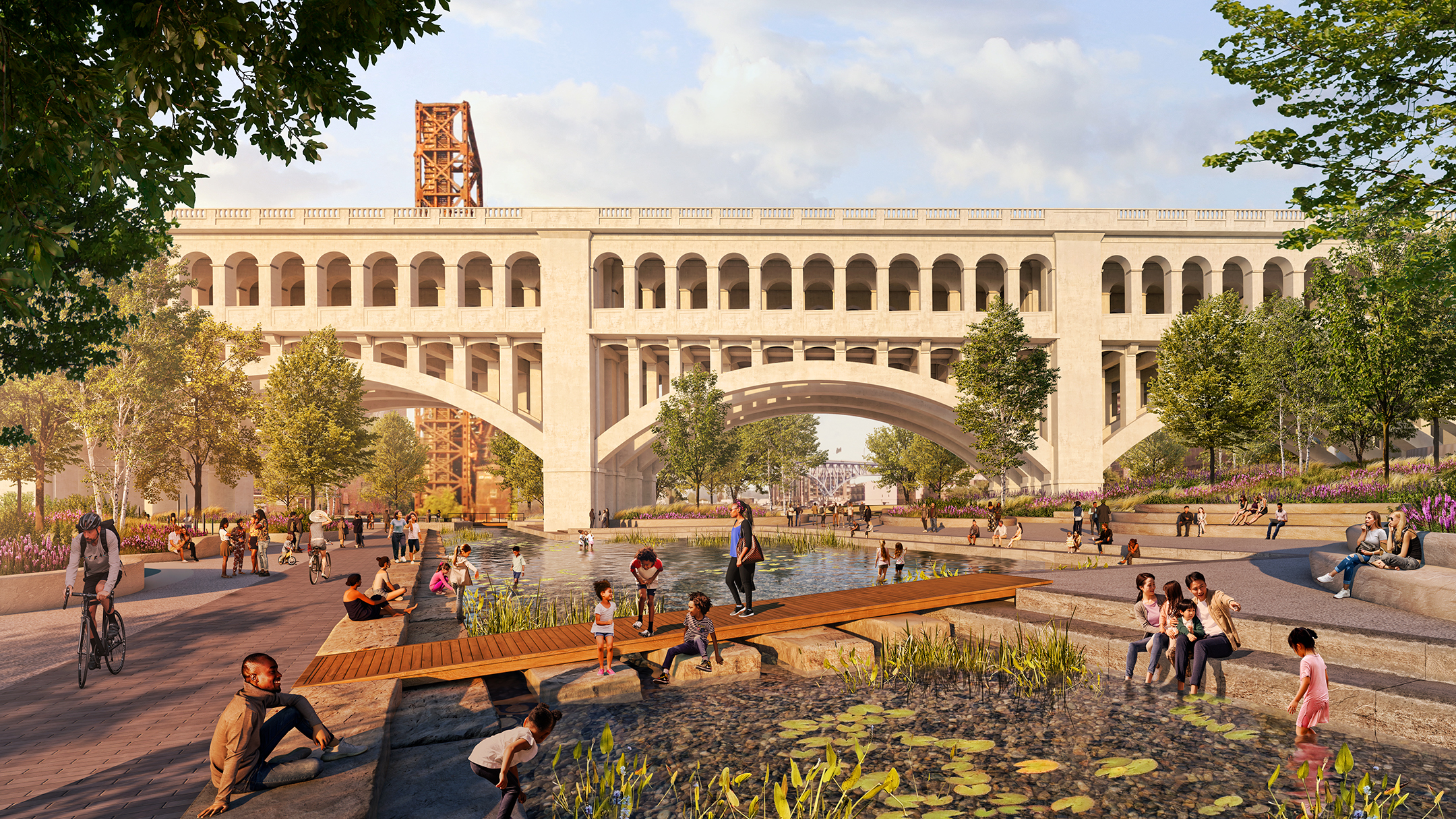
Canal Basin Park in Cleveland. Rendering and site plan via Merritt Chase.
The design of Canal Basin Park in downtown Cleveland is one example of this approach in practice. The new 20-acre riverfront park, located at the historic intersection of the Ohio & Erie Canal and the Cuyahoga River, transforms an underutilized site into a public landscape deeply connected to its environmental and industrial history. The original footprint of the historic canal basin is being reinterpreted as a stormwater collection and treatment system that will filter, clean, and recirculate water into a signature civic water feature at the heart of the park—turning infrastructure and environmental repair into a visible and experiential part of the public realm.
Ultimately, this emerging approach to public space in Middle America is not about nostalgia, but about rediscovering and reinvesting in the qualities that make these places distinct. Echoing the late historian and Pittsburgher David McCullough’s call to Pittsburghers to “not make it like other places,” a new generation of landscape architects, civic leaders, institutions, and communities across the Midwest, Rust Belt, and Appalachia is embracing a deeply regional approach to design—one grounded in local culture, ecology, history, infrastructure, and lived experience. Rather than relying on generic, off-the-shelf solutions, these projects draw from vernacular landscapes, local materials, native ecologies, industrial legacies, and meaningful community engagement to create public spaces that feel authentic, resilient, and rooted in place. In doing so, they are helping redefine the future of public space in Middle America—not by making these cities look like somewhere else, but by creating public realms that could exist nowhere else but here.
Featured image: West End Bridge Connectors, Pittsburgh, courtesy of Merritt Chase.