
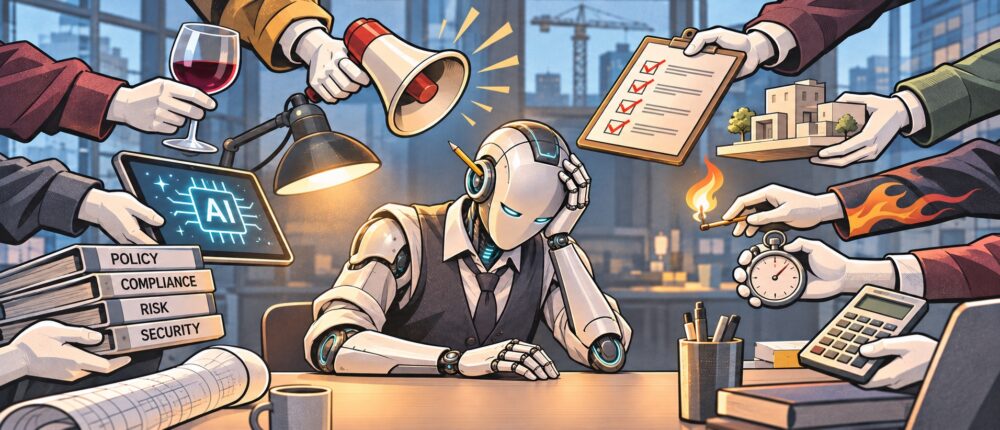
AI Walks Into an Architecture Firm…
Years ago, some friends and I got to wondering about what an architectural version of The Office would look like. The conversation didn’t go anywhere. You can tell because I’m not a famous Hollywood screenwriter. We realized that The Office was a successful show because it exposed archetypes that most office workers, whatever their industry, could relate to. The rule-obsessed, self-appointed apparatchik (Dwight), the gossipy customer rep (Kelly), the cringeworthy boss who just wants to be liked (Michael)—they’re all characters that just about everyone would find familiar. The list of archetypes in an architecture firm, however, would only really seem familiar to architects:
- That one person who worked for (insert famous architect) once upon a time and feels the need to mention it in every conversation.
- That one young designer who can make the software do anything, but doesn’t know how a building goes together.
- That one project executive who’s so protective of client relationships that no one in the firm even knows how to contact them.
The list goes on. Seeing as how GenAI is changing everything else about architecture, it made sense that it would change the list, too. Beginning in 2023, new archetypes, formed around architects’ stances on AI, started to emerge, and you’ve probably met a few of them:
- That one architect who insisted any revolutionary aspect of AI would bypass architecture completely, since architecture was so important/complicated/special.
- That one architect who thought AI was going to automate all the drudgery of architecture, and we’d all just spend all day designing, like when we were in school.
- That one architect who maintained that AI was just “fancy autocomplete.”
The last few years have seen the number of AI-based archetypes expand and crystallize into a raucous bunch of characters, perhaps even enough to staff a sitcom. Still dreaming of Hollywood stardom, I sat down to sketch them all out and arrived at about 40 or so. I had to jettison half of them to avoid seriously offending anyone. The remaining 21 should only be mildly offensive, funny, or both.
The New Firm Geography
To help us understand these 21 emerging personalities that GenAI has given rise to, it’s probably best to start with where they live—professionally, I mean. Emergent ideological conflicts around this new technology have given rise to new firm “departments.” Not literal departments, but maybe more like camps or cliques of sympathetic-minded professionals who are allied more by their professional attitudes toward AI than by their formal professional role. I’d say there are now five:
The Hype Department
In charge of constantly extolling the virtues of AI and expounding on all the ways in which it’s revolutionizing work, whether it is or not. They hype inside the firm, they hype outside the firm. They’re terrified the firm might be seen as falling behind, and so maintain (and sometimes create) the narrative that the firm is racing ahead, teetering on the frontier between field-leading progress and literal magic.
The Department of Futile Caution
In charge of keeping the firm safe. On any given day, you never really know what the DFC is actually keeping the firm safe from. Some days, they’re guarding the firm against legitimate liability risks. Other days, they’re keeping it safe from growth, progress, profits, etc. They can’t tell you, because they can’t tell one from the other.
The Ownership Arbitration Department
In charge of figuring out, in the age of AI, who actually owns the work—legally, yes, but also philosophically and conceptually. If an architect prompts an AI to create something, and it does, is that a creation of the architect, or of the AI? Or the sum of whatever the AI was trained on? Who gets paid for what? The OAD is almost always at odds with itself, for the same reason that architects are always at odds with themselves: they want ownership of the creation without the liability that comes with it. They want revolutionary designs, but lawyer up when the roof starts leaking.
The Department of Professional Self-Destruction
In charge of ensuring the future success of the firm by destroying the profession. Does this sound stupid? Yes, but don’t judge them too harshly. It’s no more stupid than a species that measures its development by how much of its planet’s limited natural resources it can burn up. The DPSD is driven by the same instinct. And in an effort to adopt AI for the firm, they steadily erode the foundations of professional practice, and sow the seeds for calamity, for any future aspiring architect.
The Department of Applied Contradictions
This is where the work actually happens. It’s where the competing wills of the other departments are worked out in actual drawings, and models, and migraines. It’s not all CAD/BIM gurus, though. That would be simple and absent of drama, which hardly makes for good television.
Within the connective tissue of these five departments, the true future of architecture is being worked out.
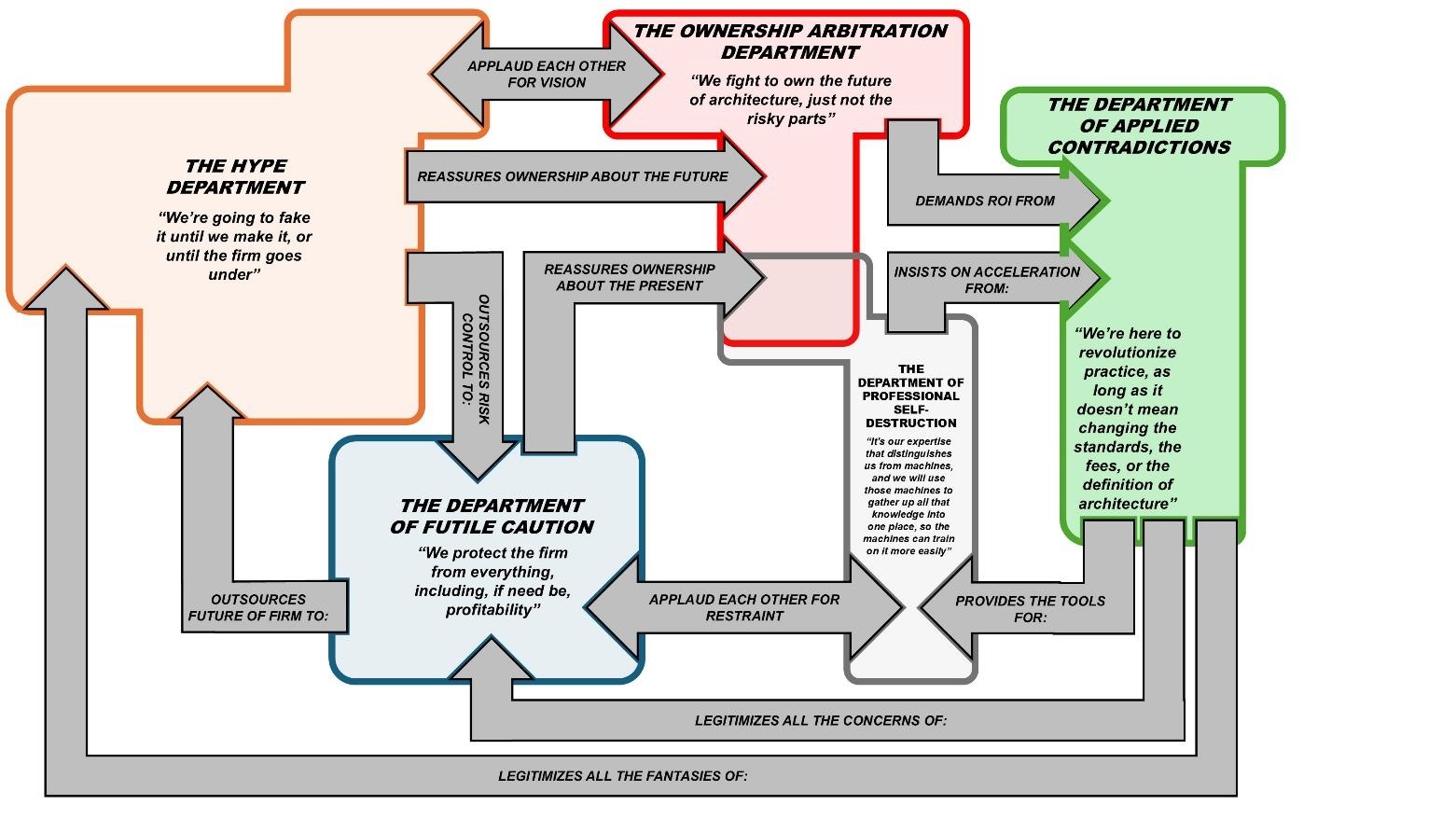
And within each department, distinct personalities argue fervently among themselves.
An Inside Look: The Hype Department
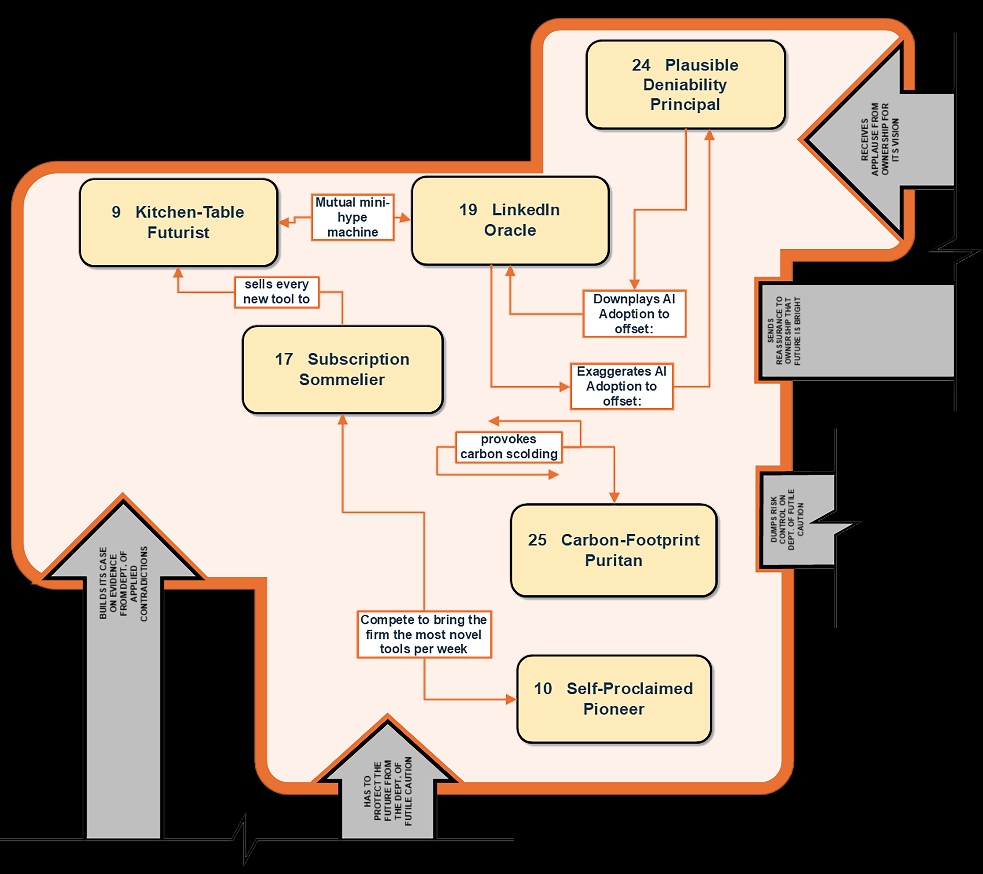
Motto: “We’re faking it until we make it, or until the firm goes under.”
#17: The Software Subscription Sommelier. Has personally tested every AI application ever released and can explain the subtle differences between 17 rendering platforms, 12 coding assistants, and eight agent frameworks. Has convinced the firm to purchase $100,000 in annual subscriptions, but everyone mostly just uses their $20/month plan. Signature line: “Oh, you’re still using THAT? Dude. You gotta try THIS.”
#9: The Kitchen-Table Futurist. A senior principal who is absolutely convinced AI represents the greatest transformation in architecture since reinforced concrete and insists everyone in the firm start using it immediately. His personal experience consists almost entirely of generating soup recipes, restaurant recommendations, and humorous birthday poems for his spouse. Signature line: “OMG, everyone, you have no idea what this technology can do.”
#10: The Self-Proclaimed AI Pioneer. Regularly announces extraordinary AI breakthroughs that he personally discovered through months of tireless experimentation. The breakthroughs invariably turn out to be workflows someone posted on Reddit two years ago. Signature line: “Look what I figured out …”
#19: The LinkedIn Oracle. Hasn’t produced a construction document since 2014 but has become an internationally recognized authority on AI’s transformation of architectural practice. Posts 17 times a week about how architects must adapt, despite having no discernible experience actually adapting anything. Signature line: “AI won’t replace architects. Architects who use AI will replace architects who don’t.”
#25: The Carbon-Footprint Puritan. Refuses to use generative AI because of its catastrophic environmental consequences and maintains a spreadsheet estimating the carbon footprint of every ChatGPT query made by the firm. Has never calculated the environmental impact of the firm’s five-person delegation to Climate Week in New York City every year. Signature line: “You know every one of your prompts consumes a whole glass of water, right?”
An Inside Look: The Department of Futile Caution
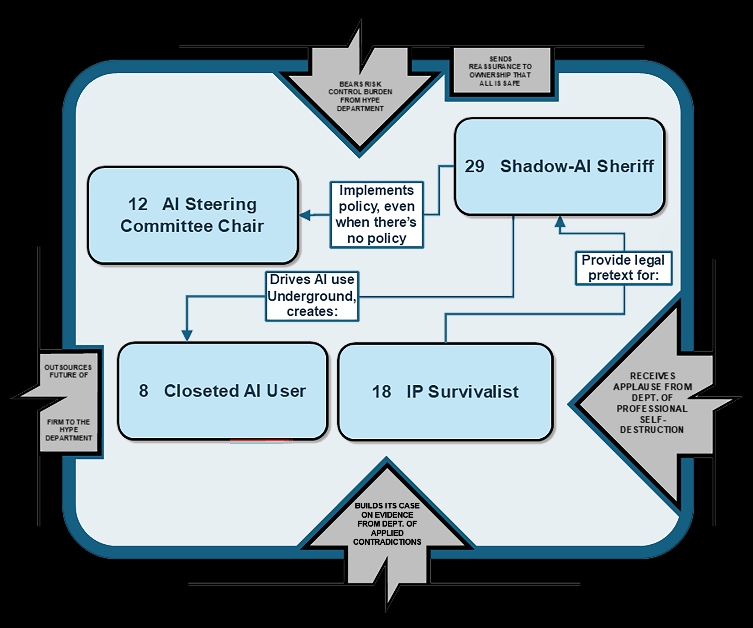
Motto: “We protect the firm from everything—including, if need be, profitability.”
#12: The AI Steering Committee Chair. Has made responsible AI adoption the firm’s highest strategic priority, establishing four committees, commissioning three risk assessments, and scheduling a two-day leadership retreat. Eighteen months later, nobody has actually been authorized to use anything. Signature line: “Before we move forward, I think we need to establish a framework for [blank].”
#29: The Shadow-AI Sheriff. The IT director who has blocked ChatGPT, Claude, and every other AI application pending a comprehensive security review, inadvertently driving the entire firm’s AI usage onto personal devices and unmonitored accounts. Proudly reports to the executive committee that unauthorized AI usage has been reduced to zero. Signature line: “We take information security very seriously. And the greatest threat to security is everyone’s access to information.”
#18: The Intellectual Property Survivalist. Absolutely terrified that AI companies are stealing the firm’s irreplaceable intellectual property, which consists largely of modified manufacturer details and design ideas borrowed from other architects. Regards AI training on architectural work as theft but considers his own lifelong practice of studying and adapting other architects’ work to be evidence of a sophisticated understanding of architectural precedent. Signature line: “When they do it, it’s theft. When I do it, it’s an homage.”
#8: The Closeted AI User. Makes a great show of defending human creativity and independent professional judgment while quietly using ChatGPT to write every email, proposal, and presentation. Occasionally criticizes AI-generated work in a meeting, then returns to his desk and asks Claude to make his criticism sound more authoritative. Signature line: “Personally, I prefer to do my own thinking.”
An Inside Look: The Ownership Arbitration Department
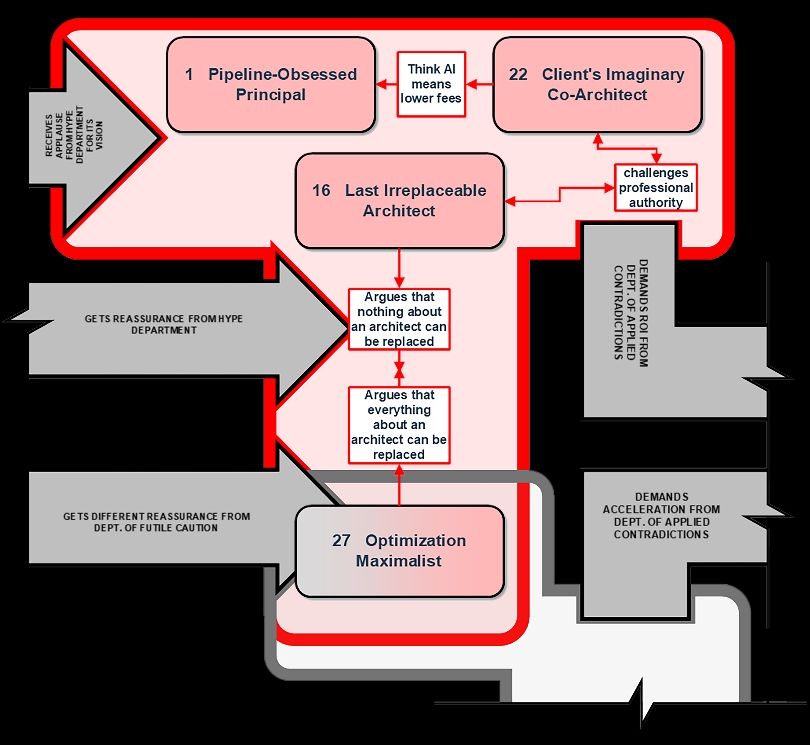
Motto: “We fight to own the future of architecture—just not the risky parts.”
#16: The Last Irreplaceable Architect. Absolutely convinced AI will eliminate thousands of architectural jobs and automate virtually every aspect of professional practice, with the singular exception of whatever she happens to be doing at the moment. Signature line (repeated monthly): “Yes, AI can do that now. But that’s not what architecture is really about.”
#27: The Optimization Maximalist. Believes architecture has finally entered the scientific age, in which every design decision can be objectively optimized via AI. His latest residential design outscored 10,000 other AI-generated possible designs, according to his design optimization agent, despite having the visual appeal of a municipal wastewater treatment plant. By trying to reduce design to an equation, the Optimization Maximalist also earns an honorary spot in the Department of Professional Self-Destruction. Signature line: “This is objectively a better design than [blank].”
#22: The Client’s Imaginary Co-Architect. Has discovered that Claude is a much more agreeable design partner than the architect he’s paying and now arrives at every meeting with AI-generated alternatives that completely undermine the previous week’s decisions. Believes the architectural fees should be reduced because he’s now doing half of the design work himself. Signature line: “I don’t want to get in your lane, but I was messing around with Claude last night and …”
#1: The Pipeline-Obsessed Principal. Knows perfectly well that AI is transforming architectural practice, but after 36 consecutive months of declining billings, his primary interest is filling the firm’s project pipeline before everyone gets laid off. Has mastered enough AI terminology to sound sophisticated in client meetings, but the interest in the technology ends exactly where the client’s interest ends. Signature line: “Absolutely, we’re doing some very exciting things with AI. I can’t really share specifics until you’re a contracted client …”
#24: The Plausible Deniability Principal. Insists the firm become AI-native and enthusiastically demands that every department integrate AI into its workflows, right up until the professional liability insurance renewal arrives. Has instructed marketing to advertise the firm as AI-powered and legal to deny that characterization. Signature line: “Of course we use AI. Responsibly.”
An Inside Look: The Department of Professional Self-Destruction
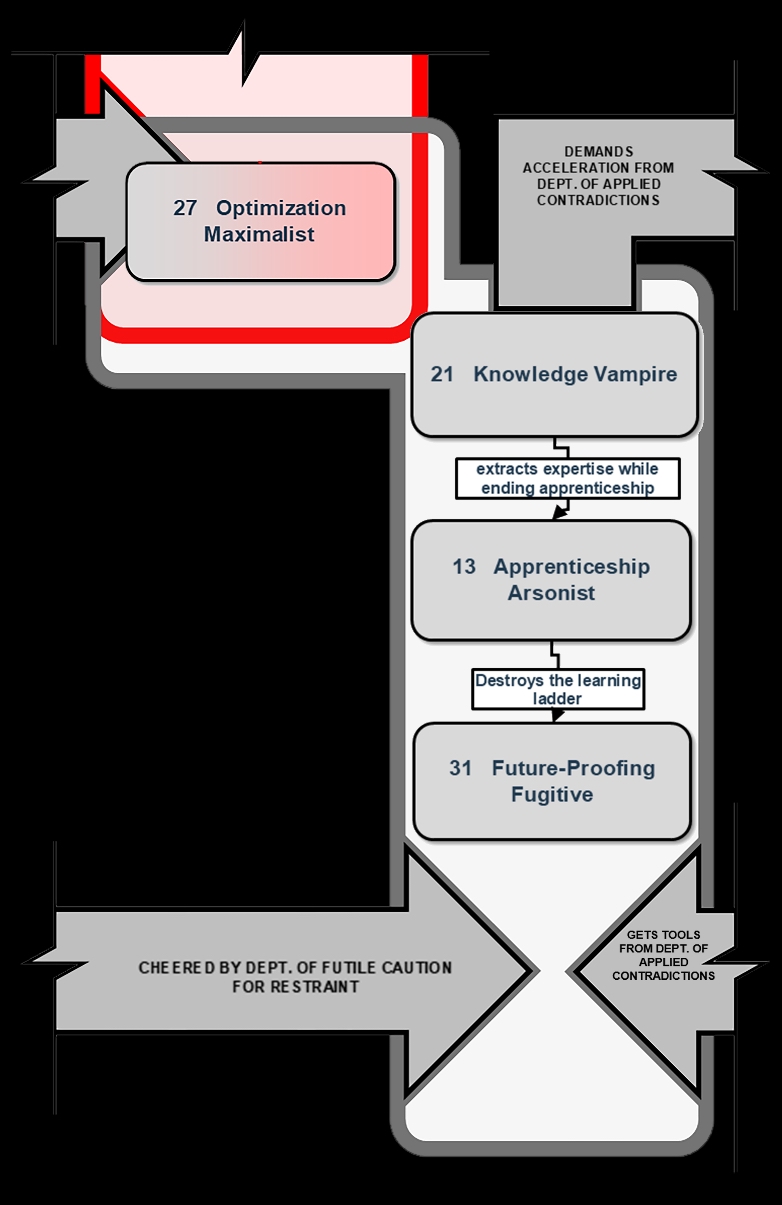
Motto: “It’s our expertise that distinguishes us from machines, and we will use those machines to gather up all that knowledge into one place, so the machines can train on it more easily.”
#13: The Apprenticeship Arsonist. A senior principal delighted that AI can eliminate the expensive, inefficient production tasks traditionally assigned to junior architects, thereby dramatically reducing staffing costs. Six months later, complains bitterly that nobody coming out of architecture school knows how to detail a building or put together a construction document set. Signature line: “I don’t understand what’s happening to architectural education. Nobody knows anything anymore.”
#21: The Institutional Knowledge Vampire. Believes the firm’s greatest asset is the accumulated knowledge of its experienced architects and has accordingly launched an ambitious initiative to extract everything they know into a proprietary AI system. Cannot understand why 40-year veterans seem unenthusiastic about spending their afternoons training their replacement. Signature line: “We’re not trying to replace you, Bob. We just want to make sure your wisdom is shared and accessible to everyone.”
#31: The Future-Proofing Fugitive. A talented young architect who has successively reinvented herself as a visualization specialist, prompt engineer, computational designer, and AI agent developer, only to watch each new specialization become increasingly automated. Recently decided to move into CA because somebody still has to visit actual buildings, until a colleague showed her an autonomous construction inspection robot. Signature line: “I’m just trying to identify the one thing AI will never be able to do. Rent is due.”
An Inside Look: The Department of Applied Contradictions
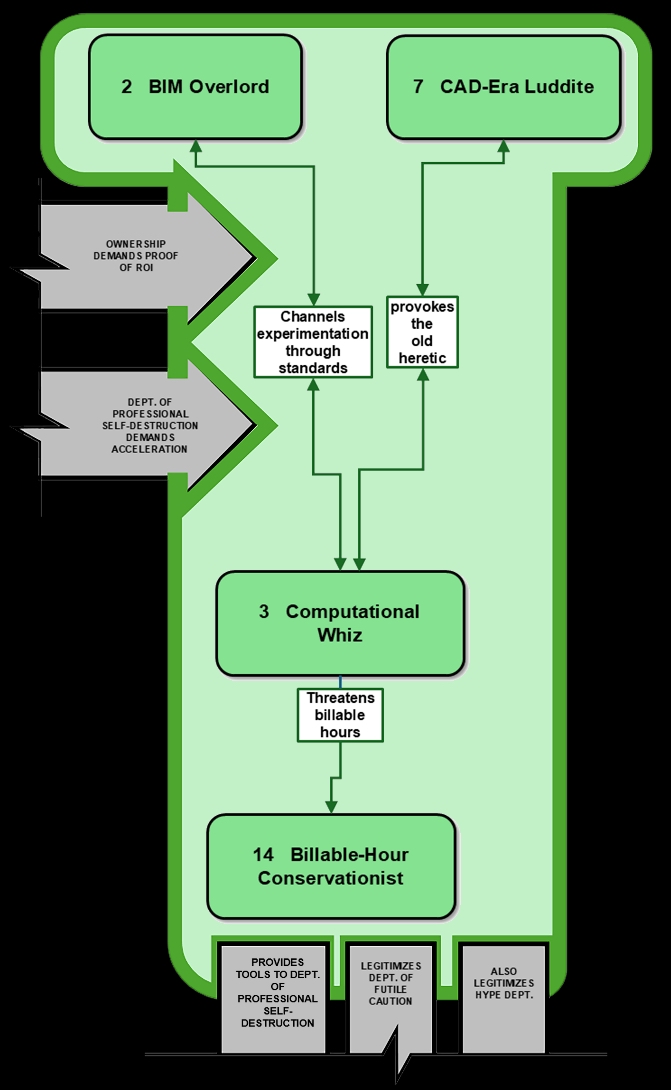
Motto: “We’re here to revolutionize practice, as long as it doesn’t mean changing the standards, fees, roles, or definition of architecture.”
#2: The Newly Anointed BIM Overlord. After 15 years of being ignored whenever she raised questions about BIM standards, interoperability, and digital workflows, she has suddenly become the most important person in the firm. The principals now require her approval for virtually every AI initiative, and she’s enjoying it. Signature line: “Interesting that you’re asking me now. I’ve been raising this issue since 2017.”
#3: The Young Computational Whiz. A brilliant young architect who can write Python scripts, build autonomous agents, optimize parametric models, and automate workflows that would previously have taken entire teams weeks to complete. Unfortunately, he has no particular understanding of how architectural practice operates, what CDs are supposed to communicate, how buildings go together, or why the clients are pissed. Signature line: “I automated the whole process. It should be fine. I’m not sure what happened.”
#7: The CAD-Era Luddite. Insists that AI distances architects from the essential intimacy of the design process and threatens the profound human connection between the architect and the work. Thirty years ago, he led his previous firm’s transition from hand drafting to CAD and contemptuously dismissed the older architects who made precisely the same argument. Signature line: “CAD was different. That was just a tool.”
#14: The Billable-Hour Conservationist. A managing principal who is absolutely thrilled that AI can accomplish eight hours of production work in 20 minutes. Has spent the past six months evangelizing about AI productivity while simultaneously berating project managers for declining utilization rates. Signature line: “AI was going to revolutionize our productivity! Why isn’t it showing up in my quarterlies?”
Writing the Script for the Future
Given my satirical treatment of these characters, you might imagine that a firm full of them would inevitably circle the drain toward failure and bankruptcy. But that’s not necessarily the case. You can succeed for years with an office full of dysfunctional clowns, just like at that firm you used to work at. Or, hell, look at The Office—it ran for 201 episodes over nine seasons.
But we’re in a new age, and this ain’t Hollywood. Slow, grinding progress toward AI adoption is probably the same thing as no progress at all. To prevail, our 21 heroes need to make their friction productive. AI doesn’t live in the IT department or the C-Suite; it lives everywhere. Thus, so does the friction. And there’s no department to hand that friction to. Maybe that’s both the lesson and a window to the future: The firm of the future isn’t the one with the fanciest tech, but the one that best negotiates these ideological factions and frictions, without letting any one of them become the whole script.
All images created by the author.