
Can Cities Plan and Design for Spontaneity?
A classic joke has a lost tourist in a sportscar, seeking directions from a Maine old-timer on a porch. “You can’t get there from here,” the native keeps saying, until the tourist barks that the local doesn’t seem very bright. “I ain’t lost,” the old-timer replies. Among other things the tourist misses, consider the genius of the place. Let’s assume some filigree on the Mainer’s rocker or some Shaker detailing on the porch passed him by. You need to build skill in looking around and exploring to learn from a distinctive place. And as long as we get around by GPS, we’re as lost as the tourist.
These days, our apps guide us with a chillier message: You can get there from here, exactly as we tell you to go. This condition saps peoples’ spontaneity, at a time when we’d seem to desperately need it. Our society faces unpredictable weather, uncharted technology, and unheard-of inequality. That all seems more addressable when more of us can improvise into new conversations, contexts, and ideas. And so designers and clients face a slipperier challenge than the lost tourist: they have to encourage people to improvise their way through more of public life.
Before I suggest some frameworks for this task, let’s give GPS its due. Google Maps, as procrastinators know, will calculate a walking route from Manhattan Beach, Brooklyn, to Manhattan Beach, California, warning you that it includes a ferry. It will also guide you from 405 E 61st Street to 405 E 63rd Street, which it declares you can cover in four minutes. This can save time and gasoline. But it also routes too many people onto the same paths: neighborhood streets clog as every driver takes a “shortcut” and other streets stay silent. In this setup, are we perceiving even less than that hapless tourist in Maine?
I think so. So I’ve been asking: How can architects, planners, developers, and policymakers design for spontaneity? How can we nourish places so people discover new friends and abilities?
This challenge arises everywhere, dovetailing with the loneliness plaguing America’s quietest villages and noisiest cities. Meeting it begins, most likely, with making more places friendly and welcoming, a strategy that combines elements of humanism, wayfinding, tactical urbanism, and historic preservation (with heaps of patience).
If you want more people to buck their app’s prediction about how long a trip will take, perhaps you want to induce them to slow down with an ornate public plaza or a row of shaded benches. So on one read, cities will encourage more wandering when they provide more places for anyone to go. This entails making the meander more intuitive than the preprogrammed route by placing refuges and openings around town. Today, you find lots of “hostile architecture” in public places—benches with spikes to prevent homeless people from sleeping, for example. Cities put those choices in place long before Google Maps started making recommendations.
Keelin Burke, digital strategy director at branding shop Agency15 in Buffalo, New York, spoke at a recent conference on designing trust in public life. She compared deceitful online designs to real-world “hostile architecture” features like narrow benches in subway stations almost impossible to sit on and unshaded bus shelters—signals that deter both the head-down and the curious.
As the main streets stay too wide to linger on and the apps never guide people to the side streets, she adds, a vicious cycle kicks in. Even without the “reccos,” she notes, “there are fewer places to visit” in some cities. With more people crowding onto the main thoroughfares while looking at their phones, cities can start to feel like those automated walkways in airports. Burke tells me she can imagine a two-step throttling at work: first the real world shoos people, then the online recommendation hurries them somewhere else.
Instead, places can entice people. Overall, Burke says, city design guidelines can support human ecology, and some already are. She tells me Chicago has piloted warming strips at transit stops in winter and that cities can also place spray fans at hot bus shelters in summer. More simply, she suggests, “A good way to get people off their phones is to have more interactive maps around cities.” Mounted maps like those we Gen Xers remember from shopping malls, Burke suggests, can take some pow away from the barrage of (paid-for) recommendations on your Google Map. They can make a trip down a side street feel both more manageable and more collegial. So with more reassurances and invitations that appeal to the corporeal, real places might invite more real activity.
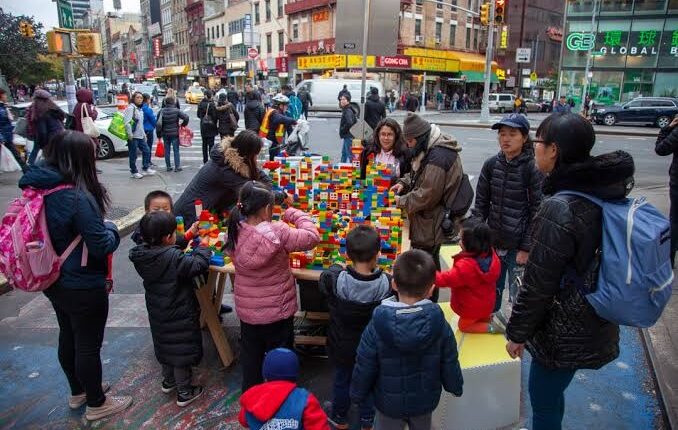
Enticing passersby makes intuitive sense, but it loses steam as a strategy if the people doing the enticing bog down in regulations. Cathy Lang Ho, Deputy Director of the Gensler Family AAP NYC Center, says cities should rework permit regimes so it’s simpler and cheaper to host block parties, swaps, barbecues, and other events. She ought to know: a one-time magazine editor and writer and community activist, she pioneered progress in public-space use during lockdown and helped promote Gotham Park, a new skateboarding and relaxing space under the Manhattan anchorage of the Brooklyn Bridge. Loosen the bonds on gatherings, she says her lockdown days taught her, and people will gather in unexpected ways: this certainly happened in New York City during the NBA finals, when I found myself sprinting past a TV on the street so I wouldn’t block anyone’s view while I hurried to my own watch party. A tactical urbanist with folding chairs and a few gallons of paint can enliven this logic by quickly turning overlooked places into zones for book clubs and breakdancing.
Like tactical urbanism, a host-first approach to making cities more intuitive should focus on keeping costs low. Ho points to costs as a block to improvisation: a permit for a gathering, she says, used to cost hundreds of dollars and annual applications in New York City. Today, anyone planning a farmer’s market or street cleanup or block party can apply online for lower cost. Ho has supported her thesis outside the restaurant she co-owns on my block, with swaps and pickleball on Saturday afternoons. (My family has hosted fundraisers and festive dinners at the restaurant.)
The commitment to making street life cheaper extends past a single-day event or tactical urbanism trick, however. Tim Tompkins, a scholar and the former head of the Times Square Alliance (a business improvement district for which I’ve done some recent work), notes that the city often refuses to accept liability when community groups want to manage events or gardens on city property. This discourages creative use of dead land. Wouldn’t more people wander into more places if the places they expected to be parking lots turned out to host potlucks or plantings week after week?
There’s a shapeless danger occluding these sensible ideas, though: our culture of inattention. What if people following their Google Maps and reccos never notice the block parties, benches, gardens, and surprise sculptures as they walk or drive by? Maybe it’s a matter of volume, and designers and civic leaders need to overwhelm the saturating instructions that screens constantly issue. Or maybe it’s a matter of design vocabulary. One durable strategy to attract attention involves visibility, unpredictability, and patience.
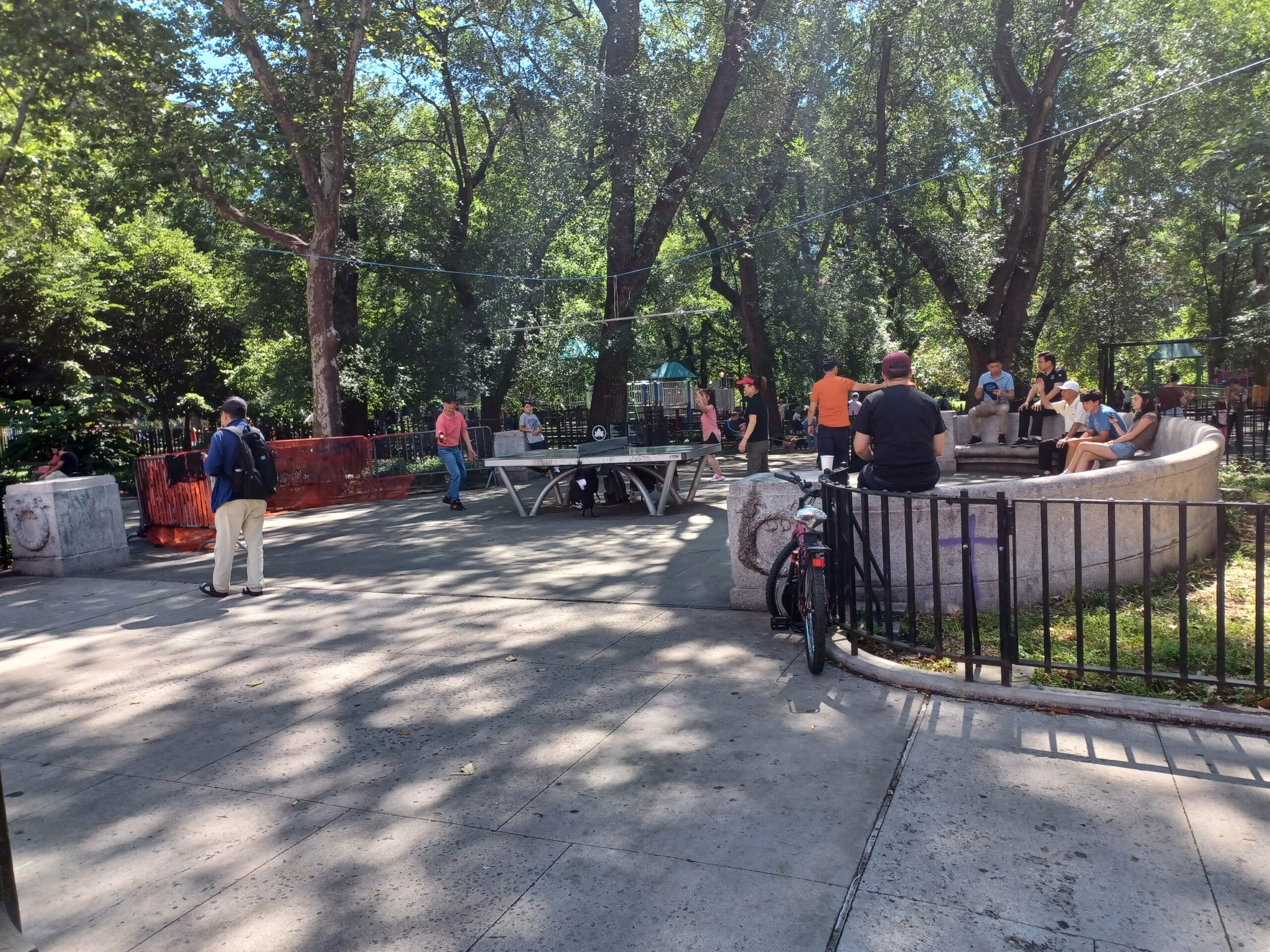
Consider a cupola to Lower Manhattan’s Seward Park, around the corner from my building, where my wife and I walk most nights. Someone at some point in the past few years placed a ping-pong table there. Chinese-speaking neighbors use it on the main, but its use swells and swerves. A tween I know started competing at an elite-ish level. Scenemakers drifting from the nearby bars and skate parks started hanging out, sometimes jawboning with the locals. Now and again someone will trot out a karaoke machine. From this humble example, we can hope that if an element registers as weird enough then it will break the filter’s spell, at least for a while. (Cities might also prioritize local materials and symbols over what New Yorker writer Kyle Chayka calls “Generic Coffee Shop” aesthetics in order to make it harder to float through neighborhoods.)
Making cities friendlier to everyone, streamlining setup for celebrations and meetups, and celebrating local heritage all seem potentially helpful to lots of agendas. If we use these principles to encourage spontaneity in cities, though, let’s be humble: the big tech companies are working hard to fix everyone’s attention and routines onto phones at all times. So the main ingredient in promoting spontaneity is one architects have learned from clients: patience. This includes sympathy rather than sneering at people who don’t seem ready to spelunk through their cities.
People in their 30s grew up on Instagram, says social psychologist Jonathan Haidt, and teens are now growing up on the more frantic TikTok. Many never learned to read a static map, while many older people (and cab drivers) have forgotten how. My hunch says designers need to work harder than ever to thwart the algorithm and its cues.
That means building trust with regulators, as Cathy Ho says, for the license to take some risks. Can you place statues and then move them before the Google Street View drives through? Can you place blackout zones on GPS at beaches and in parks, so there’s no concern about automobile safety? Can you focus on placing street furniture at the height where people normally hold their phones—which, coincidentally or not, is roughly the height of a ping-pong table?
Hard, patient work also means designing public spaces that appeal to a lot of moods. Pier 26, which opened on Manhattan’s waterfront during the pandemic, has grown popular. It includes volleyball and hidden benches along with grand ramps and “eco-zones” that mimic New York State biomes. Someone who arrives expecting to tan might sit in the swing in the shade. You can see every part of the park from every other part. It’s an invitation to exploration.
Burke says physical maps also encourage exploration, and that cities should place plenty of them in easy reach. But encouraging wanderlust might mean letting more people get lost, with parks that veer into the unmapped. Of course, realizing any of this design strategy at scale requires capital. A big city needs flexible round-the-clock transit to richly prime spontaneity. A city of any size needs to retune its public works budget and its public works staff’s skills. That means regulators, designers, and civic leaders all need to practice patience with each other, and would all do well to go where they didn’t expect to in planning and negotiations. Climate disaster and economic upheaval will require that openness anyway—and design experiments can encourage human experiments. I’m hopeful: according to advocacy group New Yorkers for Parks, there’s ping-pong in the new Queensbridge Baby Park.
Featured image via Street Labs.