
Chasing the Ghosts of Downtown Los Angeles
Some landscapes hold secrets. Others shout them out. At the recent American Society of Landscape Architects 2026 Conference, held in Los Angeles, I had the opportunity to participate in two walking tours that explored landscapes I know intimately: the Latino urbanism of Boyle Heights and East Los Angeles, and the queer landscapes of downtown Los Angeles.
These were not simply professional tours for me. They took me through places that shaped my life and the way I understand cities. The Exploring Sensory-Based Latino Landscapes tour moved through parts of L.A. I grew up around and have studied for decades. Here, culture often announces itself loudly: it spills into the streets through front yards, murals, shrines, plants, fences, food, music, vendors, hand-painted signs, and the countless ways people adapt buildings and public spaces to fit everyday life. You can see it, hear it, smell it, taste it, and feel it. The landscape tells you who lives there.
The Displacement and Defiance: Queer and Marginalized Histories of Downtown Los Angeles tour took me through many of my old haunts and told a very different story, one about a community that has largely disappeared.The sexually charged downtown landscape I once knew barely exists today. What remains can sometimes feel like a hollow shell of the city I remember.
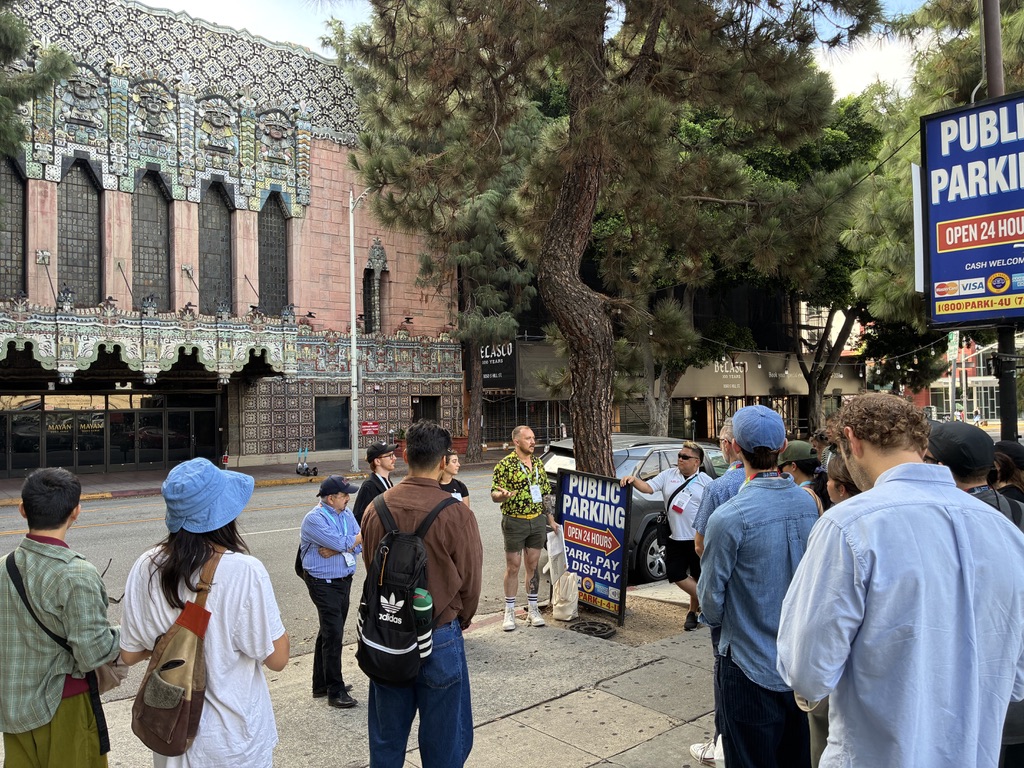
The Metropolitan Community Church (MCC)—widely recognized as one of the world’s first prominent gay and lesbian Christian congregations—purchased the historic Belasco Theater in 1974, to serve as its headquarters and house of worship. Photo courtesy of the author.
Like a noir film, much of L.A.’s queer history was hidden in the shadows, visible only to those who knew how to read the clues. A department store, movie theater, storefront, park, sidewalk, alleyway, restroom, or dark corner could become a place for connection, cruising, friendship, desire, or simply the reassurance of finding someone else like yourself.
Back then, the hustle and bustle of the metropolis helped hide a city of cruising in plain sight. Today, many of those same streets can feel empty. There is less to hide. And in that emptiness, my memories rise to the surface and fill the space. Unless someone tells you the story, you might walk right past these places without ever knowing what happened there.
Downtown’s Hidden Queer Geography
Before West Hollywood emerged as a major center of gay life in Los Angeles, downtown was one of the city’s historic gay playgrounds. My father once told me that long before gay liberation, men cruised the balconies of old movie theaters, Pershing Square, Main Street, and the streets of Bunker Hill.
These were landscapes where an earlier generation of gay men carved out spaces for connection within the public realm. During World War II, thousands of soldiers and sailors passed through Los Angeles, adding another layer to the nightlife and sexual geography surrounding downtown’s theaters, bars, burlesque houses, and streets. Decades later, John Rechy captured this hidden world in City of Night (1963), in which downtown Los Angeles and Pershing Square became important settings in his portrayal of gay urban life.
By the time I came of age in the 1970s, traces of that older world still remained. Many classic cruising grounds, including Main Street, were changing as redevelopment transformed downtown, while Hollywood, Silver Lake, and West Hollywood became increasingly important centers of gay life.
At the same time, another downtown was emerging, one shaped by an increasingly empty civic core and a growing Latino immigrant population. For young Black and Brown queer people like me, this changing landscape offered new possibilities.
Finding Queer Freedom in the Crowd
The Eastside and South Central gangland landscapes offered few places where queer Black and Brown youth could openly express who they were. For working-class queer youth like myself, downtown Los Angeles offered something different: a sense of freedom, anonymity, and possibility.
We could reach downtown simply by taking a Rapid Transit District bus. We didn’t need much money, and we didn’t need a car. A bus ride could transport us from the familiar streets of our neighborhoods into a completely different urban world. Downtown created another queer geography, one that allowed us to move beyond the social boundaries of our own communities.
We were young people crossing neighborhoods historically divided by race, class, freeways, redlining, and segregation. Yet through public transportation, we could enter a shared urban landscape where we could explore, encounter strangers, discover new identities, and experience a freedom that wasn’t always possible at home.
For us, public transit was more than transportation—it was a pathway to independence, self-discovery, and queer freedom. And downtown was not just a destination, but a place where we could begin to imagine different versions of ourselves.
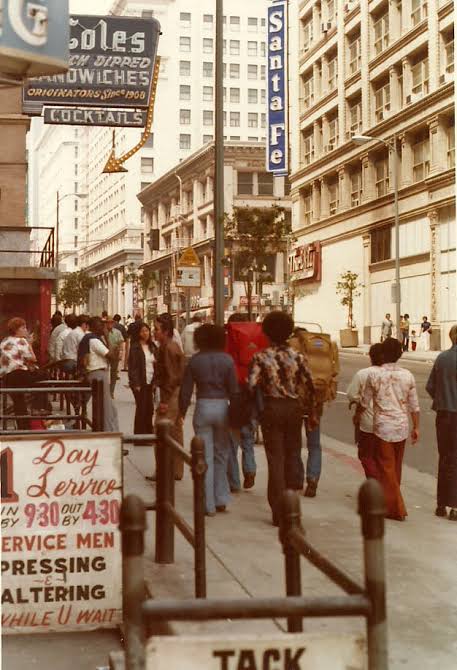
Once we stepped off the bus, the streets became our gathering place. We could disappear into the crowd while searching for ourselves.
The sidewalk became our fashion runway.Wearing platform shoes, tight pants, feathered hair, Afros, and stack perms, we moved through the throngs, trying to look effortless. We watched one another, recognized one another, flirted, laughed, talked smack, and found our tribe. In those moments, we owned the city.
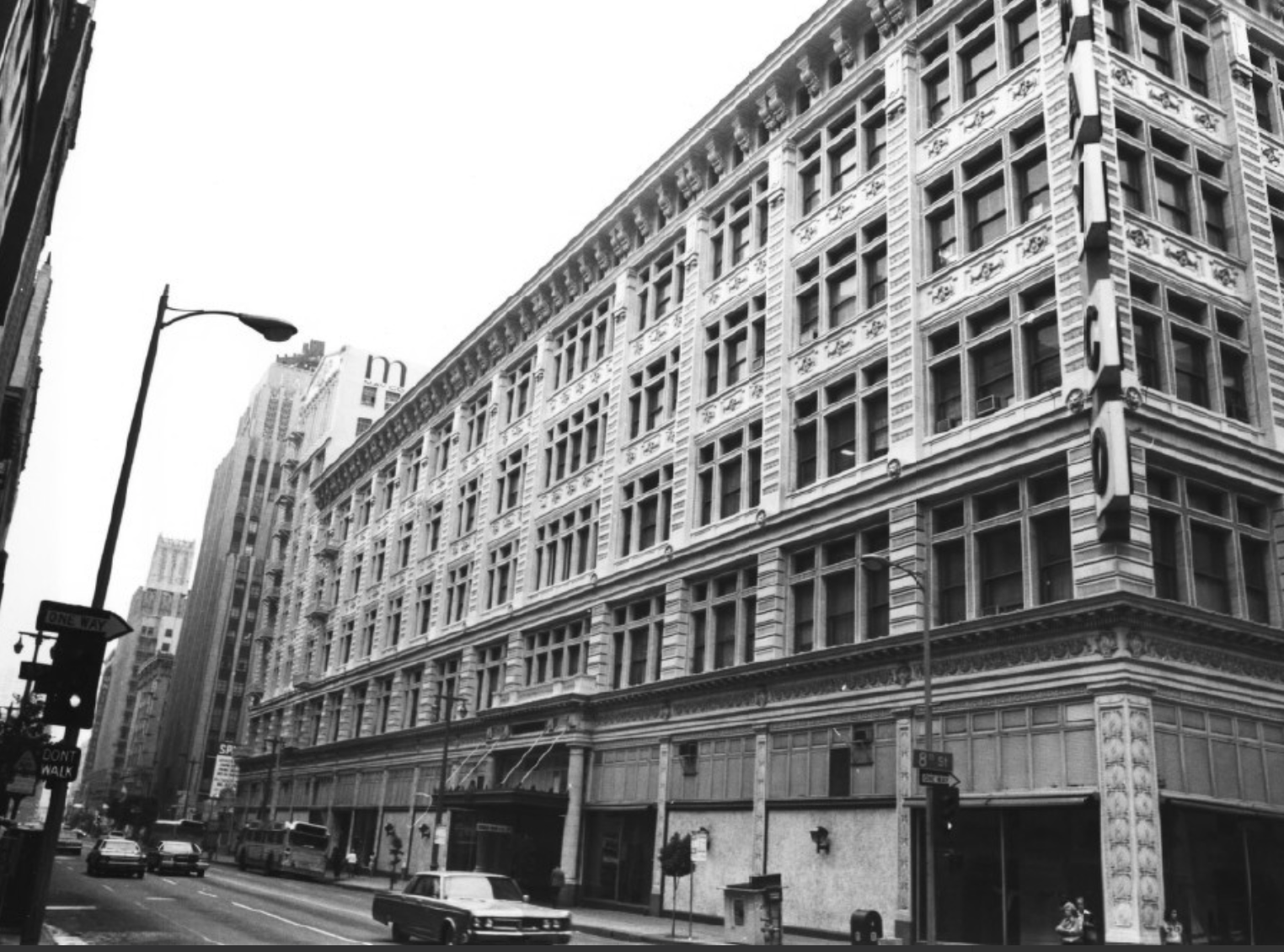
I traversed a landscape where different generations and cultures overlapped: the bustle of Grand Central Market, bars like the Score, the KYLT bathhouse, department stores along Broadway, and the lingering public spaces where earlier generations of gay men had gathered.
These places were part of a larger queer landscape, much of it invisible to people who simply passed through. Some spaces were openly queer, while others became queer through the ways we occupied them, recognized one another, and made them our own.
The remnants of one gay generation coexisted with the beginnings of another. Black and Latino youth were creating our own ways of occupying the city, bringing our music, fashion, language, attitudes, and cultural identities into the streets.
For young Black and Brown queer people, the anonymity of downtown was part of its freedom. We didn’t need a designated neighborhood or an officially recognized queer space to experience belonging. Sometimes all we needed was a sidewalk, a crowd, and the possibility of encountering someone like ourselves. The crowd could hide us. But it could also help us find one another.
Looking back as an urban planner, I realize that downtown Los Angeles offered something conventional planning rarely measures: the freedom to discover who you are through the experience of moving through a city.
Our queer geography wasn’t necessarily defined by property ownership, buildings, or official boundaries. It was created by movement, public transportation, sidewalks, fashion, chance encounters, and the unspoken recognition of one another.
We weren’t just discovering downtown L.A., we were discovering ourselves—and, in the process, creating our own queer urban landscape. None of this would have appeared on a city map. But it was a city nonetheless.
Two Ways of Making Place
Walking through Boyle Heights and downtown during the ASLA conference made the contrast especially vivid. The Latino landscape was still announcing itself around me. The queer downtown landscape kept its secrets. But I carry them with me. Those experiences continue to shape my work as an urban planner.
I have always been interested in the city that cannot be seen, the emotional landscape carried in people’s stories.
Those journeys taught me that communities are not simply places on a map. They are created through memory, behavior, relationships, desire, movement, mutual support, and shared experience.
Walking through these two L.A. landscapes reminded me that reading a city is not simply about looking at buildings. Sometimes, we need to pay attention to what a landscape proudly displays. Other times, we need to listen carefully for what it learned to hide. And occasionally, when the people, crowds, sounds, and activities are gone, memory becomes the landscape. The city may appear empty to someone passing through. But for those of us who remember, it is still full.
Featured: May Company department store, in downtown Los Angeles, 1977.