

Cities Hold the Cards in the Coming AI Economy, If They Play Them Right
For city leaders, artificial intelligence is yet another disruption that arrives with a long list of promises and perils. Cash-strapped governments are buying AI tools from private contractors and risk getting locked into proprietary systems in which vendors control public data and algorithms. Cities are dense with the administrative, legal, and customer-service jobs most exposed to automation. And unless someone is watching closely, models trained on historical city data can carry old inequities into policing, tenant screening, and code enforcement.
At Cornell Tech’s recent Urban Tech Summit, Noel Hidalgo, executive director of the civic technology organization BetaNYC, recalled how residents of Barcelona—home of the oldest and largest smart cities conference—came to see smart-city deployments as public money subsidizing corporate surveillance. Anthony Townsend, a senior research associate at Cornell Tech, asked whether public servants would be automated out of their jobs. Algorithmic bias barely came up at all.
But the summit also made a case that cities aren’t simply on the receiving end of AI. Zach Greenberger, CEO of Empiric Earth, an AI-powered driving risk intelligence company, opened the day with a provocation: “I believe physical AI and the world model economy is going to dwarf what you have all seen with LLMs, OpenAI, and Anthropic over the course of the next 10 years.”
A world model predicts how an environment will change and how it will respond to an action before that action happens in the real world. The world model economy is everything built on that kind of prediction, from autonomous vehicles to delivery robots and drones. The raw material already exists; cameras, radar, and lidar have been collecting it for years, and “there is a real-world internet that is sitting out there that nobody has ever built.”
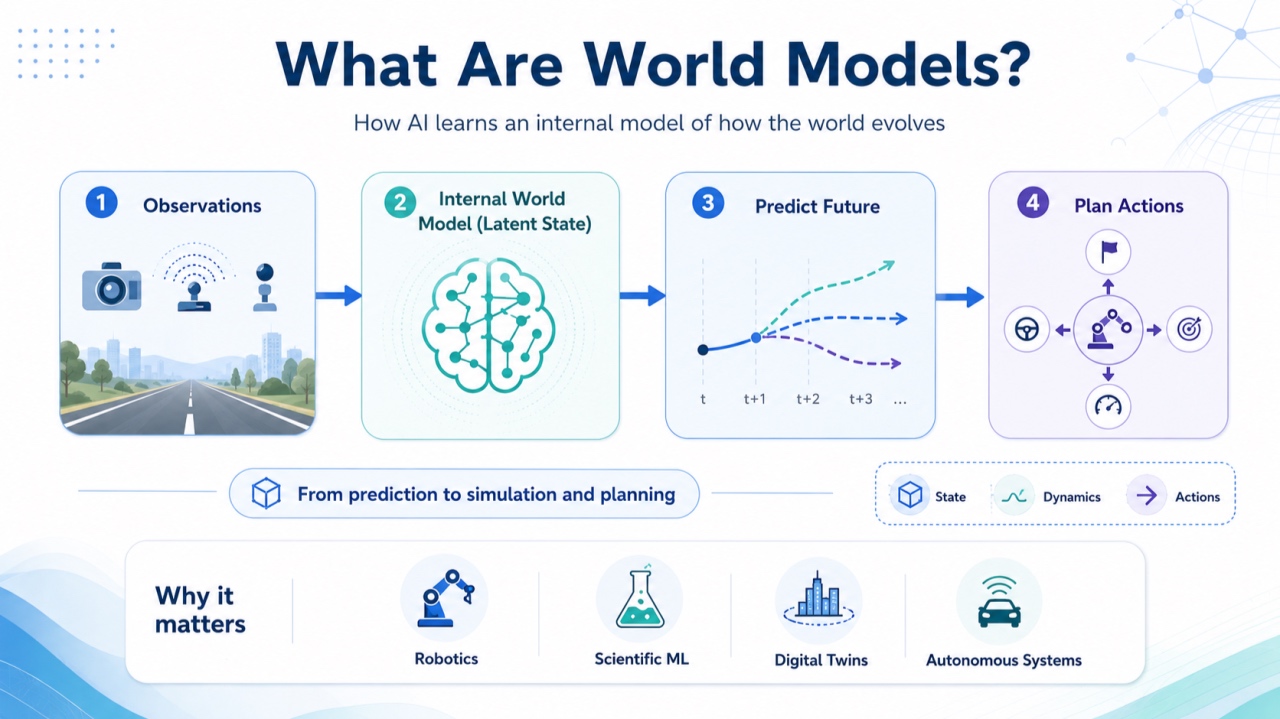
If Greenberger is right, the biggest beneficiary of real world models isn’t OpenAI or Google—it’s the city. Cities own the streets, curbs, pipes, signals, and permits that physical AI depends on, and they write the rules that govern them. As Daniel Pelaez, CEO of the road-inspection company Cyvl, put it: “The internet has been scraped. World models need this information to really do their magic.”
Done right, this could make cities among AI’s biggest winners. The case came in three parts. (1) The promise: Cities control what the next wave of AI needs, and that gives them leverage. (2) The proof: Cities already capturing real-world data are getting practical results, from catching potholes early to purging outdated rules. (3) The price: Data alone isn’t enough; before cities can collect, they have to understand how their own operations actually work.
The Promise: Cities Hold the Cards
Cities have rarely held this kind of position in a technology boom. In the last one, platforms like Uber and Airbnb arrived first and asked permission later, and cities spent a decade catching up. Physical AI can’t work that way. Robotaxis and delivery robots need city streets, data, and rules just to function.
Nowhere is that clearer than at the curb, where robotaxis and delivery fleets are now competing with buses, bikes, and pedestrians for scarce space. Lisa Hawkins, co-founder and COO of the recently launched Daro, which connects cities with autonomous fleet operators, said cities can still steer autonomous vehicles toward transit deserts, charge for the miles they drive empty, and reward service to older residents. “Autonomous fleet operators are really eager to get into cities,” she said.
But leverage only counts if cities use it. Akshay Malik, Philadelphia’s smart cities director, noted that Waymo has access to Waze data and still drives into flooded streets. Publishing rules isn’t enough, he argued: cities need enforcement, and perhaps taxes on driverless fleets, since without a driver spending money locally, the car is “just sucking the local GDP, siphoning it off right out of the car.”
The same logic applies to public investment. Daria Siegel, a senior vice president at New York City’s Economic Development Corporation, described a $29.2 million investment in New York University’s new Quantum Fabrication Facility that will provide the city a share of proceeds from intellectual property developed there—a first-of-its-kind arrangement, according to the city. “We want an upside,” Siegel said, “and we want to take that money and reinvest it into New Yorkers.”
Leverage can also be signed away. A proprietary contract can leave a vendor in control of public data and the algorithms that run on it. Several speakers pointed to alternatives. BetaNYC has published open-source tools that connect AI agents to civic data. Tina Walha, CEO of U.S. Digital Response (USDR), a nonprofit that helps state and local governments build digital capacity, said her group gives governments a safe sandbox to test ideas first, so they don’t “pay a vendor for something that actually doesn’t solve the problem that they have.”
Cities that hand over their streets and data on vendors’ terms will end up paying for what their own infrastructure taught those companies. Cities that set terms—on data, access, revenue and equity—can capture some of the value they help create.
The Proof: AI’s Killer App Is Maintenance
The evidence that cities can benefit is already on the ground, and it looks less like science fiction than like maintenance. Pelaez contrasted water and roads. New York’s 7,000 miles of water pipes have sensors and crews watching them around the clock. Roads get nothing of the kind: the industry standard is still to inspect a random 10% of roadway and extrapolate—like a mechanic, Pelaez said, who “checked 10% of your car parts randomly.” Cyvl’s sensor unit, which mounts on top of city vehicles, scans every inch of road with lidar and cameras, catching cracks before freeze-thaw cycles turn them into potholes. More than 100 U.S. cities use it.
Regulations need maintenance as well. For New York Governor Kathy Hochul’s Regulatory Reset, a statewide initiative to eliminate outdated rules, USDR built an AI tool that scanned the state’s entire regulatory code for contradictions and dead letters. Just one of many findings: a rule requiring a telegram when someone couldn’t be reached by phone. “No human being in any state or local government is going through their rules and regs,” Walha said. The AI flags; the governor’s policy team decides what to cut.
Ryan White, transportation planning lead at the engineering firm Jacobs, described a tool that shrank the analysis of public comments on one project from 60 days to three.
None of this is glamorous, but it’s exactly the kind of real-world data Greenberger says the next AI economy will run on. It also sharpens Townsend’s initial question: If a tool does two months’ worth of work in three days, what happens to the people who used to do it? White’s answer was that planners get to focus on “judgment and creativity and collaboration and problem-solving.” That may hold for planners, but it is less obviously true for the clerks, call-center staff, and paralegals who make up so much of a city’s workforce.
The Price: Cities Have to Know Themselves
Data, though, is only half of what a world model needs. The other half is a model of how things work—and this is where cities get in their own way. Again and again, speakers described AI projects that exposed how little cities understand about their own operations.
Walha described a state that asked USDR to prototype an AI tool for environmental permitting; when it was done, officials realized their process worked differently than they had thought. In Philadelphia, Malik said, approving a single street closure means “a person eyeballing 14 apps” to check fire routes, trash days and ADA access.
The stakes can be life and death. Alanus von Radecki, CEO of the Berlin firm DKSR, described flooding in San Antonio this year in which 13 people died; it took the city four hours after the first 911 call to close roads. The water authority, hospitals, fire department, and city operations each held part of the picture; nobody held all of it. “The large language model is just statistics,” he said. “It gives you a very good-sounding analysis, but it may be completely wrong.” To help, AI needs a model of the city itself: its assets, its agencies, who has authority over what. In effect, DKSR is building a digital twin of the city’s institutions, not just its physical assets, and piloting it in San Antonio.
Santiago Garcés, Boston’s former chief information officer and now co-founder and director of the AI Lab for Cities at Harvard Business School and an adjunct lecturer at Harvard Kennedy School, argued that this kind of deliberate groundwork is an asset. Government rules and procedures, he said, can work like the “harness” that keeps AI tools predictable. Boston’s AI work rests on a decade of investment in its website, open data, and shared digital infrastructure.
Garcés made one more point that reframes the question of who wins. Wealthy people have always had agents—lawyers, architects, engineers acting on their behalf. AI could extend that to anyone navigating a permit, a benefit or a housing application, but only if cities build it on purpose. “If a human being does not get value out of what we did,” he said, “we failed.”
Featured image via OECD.