
Con Permiso: Learning to Navigate Public Space in Mexico City
Among the gestures of graciousness that are commonplace in Mexico City, the subtle negotiation of shared public space often requires getting through crowds of people eating tacos, tortas, gorditas, and dorados at the ubiquitous puestos callejeros (food carts) crowded around every metro station; moving past others on staircases and in supermarket isles with a cordial buenas tardes (Good afternoon) and adelante (forward); deciding who goes first through doorways; and always asking before passing through another’s personal space.
As a self-confessed curmudgeon about the unwritten rules of behavior on the street, so often befouled by attention-deprived smartphone users in the last decade, a magic phrase has become a secret password for a more humane and hospitable existence: Con permiso (With your permission). It’s one of several polite little phrases that make Mexico City an especially charming place to live as a foreigner, even a gringo hailing from its imperious northern neighbor, which robbed Mexico of no less than 55% of its territory less than a century ago during the Invasión Estadounidense and now has the nerve to complain about Mexican citizens, an essential part of the U.S. labor force, crossing north and south freely. (Freedom of movement throughout the Americas is a fundamental human right of indigenous peoples, and there are UN conventions to support the claim.)

View from the author’s window overlooking Roma Sur to the east.
For almost a year now, I have been living in the neighborhood of La Roma, which is probably the biggest cliché for a U.S. citizen living in Ciudad de México. It’s one of the more fashionable areas in the city, with a convenient proximity to galleries, literary readings in bookstores, museum openings, clubs, and bourgeois cafes and restaurants. I cop to that: In seeking self-imposed exile from the fascistic federal government of the U.S., I chose to live in the most cosmopolitan city in Latin America, to immerse myself cien por ciento (100%) in the Spanish-speaking local cultural life, and to be able to live, at least at first, in the manner to which I had become accustomed in East Williamsburg, Brooklyn, including being able to play tennis for an hour or two every day. The latter has become, as it was in New York, my most familiar, closely knit community, the cancha pública (casual athletes) at Velódromo Olímpico, reachable in about 20 minutes, six stops away on the 9 train from Chilpancingo.
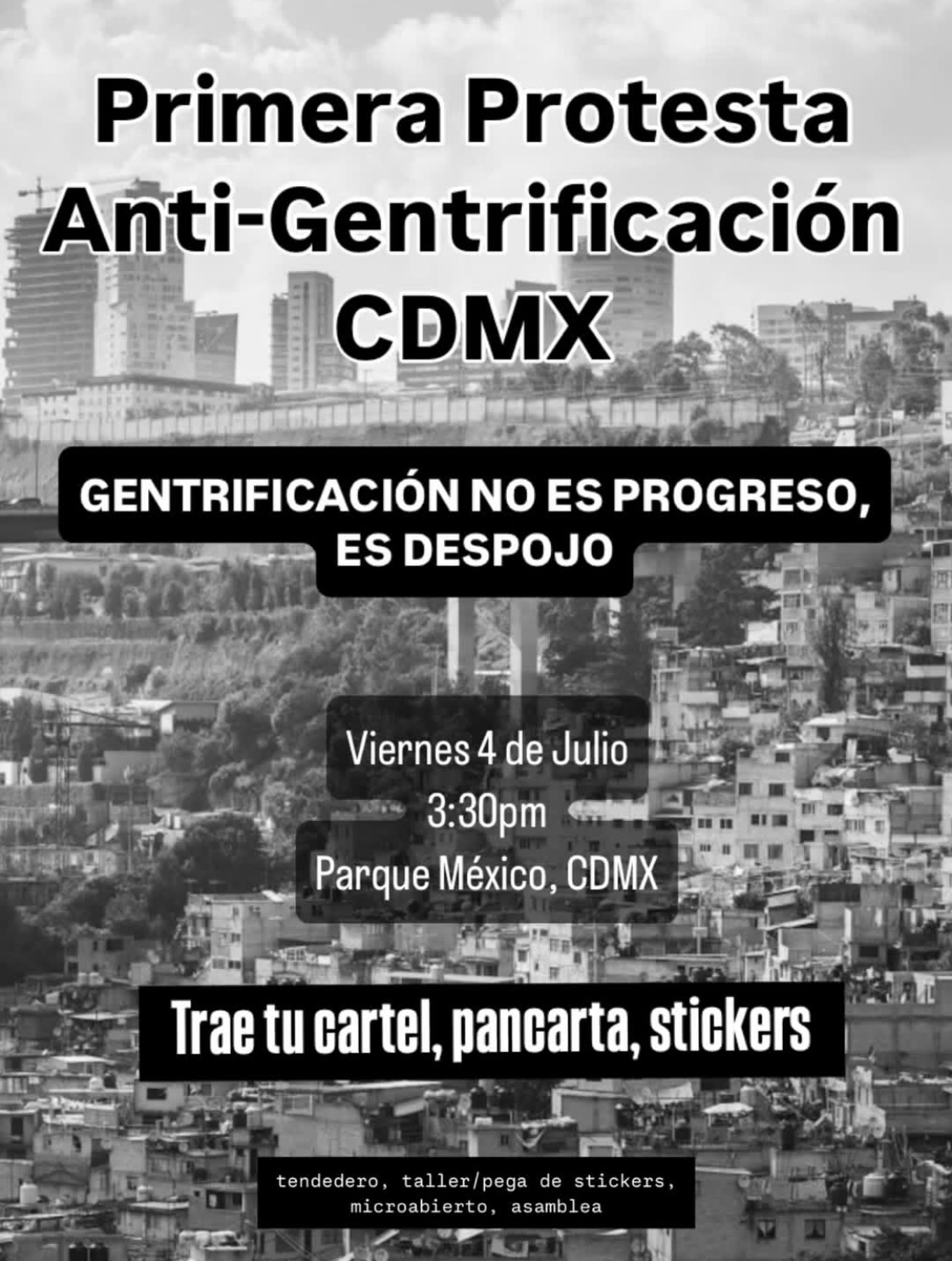
Flyer for first anti-gentrification protest in Mexico City, July 4, 2025 in Parque México: “Gentrification isn’t progress, it’s dispossession.”
Meanwhile, in nearby Parque México, a few months ago, a protest against gentrificación (no translation needed) emerged, the start of a national movement that called out the prevalence of digital nomads, gringos, and extranjeros (foreigners). Hundreds of protesters showed up in Parque México’s art deco Foro Lindbergh bandshell in the lovely Condesa neighborhood—an even-more cliché destination for foreign tourists—articulating a series of objections to the higher costs of living, unaffordable rents (the average is around 2,000 pesos, roughly $1,111 as of now), and the prevalence of establishments and policies prioritizing foreigners. I tried to push the word agringamiento (Americanized) as a substitute for the borrowed Britishism, but it’s not exactly accurate either. (The word “gentrification” was imported from London to New York in the mid-1970s, first appearing in the New York Times in 1974 and becoming popular in the early 1980s in the context of real-estate speculation during the rise of the gallery scene in the East Village.)
The first anti-gentrificación protest culminated in a march through Roma Norte to the Zocalo. Banks, multinational businesses, and small tiendas (shops) serving the bourgeois class were vandalized with anti-gringo and pro-Palestinian graffiti. Of particular fascination to me was the rapidity with which the government of Claudia Sheinbaum Pardo responded with policy pronouncements, daily comments during the mañanera press briefings, announcements of affordable housing projects, and community forums. The word was everywhere in the news for weeks after. Organizers have not stopped marching and making demands, continuing to put pressure on the government.
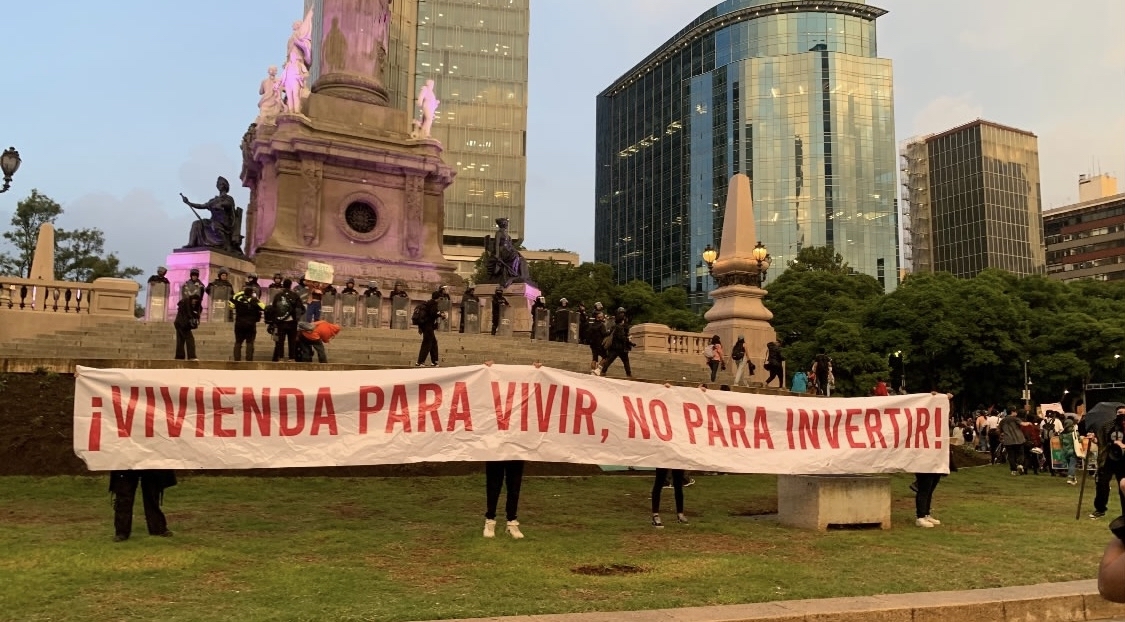
Anti-gentrification banner in front of the Monument to Independence during July 4 protest, which reads, “HOUSING FOR LIVING, NOT FOR INVESTMENT.”
The anti-gentrificación movement appeared to be a well-organized phenomenon taking place simultaneously across cities throughout Mexico. I have never seen such a coordinated and effective effort to raise issues of affordability in more than 25 years living in New York—except perhaps through the Housing Is a Human Right! tenant policy campaign of the Democratic Socialists—nor any comparable effort on the part of any level of the local, state, or federal government to respond to issues of housing affordability. I have yet to find out who coordinated such an extensive undertaking here. I’m too new to the city to have witnessed the changes first hand. It would take some investigative reporting to comprehend what happened to provoke such a large outpouring of support.
Anecdotally, there is a sense that the Roma/Condesa area caters to foreigners, but the area is nowhere near as outwardly rich and filled with polo-and-khaki-clad people as Polanco. Located only a few miles away across Parque Chapultapec, Polanco resembles a combination of SoHo and the Upper East Side of Manhattan; real estate here is significantly more expensive, luxury stores much more prevalent. There are also wealthier upper-class neighborhoods near the center like Lomas de Chapultapec and Jardines de Padregal that nobody complains about. It is taken for granted that they are rich.
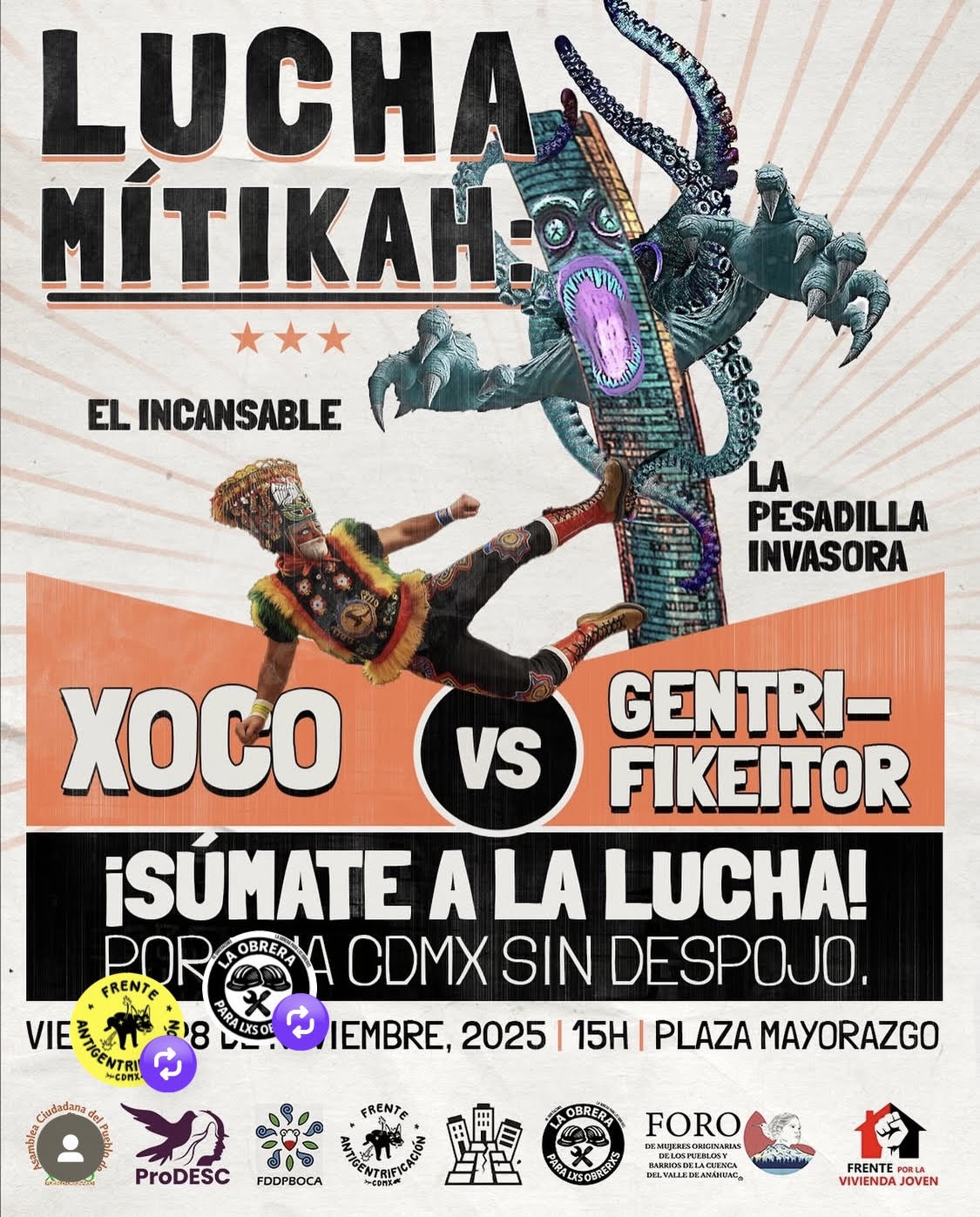
Flyer for anti-gentrification protest on November 28, 2025 at the Mítikah tower, a 2022 commercial development in the Coyoacán neighborhood.
What distinguishes neighborhoods around the Roma may be the sense that they should belong to, and be affordable to, Mexicans. According to friends and acquaintances, prices in these areas have increased rapidly over the last two decades, far beyond the average income of locals. The phrase “digital nomad” stands out as one often used here—much more than in New York—to characterize a certain kind of undesirable foreigner, often witnessed doing business in English on a smartphone in public spaces. There are a certain number of foreigners you see casually gathered in cafes, restaurants, and bars, loudly speaking in American accents. I find them annoying as well. Although I am an estadounidense (U.S. citizen), I insist on speaking Spanish, even with English speakers, even though quite a number of locals like to practice their English on you. A big part of the glory of being here is to be immersed in a Spanish-speaking culture. But extranjeros do not appear at all as common in Mexico as foreign tourists, immigrants, and professionals in New York City, for what it’s worth. Tourism represents nearly nine percent of the Mexican economy and a huge source of local employment, so there is a significant public benefit and reason for the government to encourage it, to the extent that it doesn’t completely destroy the local sense of place.
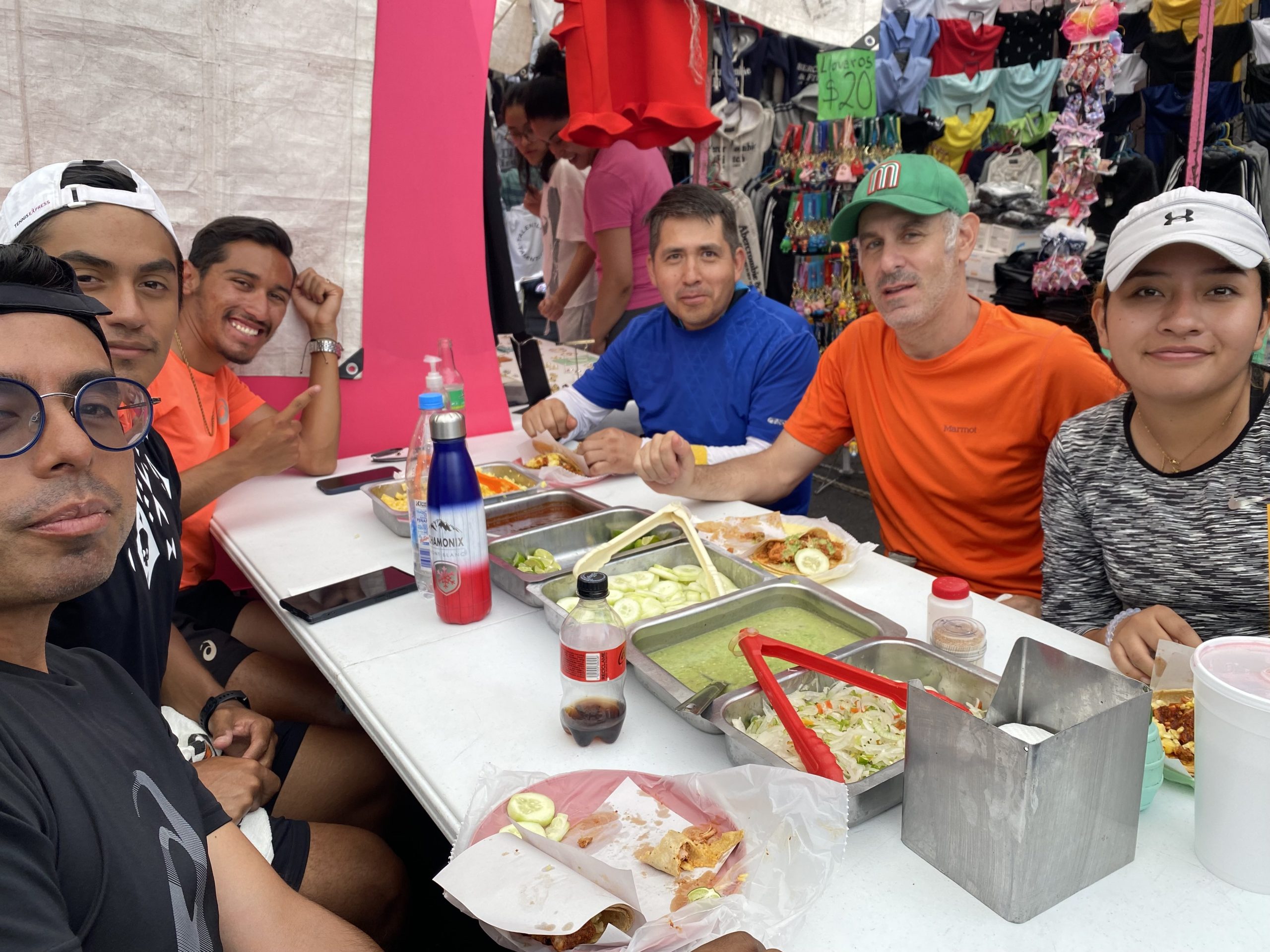
Lunch with tennis friends from the Velódromo Olímpico courts at the nearby tianguis (weekly street market). Clockwise from top left: Héctor Cabrera of the Cabrera Tennis Academy; Said Miranda, computer engineer; the author; Sam Chávez, student; Oscar Curiel, station manager at Benito Juarez International Airport; and Juan Hernández, director of Saque Ace, a popular tennis social media channel.
My personal experience has been overwhelmingly positive. Rarely, if ever, do I experience a sense that my presence is unwelcome. To the contrary—and I believe this is characteristic of Mexican people, culturally—I constantly find people going out of their way to welcome me, express curiosity and interest, and teach me about the local culture and slang. Nearly everyone I meet has family and friends living in the U.S. U.S sports team shirts and U.S. brands are impossible to avoid. There’s a sense that we’re part of one community in the end, though the underlying inequality and difference in power is egregious. I cannot say whether my experience is purely anecdotal or is widely shared. I am aware that my lighter-skinned appearance marks me for special treatment—a postcolonial inheritance that I’m only beginning to be able to glimpse and comprehend in Mexican society. All I can say is that, for me, living here has been a stroke of good fortune in a moment of political despair. As such, I try to negotiate the space of being a stranger with a sense of gratitude and graciousness. Everything is con permiso. Except maybe on the tennis courts.
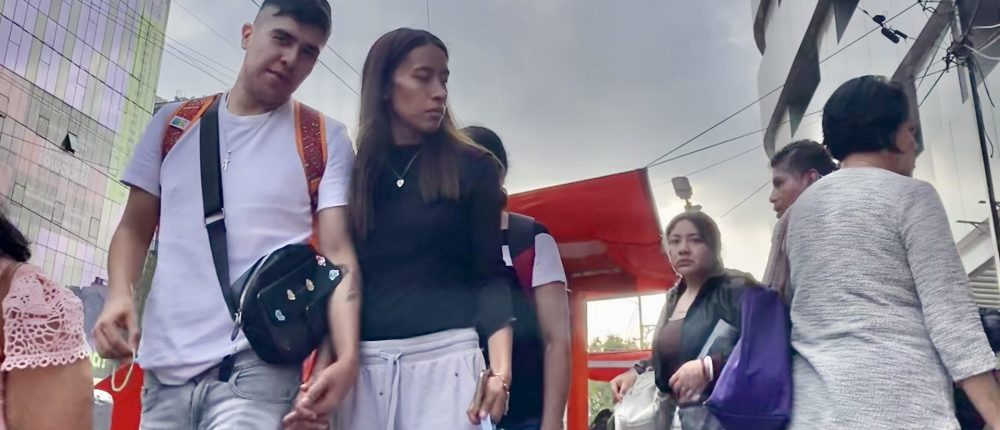
Featured image: Pedestrians entering the Chilpancingo station of metro line 9 on Avenida Baja California, in Mexico City. All photos courtesy of the author.