
Flagler College Invests in Its History
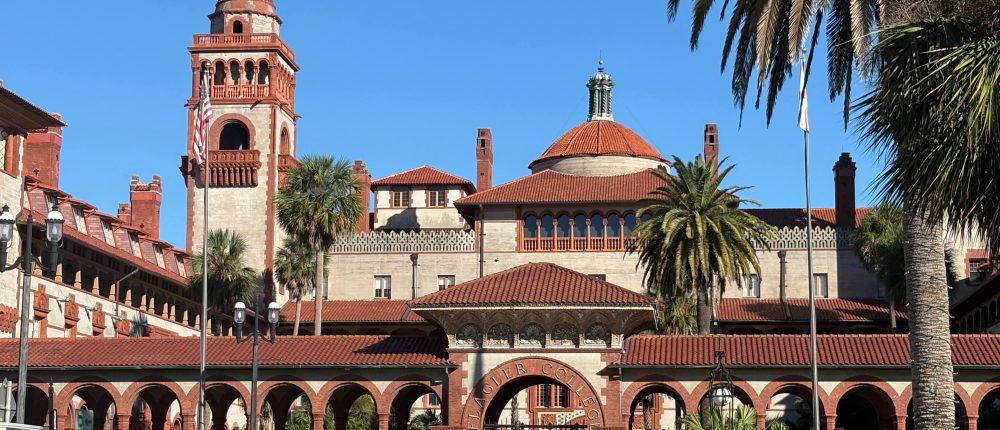
When Flagler College, in St. Augustine, Florida, began to educate young women in 1968, it had the opportunity to purchase a run-down hotel in the middle of the city’s historic district. Built in the mid-1880s, the Ponce de Leon Hotel had been a Gilded Age gem under Henry Morrison Flagler’s ownership, but it was finally shuttered in 1967. Intricate plasterwork was crumbling, and once-crisp terra cotta was falling from the building’s cornices and towers. Clearly, the massive building, which covers almost 5 acres, needed major work in order to be converted for educational purposes. Someone had done their homework, recognizing that this early concrete masterpiece by Carrère & Hastings was an ideal candidate for “adaptive reuse,” as it was then understood. But it was a risky bet.
At the time, historic preservationists were mainly concerned with restoring the first wave of landmarks associated with U.S. history: founders’ houses, great architectural masterworks of the nation’s premier architects, and sites associated with key historical events such as battlefields and ritual places. I began my career in that first period of experimenting with techniques, research programs, and legal protections for our most precious heritage resources.
Through the years I worked with nonprofit clients to use the state-sponsored landmarking and grant tools, sometimes over more than a decade, to save and restore many small and medium buildings, farm landscapes, cemeteries, and churches in New York and New Jersey. Often, a client (such as a church vestry or session) would become frustrated by the long, arduous process of listing on the local, state, or national register, securing grants for design studies, and, finally, administering the brick-and-mortar grants to have construction completed and approved. They would sometimes quit, forsaking the resources offered. It takes truly dedicated, visionary people to wait—and wait, and wait—and finally secure the funds to complete a full project.
I wrote a major book, with colleagues William Morrison, Kate Lemos, and Charles Warren, on the architecture of Carrère & Hastings, that was published by Acanthus Press in 2006. While researching it, we learned that both the Alcazar and Ponce de Leon hotels, the firm’s first major buildings, were standing and in good condition. What we did not know was the degree to which Flagler College, the Lightner Museum, and the city of St. Augustine believed in the historical significance of their Flagler buildings, and the extent of their support for historic preservation as an engine for economic development.
Florida depends upon tourism for its tax base and general prosperity, and so has paid great attention to the maintenance of historic places—something especially rare for a red state. Reading a recent article in Buildings and Landscapes on the extraordinary support for the St. Augustine Lighthouse Museum gave me a sense of the unusual care lavished on landmarks there. Thus, when Flagler College applied for state grants to study and care for its Carrère & Hastings building, it found robust advocates in the state legislature. Rather than seeing the hotel as an outdated and crumbling relic, civic leaders were intrigued by its building technology and history.
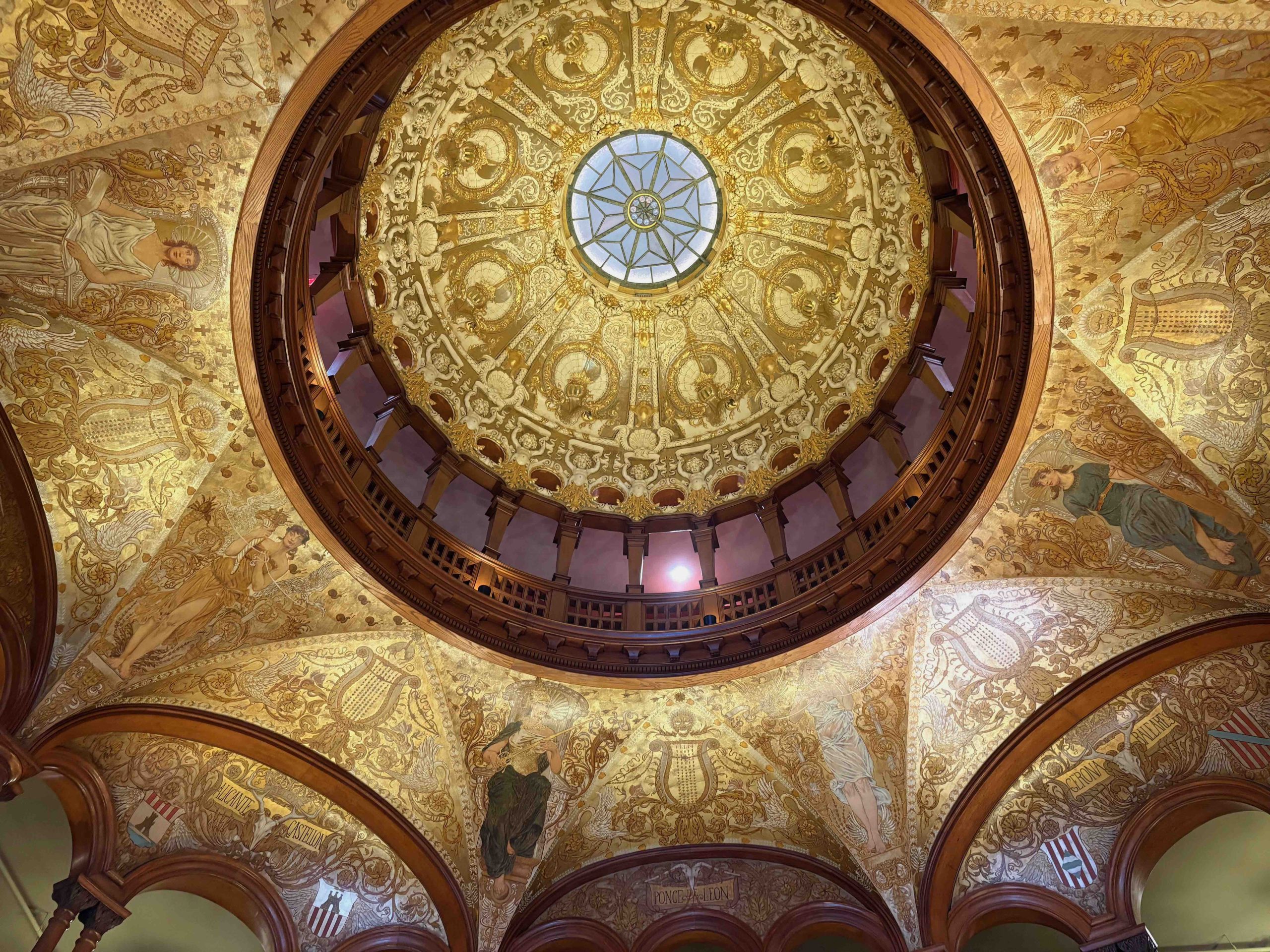
The first steps were listing the hotel on the state and national registers in 1975, and then elevating it to a national historic landmark in 2006. In 1988, the college received enough funding to fully restore the dining room to its original splendor, reinstalling Tiffany windows, wall decoration, woodwork, and gilded ceilings. This convinced local, city, and state supporters that it would be possible to bring much of the building back to its original 1880s condition with careful research and incremental restoration. The college was also gaining notoriety and building new buildings, often in the style of the hotel and surrounding Spanish colonial town. It recognized the value of place as a marker of character. In 2013, the administration made further investment in the building by restoring the solarium to its early condition.
Flagler College invited me to attend an unveiling in October of their complete and spectacular restoration of the Ponce de Leon, now the centerpiece of a beautiful urban campus. Unlike the Savannah College of Art and Design, which purchased and repurposed numerous buildings in its historic city, Flagler chose to make a single building the symbol of its investment in St. Augustine. Both strategies made sense, but I think the adaptation of a true masterpiece of American architecture was the more impressive achievement. Let me explain why.
By working with a national historic landmark, the college had some advantages, but also many disadvantages, associated with compliance with federal guidelines, the so-called Secretary of the Interior’s standards for work on historic buildings and landscapes. Fortunately, they had Michael Blake of Lane Architecture and A.D. Davis Contractors on the project, an already trusted team. Most important, they hired International Fine Arts Conservation Studio from Atlanta to head the multiyear project of dealing with every historic material, detail, and decorative scheme in the complex building. Imagine looking to reproduce intricate terra cotta cornices, sculpture, and finials that had deteriorated beyond repair. Only a few companies in the world can produce these pieces. How about decorative painting and gilding over large surfaces in ceilings and domes? Again, very few artisans were qualified. Intricately carved woodwork? Ditto. The list goes on. Laura Stevenson Dumas, the vice president in charge, and her communications director, Beth Sweeny, were enthusiastic about the entire team of designers, artisans, and conservation consultants when I spoke to them in October.
Even more challenging was the experimental coquina shell concrete. Carrère & Hastings initially tried to use another method, but came to trust the Smith Company’s recipe for laying the Portland Cement mixture in 3-inch lifts, tamping each one and letting it dry before applying the next layer. The resulting 2-foot courses, reinforced with iron rods, have barely moved or spalled in over a century. Though I can publish just a few photos, you won’t see a blemish anywhere. I reviewed Princeton’s multimillion-dollar restoration of the University Chapel, a Ralph Adams Cram masterpiece, years ago. That project was simple in comparison to this one.
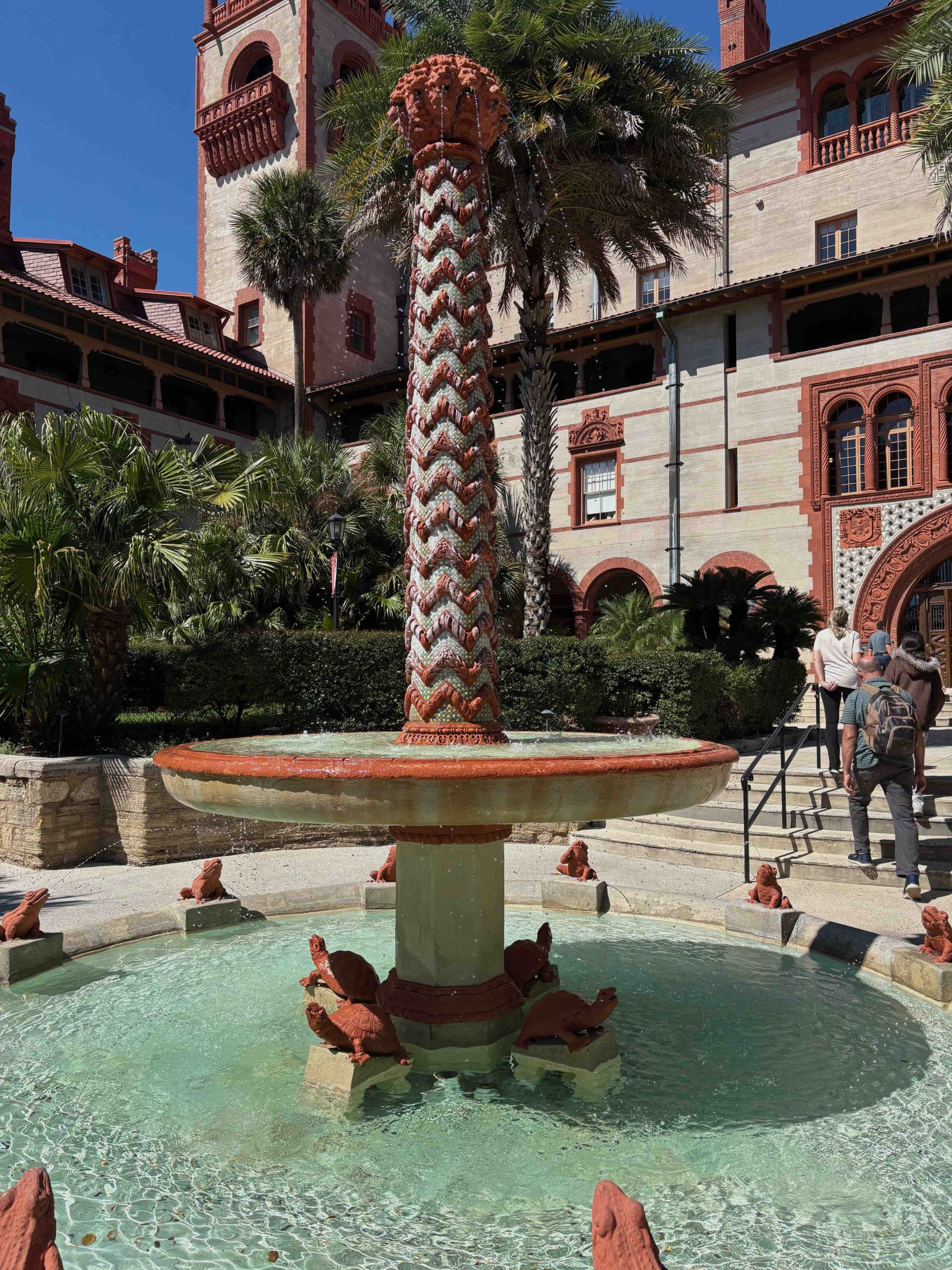
The landscapes in the front courtyard are bright and verdant, centered on a circular fountain adorned with ceramic frogs. Every façade is brilliantly colored under the Florida sun, and the concrete has a burnished patina that could be mistaken for limestone. One can ascend the elevator to open terraces that provide expansive views of the city and its harbor. Roof tiles, terra cotta ornament, and copper details crown the top of the building. The ensemble is spectacular.
If you are able to take a guided tour of the restored interiors, the Flagler Room should be your first priority. Unlike most of the rooms, this one was done in 1880s classical décor by Herter Brothers, New York’s premier decorating company. The color scheme, for women guests, is a subtle range of off-white and pastel hues that I have never seen rendered in such detail. The research on the colors was one thing, but getting painters to replicate every hue was like restoring a Vermeer. More important, there isn’t a Herter Brothers room in New York City that survived the destruction of the Millionaire District on Fifth Avenue that compares to this one. It is unique. Equally so is the huge, domed rotunda, with copious ornament designed by a young Bernard Maybeck. The gilded ceiling and pendentives were painted by George Maynard, who also painted the ceilings of the adjoining dining room, the real centerpiece of the building.
Why spend so much money, and time, having things done perfectly? Flagler College clearly believes that historic preservation is essential to its overall educational mission. So far, it has benefitted handsomely from a commitment to the highest quality architecture and restoration. How many campuses across the country can say the same? Most hire starchitects to insert an out-of-character white elephant into their historic campuses, hoping that the design mavens will praise their choices, but secretly knowing that students and faculty will hate the new buildings. Washington University in St. Louis tried a little of both strategies in recent years, but eventually built new buildings in the Collegiate Gothic style of their Cope & Stewardson campus. So did Rice University, as I have observed on this website. None, however, have made the kind of commitment evident when one looks at the Ponce de Leon. Will others emulate its success?
Featured image: The view of the Ponce de Leon from King Street. All photos by the author.