
How AI Can Make Design Work Appear Prematurely Resolved
An architecture student can now walk into a review with more images than understanding. This sounds harsher than I mean it, but in some ways, it’s extraordinary. A young designer can study a site, generate alternatives, test massing, produce renderings, summarize precedents, diagram environmental factors, and assemble a presentation with a speed that would have been unimaginable not long ago. The work can look full and polished, like it has already passed through several layers of thought. Sometimes it has. Sometimes…not.
That’s the uncomfortable part of this moment. AI can make design work look ready before judgment has caught up. The image can appear smarter than the designer. The diagram can seem more resolved than the argument. The proposal can look inevitable before anyone has asked what it leaves out.
This is not just a problem for architecture schools. It’s a problem for firms, clients, public agencies, planning boards, neighborhood groups, and citizen planners. Design material is entering public conversation faster and more persuasively than before. Renderings look better. Test fits multiply. Zoning summaries, feasibility diagrams, and environmental comparisons are rapidly assembled. Public meetings may soon be filled with more polished material than anyone knows how to question. This does not make AI bad. It makes judgment more important.
Teaching architecture has always been more than just transferring information. At its best, it’s an act of attention: listening, questioning, challenging, correcting, occasionally refusing to let a student stop at the first convincing image. A good teacher does not merely know more; a good teacher has spent enough time inside the work to help students see what they cannot yet see. This role becomes more important when tools become more fluent.
If every student can use AI, then the studio cannot simply be a place where students learn software. It has to remain a place where they learn how to doubt the work in front of them. What is authorship? Design intent? What did the tool flatten? What and how did the student actually decide? Is the project better, or does it merely look more complete? Are we teaching critical practice—or speed? These questions now belong far beyond the school.
The next question is larger than the studio: When design gets faster, who teaches judgment? This question follows from a larger problem. If AI accelerates production, the design professions have to be clearer about where judgment comes from, how it’s formed, how it’s recognized by clients, institutions, and the public.
Judgment does not arrive automatically with a license, a degree, a title, or a software subscription. It is not the same as technical fluency or knowing how to prompt a system and assemble a persuasive board. It’s not even the same as producing a good-looking answer. Discernment develops when a person learns how decisions behave after they leave the screen.
This usually means consequence. Professional maturity develops when a decision leaves the drawing and meets the world: when a detail fails in weather, when a cost-saving move becomes a maintenance burden, when a public meeting reveals that a diagram misunderstood the neighborhood, or when a space that looked generous in a rendering feels different in daily use. These moments are not interruptions to design education. They are exactly how architects, planners, landscape architects, and designers learn what their work actually does.
That’s why the educational question cannot remain inside schools. The schools, the studios, the desk crits—all of them still matter. But professional judgment continues to form in firms, agencies, construction sites, public meetings, maintenance conversations, and post-occupancy visits; it forms wherever design encounters people, budgets, codes, weather, politics, operations, and time.
The danger is that AI may compress the visible work while leaving the slower formation of judgment behind. If a design option arrives polished, rendered, quantified, and accompanied by a confident explanation, it can feel as if the hard work has been done. But the hard work is often not producing the option, but deciding whether the option is trustworthy.
This is easy to imagine. A young designer produces a handsome test fit in one morning. The plan is clean, the furniture works, the rendering has atmosphere, and the client can understand it immediately. But the real review begins when someone asks what assumptions sit beneath it: where the exiting goes, how the structure works, what the code requires, who maintains the space, what budget reality it assumes, what the image has made too easy to believe. The design may still be useful. It may even be good. But it is not architecture simply because it is convincing.
This distinction matters to the public as much as it does to the profession. Citizen planners will increasingly encounter AI-assisted design material. A neighborhood may see a development proposal that looks more refined than it is. A planning commission may receive more studies and simulations. A public agency may rely on software-generated options. A client may ask for more alternatives because more alternatives now seem easy to obtain. More options do not automatically mean better judgment. In fact, abundance can make discernment harder.
When there were three schemes on the wall, people could study the differences among them. When there are 50, the questions change: Which ones are misleading? Which rely on incomplete assumptions? Which solve one problem by creating another? Which should never enter public conversation because their polish exceeds their truth? The built environment does not need more convincing images as much as it needs people capable of asking better questions: What was optimized? What was ignored? Who benefits from the metric? What happens if maintenance is underfunded? What will this place feel like in 10 years? What does the rendering omit? What would make this project fail after it opens? These are both design and civic questions. For citizen planners, the challenge will be learning to question images that arrive with the authority of analysis but not necessarily the discipline of tested judgment.
Judgment is not transmitted only through information. It is passed through attention, conversation, and watching someone with more experience refuse an easy answer.
That is why teaching matters. Judgment is not transmitted only through information. It is passed through attention, conversation, and watching someone with more experience refuse an easy answer. It comes from being told that the image is good, but the argument is not. It comes from being asked to return to the site, talk to the consultant, read the code again, or explain why the option should survive. AI can answer many questions quickly. A teacher, mentor, or engaged citizen often asks the slower question that matters more.
The student no longer depends on the professor for information in the old way. The tool can offer precedents, propose options, generate language, and revise patiently. This can be liberating—or it can be deceptive. If the machine can generate the image, the teacher’s role shifts. The teacher becomes less valuable as a source of answers and more valuable as an interpreter of judgment.
The same thing is happening in practice. A senior architect, planner, or landscape architect may no longer be the only person in the room who knows where to find information. But they may be the only person who knows when the information is incomplete: when the code summary misses a local interpretation, the site diagram ignores a political reality, the planting strategy will fail under actual maintenance conditions, or the beautiful plan creates a daily frustration no one has named. This kind of knowledge is not merely information—it’s accumulated attention to consequence.
The design professions should therefore be careful about the way AI is absorbed into schools and firms. If AI is treated mainly as a productivity tool, it will teach people to value speed. If it’s treated as a critical tool, it can help people ask better questions. The difference is not in the software, but in the culture around it.
A useful studio in the age of AI should not only teach students how to produce more, but how to doubt what they have produced. It should ask them to identify assumptions, explain authorship, test outputs against reality, and defend why a result should be trusted. A useful firm should do the same. Young professionals should not be turned into prompt operators or rapid production engines. If AI helps produce a test fit, the next conversation should be about use, cost, accessibility, maintenance, code, and risk. If AI helps generate a rendering, the next conversation should be about what the image hides.
That same discipline belongs in the public process. If AI-assisted material is used in community meetings, planning reviews, or civic conversations, the assumptions behind it should be made legible. The public should not be asked to respond only to polish. Citizen planners deserve to know what has been measured, what has been left out, what tradeoffs were considered, and where professional interpretation still governs the proposal. Visual clarity should not be confused with civic truth. Clients need the same distinction. Many will reasonably expect some work to happen faster because some portions of production will be faster.
This is not inherently unfair. But faster production does not eliminate interpretation. A zoning summary is not an entitlement strategy. A code search is not a life-safety approach. A rendering is not a building. The work is not merely producing the material. It’s teaching people how to judge the material. That may become one of the central responsibilities of the design professions in the next decade: teaching judgment in an environment where AI makes premature confidence easier.
In practical terms, this means changing what gets reviewed. A student or young professional should not only show the final image, but the rejected options, the assumptions behind the model, the risks that were identified, and the reason one option was carried forward. In the public process, a board should not only ask what a proposal looks like, but what it depends on. In firms, AI-assisted work should be reviewed not for polish first, but for assumptions, consequences, and omissions. The goal is not to slow everything down for its own sake, but to keep speed from replacing thought.
This is not defensive practice alone. It’s educational practice. The more design material AI can generate, the more important it becomes to show how responsible designers think, whether the audience is a student, a young professional, a client, or a citizen planner trying to understand the future of a community.
The built environment is not shaped only by what experts produce, but by what everyone learns to accept, question, resist, fund, maintain, and live with. If AI makes design proposals easier to produce and harder to interrogate, we may get more images, more studies, and more apparent certainty without getting better places.
The question, then, is not whether AI belongs in the studio, the office, or the public process. It already does. The question is whether those places can still teach the discipline of judgment. That discipline begins in a moment we’ve all seen: the image looks finished, the room goes quiet, everyone feels the pull of believing it. This is precisely when judgment must begin. AI can generate possibilities, but it cannot teach us which possibilities deserve to become places. That responsibility remains with us.
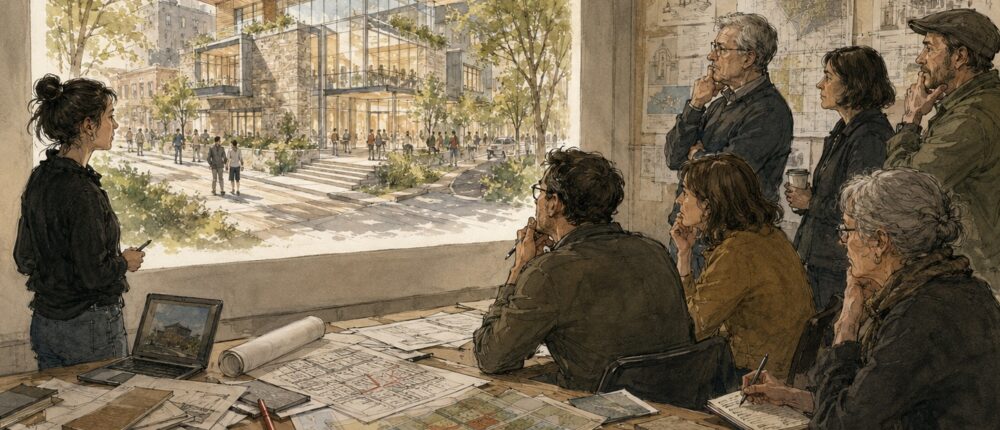
Featured image created by the author, using DALL.E prompts and then refined through manual editing.