
Ignoring the Climate Challenge Is Not an Option
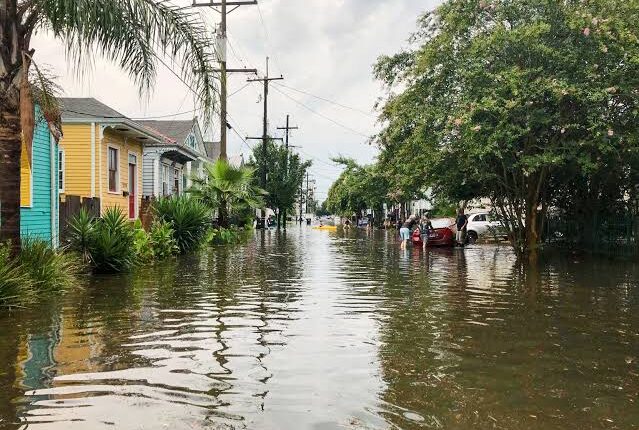
Climate reckonings are a hard thing to grasp, unless you’ve lived through one: people in western North Carolina standing helplessly by as Hurricane Helene’s raging rivers and mudslides wipe out houses, businesses, and the lives of more than 100 of their friends and relatives; residents of Pacific Palisades and Altadena, California, sifting through the smoldering ruins of their homes, in the aftermath of an urban firestorm; the horror of watching my beloved city of New Orleans go underwater, with nearly 900 lives lost, after Hurricane Katrina.
Sadly, these sorts of cataclysms are no longer once-in-a-lifetime events. With summer wildfires racing across Canada and Europe, a diminishing Colorado River demanding federal mandates for water rationing, wildfire and flood risks accelerating across California, Appalachia, and the Ozarks, and extreme heat nearly everywhere else, these conditions are no longer an abstraction. And yet the idea of addressing the root causes of these impacts in the political realm is retreating.
That’s the strangeness of the moment: The weather keeps getting more extreme right in front of us, but the political will to change course is nowhere to be found. It’s not hyperbole to say that we’re sleepwalking through one of the most urgent transformations in human civilization— driven in part by our collective failure to elect leaders willing to work together on a more realistic and responsible path forward. It’s time to wake up from our sleepwalking and face the music.
It’s not hyperbole to say that we’re sleepwalking through one of the most urgent transformations in human civilization— driven in part by our collective failure to elect leaders willing to work together on a more realistic and responsible path forward.
In spring 2026, a different sort of wake-up call came to my city, when The Guardian issued warnings from climate scientists that it was already too late for low-lying cities and towns—they must start planning for retreat to higher ground. The question was no longer rhetorical: Do we move, as advised, or stay and ride out the storms we know are coming?
In New Orleans, most of us will stay, in part because New Orleans has soulful qualities found nowhere else in this country. It was recently named the only U.S. city on the World Monuments Fund’s new “Irreplaceable America” list, a living cultural landscape, the birthplace of jazz, and an international nexus for culinary arts, architecture and creative improvisations that are all worth fighting to preserve. And partly because in the future the idea of higher ground might be an illusion. Even the few cities least exposed to climate impacts are now bracing for “managed retreat,” a viral infestation of humans that will likely push population densities well beyond most people’s comfort zones.
The St. Petersburg peninsula, the Tampa Bay region, and—let’s face it—the entire state of Florida have some similar ecological issues to think about. As a New Orleans resident and an urban planner who helped lead the city’s recovery plan after Hurricane Katrina, I believe that the climate-conscious citizens and innovative community leaders of both New Orleans and St. Pete can generate some creative new ways of thinking about the challenges of climate change. Environmentally and culturally, we are among the northernmost “islands” of the Caribbean. For many centuries, these cities have muscled through some of the world’s most demanding climate design challenges—hurricanes, heat, humidity, flooding—and answered with some of the most inventive architecture and urbanism anywhere: heavy timber framing, raised construction, breathable materials, wide overhanging roofs with gracious screened-in porches or cast-iron galleries for rain protection, shaded communal courtyards, water-based urban design. That is a tradition to which we already belong.
We have also learned over time that it is the people, and not formal governmental institutions, that have risen to solve these problems, as was the case with the city’s Unified New Orleans Plan for the city’s recovery after Hurricane Katrina, where a resounding chorus of 9,000 voices moved to center stage when the mayor and city council representatives couldn’t make it happen.
The same logic applies to cities everywhere. We now have the tools to rebuild communities around planning and design principles that work with nature instead of against it. The harder question is whether we have the will to demand that the billions we spend on war and accumulation of private wealth be reallocated toward more secure, collectively prosperous, and harmonious places to live.
I believe the answer is yes—if we’re willing to align how we build with the deeper logic of living systems themselves. Fortunately, several great minds can help guide us toward a healthier, collective future. The physicist and systems theorist Fritjof Capra has spent decades studying what makes living systems resilient, and four of his insights apply to how we might plan our cities.
First, our survival depends on learning to manage complex, adaptive networks rather than rigid hierarchies, the animating idea behind Joe Brewer’s culture design and John Fullerton’s regenerative economics.
Second, real resilience comes from whole-systems regeneration, as environmental entrepreneur Paul Hawken argues, in which justice, climate, biodiversity and human dignity are woven into one interconnected fabric rather than managed as separate problems.
Third, the best decisions come from broad and authentic community engagement, a founding American premise that, when it comes to creativity, all of us are smarter than any of us.
Fourth: nature’s intelligence, tested over 3.8 billion years of evolution in natural harmony, is a more trustworthy guide for innovation than anything we can engineer from scratch, a case made forcefully by biomimicry pioneer Janine Benyus and advocate for indigenous wisdom Robin Wall Kimmerer, and echoed in environmental journalist Bill McKibben’s warnings about handing the terms of human life over to artificial systems we do not yet understand.
The path ahead will be even more challenging for our children and grandchildren than it has been for us—and at a scale that is larger than any of us can probably now imagine.
None of this means the deeper work of slowing climate change itself stops mattering. On the contrary, efforts at mitigation, decarbonization, expanding renewables and reducing consumption are more important now than ever. As we know in our hearts, the path ahead will be even more challenging for our children and grandchildren than it has been for us—and at a scale that is larger than any of us can probably now imagine.
It’s time for an army of citizens, neighborhood associations, city halls, statehouses, and our representatives in Washington, D.C., to join together and demand that we look nature in the eye and start negotiating: about how we build, where we rebuild, and how we work together to face the fact that ignoring the climate challenge is not an option. The citizens of New Orleans and St. Petersburg have done this reckoning before, and we will do it again. Every city and town on the planet will face similar reckonings, hopefully with better tools for democratic participation and whole-systems, nature-based design and a new north star: The reminder that the quality of life for each of us, our families, and our neighbors, matters more than the dissonant forms of power and privilege that keep dragging us off into an increasingly uninhabitable future.
This essay originally appeared in the Tampa Bay Times. Featured image via the Preservation Resource Center of New Orleans.