
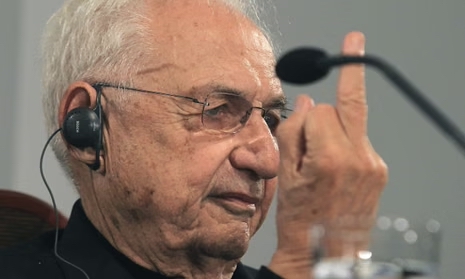
My Semester With Frank Gehry
If a layperson knows the name of two famous architects, one of them is likely to be Frank Gehry. Gehry, who passed away on December 5, was the first architect to enter wide American cultural consciousness since Frank Lloyd Wright. I was lucky to have had some meaningful exposure to him during my graduate studies at UCLA. I started my degree three years after the completion of Gehry’s best-known building, the Guggenheim Museum in Bilbao, Spain. He was an icon in our field, well known beyond it, and, more exciting yet, he was a rebel. In a profession that teaches you to overturn the norms, he overturned the norms.
The UCLA School of Architecture was a leader in progressive design. It represented a whole religion built up around conforming to the accepted brand of nonconformity, and Gehry … wouldn’t conform. Normally, the establishment would not allow nonconformity to their nonconformity—in other words, they required conformity. For example, when I proposed a thesis project to analyze a religious building typology I was intimately familiar with (the Mormon temple), my professor refused to allow it. She withdrew rather than allowing me to study a topic that would have made her appear outside the bounds of acceptable nonconformity. Instead of allowing such indolence, they canceled the thesis program in favor of “allowing” students the freedom to work on the project of a famous professor as his free assistant, supporting his vision, taking his directions, so they could have the privilege of associating themselves with his project in which he set the agenda and did the thinking. They didn’t see the similarities in that structure with the religion whose architecture and culture I wished to study, with its rigid rules, norms, and expectations. (I did find another great professor who would help me, but that’s not the story here.)
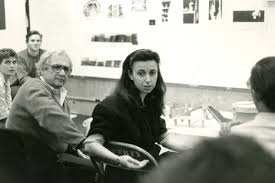
Enter Frank Gehry. Here was a rebel, but the wrong sort. The public had made him a rock star, and the establishment knew it. He was more famous than the accomplished professors. Gehry’s buildings were appearing in pop culture. He had been selected to design one right in downtown L.A., which they knew, correctly, would become an international icon. Gehry did not fit the pattern, but they knew they had to allow space for this unsanctioned nonconformist. You could sense their unease, and their understanding that they had to allow space for him or risk being sidelined. It was this dynamic that taught me the lesson they pretended to want us to learn: to be a true creative, you have to buck trends, norms, and conventions, because those things will prevent you from seeing the world with fresh eyes.
One quarter I studied under Gehry, as close as you could get to him, that is. Another prominent professor created a project for us based on one of Gehry’s favorite topics— collaboration with artists—and brought the architect, who didn’t teach, in as a consultant. We gathered in a room in his studio, and he came in to talk to us. In some professions, you retire when you’re 73 and walking with a cane, but not in architecture. Gehry was at his prime. He was the coolest septuagenarian ever, and radiated a hip energy. His cane was the contrast that gave him much more of an edge, that made him more of a rebel: not even gravity and age could stop him.
Gehry was an outsider who ironically embodied everything we were taught to value, and more forcefully so because he went against all the commandments. He didn’t theorize. He didn’t diagram everything he was going to build. He didn’t write essays with big words or give obtuse speeches explaining his brilliant ideas. He just built what he thought was cool. He started building fish with metal scales because he and his friends like Claus Oldenburg thought they were cool. Art didn’t have the same rules. As the public appreciated his creations and shot commercials in front of them, his name grew and he received opportunities to design bigger and bigger sculptural work. Bilbao was his biggest fish yet.
Under his tutelage, we were to find an artist to collaborate with. I picked Gustavo Godoy, a student who had started in our class but had been kicked out—get this—because he wanted to create art he thought was cool and refused to position it within the architectural discourse. “You can’t decide if you want to be in this school or the one down the sidewalk,” was a blistering criticism he received on one of his designs shortly before being shown the exit; down the street was UCLA’s very reputable art school, which operated by different rules.
Gustavo played artist and I played architect as we collaborated on a whirlwind of an atrium. It was fabulous and unbuildable, all the things you want in teaching a student to think big, the school’s mission. To their credit, they gave Gehry the space to share his aura, even if his teachings were apostate. Seeing Gehry up close revealed the system for what it was, a rigid structure that used the word “progressive” to build a culture that was on the brink of not allowing progressive thought, if it didn’t conform with the progressive requirements. That could have utterly nullified the entire gospel of progressive design if Gehry hadn’t come as the Messiah to deliver the real message. We didn’t need rigid rules—we needed an iconoclast. Gehry made the powers reconcile the rigid structure they called free thought with actual freedom of thought.
Gehry didn’t fit, he didn’t obey. He was everything we needed to learn.
Featured image via the Guardian.