
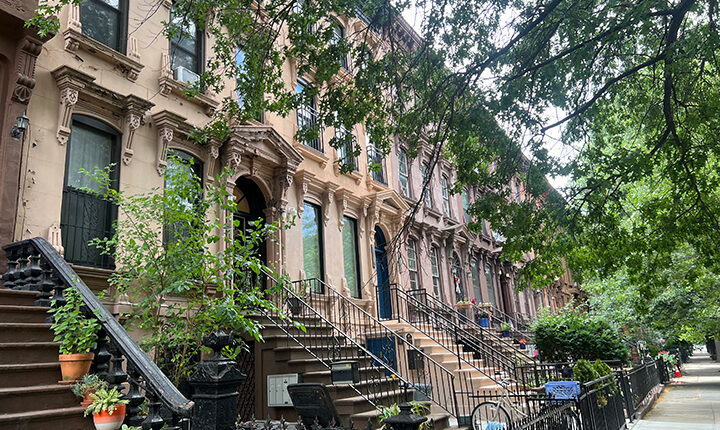
Preservation Actually Saves Affordable Housing, Contrary to Popular Belief
In the 1970s, New York City was on the verge of bankruptcy. When President Gerald Ford refused to provide federal aid to help the city, “Ford to City: Drop Dead” was the famous 1975 Daily News headline. To many, New York seemed hopeless: infrastructure was crumbling; landlords were abandoning tenements, brownstones, and small apartment buildings; police, sanitation, and other city services were deteriorating; fear was pervasive; bankruptcy loomed. All eyes were on banker Felix Rohayton and a committee of money men working with then-Mayor Abraham Beame to develop a fiscal rescue plan. When it was completed, the headlines were all about how the financiers “saved” New York.
But did they?
Physically, the city was still a mess; nothing had improved. Residents were leaving, and many stores were empty. Some city officials even suggested abandoning entire neighborhoods, closing the fire and police stations and declaring them finished. Planned shrinkage, it was called.
But a funny thing happened. While all eyes were on City Hall, on the money men and the experts, the real action, the grassroots action that eventually saved and rebuilt the city, was happening in the neighborhoods. People started moving back into the abandoned areas and purchasing empty and undervalued brownstones, tenements, lofts, and apartments. Attracted by the architectural flourishes, finely crafted plaster interiors, carved wood wall coverings, solid oak floors and spacious rooms, a new generation of New Yorkers repopulated the buildings and neighborhoods that the experts had deemed hopeless.
Urban pioneers, they were called. Many of them had grown up in the suburbs and wanted the urban alternative. Some had grown up in the city and had no intention of abandoning it. People started noticing, and press attention followed. Neighborhoods like Park Slope and Cobble Hill in Brooklyn, and Chelsea and the Upper West Side in Manhattan, were re-emerging. Newly formed block associations organized neighborhood watches, held parties, planted flower boxes, staged house tours. Nothing was organized from above; it was all organic and local. It became known as the Brownstone or Back-to-the-City Movement, and it required hard work and deep commitment. It happened in the South Bronx, too, where landlords walked away from buildings and the residents took ownership and rebuilt from the bottom up. There they actually got help from the Koch administration, which realized the city had no alternative but to help let the people do it themselves.
What many of these urban homesteaders valued were the qualities of the old, well-constructed, eminently-viable existing urban fabric built over time. Out of this trend emerged the historic preservation movement, whose central ethic was not to freeze the city or stop change, but to shape growth in layers of change that added to, but didn’t replace or overwhelm, the strength of the past. This is urban regeneration that adds and strengthens without wiping out and replacing with huge, inflexible insertions.
Historic preservation was the concept that Jacqueline Kennedy Onassis championed during the 1970’s legal fight over the future of Grand Central Station. It gained credibility for localities all over the country. Historic preservation took hold in cities whose strength rested on layers of growth. But now a new era is upon us, one in which advocates of new construction at all costs claim historic preservation and cumbersome building procedures stand in the way of progress and affordable housing and that advocates of preservation are simply NIMBYs (Not In My Back Yard).
In truth, thousands of units of affordable housing, much of it rent regulated, are protected from demolition because of their location in designated historic districts. Private owners living in part of a house often rent remaining floors at more reasonable rents than developer-built apartment houses. In designated districts, developers are prevented from buying, forcing out residents, and demolishing a building in order to replace it with large-scale luxury housing.
In contrast, in undesignated historic neighborhoods, developers are tearing down buildings similar to those in designated districts and evicting tenants from affordable apartments. Those tenants are the ones leaving the city, because affordable options are drastically fewer (and certainly not to be found in the new luxury high rises replacing the older structures). This is happening in older unprotected neighborhoods, such as Yorkville on Manhattan’s Upper East Side and Gowanus in Brooklyn. This is a clearance and redevelopment approach similar to what Robert Moses used to do, but on a smaller scale. The replacement apartments, mostly condos, are vastly more expensive than rent regulated units.
These disappearing apartments are precisely the affordable units whose rent Mayor Zohran Mamdani wants to freeze. And here it’s worth repeating: Thousands of affordable housing units are protected from demolition because they exist in the city’s 157 historic districts. While it sounds like a lot of districts (some are barely a block in size), that’s less than 4% of all the properties in the city. Rather than stopping development of affordable housing, historic preservation is protecting more of it than could possibly be built to replace it.
Older buildings are being demolished almost weekly in the undesignated neighboring districts. Most of these brownstones and small apartment houses are filled with existing affordable units, many of which were happily occupied until developers bought, emptied them out, and tore them down. In some instances, especially in Yorkville, multiple brownstones were replaced by a single tower, resulting in increased height and lower density, a lose-lose proposition for everyone but the developers. Recognizing this unpublicized reality should make everyone a NIMBY. But with a difference: these developments should not be in anybody’s backyard.
The transformation of New York City started in the neighborhoods. Some of those neighborhoods are now designated historic districts. Without those designations, even more existing affordable housing would be lost to the wrecking ball. Sadly, that is the real estate industry’s goal. It should not be the city’s.
Featured image via NYC.gov.