
Raving Amid the Ruins
In the early 1990s, many American cities had a bombed-out quality, with my ever-thriving hometown of Minneapolis barely an exception. After decades of disinvestment, these urban areas were plagued by crime and filled with surface parking lots and other artifacts that testified to the chosen destruction of what had once been fine-grained urban form. But they were also cheap and full of people making things: music, art, culture, mischief.
The silver lining of the strained, semi-vacant, low-demand reality of American cities at the time meant that a crew of folks could scout out a vacant building for a massive secret gathering, promote the happening citywide within underground circles, break into said building, set up a huge sound and light system, hold an all-night dance party, then close up shop at dawn and go off on their merry way. In short, they could throw a rave, people would come, and the organizers would not only get away with it, but do it again and again.
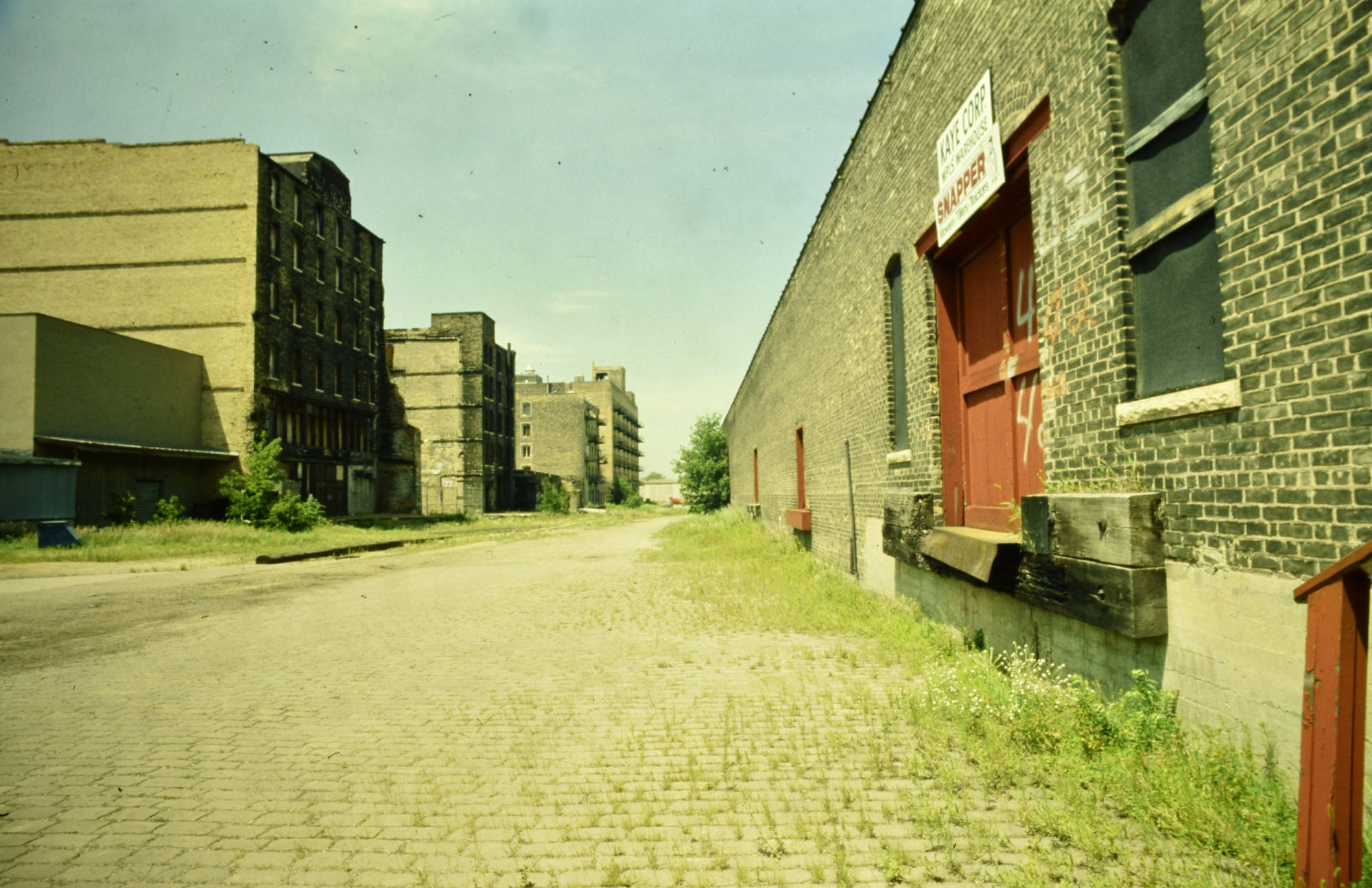
The kinds of abandoned spaces the raves of the early ’90s were held in—here, vacant warehouses overlooking a defunct freight line in Minneapolis. Many of the buildings shown have since been converted into high-end housing. Photo: Hennepin County Library, Department of Community Planning and Economic Development Records.
In late May 1993, I was 15 and nearing the end of my freshman year of high school. On a whim, a friend asked me if I wanted to go to a rave. Having read an article in Spin magazine about the whole Manchester scene and the drug ecstasy and the electronic music group 808 State, I vaguely knew what raves were but had no real mental image of what they actually entailed. As luck would have it, my parents let me go, telling me I needed to be home by 11:30. (“My friends thought I was nuts for letting you go to these,” my mom recently recalled.)
After sunset, my friend picked me up in her red Honda Prelude, tickets and paper map in tow. (Maps to the events were provided only upon the purchase of tickets, and they were always rudimentary photocopy jobs.) This led us to somewhere in the nether-region between Minneapolis and Saint Paul that was vaguely industrial and full of grim warehouses. When we arrived, it was night heading toward early morning (meaning I had essentially an hour and a half before I had to leave). I distinctly remember two things: the air soft and full of the gentle humidity of the ground thawing and trees ready to leaf out, and the pulse of the bass emanating from a building that resembled an airplane hangar.
A guy standing at a nondescript, windowless door that appeared tiny relative to the scale of the building took our tickets, and off we went inside, suddenly awash in projections on every wall, lights of all kinds, a 40-foot high steel-girded ceiling, the pulsing of the sparse but bright house and techno music of the age, and people dancing, letting loose, and sinking into a groove. Off to one side was a rudimentary mezzanine level (think two-by-fours and sheetrock built to make a makeshift set of offices), atop which danced go-go dancers and, I think, where the DJs were spinning the music.
This was the era of dancing increasingly becoming something you didn’t do but rather made fun of, wrote Heather Havrilesky for the New York Times Magazine of the era. (“We became jaded from watching mediocre Broadway musicals and Richard Simmons clones and SNL skits quickly turn our favorite dance moves into punchlines.”) And yet, within this multisensory, celebratory context of the rave, everyone danced, and it seemed no one cared what you looked like when doing so.
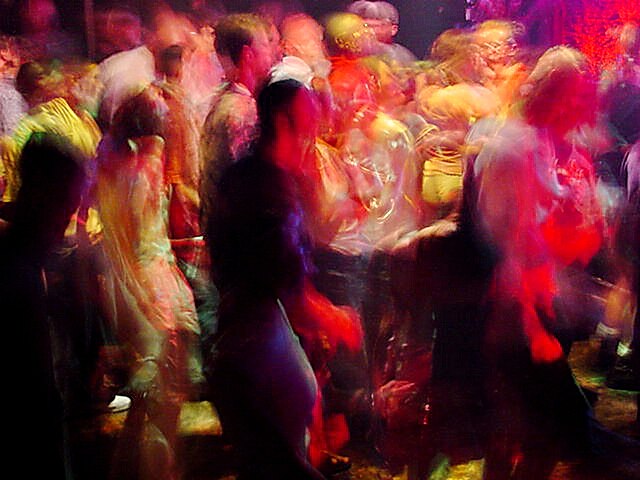
The totalizing, extrasensory experience of that first rave is still acutely etched in my mind as pretty much one of the most magical, mystifying experiences of my life and set the course for what would ultimately be an ongoing pursuit of these kinds of multisensory electronic dance experiences—yes, I went to many more raves after this—and ultimately a turn toward DJing and producing my own house and techno, which began in 2004 in Los Angeles and continues to this day.
The golden age of underground, unsanctioned raves only lasted until around 1995. Over time, the Minneapolis police wised up to the phenomenon, the local paper having run an article exposing the whole scene, predictably focusing on the drug-use aspect and conveniently omitting any of the positives. While I was never there to do drugs, they did become one of the defining features of the later raves I went to. As many raves started getting shut down by the police before the night was over, organizers began shifting them to more formal venues: night clubs, and, in the case of the last one I went to, a (groan) wedding venue. With this shift toward formality, the whole element of adventure and discovery vaporized, and the era was over.
Some 30 years later, the same friend I went to my first rave with and another rave companion and I gathered in Madison, Wisconsin, to record a podcast on what we remembered about our experiences. The conversation ran the gamut, from how we had originally found out about them, to deeper ideas about alternative spaces for those of us who didn’t really feel like we fit in within Minnesota’s oftentimes crippling conformity, to the understanding that a particular set of urban, economic, and cultural forces had really collided—or aligned—for a brief moment to make raves possible. A set of conditions that probably couldn’t be recreated today.
We talked about the music and the DJs that spun those tracks and wove them together in what we all remember as a seemingly perfect soundtrack to the kinetic, extrasensory, and exploratory qualities of the gatherings. Yet when it came to reminiscing about who these DJs were, or what they looked like, we were at a loss, having only vague recollections of where the DJ might have been within the warehouse or abandoned factory or office building the rave was held in, and never knowing which DJ was spinning at a given moment. In short, the DJs created a layer of the rave experience, but they were never the experience.
This stands in stark contrast to today’s electronic music experience…you go to a formally sanctioned space to watch a specific DJ. Almost no one dances but instead stares at the DJ and gives them, at best, a kind of syncopated, swaying salute in their direction.
This stands in stark contrast to today’s electronic music experience, in which the DJ plays a front and center role in the way that a band would: you go to a formally sanctioned space to watch a specific DJ. Almost no one dances but instead stares at the DJ and gives them, at best, a kind of syncopated, swaying salute in their direction.
Or, just as likely, you won’t travel to a physical space to see a DJ but will instead sit in front of your computer and watch the DJ within the comforts of your own home. A popular YouTube account that features DJs spinning sets has them placed within what looks like a cramped white-tiled bathroom minus the plumbing, illuminated by a sickly-yellow-tinged fluorescent light. The setting’s succinct lack of anything that suggests discovery, adventure, camaraderie, or a multisensory experience perfectly sums up how the experience of electronic music has lost its way. I can’t help but hear the words of Peggy Lee floating up and singing within the ether of my mind: “Is that all there is?”
It would be an oversimplification to say there was a singular moment when I realized DJing as a medium had become completely stuck and needed to become something else, but a friend’s former artspace in the Bay Area was probably the inadvertent catalyst for transforming what had been real misgivings about where the musical medium was headed into a tangible solution.
The art space Machinaloci was run by artist and architect Carol Mancke (who has since moved to London) that sought to bring the public inside and the private outside to explore the interplay between the two and challenge our notions of hard divisions between them. It was unlike any other, in part because Mancke served less as gatekeeper and more so facilitator of curiosity and inquiry, always open to suggestions about what could happen within the space.
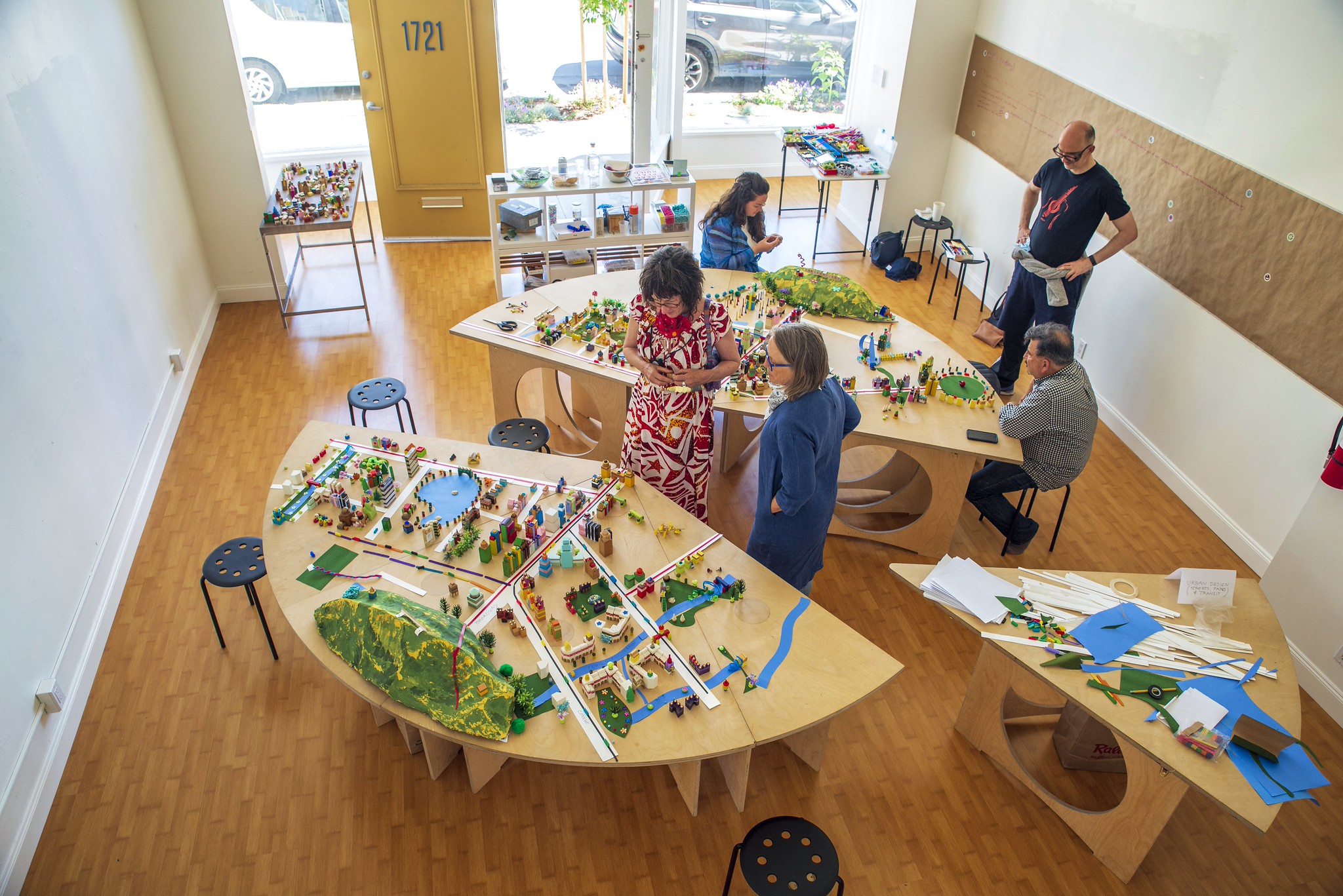
A view of the Machinaloci space and an interactive model of the Bay Area built by James Rojas and for the custom-made table by Carol Mancke. The table could be taken apart, moved, and transformed to adapt to whatever the installation of the space called for.
It was both the themes and the sense of possibility that the space offered that started getting me thinking about what a DJ event within Machinaloci might look like. And so I began sketching out an idea: planner and writer James Rojas would build a huge model of the street outside, which we would install inside; a camera above would capture the real-time image of people building their ideas of how to redesign the street, and that image would be projected onto a wall behind where I would DJ, spinning a set of tracks that sought to help participants sink into a creative flow state and build away.
Cut forward a couple years, and Machinaloci had sadly closed when Carol and her husband moved, but around that time the Exploratorium in San Francisco reached out to us about creating a model of Market Street for their Exploratorium After Dark series. I pitched the idea of adding in the DJing and video component to the installation, and the folks there were enthusiastic.
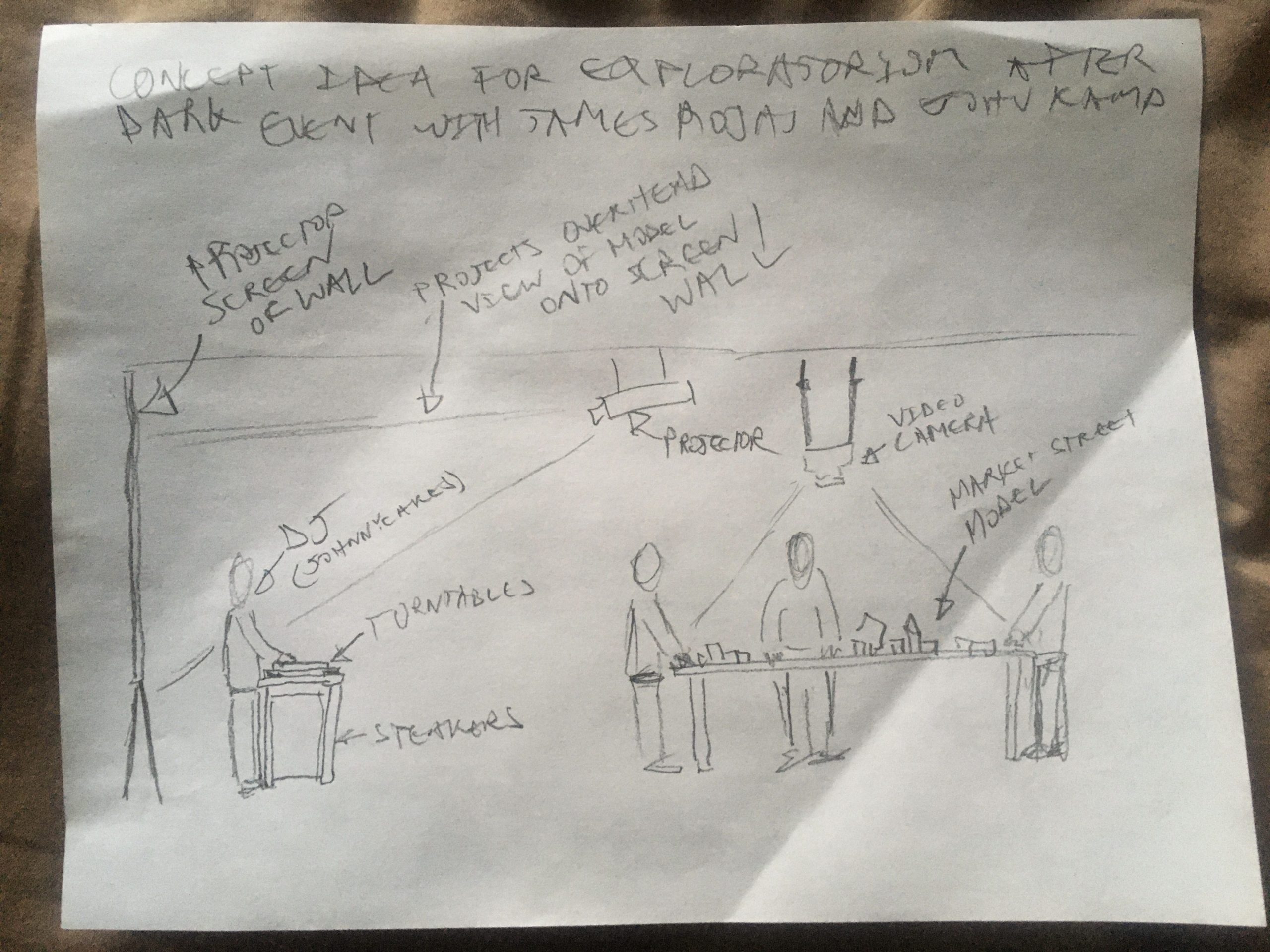
A sketch by the author of his proposed hybrid DJ/model-building/video concept.
We ended up calling the event Tracks to Build to: Market Street with the idea that the tracks I spun would serve as that sensory layer that helped you sink into the creative zone to work with your hands and build. “Oftentimes the hands can solve a mystery that the intellect has struggled with in vain,” Carl Jung once wrote, alluding to the fact that our hands can access sensory and creative knowledge that we can’t always access through language and linear thinking. Music can provide that element that helps tell our brains what to tune out and what to focus on in that hands-on endeavor.
Ultimately, James built an 8-foot-long model of Market Street, and we provided bins full of buildings and found objects people could pick from to build their ideas of the street reimagined. At that time we were coming out of the pandemic, and American downtowns had been hit particularly hard. After years of urban planning around the assumption of a permanent 9–5 pattern, that pattern had suddenly collapsed, but the infrastructure remained. How could we radically rethink what that infrastructure could become?
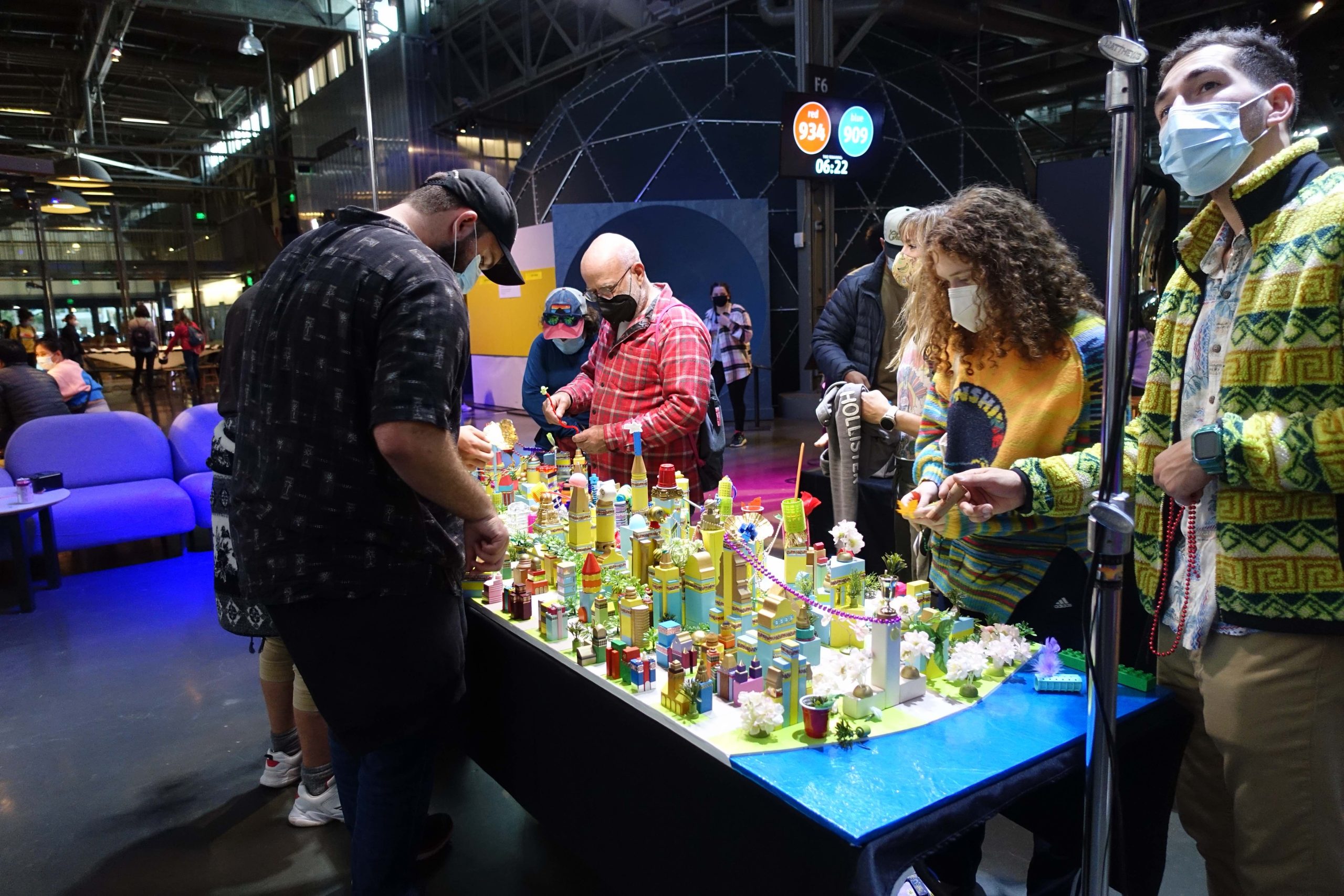
The multimedia Tracks to Build to: Market Street installation, held at the Exploratorium as part of their After Dark series.
I spun a nonstop four-hour set, and for those 240 minutes we had a steady stream of people coming through, both building their creative ideas within the video/soundscape experience and also taking a step back and observing and listening to the whole experience as it unfolded. Some even danced.
The event was so energizing and offered the promise of new avenues for multisensory exploration that we then pitched a similar idea for the South by Southwest festival in 2023 to our friend and DJ/urban planner Lauren Goshinski, who welcomed us to lead a Tracks to Build To event to cap off a day-long series of events exploring the future of nightlife in the contemporary city.
Our present-day urban reality contains nearly the complete opposite set of conditions that existed during the rave days of the early ’90s: skyrocketing rents, neighbors with the means and political capital to shut whole nightclubs down, and nary a vacant warehouse to be had. How do you create a thriving underground nightlife scene given such constraints?
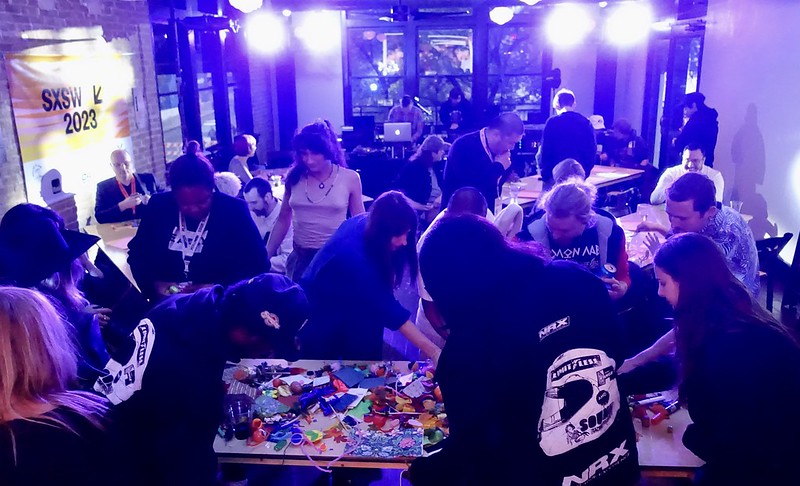
The next Tracks to Build to event, at SXSW 2023, where participants built models of their first memory of sound and their dream nightclub in an unlikely space.
In this instance we didn’t have the video component, so Lauren worked the light array, transforming the workshop into something that felt akin to a nightclub. I spun deep techno and house tracks, while James led folks in building models of both their favorite memory of sound, and then their dream nightclub in an unlikely space. The atmosphere was electric, with people coming up with exceedingly creative ideas for what a nightlife experience could be: boats that would dock at set points allowing people to get on and off, clubs floating in the clouds, clubs multiple stories underground, among many others.
More recently, we took the same concept to the Global (Un)Conference 2 at Washington University in St. Louis, where participants explored the theme of the future of urban nightlife. This time we’re going to design what people built in their models, and then we’re going to build it, throwing a one-off nightlife experience that weaves in elements of people’s creative ideas from the workshop and that creates a blueprint for charting a creative path forward: multisensory, multigenerational nightlife experiences in which the DJs are present, but you might not know where they are; they aren’t the focal point, just facilitators of a deeper sensory, exploratory, and kinetic experience.
We’re living in troubled times, but it doesn’t have to be this way. Part of change involves placing oneself clearly within the role of crafting and inhabiting that change. We then become both dreamers and active players in the shaping of the world around us. Rather than DJing remaining stuck in its solipsistic, visionless netherspace devoid of much in the way of creativity, my hope is that these Tracks to Build To events can create both a figurative and literal space in which we push the medium of DJing forward while creating that space in which it feels easy and effortless to dream up and imagine a better world. And then you use your own hands to build it with those around you.
Featured image by Rick Doble, via Wikimedia Commons.