

Tales of an Urban Critic: A Search for the Soul of Cities and Self
What makes a good autobiography? At the top of the list are entertaining stories, lots of them, shared candidly by the author as you’re taken on the tour of a life. Sam Hall Kaplan shares a number of great ones in his new book, An Urban Odyssey: A Critic’s Search for the Soul of Cities and Self (Academic Studies Press). Kaplan has led a varied seven-decade career as a print and broadcast journalist, an architecture and urban critic, and sometime urban planner and educator. (Recently, he’s written several engaging essays for Common Edge.) The book is about life choices, about the importance of place, and about what makes a great city, formulated over a personal odyssey steered more by chance and opportunity than some grand plan. “Oh, what the hell, why not?” Kaplan declares several times over his life’s course, as his journey takes him in unforeseen new directions.
Having never, ever for a moment entertained the idea of writing a book about myself, I wondered what the motivation might be. For Kaplan, it was provoked by his family. A Father’s Day email in 2022 from two of his adult children planted the idea that it was time to sit down and spin a personal chronicle, which was presented to Kaplan as “a beautiful way to preserve the power of your voice and the unique shape and content of your life for posterity”—a window, so to speak, “into his life and mind.” Kaplan notes that “I also have an ego,” which made this decision easier, as did several life-threatening illnesses, which couldn’t have helped but induce the necessary reflective mood for such a writing project.
What’s a good structure for such a book? Kaplan oscillates between an “annotated resume” and entertaining stories shared over a beer. The storyteller is much more fun to be with. A childhood in Brooklyn in the 1930s and ’40s started him on his career as an observer and champion of urban life. “The Stoop, and City Beyond,” the book’s first chapter, is dedicated to the important lessons Kaplan learned about what makes a place a neighborhood, and what makes a neighborhood an important piece of a city. “The stoop was, technically, a collective private space,” he writes, “used publicly for the immediate families living there and invited others.” The “family” in Kaplan’s Flatbush neighborhood was made up of Jews and Italians from the ’hood; outsiders from beyond the enclave, whether blood relatives or not, were cause for suspicion. His description of how the stoop is transformed through these “family” gatherings is beautiful: “Sitting on the concrete steps or the low sidewall, or a faded foldout beach chair taken from an apartment, a grandstand was formed of the exterior steps, a stage set of sorts, offering views of the interminable gabbing, lounging residents and the passing parade of characters on the sidewalk, or to make room for a stoopball game, to watch, cheer, and bet on.”
What makes this scene important? It’s the people, and Kaplan reminds us of this through Shakespeare’s insightful observation: “What is the city but the people?” As he explored the many shades and colors of urban fabric around the world, Kaplan found variations of his Flatbush stoop in sidewalks and streets, “squares, parks, and playgrounds,” along with “varied vestigial scenes, such as the iconic local stoops”—a remnant from Old World Amsterdam. For Kaplan, these places are “the existential life of the city, its ‘genius loci.’” They are the city’s soul.
In high school, Kaplan lands a part-time paying writing gig with the Long Island Daily Press, then attends Cornell (biochemistry major; later, he receives a degree in environmental studies from Princeton), and then goes on to write for the New York Times and New York dailies. His time on the Flatbush stoop prepared him well for striking up a friendship in the early 1960s with “Saint Jane” Jacobs (as he dubs her), introduced to him by William “Holly” Whyte, who mentored them both.

Here, unfortunately, Kaplan’s book veers into “annotated resume” mode. While he recounts what a good buddy and influence Jacobs was, we never get a great story. “So we became friends,” Kaplan writes, “and among other things shared our disdain for city planners and others shortchanging communities.”
Tell us the tale! Here’s Kaplan clinking mugs with Jacobs and Whyte in Greenwich Village’s White Horse tavern…but what were those beery conversations like? Let’s pull up a stool and eavesdrop! Spill it, Sam!
From here, there’s a dry spell of great stories, and Kaplan doesn’t hit his stride again until he arrives in Los Angeles in the fall of 1978, eventually becoming a critic of urbanism and architecture at the Los Angeles Times. Because he’s not a native Angeleno, he hunts for architectural color and urban vibrancy in off-ramp neighborhoods and among the city’s older architectural landmarks, cultivating new interest in the city’s built heritage, preservation, and planning. His 1987 book, L.A. Lost and Found: An Architectural History of Los Angeles, was a result.
And then he meets Frank Gehry.
Kaplan’s view is that local L.A. architects at the time were pushing to promote “trendsetting” design, an effort which (in their view) the Times’ architecture critic could (and should) focus on. He prepares for his first meeting with Gehry to see what this “aging enfant terrible” is up to. It doesn’t go well. “I felt that he was playing me,” writes Kaplan, with a mix of cliches, compliments, and the insinuation that he and Kaplan, a fellow Jew, “should bond together against ‘them.’” Kaplan distrusts Gehry as manipulative and proceeds to put up his guard whenever he writes about the architect’s work.
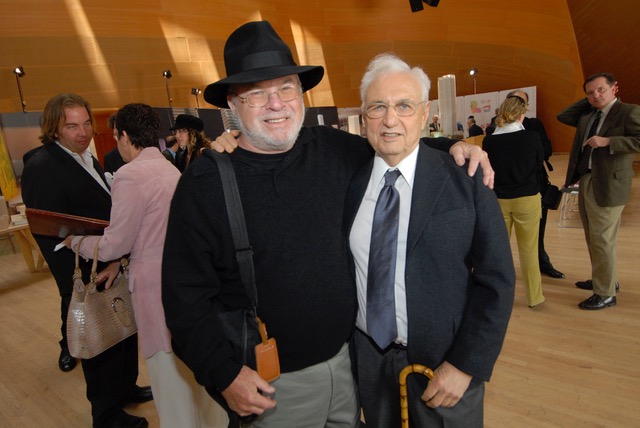
But some of Gehry’s oeuvre appeals to Kaplan, particularly his deconstructed Santa Monica home, just two blocks from where the critic lives. “I viscerally liked it,” admits Kaplan, who many mornings would walk his dog past Gehry’s house, stopping to contemplate it. The dog sensed this pause as the moment for a pee break. Amused, Kaplan later mentioned this canine behavior to a local architecture professor, who made sure it was shared widely. (I remember hearing this story on the other side of the continent.) Gehry’s “littering” complaint against Kaplan was thrown out, ensuring that the incident got even more play.
After years of writing insightful, if not always deferential, reviews of Gehry’s architecture, Kaplan attends the opening of the Disney Concert Hall in October 2003, after his lengthy review of its urban design shortcomings and functional challenges, as well as a reminder to readers that architecture is “a social art in the public realm,” one in which the building falls short. Gehry spies Kaplan in the crowd at the opening and, red-faced, physically confronts the critic, yelling, “Sam, you don’t know a fucking thing about urban design.” Ever the conscientious journalist, Kaplan asks if he can quote Gehry.
“Yes, fuck off.”
Kaplan closes his book—which, oddly, has no images from his lifelong odyssey—reflecting on the state of architecture and urban design, of which he is hopeful. Yet he’s alarmed at the pace of climate change, racial prejudice, income disparity played out in “private opulence and public squalor, homelessness, and hunger. Humankind doesn’t seem to be getting any better.”
True. But that’s not the end of our story.
Featured image: Gehry house in Santa Monica, CA., via Sam Hall Kaplan.