
The Architectures of Kengo Kuma
This is an excerpt from the newly published monograph, KKAA: Kengo Kuma and Associates: The Details of Designing Soft and Small (Schiffer Publishing).
The Architecture of the Handmade
A handmade architecture composed of natural materials is a signature of the Japanese architect Kengo Kuma. What is so important about handmade architecture? “An architecture shaped by human hands gives us comfort and rich experiences,” Kuma says. “I believe that such architecture is more like a living creature than an artificial object. Human hands give life to the building and people are nourished by it.” For Kuma, a wooden railing shaped by human hands, or buffed again and again by the hands of others, takes on a luster akin to long, silken hair lovingly brushed over and over. A stone wall that bears the marks of the mason’s chisel, an iron gate shaped with the blows of the metalworker’s hammer, reveal the personalities of those who wrought them. “I emphasize the emotions that humans can get from natural materials,” explains Kuma, “which can create a sense of delight and comfort, or even change one’s perception of the world.”
The places in which Kuma builds speak. As he has worked on sites farther afield from his native Japan (he currently has projects in about two dozen counties), his approach to the design of place has evolved with a consistency. He concludes that a country as an architectural entity is an abstraction. What is meaningful and rewarding is to make architecture in each locale using materials and talent unique to the location. His approach is to walk the site—slowly. “It is not easy for architects to be humble,” Kuma reflects, but good design demands a certain humility. Kuma must touch the ground with his own feet, touch the trees with his own hands, to feel the reality of a locale. “That is the start of the conversation with a place,” he says.
To achieve a handmade architecture, Kuma collaborates not only with his colleagues at Kengo Kuma and Associates, but also with those who craft his designs. His method is to work closely with craftspeople who are indigenous to whatever place he is designing for. He describes such home-grown craftspeople as “the bridge, or the medium between the architecture and its location. Craftspeople can give a soul to an artificial structure.” How does he discover these gifted fabricators? Kuma employs a variety of methods: Conversations with the client and local people often uncover these creators. (Kuma likens the process to that of a good Buddhist priest, who gently visits a place and spends time honestly speaking with the people of that place.) But sometimes even an internet search might uncover potential collaborators. “When I work with the craftspeople, I would never force or insist on my idea with them,” says Kuma. “I try to know their work as much as possible and bring out their skills and ideas to the maximum.” In a sense, Kuma uses the design to conjure the best work out of the native craftspeople that he works with.
Kuma collaborates with craftspeople in many ways, but never through words alone. A turning point in his evolution as an architect was to relocate his practice in the early 1990s from Tokyo to the countryside. For a decade he worked intimately on small-scale projects with craftspeople, which changed his work and how he collaborated with “native geniuses” (to use Sibyl Moholy-Nagy’s term). “I often draw new sketches specifically for them to show what sort of details we aim for,” Kuma explains. “At a certain point in the construction we build a full-scale mock-up and check it carefully with them.” He is wary of using three-dimensional computer renderings or models in this process—he views them as abstractions that do not reveal the soul of the design in its details. Full-scale fabrications in the materials to be used are Kuma’s preferred way of collaborating with colleagues and craftspeople. Of the five senses, he relies most on visual and tactile sensibilities.
The Architecture of Small, Gentle, Soft
Kuma came of age as an architect in Japan as the figures of Modern architecture reached their apex—architects such as Kenzō Tange, Arata Isozaki, Fumihiko Maki, and Tadao Ando—whose works were often hard-edged and unrelenting, made of anonymous materials such as steel, glass, and concrete. As Kuma matured, he came to perceive such architecture as disconnecting people with nature, cutting them off from life-giving qualities that can be found in such materials as stone, paper, textiles, and especially wood. “Wood is always small, gentle, and soft,” Kuma says. “Wood is humble.”
Such natural materials were also the setting of Kuma’s childhood, particularly his home in the suburbs of Tokyo. In the late-1950s and ’60s he was brought up in satoyama—small, hilly woods that exist in suburban areas of Japan. He grew up next to a farm, feeling close to the animals the farm family kept there, and the surrounding woodlands. Kuma relates that as an architect he has benefited from these memories. His own family’s home was a 1940s traditional house, a single-story wooden structure, to which over the years his father added a series of extensions. “My father asked me to design and even build the structure together with him,” Kuma reflects, “so we shared the process of house-making, which eventually contributed to the way I work as an architect.”
It was a house of wood, paper, and tatami, and even today he recalls the scent of its materials, their textures—memories that can be triggered in the olfactory aftermath of a rainstorm. In Kuma’s recollection one cannot help but hear echoes of childhood recollections that shaped other designers, such as the Finnish architect Juhani Pallasmaa, who wrote in his book The Eyes of the Skin, “I cannot remember the appearance of the door to my grandfather’s farmhouse from my early childhood, but I do remember the resistance of its weight, the patina of its wood surface scarred by decades of use, and I recall especially vividly the scent of home that hit my face as an invisible wall behind the door.”
The Architecture of Gentleness and Shadow
Kuma’s increasing attention to humble, natural materials has yielded a theoretical posture that embraces what he has called “Defeated Architecture,” one in opposition to the “Victorious Architecture” that characterized 20th century Modernism. Such architectural heroism, writes Kuma, resulted in buildings that used “the hard, strong, heavy material of concrete as a means of defeating the environment.” While I accept Kuma’s dichotomy of “defeated” versus “victorious,” and its architectural implications, I believe that better descriptors are at hand: an architecture that is compliant; an architecture of gentleness; buildings of compromise; environments of surrender.
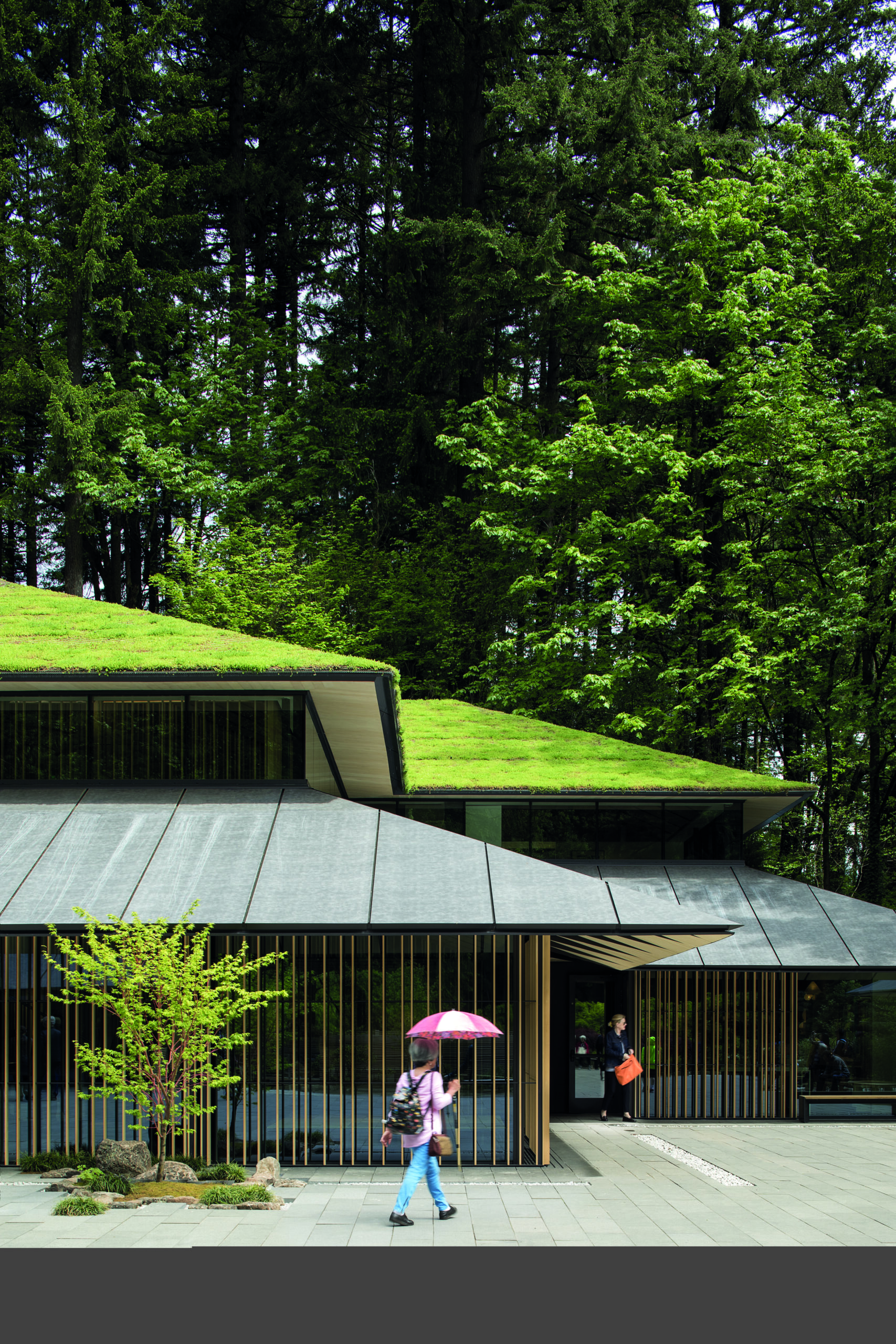
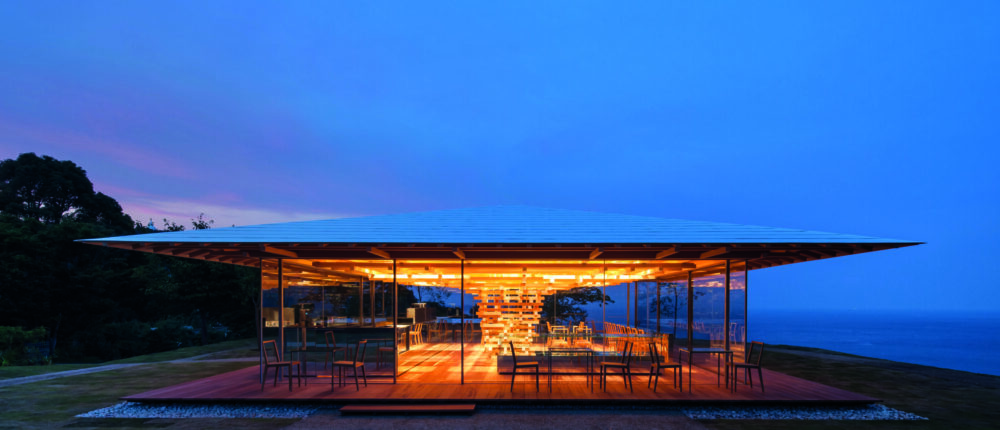
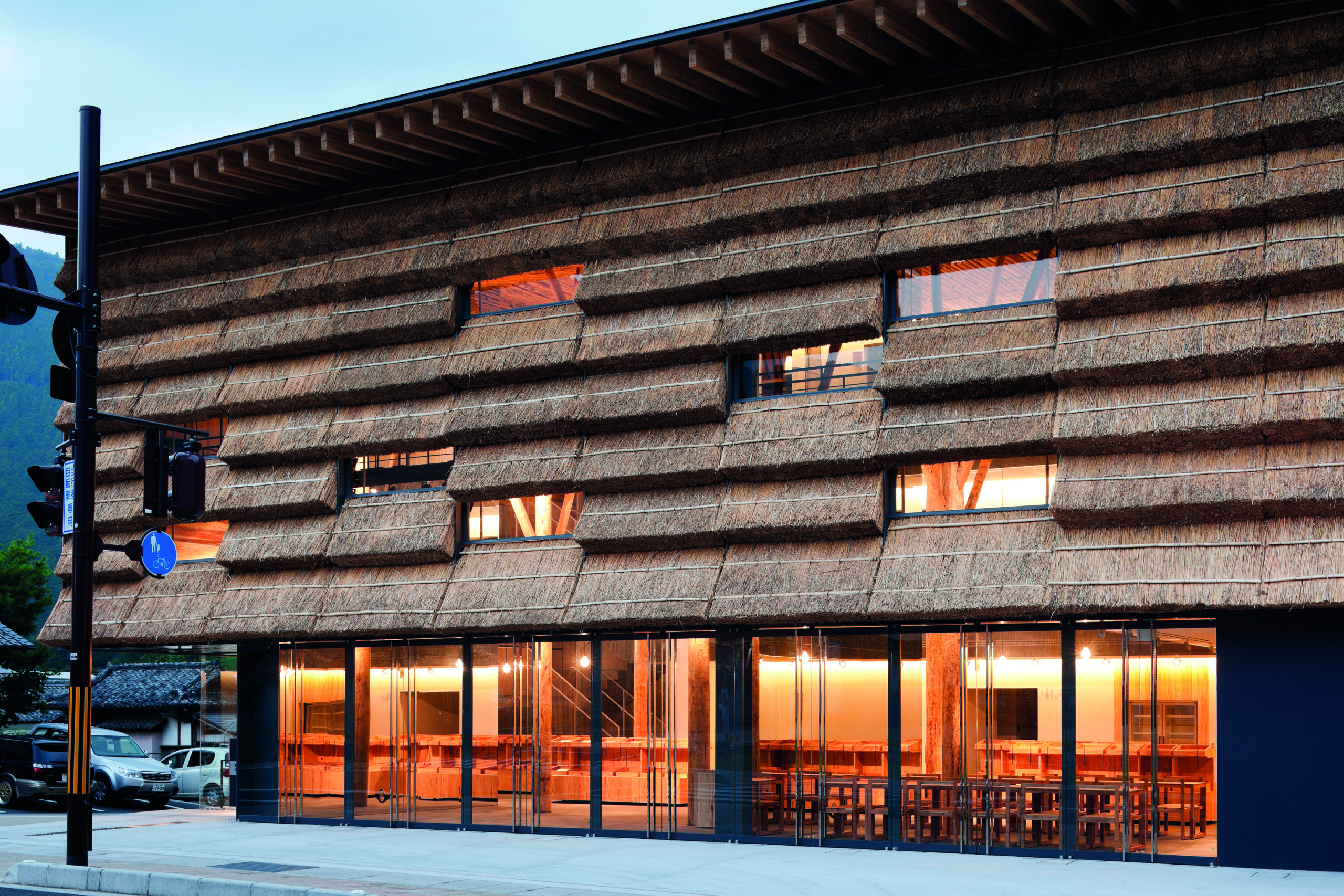
Kuma believes that when he wrote his book Architecture of Defeat more than 20 years ago, his theory and thought outpaced his actual work. Today he believes that projects completed in the past two decades reflect in one way or another an architecture that bends to touch the human spirit in tender ways, that has a spiritual dimension no matter what its function. We see abundant evidence of this in Kuma’s work, such as Mêmu Meadows, an experimental residence of textiles and wood, designed to safely respond to local seismic threats; Coeda House, made of randomly stacked cedar boards that appear to grow into a single, spreading bough supporting a delicate, sheltering pyramidal roof; the Portland Japanese Garden Cultural Village, a congeries of deferential pavilions gently inserted into the existing, wooded natural environment, to create a courtyard that opens on one side to gardens; and the Community Market Yusuhara, a farm market enclosure with a façade of thatch that recalls the roofs of traditional Cha Do tea houses that long ago provided hospitality to weary travelers.
As related to environments of compromise and the architecture of gentleness, Kuma detects a connection between such buildings and how they influence the people who encounter them, inhabit them, work and play in them. “It is often said that the people who you’ve met make you who you are,” Kuma notes, perceiving his buildings as persons. “You are shaped by the people surrounding you … if you have family and friends who are gentle and kind, you should naturally be influenced by them, and that is the same for architecture. That is one reason I tend to choose soft and weak materials for my projects.”
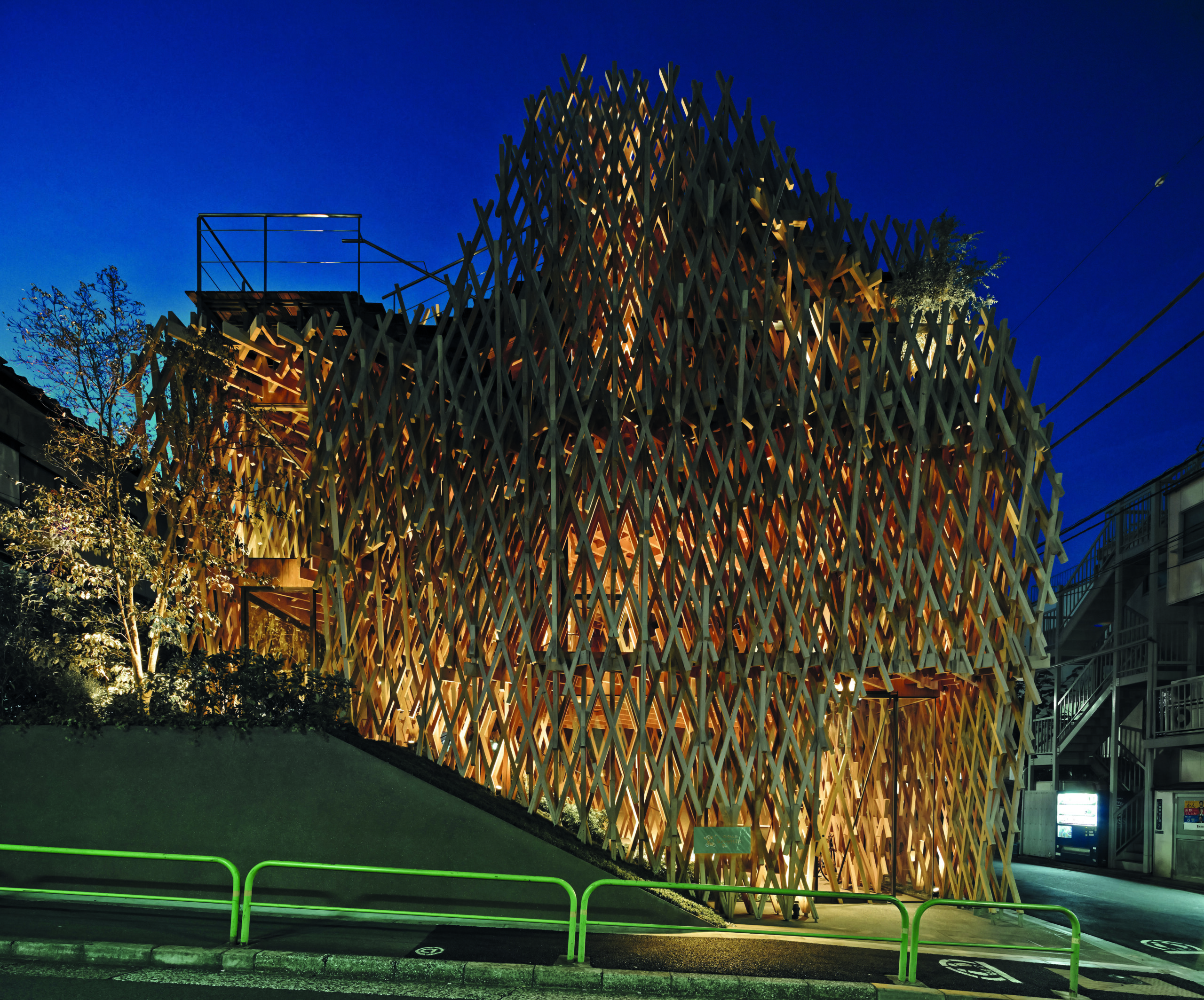
Kuma’s architecture of gentleness, compromise, and servitude is infused with the qualities of wabi-sabi—the Japanese esthetic “of things modest and humble, imperfect, impermanent, and incomplete,” as described by the writer Leonard Koren. “Things wabi-sabi are usually small and compact, quiet and inward-oriented. They beckon: get close, touch, relate.” Koren notes that such qualities reduce the psychic distance between people and objects, as well as between people and nature. In its soundless directness, Kuma’s architecture is enveloped in mystery, things implied and not seen, merely hinted at. In this way, shadows play an important role in his work. Often Kuma creates a weave of solids and voids, light and shade, material nets that capture the magic of shadows like fish. The Sunny Hills Japan Taiwanese cake shop is such a weir—its intricate wooden members employing a jigoku-gumi construction technique. As do other projects by Kuma, Sunny Hills Japan manipulates light and shade to create dappled patterns on floors, walls, and the people who move through the stippled cascades. The delicate wooden façade bathes the interior in patterns of light, creating a sense of hamorebi—light filtered through the leaves of trees. You find yourself in a virtual forest clearing, with sunlight and shade sifting through layers of wooden slats. Kuma cloaks these spaces in the mystery of shadow and shade, creating what the late author Jun’ichirō Tanizaki described in his book In Praise of Shadows as the “beauty not in the thing itself but in the patterns of shadows, the light and the darkness, that one thing against another creates. Were it not for shadows, there would be no beauty.” Kuma observes of his own architecture: “No shadow means no spirit.”
Featured image: The elegantly spreading Coeda House is supported by a single central support of stacked cedar members. Photo: Kawasumi-Kobayashi Kenji Photograph Office.