
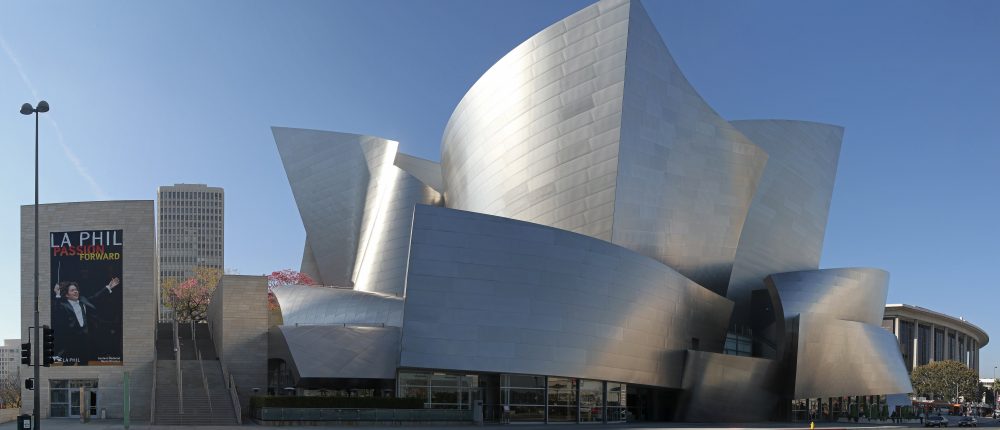
The Contradictions of Disney Hall
In my long and embattled relationship with Frank Gehry when I was the design critic for the Los Angeles Times in the 1980s and then, after that, for public radio and television, one memorable incident stands out. It occurred in 2004, a year after Disney Hall was dedicated, when I was attending a concert.
The occasion was a family event, as revealed in a most personal review I did that was subsequently widely reprinted. “Dear listeners, indulge me,” I prefaced the script that I saved as a family memento and included in my recent book, An Urban Odyssey (Academic Studies Press, 2024). “My antithetical feelings for Disney Hall continue, especially after attending a concert there that included my 15 year-old son, Kyle, performing on the bassoon. There is nothing like parental pride to further cloud one’s critical faculties.” I continued:
“Ever since the Hall began to take shape a decade ago, I have found it a particularly difficult project to comment on—not only because of its distinctive if arbitrary and indulgent design, but also because of its hype and multiplexity of purposes.
“The sails and swirls of the stainless steel aside, the Hall on a personal level is an international icon for its arching architect, Frank Gehry, and a laurel for its local boosters galvanized by philanthropist Eli Broad. It is hard to think of the three hundred million dollar exercise separate from the many egos involved.
“However viewed, its significance cannot be denied. In the flush of dedication less than a year ago, the Hall has become a symbol of the cultural aspirations of Southern California, another piece of the puzzle of an emerging Downtown, and a critical focal point for the recently launched redevelopment of Grand Avenue. who experience the building, whether purposefully attending an event there, and thus having to find a seat and possibly a bathroom, or just driving or walking past it, or living and, or working nearby.”
I also noted that the people who perform in the building or who service it were to be considered: the musicians, maintenance personnel, ticket takers, ushers, and the persnickety person who tells you to put away your camera, even during intermission, when your son is on stage gathering up his reeds. All have their differing needs and priorities, which I maintained should be considered when commenting on the building’s architecture.
Reminding listeners that was my calling. I wrote, “generally I have welcomed the building, which I’ve described as an arresting ego encrusted icon.” Further contending that I had questioned its excessive cost and contorted urban design, while trying to be fair and balanced out of respect for the professionals involved in shaping, styling, and serving the hall, as well for the public, I announced, “That is until last week.”
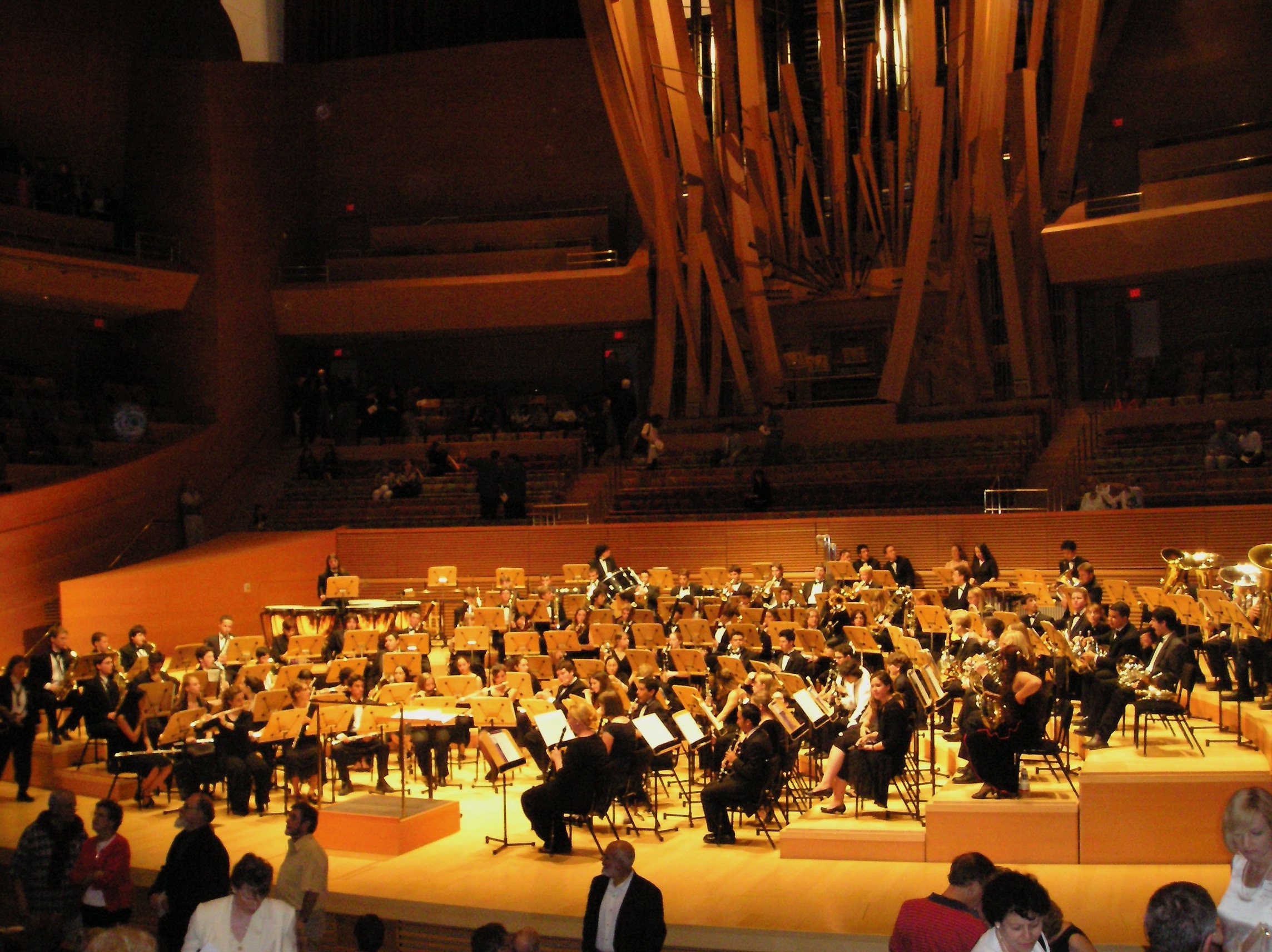
The author’s son, Kyle, played the bassoon with the Festival Wind Ensemble as part of a Idyllwild Arts Foundation program held at the Walt Disney Concert Hall, in Los Angeles. Photo by the author.
I then professed that all pretense of being a critic faded when my youngest progeny performed with the Festival Wind Ensemble as part of an evening program staged by the Idyllwild Arts Foundation. The program that also featured the festival choir and orchestra filled the hall with friends and family of the several hundred talented youths from Southern California and beyond who had studied at the foundation’s internationally renowned summer program in the San Jacinto mountains.
Kyle was excited, I confided, and so was his mother, my wife, Peggy, his older sister, Alison, who flew in from New York city for the gala event, and one of his two older brothers, Josef, who happened to be the music critic for his college paper. Also attending was Kyle’s much-revered bassoon teacher, Sara Banta.
It was impressive that Kyle had found time between his education, studying for the SATs, surfing, soccer, and ascending social life to take up one of the most demanding musical instruments. I remember being excited, too, and proud. Of course I had attended concerts in the hall when writing my commentaries, but now having to meet my family in the lobby and then go to hear my son perform heightened my anxiety and also my awareness of the building’s design.
The lobby, I wrote, “does not work particularly well as a welcoming space nor as a place to comfortably meet and mingle. Unlike most other great music halls and opera houses, the entry from Grand Avenue is unexceptional, no hint of ceremony, no perspective for a processional. It is rather sadly more in the mode of a multiplex movie house.”
I added that there was no real center point or focus in the main lobby, some spot you can easily mark as a place to gather—and that, as a result, I had spent several long and anxious minutes searching the crowd for the various members of my party. Not helping was that the lobby has no real edge, but instead drifts off and up into fragments of spaces on five levels. Circulation seems to have been an afterthought, with the interior spaces squeezed to accommodate the exterior shape.
The focus of the hall, of course, is the main auditorium, a dramatic, curved, wood-lined space in a vineyard shape with staggered, wrap-around seating that promises a more intimate experience. And much to my pleasure, that’s what I had found in my previous visits when I moved around the auditorium to experience different views and listening posts (and a few seats with limited leg room).
As for the concert, I had purchased seats in the third row of the orchestra, which I was expecting would be a good location for me and family to view and hear Kyle play. But my and Peggy’s seats were off to the far left and had a limited view of the ensemble, and none of our son. The others in my party could glimpse him, if awkwardly.
We were devastated, and I reacted as any parent and New Yorker would most probably do in such circumstances, which was to ignore the ushers and determinedly scramble to command two vacant seats two rows up in the center of the orchestra, in clear view of the musicians. With furtive glances left and right, my wife and I settled in with the nervous hope that the people the seats were for would not show up—at least not during the program’s first two offerings, in which Kyle was performing.
They didn’t, and we saw him, and he saw us; beaming smiles were exchanged, and we settled into our purloined seats and watched and listened with parental pride as he played. Incidentally, the acoustics were excellent, at least for us and, I presumed, for the near-capacity audience, to enjoy the balance of a stirring performance that included a memorable rendition of Aaron Copland’s Appalachian Spring.
Kyle later said that the acoustics prompted some adjustments by him and the ensemble because, unlike other experiences in other halls in which he had played, in Disney he could not hear the other musicians but, oddly, could clearly hear the audience. All this was in my commentary.
Also included was Kyle’s dismissal of my perhaps overexacting observations—that they were irrelevant to the thrill of performing in a clearly singular space before an obviously appreciative audience that included his family and his teacher. And while to me it was an illustration of the importance design makes in shaping experiences, I was thrilled to tears for him, myself, and the family.
As for Frank…several years later, when we were both octogenarians and finally mellowing, I related the story to him of attending the concert at Disney Hall, paying my own way, and the pure elation my son Kyle experienced performing there.
He smiled, and then admitted to me that the 1988 column I had written as a critic for the Times praising his entry in the design competition for Disney Hall and urging his selection as architect had been critical to him getting the commission. I replied that if that was a rare thank you from him, I’d accept it. Then, in typical Frank fashion, he added, “Of course, my design was the best.”
Featured image of the Walt Disney Concert Hall via Wikipedia.