
The Dutch Canal House: Six Feet Below Sea Level
In the heart of northwestern Europe, an unlikely swamp became an ingenious experiment in domestic architecture. The Netherlands occupied a precarious position in a delta where three of Europe’s major rivers met the temperamental North Sea. This low-lying region, with its ever-shifting boundaries between water and land battered by relentless North Sea storms, remained sparsely populated for centuries. Yet from this challenging landscape emerged two important concepts at the dawn of the Industrial Revolution: a new approach to family living and a reimagined relationship with the natural environment.
Early explorers noted the people’s defining struggle against water. Around 320 BC, Greek explorer Pytheas of Massalia observed of the inhabitants of this marshy region that “more people died in the struggle against water than in the struggle against men.” Later, Roman naturalist Pliny the Elder echoed this sentiment, describing the land as “pitiful” and prone to flooding. He noted, “These wretched peoples occupy high ground, or manmade platforms constructed above the level of the highest tide … they live in huts … and are like sailors in ships when the waters cover the surrounding land, but when the tide has receded they are like shipwrecked victims.”
By the twelfth century, the inhabitants near modern-day Amsterdam—future capital of the Netherlands—began to seize control of their environment. They piled earth to build dikes a few feet high, shielding their village and farmland from floods. They cut channels through peat soil, diverting water toward the river. This transformation of marsh into usable terrain led to the saying “God created the Earth, but the Dutch created the Netherlands.”
But this seeming control over nature came with unforeseen consequences. As water was drained, the peatland sank. This in turn required higher dikes and more maintenance—an early harbinger of the environmental dilemmas the Netherlands still faces today. To address the challenge, communities formed “water boards” to manage water collectively. These organizations, predating city governments, levied taxes and assigned farmers to maintain specific stretches of dike.
After the catastrophic All Saints’ Flood of 1170, farmers built a bridge across the Amstel River, with locks underneath to control the water. This dam gave the city its name—Amsterdam. The residents developed a network of canals to manage water and to serve as routes for transport and trade, while doubling as a rudimentary sewer system—with the first household chore often involving emptying the family chamber pot into the canal.
The catalyst for Amsterdam’s transformation came in 1585, when the Spanish siege of Antwerp drove a wave of wealthy merchants and skilled artisans north. They brought capital, craftsmanship, and global trade connections. They helped make Amsterdam the center of a thriving republic built on commerce and relative freedom from monarchic rule. The Dutch grew rich through maritime trade, to the envy of neighboring nations.
The city’s reputation for liberal culture and tolerance of religious differences became legendary, and Amsterdam became a haven for people of all backgrounds. This distinctive social fabric was, arguably, born from the shared struggle against water, which required everyone to contribute, regardless of their beliefs.
Dutch water management also transformed land ownership, in contrast to the feudal manorial system dominant in medieval Europe. Through the engineering of “polders”—new land reclaimed from marsh and sea by enclosing it with dikes and draining it with windmills—more farmers became landowners. By the sixteenth century, in Holland’s peat-rich regions, the vast majority of the land was owned by individual farmers. This independence from feudal authority fostered a spirit of entrepreneurship, paving the way for the emergence of the world’s first multinational corporation in Amsterdam, the Dutch East India Company (VOC), in 1602. The VOC pioneered innovations in stock ownership, shipbuilding, cartography, and insurance—though its legacy is tarnished by its deep involvement in slavery and deforestation of colonial lands.
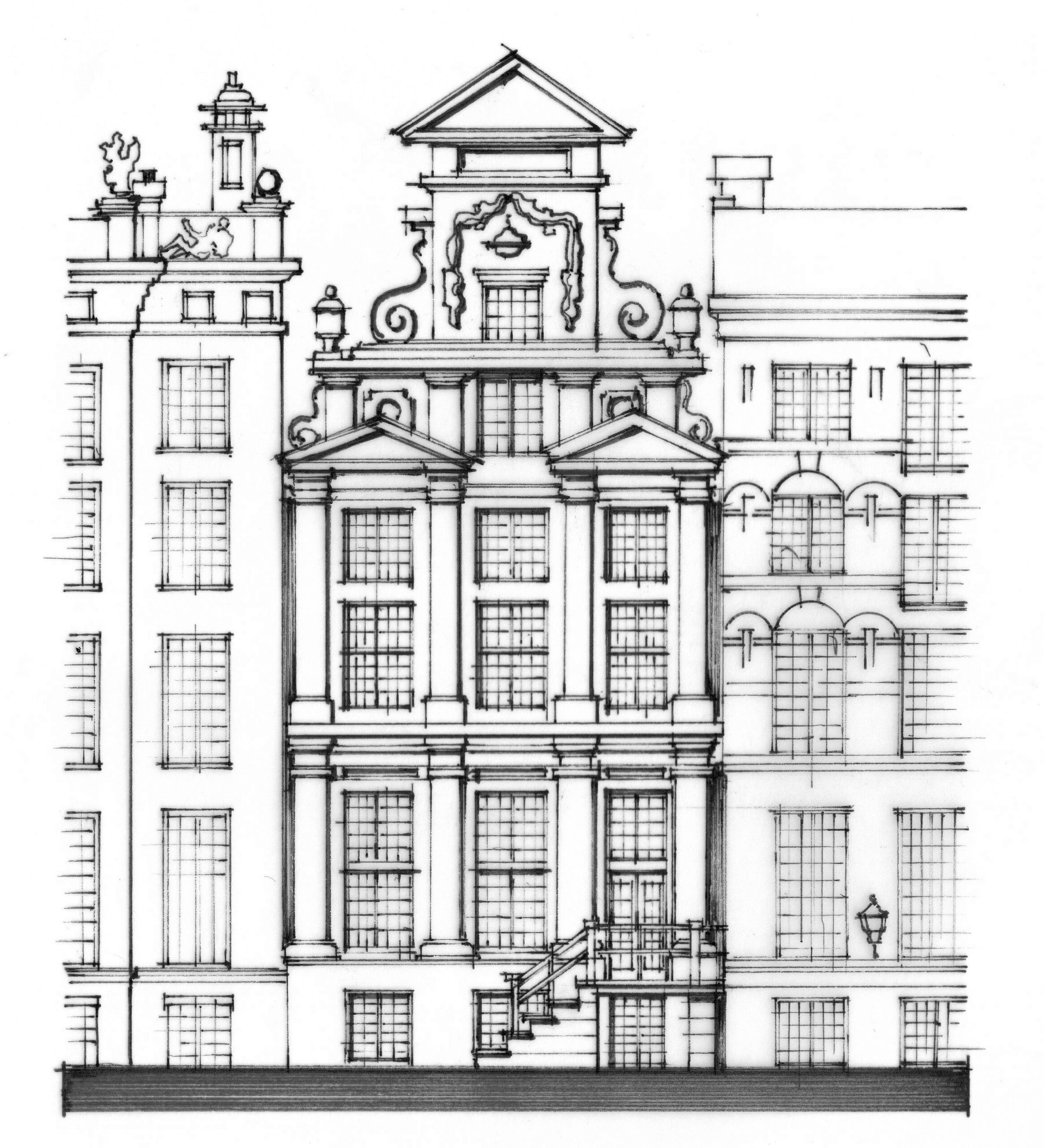
This economic boom coincided with a profound shift in domestic life. The transition from communal feudal households to private single-family homes marked a new chapter in how people lived. Medieval houses were primarily “public,” meaning that families, servants, and guests frequently shared living quarters, sleeping in communal rooms. Even Italian Renaissance palazzi offered little privacy, with rooms sometimes featuring four doors, one on each wall. By contrast, the Dutch bourgeoisie, less dependent on servants than their European peers, cultivated smaller, more intimate living spaces. Their new homes, the canal houses, were designed around the nuclear family. As architectural historian Witold Rybczynski has argued, these canal houses helped shape the modern concept of home.
The golden age of canal house construction coincided with the Dutch Republic’s peak of urbanization and innovation. In the seventeenth century, the Netherlands was likely the most urbanized society in the world and a hub of industrial ingenuity. Meanwhile, Amsterdam’s population surged from 30,000 in 1585 to 240,000 by 1680.
In response, the city built the Fourth Extension, a bold urban plan executed between 1663 and 1682. It added three great canals—Keizersgracht (Emperor’s Canal), Herengracht (Patricians’ Canal), and Prinsengracht (Prince’s Canal)—defining the city’s signature crescent-shaped layout.
Building on swampy ground posed enormous engineering challenges. The low peatland required canal excavation and the installation of locks to manage water levels. Each house’s foundation relied on about forty wooden piles—usually made of imported Scandinavian softwood—driven as deep as sixty feet through layers of peat, sand, and clay. The rhythmic work of pile drivers became such a constant feature of city life that it spawned its own genre of folk songs, often with suggestive lyrics: “There he goes, all day long, up and down.”
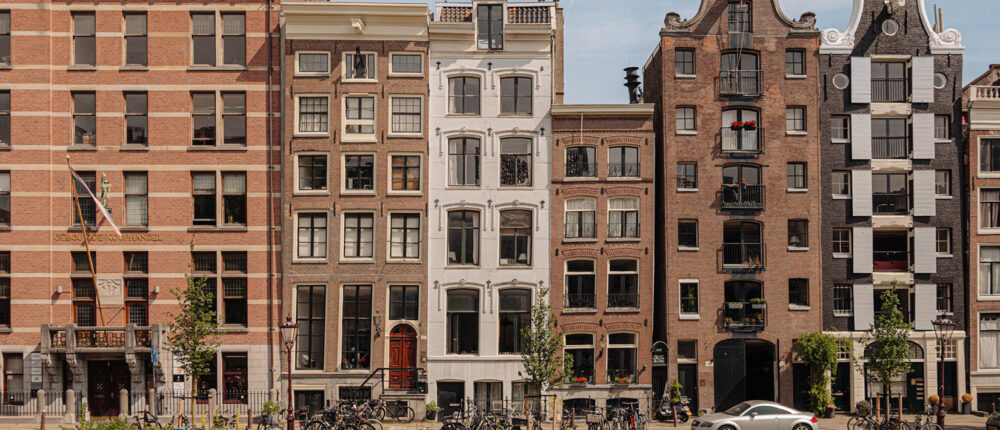
The resulting architecture was remarkable. The canal houses emerged as gabled brick structures, primarily built as merchant homes. Tax policy drove their distinctive form: buildings were as narrow as sixteen feet since taxes were based on frontage width. To compensate, houses were deep and tall, up to seven stories—with steep red-tiled roofs and distinctive gables reaching skyward, reminiscent of the ships’ masts dotting the horizon.
The narrow design, while fiscally prudent, demanded architectural ingenuity. The most obvious compromises were the extremely steep staircases—typically without landings—that still challenge the nerve of modern-day tourists. Yet within these constraints, each house retained its individuality. While unified by their shared narrowness, they each had unique frontages with subtle symmetry and pronounced gables. This gave rise to an increasingly diverse array of styles, with stepped, bell, and spout gables. One architect in particular, Philips Vingboons, became renowned for inventing the widely imitated neck gable and applying classical principles of symmetry to narrow facades.
The facades themselves told stories of their owners through their decorative elements. Gable stones served as both address markers and advertisements, depicting images that signaled the owner’s trade or family name—such as a man reaching into another’s mouth, signifying a dentist. The ways in which the homes met the street contributed to a vibrant street life. Stoops and steps connected front doors to the sidewalks, creating semiprivate platforms ideal for sitting, sharing a beer, and people watching—a tradition still embraced by Amsterdammers today.
These buildings balanced domesticity and commerce. They were both homes and warehouses, allowing merchants to store goods when market prices were unfavorable. The ground floor often housed an office, with family living quarters behind it. Upper levels were dedicated to storing goods like spices. The most ingenious feature sat near the roof on the gable: a cantilevered beam with a metal hook. This simple device transformed the building into a hoisting machine—merchants could employ a rope and pulley to lift cargo from their boats through large windows. There, sash windows could remain open at any height, thanks to an innovative counterbalance mechanism of pulleys and counterweights.
Commerce and domestic life shared a roof, but they remained deliberately separate. Corridors and partitioned rooms cultivated a sense of privacy. The vertical arrangement reinforced separation as well. Workshops were often located partially below ground, while the raised ground floor reception area led into the domestic realm.
This attention to spatial organization extended to an almost obsessive devotion to cleanliness. During a seventeenth-century visit to Amsterdam, English diplomat Sir William Temple observed “the strange and curious Cleanliness so general in that City.” One particularly vivid anecdote described a “strapping North Holland lass,” who, upon noticing a magistrate’s dirty shoes, “took him by both Arms, threw him upon her back, carried him cross two Rooms, set him down at the bottom of the Stairs, pull’d off his Shoes, put him on a pair of Slippers that stood there, and all this without saying a word.” An English writer observed how even doorknobs, nails, and hinges were polished to a shine: “Every door seems studded with diamonds.” The Dutch, concluded Irish travel writer Thomas Nugent, were “perfect slaves to cleanliness.”
The interior spaces of these homes reflected the values of the emerging middle class. One architecture critic later called the seventeenth-century Dutch dwelling “the home of the home,” noting how its inhabitants “emptied their purses into domestic space.” This investment in domestic comfort is immortalized in Vermeer’s paintings, which depict interiors rich with consumer goods that would come to define middle-class life: original artwork, imported vases, fine furniture, and decorative wares.
Yet the Dutch struggled to reconcile their newfound wealth with Calvinist values of austerity—a tension that historian Simon Schama called an “embarrassment of riches.” Even among the elite, magistrates were noted for the simplicity and modesty of their way of living.
There was, however, one acceptable indulgence: nature. Many homes had rear gardens growing roses, irises, hyacinths, and lilies, a quiet rebellion against Calvinist moralists who frowned upon such horticultural frivolity. Amsterdam’s fertile alluvial soil and maritime climate created perfect conditions for cultivating rare plant species. The introduction of tulips from Turkey in the seventeenth century sparked a significant Dutch industry. It even led to the infamous “Tulip Mania,” a botanical gold rush that is considered the first recorded speculative bubble.
The Fourth Extension regulations struck a balance between collective harmony and individual expression. Planners mandated buildings to meet the property line, creating aligned rows of canal houses. They ensured continuous garden space within blocks, limiting garden houses and pavilions beyond ninety feet behind the front property line and capped them at ten feet. But they also encouraged architectural creativity within these constraints, allowing “cornices, ornaments or protruding parts of buildings, used for commodity and beauty.” These, as well as balconies, could extend beyond property lines, without incurring tax penalties. Amsterdam’s building codes had evolved from reactive medieval regulations into forward-thinking guidelines that actively encouraged architectural innovation.
The new canals were lined with carefully spaced trees that helped stabilize the marshy ground. British diarist John Evelyn described Amsterdam as “a City in a Wood,” noting that “nothing can be more pleasing, especially being so frequently planted and shaded with the beautiful lime-trees, set in rows before every man’s house, affording a very ravishing prospect.” The city’s design enhanced this experience: its radial concentric layout, with curving ring canals, broke lines of sight and created an experience of suspense and intimacy.
The completed canal rings drew global attention. Peter the Great even took up residence in Amsterdam to study its engineering and urban planning, later applying what he learned to the founding of St. Petersburg, also built on shifting marshland. Today, the canal rings are a UNESCO World Heritage Site, hailed as “a new and entirely artificial ‘port city.’ … [and] a masterpiece of hydraulic engineering, town planning, and a rational programme of construction and bourgeois architecture.”
Dutch architectural influence spread globally through maritime trade and colonization. The distinctive step gables found their way as far as New York. Dutch bricks—especially the high-quality yellow klinkers—were a prized export, used both as valuable cargo and as ballast to stabilize ships. The scale was impressive: the ports of Amsterdam alone exported some 30 million bricks in 1668, which found their way to colonial outposts and port cities across Asia, Brazil, and North America.
But the Golden Age did not last. In 1672, known as the “disaster year,” England challenged Dutch naval supremacy and lucrative trade routes. Meanwhile France, backed by two German states, launched a land invasion. Dutch dominance began to fade.
Amsterdam’s delicate relationship with nature would also come to haunt it. Today, the canal district faces new threats: subsiding soils, settling foundations, intensifying storms, and rising seas. These challenges are no longer uniquely Dutch. With roughly 1 percent of the world’s inhabited land reclaimed from water, Amsterdam offers a sobering preview of what many coastal cities may face in coming decades.
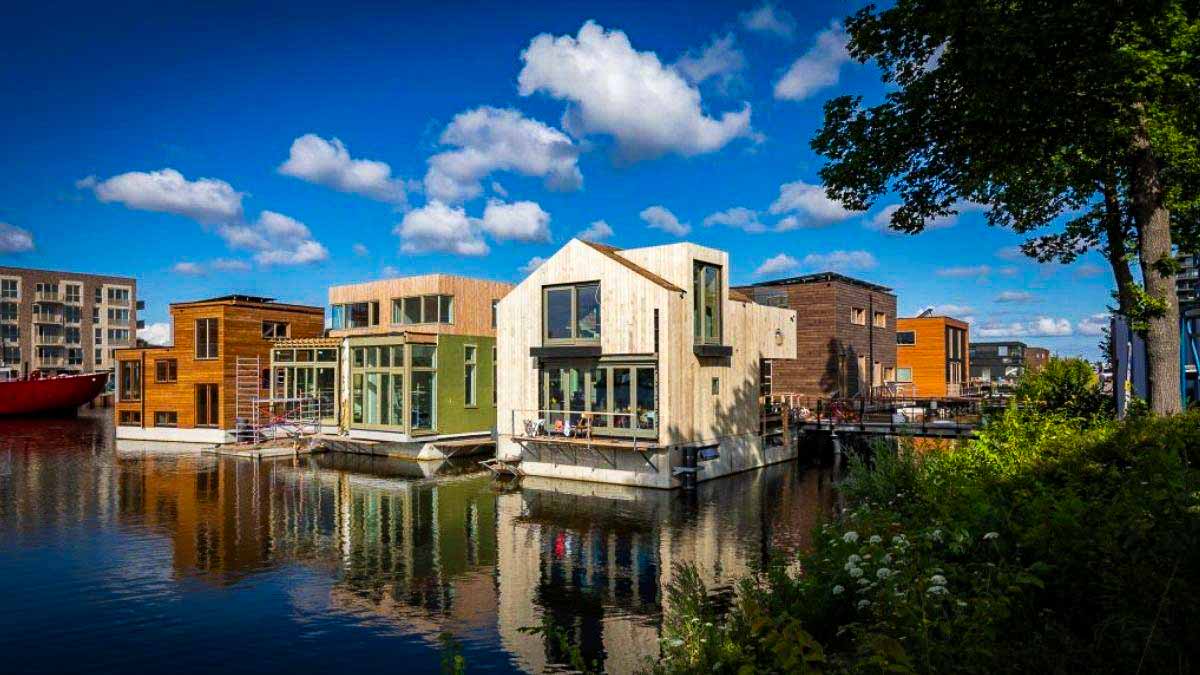
Yet its allure endures. Having lived in the city myself, I’ve seen how the canal houses remain vibrant, if idiosyncratic, homes—complete with creaking floors, perilously steep staircases, and the famously uncurtained windows that still startle visitors. But walking beside those tranquil canals—knowing they sit six feet below sea level—is a quiet, persistent reminder of both Dutch ingenuity and the mounting pressure of climate change.
Much like its seventeenth-century canal houses, Amsterdam continues to live in tension with water. The city adapts and innovates, transforming environmental threats into design opportunities—but some warn that, in time, it may have to relinquish parts of the very land it once so boldly reclaimed.
Featured image: 17th century Dutch Canal Houses, via The Spaces.
Excerpted and adapted from Dwelling on Earth: The Past and Future of the Places We Call Home. © 2026 by Stefan Al. Illustrations © 2025 by David M. Dugas. Used with permission of the publisher, W.W. Norton & Company, Inc. All rights reserved.