
The Obama Presidential Center: “It’s a Canvas. People Are Leaving Their Imprint on It”
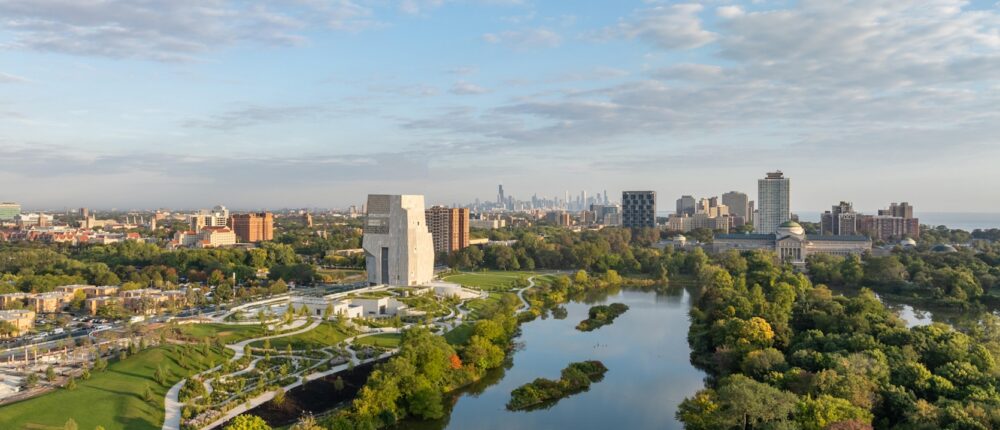
The early critical response to the Obama Presidential Center—which opens to the public in Chicago, on Juneteenth—has been decidedly mixed. Located on about 19 acres of land in Jackson Park on the South Side, the $850 million privately funded center includes a museum, a branch of the public library, 30 pieces of newly commissioned art, and a range of outdoor spaces that may, in the end, be its real legacy. Tod Williams Billie Tsien Architects designed the building; landscape architects Michael Van Valkenburgh Associates handled the park, and Moody Nolan, one of the largest African American-owned design firms, designed an athletic facility at the southern end of the campus.
The harshest criticisms, however, have centered on the complex’s 225-foot tower, nicknamed the “Obamalisk.” According to the foundation, the former president wanted the tower to resemble four upraised hands (Brancusi was a reference). Instead, critics are seeing instead “a boulder in a park,” “a shrine to himself,” “a monument to a lost America,” even a “Klingon prison.” (Personally, my monument to a lost America would be an abandoned strip mall, but everyone is entitled to an opinion.)
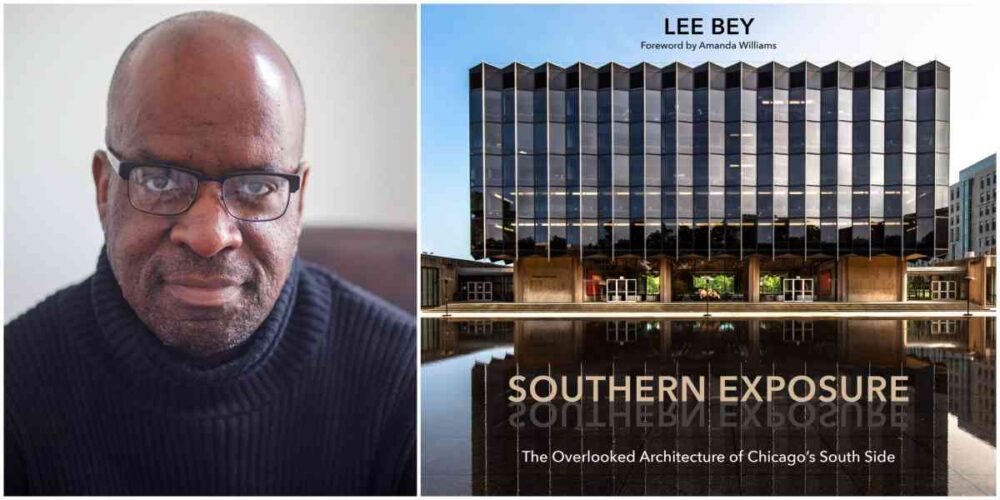
I have not yet visited the museum, but I’m friendly with Lee Bey, the architecture critic for the Chicago Sun-Times and a South Side resident, whose recent review of the building was one of the few unqualified raves that I’d read. What was he seeing that most of the out-of-town critics were missing? (Or, maybe they didn’t miss a thing.) Last week I talked to Bey about how his view of the center has evolved as it lurched to completion, the urban design that’s part of the institution’s legacy, and his belief that Chicagoans will not just accept, but eventually embrace, the “Obamlisk.”
MCP: Martin C. Pedersen
LB: Lee Bey
I’ve read at least a dozen reviews of the Obama Center and they’ve all been mixed or negative, except yours and Ed Keegan’s, two local critics. I know you have a history with this building and, as a South Side resident, probably knew Obama as a community organizer. You’ve watched this project through all of its gestations. What do you make of the critical reaction?
I knew him a bit as a community organizer, and then more when he joined the state legislature. But the funny thing is, when it was first proposed, I wasn’t a fan of it at all. Right around the time we were putting my book, Southern Exposure, to bed, the renderings had just been made public, and I thought the tower was totally crazy. I thought it was too hard-looking and wouldn’t be a good fit for the South Side. But the architects have obviously refined it, and when I did a pre-walkthough last November, I began to come around. And once it was all put together, I thought it was really good. And not to rain on people from other places who are writing about this—once you see it in relationship with not only Jackson Park, but the South Side, and understand that full context, I think you can look at it a different way.
Initially there was criticism of the foundation, because it didn’t do a community benefits agreement and wasn’t doing a lot of public engagement. Maybe some of that is embedded in the criticisms.
Locally there is some of that. But here’s what I think. I saw this during my recent visit, and I’m certainly seeing it as I drive by, and as I look at the wealth of images and videos on social media: people are coming to this place, and as it turns out, it’s a kind of canvas. We were thinking of it as a frame, but it’s a canvas. People are leaving their imprint on it, and as long as the center allows that to happen, people will bring life, animation, and other things to it.
It’s like what happened with Millennium Park. It was one thing when it was designed and planned, and it became something a bit different and more active when people got their hands on it, and I think something like that is already happening here. So, yes, the lack of community benefit agreements was unfortunate, but there’s great potential for people to engage with this building and make it theirs.
I haven’t seen it yet, but it does look like an improvement to Jackson Park, an expansion of the park.
There was parkland already there, including the Women’s Garden to the south, which was a lovely place, but some of those trees in that area were sick and dying. The important piece that doesn’t get talked about enough is the closing of Cornell Drive, which ran between the Museum of Science and Industry and the land that’s now occupied by the center. This was like a six-lane highway for the most part. I was telling Billie and Tod that when I was a kid, you could drag race at the right time of the day from Lake Shore Drive and 57th Street through this and up Stony Island through the Chicago Skyway and into Indiana without ever touching a brake pedal. That’s how intrusive that thing was. So ripping that up and allowing park space and a promenade, bringing pedestrians to the shore of the Columbia Basin, Jackson Park Lagoon, is a master stroke that doesn’t get talked about enough. People will love that.
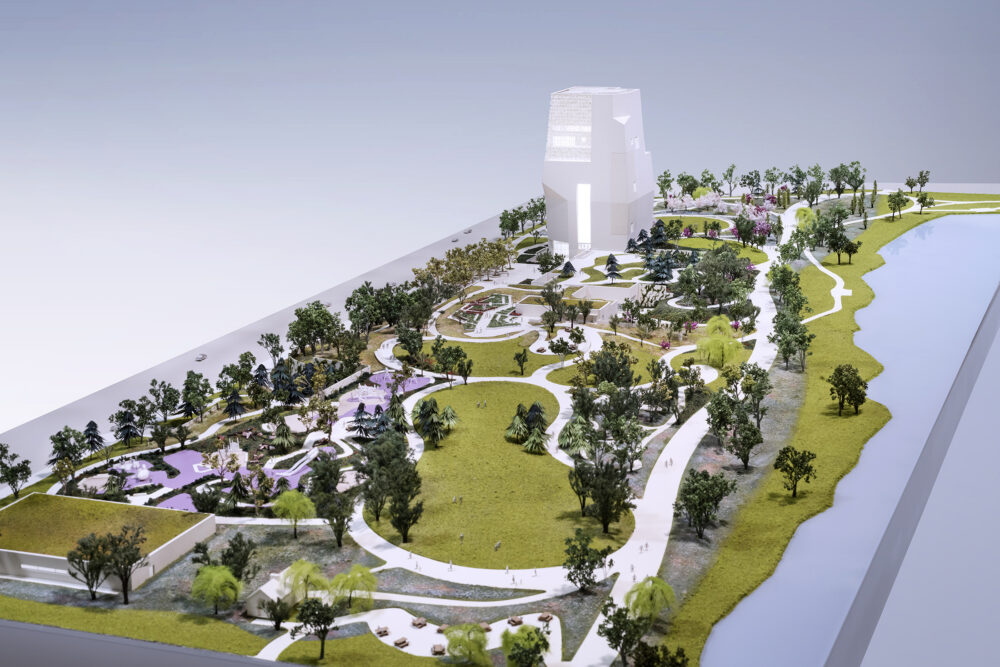
Campus model via Michael Van Valkenburgh Associates.
The critics are fixated on the tower and its monumentality. But Clinton built a bridge virtually across the Arkansas River, and while George W.’s Dallas library isn’t monumental, it’s a big building.
The tower is startling because it’s so much taller than most of the buildings in Hyde Park and Woodlawn. Certainly, having a tower in a public park is kind of startling. So for it to be successful, it has to somehow become an extension of the park. The museum you have to pay to get into, but there’s a lot in that tower that isn’t paid admission. And so the secret of making that work—and this is where programming shakes hands with architecture—will be how successful they are about allowing programming to bring that park inside, and the building out to the park. That’s where the thing lives or dies. Not so much, as time passes, with the design. We will get used to a tower. That’s what we do in this city: we get used to tall buildings. But will it feel like my tall building, or will it feel like a fortress to Obama? That’s where programming is going to make a difference. And they seem to be leaning toward making it a public and welcoming place.
There were obviously justifiable concerns about what this would do in terms of gentrification and displacement on the South Side. How do you think that’s going to shake out?
Oh, that’s exactly what’s gonna happen, sadly. I think it would have happened either way. As long as the University of Chicago is a player in Woodlawn, and they have been for the past 20 years, we’re going to see gentrification. Woodlawn, which is close to the center, is within the golden circle that I call “around Chicago.” It used to be within 30 blocks of Chicago, north, south, and west. That’s where the sweet spot was.
Now that circle has widened a bit, and 60 blocks west, you’re looking at parts of Austin that are slowly beginning to wake up. And 60 blocks to the south, near the Obama Center? Listen, when I was in college, back in the ’80s, I used to date a woman whose father lived in Woodlawn. This was the summer of 1984, and Woodlawn was missing teeth, with beautiful gray stones that were hanging on by the edge of their fingertips. Like Harlem, it was a poster child for urban blight. And I remember this woman’s father, he was a smart guy, and a little younger, too, and we were thinking, Why is he still living here? He said to us, “Just you wait. One day, houses around here are gonna cost a million dollars.” And me and my friend laughed, because you could buy a house in Woodlawn for $30,000 back then.
About a year ago I saw a new home listed for $799,000 and I thought, Man, I wish I could find that guy today and tell him how right he was. He had to wait a long time. It wasn’t like it happened overnight. But that’s where the neighborhood is going. The bigger question now is: There are enough vacant lots in Woodlawn and Washington Park, its neighbor to the west, but is there a strong enough city policy to make room for the gentrifiers—who are gonna come, they’re already there—but also in those vacant lots build affordable housing for those who need to and should be allowed to stay in the community at a lower price than tech millionaires?
Well, the tech millionaires are going to Lincoln Park…
Yeah, they are, but somebody who can afford an $800,000 house is not smoking used stogies on the porch. They’ve got some kind of cash. And I think generationally you’re seeing a shift. Black professionals who normally would leave a neighborhood like Woodlawn no matter what, now want to live there. And younger white people, whose parents might have thought, I don’t wanna live in a predominantly black or mixed neighborhood, see things differently. This also comes into play, not only in Woodlawn, but in other parts of the South Side, Roseland, historic Pullman, where I live. I drive through Roseland and see people that I never would have seen a half generation ago. So something is happening, and if something is indeed happening, how do you make Woodlawn, with all the resources that are coming to it, how do you make it livable for everyone?
If you were appointed executive director of programming at the Obama Center and your charge was to serve the community, how would you program that building?
I would say: Listen to the community. There are things that the predominantly Black majority in that community do as part of their culture. The Silver Room in Hyde Park has a street festival. There’s the house music festival that happens not too far from there in Jackson Park. So there are these important cultural things that are happening in Black Chicago that often just need a home. So if the center became a hub for these events, it would go a long way to making it part of the neighborhood. That’s one thing.
Certainly it’s important to have art inside that reflects the community and the larger community. They’ve done that already. There’s the work of Theaster Gates and a number of other important artists. That’s perfect. And as a venue for art, for a non-art museum, it’s really good. But I also think they have to just allow that parkland to be. They’ve got the barbecue grills and the slides and the garden that Michelle Obama and the Chicago Botanic Gardens are attending to. These places, again, become canvases that, if programmed correctly, will allow people to imprint all kinds of good things on them.
It will allow it to become their center.
Exactly. I was on a podcast a couple of days ago talking about it, and one person said, “Well, the building, especially the tower, is really aligned with the University of Chicago,” and I said, “Oh, no, I’m a South Sider, that’s our park. You can’t tell us, we can’t go there. That doesn’t fly.” And I think that the people who are running the center are sophisticated enough to know that. And, to their credit, programmatically, in terms of design, they’ve made room for it. All they gotta do is live up to the promise of just letting it be, letting it do that.
And your argument in your Chicago Sun-Times review is that they will come to, if not love, accept the monumentality of the tower, because Chicago has always had towers and monumental structures.
And in fact, as the days go on, I may have even had that backwards. They will not just accept it, I think they’ll embrace it: “That’s my tower. I went there last week for a concert.” And I’ve got to look to Millennium Park again. People flocked there, because it was perceived as their park. And I think you’re gonna see that with the Obama Center.
Featured image via the Obama Foundation. Photo by Angie McMonigal.