
The Seeds of Our Housing Crisis Were Planted in the Reagan Era
Though economists and historians will study the decline of the American economy and the rise of oligarchic capitalism for decades, those who lament the resulting loss of affordable housing and infrastructure must also understand how politics affected the building sector. For most of the 20th century the nation had banking, education, and labor policies that spurred the construction and design industries, but after 1980 things changed dramatically. Our government scrapped protections for workers, including construction workers, and curtailed the influence of unions. The financial sector was gradually unleashed with policies that allowed investment banks to make riskier investments in real estate. All of these policies—along with the U.S. Department of Housing and Urban Development’s abandonment of programs that supplied low and moderate income rental units—had a devastating impact on the housing sector.
Historians mark the mid-1970s as a turning point in capitalist economic history: cycles of growth and decline were regular and predictable before the Arab oil embargo and the energy crisis. Thomas Piketty and others pointed out that a generally equal distribution of wealth following the end of World War II came to an end in the third quarter of the century with Reaganomics and subsequent policies favoring the top 1%.
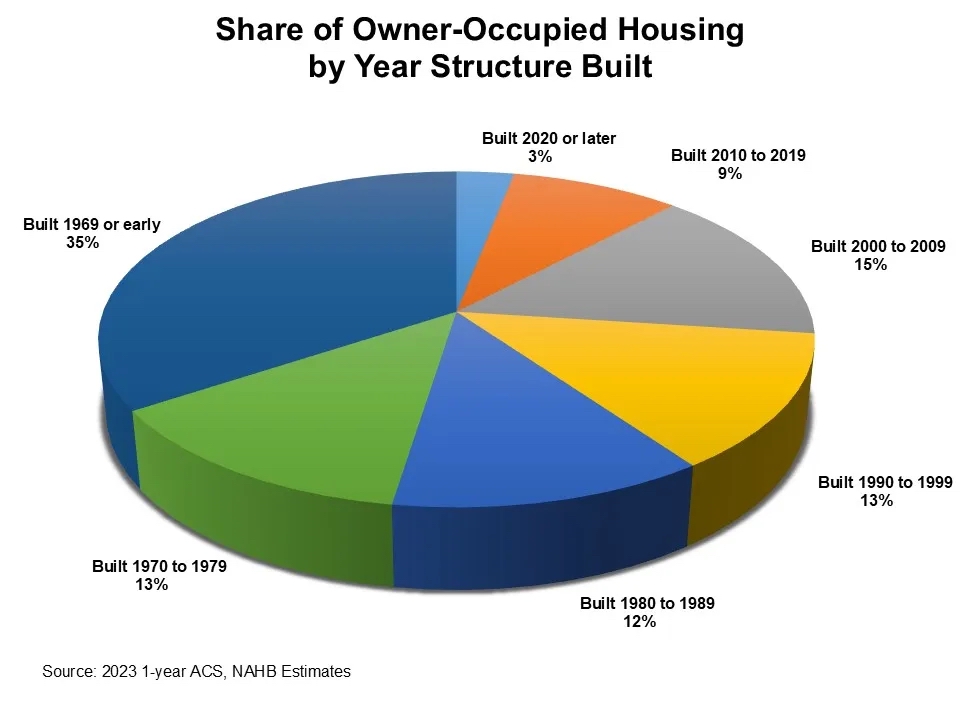
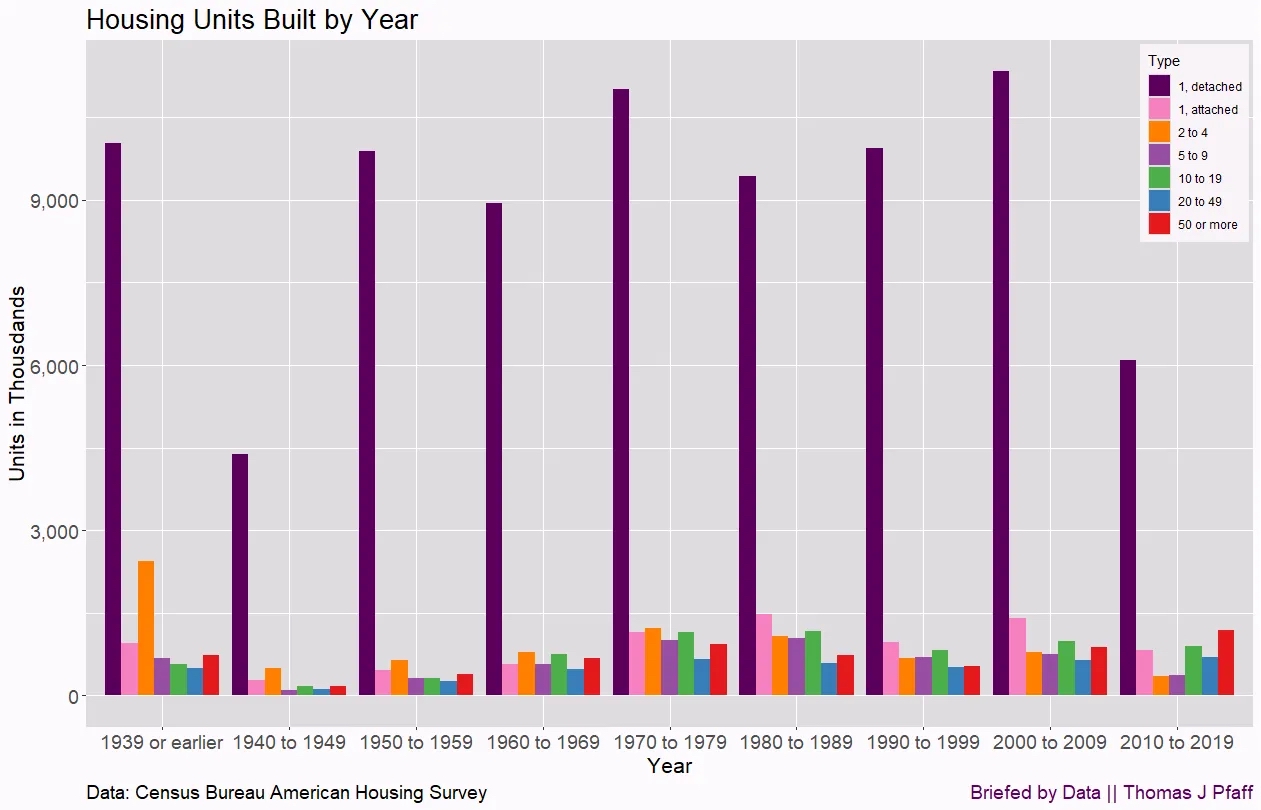
The economic boom that followed the Eisenhower era building of the interstate highway system made way for the suburban expansion I knew as a kid growing up in Illinois, California, and Seattle, Washington. Indeed, almost half of the current U.S. housing stock was constructed before 1980, according to the National Association of Home Builders. Data from the U.S. Census indicate that after 1940, the peak decade for single-family house construction was the 1970s, when baby boomers were most in need of housing. The 1920s were a growth decade in general construction, but that surge dissipated during the Great Depression. Likewise, as housing and construction took off during the 1990s, the Great Recession in 2008 put an abrupt halt to the upward trend. Architects were lulled into complacency as the bubble expanded and then blindsided when the economy tanked.
Banks and Lending Before and After Reagan
President Reagan and his economic advisers not only promoted “trickle down” policies favoring the rich but also passed legislation that changed banking laws to promote riskier and more expansive lending practices among interstate commercial banks. A 2020 paper from St. Andrews University analyzed financial deregulation after 1980, pointing out that prior to that date, U.S. banks were stable but not competitive, and many laws forbade state banks from doing business outside their state boundaries. The reforms that followed the Great Depression, mainly during the Roosevelt administration, strictly limited what banks could do. The Glass-Steagall Act of 1933 prohibited commercial banks from trading in securities and managing investments. The 1927 McFadden Act had already prohibited interstate branch banking, protecting local institutions that lent money for building with a close eye on risk management.
George Bailey’s travails in It’s A Wonderful Life were a reenactment of the problems that had led to the Great Depression. As the St. Andrews study makes clear, “in 1980, there were many banks, but few branches,” precisely the opposite of today’s landscape. I bought my first house in Houston in 1984, with a loan from an old-fashioned local bank. The closing took five minutes, and interest rates were negligible. Today, George Bailey is anyone under 40, and I’m the boomer they all envy.
Guided by the Federal Reserve and the U.S. Treasury, banks offered relatively low interest rates on loans from 1955 to 1977, between 2% and 6% on average. Rates were even more stable between 1965 and 1977. Steady rates made mortgage lending simple and predictable, and banks had little risk of defaults. Indeed, bank failures were rare before Reaganomics changed the rules. The 1980s savings and loan crisis was a canary in the coal mine for what would come in 2008. There would be few interest rate barriers to home ownership were it not for decades of bank deregulation.
When Alan Greenspan took over as Fed chair in 1987, the body had already expressed doubts about restrictions on investment banking activities in national banks. Greenspan further loosened those restrictions, giving rise to more money market funds and other instruments, with the justification that U.S. banks were not globally competitive. These and other moves created the nationwide banking system we have today. In 1975 there were almost 75,000 banks; by 2005 the number was less than 25,000.
With the Garn-St Germain Depository Institutions Act of 1982, the government removed all restrictions against real estate lending by national banks, permitting them to enter a market that had been dominated by smaller state banks and savings and loan institutions. With this, the risk to lenders increased, as they could no longer monitor loans in their area or evaluate credit from close scrutiny. This legislation paved the way for the Great Recession of 2008. Moreover, the rise of derivatives investment during the 1990s meant even more risk for bankers in favor of high profits on new instruments. When George W. Bush became president, his administration continued to loosen regulations and promote riskier investment instruments. Like many architects who were practicing in the single-family house market, I saw my fees and workload increase from 1996 until 2007. Since I also did reuse and preservation, there was an uptick there as well—more lending options led to loans for nonprofits that funded this construction.
Bank Failures and Deposit Insurance Losses 1940–1999
Decade Number of Bank Failures Deposit Insurance Losses ($ million)
1940–1949 99 6
1950–1959 28 3
1960–1969 43 8
1970–1979 76 117
1980–1989 1,086 22,961
1990–1999 509 13,769
Source: Lawrence J. White, “Bank Regulation in the United States: Understanding the Lessons of the 1980s and 1990s.” Japan and the World Economy 14 (2):137-154 (2002).
Unions and Labor Laws Before and After Reagan
President Reagan created the playbook for how an administration could wreak havoc on national institutions when he fired the existing lawyers on the National Labor Relations Board and replaced them with his own pro-management appointees in 1981. Shortly after that, he fired 11,000 striking PATCO workers and began his relentless drive to reduce the number of labor unions and legal protections for their members.
Before Reagan’s board began their campaign, there were strict limitations on employers’ inquiries about union membership and activity. When the NLRB instituted its Rossmore House rule changes in 1984, it allowed management to question employees about their union sympathies, leading many to press them not to join labor organizations. This and many other decisions limiting worker rights and favoring management led to the largely anti-union attitudes that pervade the workplace today.
Under Tip O’Neill, the powerful Democratic House speaker, the Democratic Congress allowed unions to be attacked and often curtailed under Reagan. O’Neill made deals with the Republicans in Congress to curtail union authority and weaken even those who traditionally supported Democrats, like the Teamsters and education unions. His devil’s bargain allowed Reagan to pursue anti-union policies and gave a green light to Republicans during the Clinton administration. When President Clinton instituted “welfare reform,” he also weakened labor protections for low-income working families. The die was cast for big companies—like Target, Toyota, Amazon, and Walmart—to freeze out union workers. (Manufacturers such as General Motors, Ford and US Steel continued to negotiate with big unions.)
In the construction industry, efforts under presidents Nixon, Ford, and Carter to stem corruption and violent action against “open shop” construction projects bore fruit in lawsuits filed against the most powerful AFL-CIO unions during the early to mid-1970s. Widespread “featherbedding” and other illegal activities tainted these unions, making it easier to assign blame when labor costs rose and unemployment spiked after 1975. An Engineering News-Record study published in 1972 documented widespread high labor costs, union actions slowing large jobs, and lack of adequate apprenticeship education as industry problems that needed attention. By 1975, a number of large contractors were operating “double-breasted” jobsites that allowed as much as 50% non-union labor on individual projects.
Associated Builders and Contractors, an open-shop organization, began in 1950 but increased its membership significantly during the 1970s. It sued major AFL-CIO unions in 1977 to resist violent coercion on its job sites. By the end of the decade, when Reagan took office, the erosion of union power in heavy industries was underway. Today, virtually all single-family houses and many commercial construction projects use a high percentage of non-union, and often non-legal, workers.
One of the biggest issues with Trump-era immigration policies has been the drain on qualified construction laborers, especially in border states like Texas, Arizona, and California. However, the worst net effect on the building sector over the last 50 years has been the drastic decline in skilled laborers, such as carpenters, roofers, framers, sheetrock installers, plumbers, and electricians. Without union support and a national system favoring hand-skill education, the U.S. has become too dependent on foreign labor. Millions of young people who do not have college degrees, and millions more who do and work in low paying jobs, would benefit from a system of trade schools in the building arts. Such systems exist in Europe and have been expanding; the U.S. could learn from them and increase education and apprenticeship opportunities.
Homeownership and Mortgage Lending Under George W. Bush
The 2008 Great Recession was the most cataclysmic event in the lives of U.S. architects, engineers, contractors, and building trades workers in almost a century. It drove many young architects and landscape architects out of the profession and resulted in a rise in the number of small firms, a decline in the middle market, and a general spate of acquisitions by the largest international architecture and engineering players, such as Gensler, AECOM, HDR, Perkins & Will, and SWECO. I laid off my five employees in 2013 when we could no longer endure the pain of sparse work. It was one of the saddest days of my life.
In his 2010 book, Too Big To Fail, Andrew Ross Sorkin described the monumental failures of Bush administration officials and the financial industry to foresee and stem the largest banking crisis since the Great Depression. In 2003’s The Great Unraveling, Paul Krugman had already written a cautionary expose of Bush policies and massive corruption in regulatory agencies charged with protecting consumers, but his opinions went unheeded.
Once Reagan officials and Republican think tanks had decimated the lending system that protected not only homeowners but institutions like schools, small businesses, and nonprofit agencies from predatory commercial banks and mortgage companies, Bush officials could run free with their faulty ideas about wider home ownership for families with poor credit. The system they built had by 2007 pumped up the financial industry to the tune of $53 billion in total profits for executives and accounted for 40% of all corporate profits that year.
A large part of those profits, we now know, came from mortgage derivatives managed by the major banks but hidden in a system of corrupt ratings agencies, along with a toothless Fannie Mae. George Packer’s excellent 2013 book, The Unwinding: The Inner History of the New America, exposed the dirty money paid to the largest ratings agencies to allow them to ignore the shoddy due diligence provided by the mortgage banks, encouraging low-income households to borrow too much and leading to foreclosures once the panic hit in 2008. It is still mind-boggling to read about the degree to which lenders wrote shoddy mortgages, sold them to middlemen, and converted them into instruments that could be traded on the market. No bank executives were prosecuted for their crimes after the full accounts emerged after 2010. They had contributed funds to elect President Obama and did not allow his Department of Justice to touch their executives. Despite this, Obama’s mortgage relief legislation helped save my house and millions of others.
More important, policy makers failed to reform the basic system that allowed home builders to rip off their clients. Large corporations such as Pulte Homes, whose CEO is a confidant of President Trump, escaped unscathed from the chaos, and rose to make even higher profits after getting rid of dead subdivisions in places like Florida, Ohio, and the Southwest. These builders of largely luxury single-family McMansions choked out builders of mass and affordable units in cities, remaining in their suburban “greenfield” cash mills. My Common Edge essay on the trials of developing Civano in Arizona shows how they nearly killed a beautiful and innovative new town.
The effect on the building industry in the mass housing sector was enormous: thousands of small architectural firms went bankrupt; thousands of small, well-qualified subcontractors in the needed trades also went out of business, leading to high prices for these contracts; and the allied trades, and the necessary business infrastructure for this kind of construction, were decimated. Twenty years later, the industry hasn’t recovered.
Many colleagues and competitors in the housing market still work with smaller staffs—or none at all, if well trained in digital design. We understand from bitter experience what this means for our fellow Americans, and we’re angry. Many of us were trained to design mass housing in architecture school, but were compelled to design for the rich. Journalists and policy analysts need to wake up: NIMBYism and local zoning restrictions aren’t the only barriers to housing construction. The entire building industry, which provides jobs for architects, engineers, construction workers, finance workers, and a host of others, is on life support, thanks in large part to the policies first put in place by Ronald Reagan nearly 50 years ago.
Featured image via the Ronald Reagan Library.