
Want Some Bad Food and Poor Design to Go With Your Tesla Charge?
Among his many talents, Elon Musk has a singular knack for taking things that are cool—fast cars, rockets, (arguably) marijuana—and making them nauseatingly uncool. Equally impressively, he is adept at taking things that are decidedly not cool and pretending they are cool: racism, nativism, video games, parenthood, to name a few. He’s the opposite of the Fonz.
We can now add to the latter list the unlikely category of restaurant design.
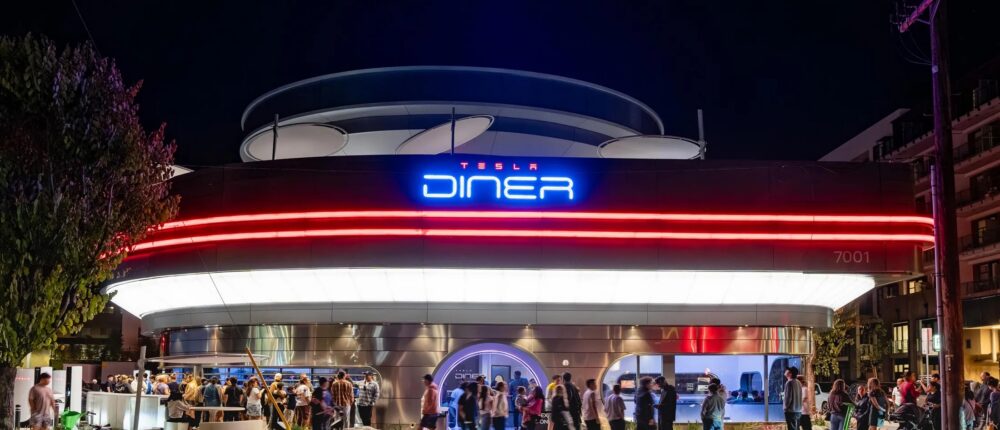
At roughly the same time Musk was attempting to chainsaw the U.S. government in his own image, he also added a singular asset to his electric car empire. It’s not a new model of roadster or another monstrous truck, but rather a very much earthbound charging station—with a diner attached.
I do not, and will never, own a Tesla, but I have to give credit where credit is due. In the mishmash of commercial charging options—from individual curbside stations stuck to power poles, to the occasional parking space in a grocery store lot, to confusing hookups scattered here and there—Tesla has by far the finest technology. Its stations are large and clean, and, more important, the chargers are fast. But even at their speed, electrons flow more slowly than their hydrocarbon counterparts. That means a lot of sitting around, playing Candy Crush or making soft-core porn deepfakes with Grok.
Musk’s solution? He invites you to get a bite while you charge.
Located a few blocks south of the Hollywood Walk of Fame, the Tesla Diner opened in 2025, but Musk had been bragging about it since 2018, making its development consistent with many of his other premature promises and baseless predictions. (I think we were supposed to have a roller disco on Mars by now.) The site, which was apparently Musk’s second choice (after one in more staid and less visible Santa Monica), consists of two small parking lots with several dozen chargers, the majority filled with Tesla vehicles, alongside other brands that are compatible with its chargers.
The centerpiece of what might rightly be called a new architectural typology is a roundish, two-story diner. It’s not quite a drive-in, but it evokes that space-age feel, at least in broad strokes, that drive-ins once did in the 1950s golden age of roadside architecture. It hearkens back to the days of carhops, tray tables, and suburban white flight, but now electric car owners and acolytes can grab a bite, fuel up, and envelop themselves in Musk.
Musk’s aesthetic, if one can call it that, has always been spare. He has described himself as being on the autistic spectrum, and research suggests that people on the spectrum experience “sensory defensiveness,” often preferring cleaner, simpler aesthetics to busier ones. (Think Art Deco rather than Rococo.) Whether or not that is relevant here, the diner certainly reflects this sensibility. (The credited designer is the global megafirm Stantec, which is based, ironically, in the Canadian petroleum capital of Edmonton.)
The exterior is barrel-shaped and chrome, with neon highlights in Tesla red. The interior feels like how I’d imagine a Swiss morgue to be, or a facility in a science fiction film where they process deviants for reeducation. There is no adornment; the interior is all white, the wall surfaces rounded. The menu is minimalist, housed on a touchscreen tablet where you place your order without human interaction.
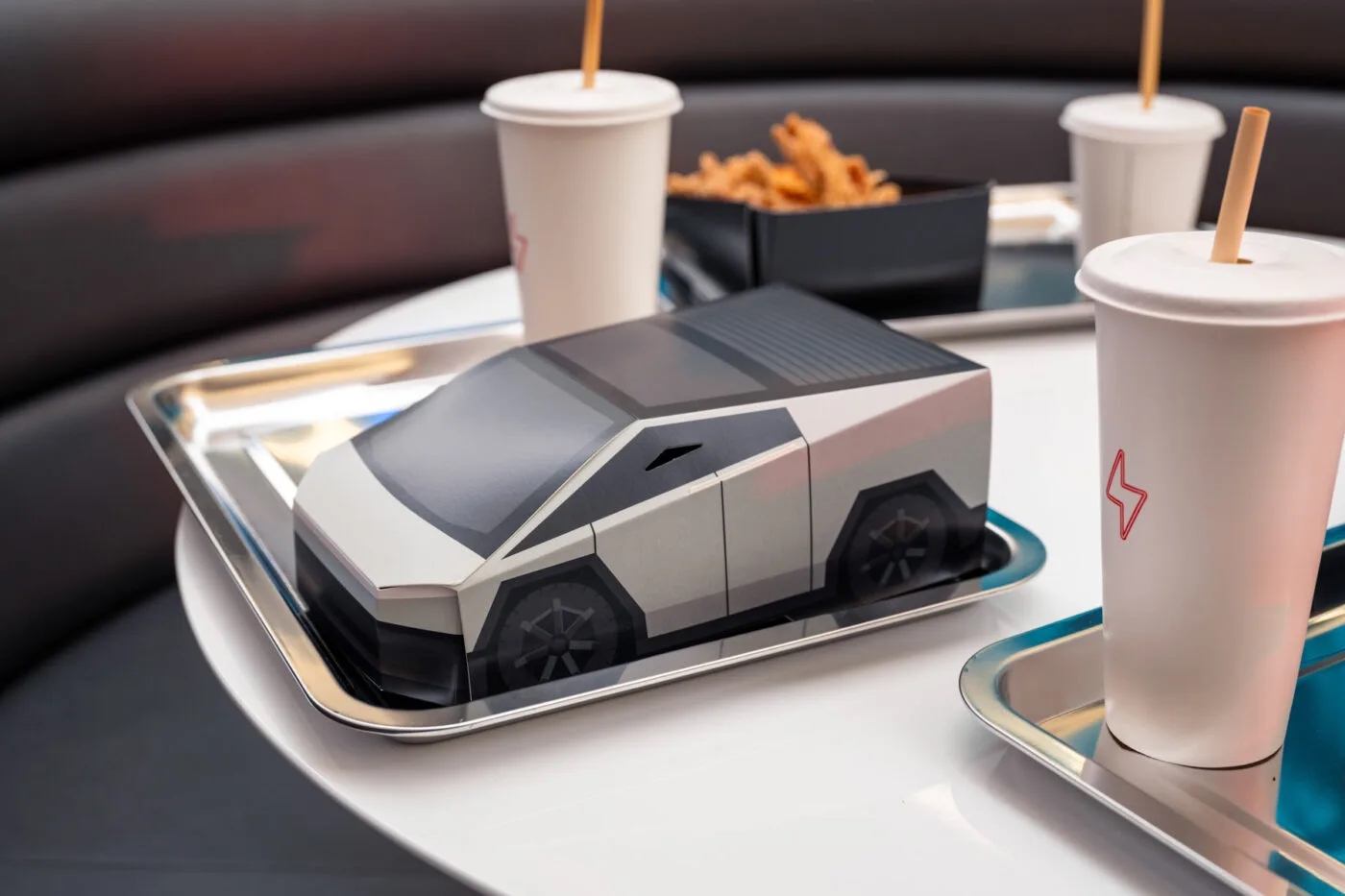
Irrelevant to architecture but worth noting: the food is disgusting. I had the burger, about which the best thing you can say is that it was limp. My partner had the “Falcon Wing Fried Chicken Sandwich,” which was drowning in mayo and not exactly as impressive as its namesake rocket. Both are delivered in little boxes shaped like Cybertrucks. The crinkle fries are standard, and we ran screaming from the green-and-red Ludicrous Milkshake. Nobody older than 8 can like this menu. By that account, perhaps half of Musk’s 14 (known) children might get a kick out of it.
Of course, we’ve been here before. The entire mid–20th century, from the Art Deco and Streamline Moderne eras onward, was about futurism: designing things that looked ultramodern, impressive, and fancy in ways that were self-congratulatory, often obscuring the real advancements of the time and often neglecting to appreciate the actual human condition. Designers celebrated the future at the expense of the needs of the present and the useful lessons of the past. Walkability, human scale, intrigue, and the efficient urban principles that had shaped cities for centuries were ignored, recklessly replaced with rote modernism and a faith in technology.
Musk has done the same again, both in his products and in this design. There is nothing pleasant or interesting about the Tesla Diner, just as there is nothing pleasant or interesting about cars invading cities, chopping them up, and pushing people apart, no matter how efficient their propulsion systems or clean their exhaust pipes may be. Tesla may be cutting down on greenhouse gas emissions, but Musk has no interest in solving the larger problems facing cities.
(It’s worth noting that the man Musk helped elect has now invaded the world’s most important oil-producing region, causing gas prices to go up and making electric vehicles relatively more economical. Meanwhile, that same man has reduced subsidies and incentives for green power and vehicles. Somebody, please make it make sense.)
For all its optimism, the diner is just as dismissive of cities as any oil baron or 20th-century car magnate ever was. Of course, Musk has been trying to undermine cities for years (literally). His Hyperloop was a sham, designed partly to shake public support for California’s high-speed rail system, and his Boring Company promises to further denigrate public transit with demonstration projects in Las Vegas and Nashville.
Let’s also consider what Musk hasn’t done for civil society. He may have a diner and a bunch of showrooms, but he otherwise has no urban presence: no hospitals, concert halls, art museums, schools, or other vanity philanthropic projects. Nothing to nominally benefit humanity—or put even the slightest dent in his nearly trillion-dollar net worth. It’s as if he thinks his bank account is a silicon wafer and even the most nanoscopic blemish will ruin it.
The Tesla Diner has one delightful feature: it replicates a drive-in movie theater. The night I was there, one of the Star Wars films was playing on two enormous screens. Visiting Tatooine was a fine way to pass the time while eating a limp minuscule smashburger and wishing for more fries. Yet even these screens are anti-urban: they’re in full view of nearby apartment buildings and thus cannot be pleasant for residents. As far as I know, they weren’t even permitted. I don’t believe in requiring permits for everything, but I do believe in permitting enormous, glowing screens visible from blocks away. I just hope we don’t see Big Brother three stories tall someday.
So what we have with the Tesla Diner is … I don’t want to call it fascist, but it’s something that certainly feels like projection rather than reality. Whatever it is, it’s definitely not cool.
Meanwhile, March 2026 in Los Angeles is already the hottest on record.
Feature image via Bloomberg.