
We Don’t Have a Climate Design Problem: We Have a Trust Problem
American cities are spending billions on climate adaptation, building flood barriers, drafting resilience plans, planting trees, and installing green infrastructure. Yet heat deaths are rising, insurance markets are retreating from high-risk regions, and public trust in local government continues to erode.
The problem is not a lack of engineering. It’s a lack of alignment.
We continue to treat environmental performance, civic governance, and everyday urban life as separate domains. Sustainability is handed to technical experts. Public engagement becomes a procedural requirement. Architecture delivers compliant buildings. Each discipline optimizes its siloed piece.
But cities are not mechanical assemblies. They’re living systems, comprising features that include water and energy infrastructure, nature, buildings, institutions, and human relationships. When those systems fail to reinforce one another, resilience strategies stall—not because the technology fails, but because coordination does.
Climate adaptation is not only a technical challenge. It’s a civic one.
Dignity Is a Design Decision
City leaders speak frequently about equity and inclusion. But dignity is not secured by policy language. Instead, it’s reinforced when residents can clearly see how decisions are made, where public money goes, and how they can influence outcomes. When processes are opaque, participation feels symbolic. Distrust follows.
In his book Conversations for Action and Collected Essays, organizational theorist Fernando Flores describes institutions as networks of commitments—promises made, and kept over time, that build trust. Cities function the same way: agencies commit to maintain infrastructure; developers commit to provide public access; officials commit to transparency.
When those commitments are unclear or inconsistently honored, coordination weakens. Maintenance is deferred, public space deteriorates, and environmental systems suffer because responsibility becomes diffuse.
The physical environment signals whether those commitments are real. A clearly marked public entrance invites participation; a blank façade discourages it. Visible stormwater systems suggest competence and care; neglected infrastructure communicates indifference.
Rotterdam’s water plazas illustrate this well. Public squares such as Benthemplein have playgrounds and gathering places that double as stormwater basins during heavy rain. Instead of hiding flood control underground, the city made it visible, civic, inviting. Residents can see how their neighborhood manages water. They can take pride in it.
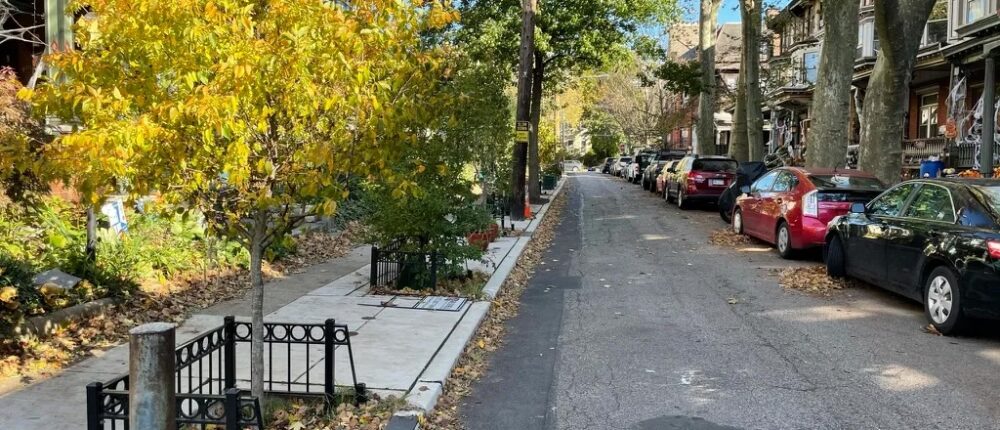
In the U.S., Philadelphia’s Green City, Clean Waters program has taken a similar approach. Rather than rely solely on buried pipes, the city invested in visible rain gardens, tree trenches, and greened schoolyards. Stormwater management became part of the daily experience and a vital part of civic pride and the greening of the city, not hidden machinery.
Design communicates whether dignity is performative, or real.
Behavior Follows Environment
We often assume that better policy produces better behavior. But behavior responds more reliably to context. If sidewalks are narrow and unshaded in a hot climate, fewer people walk. If cars and bikes are comingled, few people will choose to put themselves at risk. If stormwater vanishes underground, residents have little awareness of how risk is managed. If crossing the street feels unsafe, pedestrians disappear.
The environment trains us.
Shaded streets reduce heat stress and increase pedestrian activity. Protected bike lanes increase cycling because they feel safe. Visible rain gardens help residents understand how flood mitigation works as they move through their city. Walkable neighborhoods increase everyday contact between neighbors, strengthening informal trust.
Climate strategies that ignore lived experience become compliance exercises. Strategies that reshape daily conditions shape culture.
Trust Is Designed
Trust is often described as political or cultural. But it is also environmental.
When flood mitigation systems are understandable, when public maintenance is consistent, and when street design makes safety intuitive, residents experience institutional competence. Clarity reduces anxiety.
Hidden flood risks, confusing traffic patterns, and contradictory design cues—such as crosswalks that lead into fast-moving traffic—create uncertainty. Uncertainty breeds withdrawal.
Trust accumulates when governance, infrastructure, and physical space align. It erodes when they contradict one another.
Cities that ignore this will continue to struggle, not because residents are apathetic, but because the conditions for cooperation are weak.
Relationships Are Infrastructure
Cities invest billions in roads, pipes, and electrical grids. These things are essential. But during extreme events, informal networks often determine how quickly aid spreads. Social capacity is a form of risk mitigation.
Resilience also depends on relationships: who checks on whom during a heat wave, who shares information during a flood, who alerts neighbors of the threat of fire, who trusts official guidance in an emergency.
Urban form influences whether these kinds of relationships can be established. Public squares, shaded sidewalks, accessible ground floors, and active parks and greenways create the conditions for repeated encounters. Gated developments and isolated office parks reduce those opportunities. When everyday spaces discourage interaction, coordination weakens.
Ecological systems reinforce this dynamic. When water, trees, and shade are visible and shared, residents are more likely to value and protect them. When systems are hidden, they become someone else’s responsibility. Resilience is relational.
The Missing Layer
We cannot reduce emissions without changing behavior. We cannot change behavior without reshaping daily context. We cannot reshape context without building trust in the institutions leading that change. And we cannot value and protect what we do not understand.
Climate resilience is not only about carbon reduction or engineering capacity. It is about whether residents believe the systems around them are coherent and fair. It’s not enough to design greener buildings. We must design environments that:
- Make civic commitments visible.
- Make ecological systems legible.
- Make participation meaningful.
- Make cooperation easier than withdrawal.
Sustainability metrics measure carbon; they rarely measure trust. Yet cities facing extreme heat, flooding, rising insurance costs, and migration pressures cannot adapt without trust. Cities do not collapse because they lack innovation—they collapse when the conditions for coordination and care are weak. Design shapes those conditions.
If climate adaptation is to succeed, it will not be because we perfected the technology alone. It will be because we built cities where trust is reinforced daily through space, systems, and shared responsibility.
That is not an aesthetic adjustment. Alignment is a structural correction.
Featured image: Green City, Clean Water program, via the Philadelphia Water Department.