
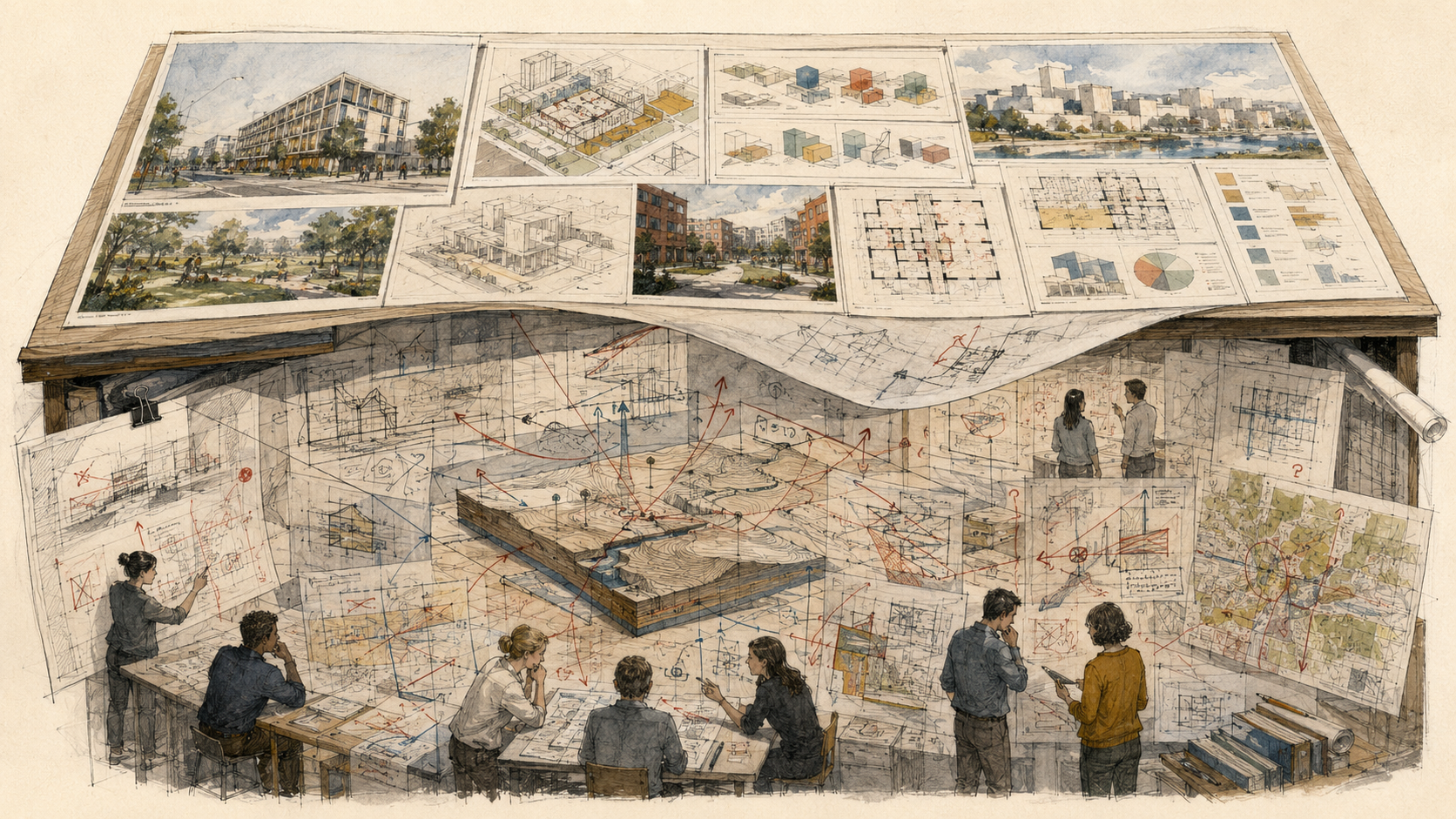
When AI Makes Design Look Easier Than It Is
One of the most useful responses I received to my previous Common Edge essay, which focused on how artificial intelligence could impact the pricing of architectural services—was also one of the hardest to answer simply: If AI makes production faster, and if designers need to shift their value from production toward professional judgment, how do we actually do that?
It’s the practical question beneath much of the anxiety now surrounding AI in architecture, planning, landscape architecture, and the broader civic conversation about the built environment. It’s one thing to say that design professionals should not define themselves by production alone. It’s another to explain this distinction to architects, planners, landscape architects, and citizen-planners who now see design material appearing faster than ever before.
For decades, the value of design has usually been viewed through its deliverables. Plans, renderings, models, specifications, reports, diagrams, public presentation boards, and permit drawings appear to be the service. When technology accelerates their production, it’s understandable that some people conclude that the work itself has become easier.
But professional judgment has never been identical to the artifact that carries it. A drawing is not valuable only because someone spent time drafting lines; it is valuable because it organizes decisions about space, structure, enclosure, access, life safety, cost, regulation, maintenance, and use. A zoning analysis is not valuable only because someone found the ordinance; it is valuable because someone understood what the ordinance means for a particular site, risk profile, and public context. A feasibility study is not valuable only because it produces a diagram; it is valuable because it helps determine whether a project should proceed, change direction, or stop.
The mistake would be to defend old ways of working by pretending production hasn’t changed. It has, and it will continue to.
AI can assist with all of these activities. It can also make them appear simpler than they are. This is where the design professions, and the public that depends on them, need to be careful. The mistake would be to defend old ways of working by pretending production hasn’t changed. It has, and it will continue to. The equally dangerous mistake would be to accept the market’s instinct that faster production automatically means lower value. If the design professions respond to AI only by promising more material faster, they will train clients, institutions, and the public to measure them by speed, volume, and polish. That path leads directly to commoditization, a race to the bottom.
The better response is to stop hiding professional value inside deliverables.
Design professionals often describe their services through phases and products: schematic design, construction documents, permitting, public presentations, master plans, feasibility studies, and construction administration. These categories are necessary, but they don’t fully describe the value being provided. Within them, designers are constantly making judgments: what options should be studied; which risks are worth accepting; which code or zoning interpretations are defensible; which cost-saving measures will create future problems; which public concerns are legitimate; which requests should be resisted because they compromise performance, safety, durability, access, or civic responsibility. These decisions are often the real work. Yet they are rarely perceived—or billed—as such.
AI makes that invisibility more dangerous. When software can produce more visible material in less time, the hidden structure of judgment becomes easier to overlook. A client, planning board, or neighborhood group may see 10 polished options and assume the proposal has been resolved. But someone must still determine which options are valid, which are misleading, which rely on flawed assumptions, which create downstream risk, and which should never be advanced because they are technically plausible but professionally or civically irresponsible.
That is why the first shift has to happen before drawings, renderings, or public boards are ever produced. It has to happen in the way design professionals describe the work. The work is not merely producing drawings, meetings, and revisions. It is helping determine whether the project is feasible, how the code or zoning should be interpreted, where entitlement risks may appear, how consultants should be coordinated, where construction or maintenance problems are likely to emerge, and which compromises may cost more later than they save now. These are not incidental services. They are the professional work that allows a project to move from intention to consequence.
If AI is used in that process, the point is not to advertise the tool. The point is to clarify responsibility. AI-assisted analysis may help with zoning review, site planning, test fits, code research, cost comparison, schedule evaluation, or environmental modeling. But the value lies in knowing what the output means, when to trust it, when to question it, and when to set it aside. This distinction matters because the built environment does not simply need more information; it needs better decisions.
Most projects already suffer from too much information: budgets, ordinances, financing pressures, contractor opinions, neighborhood concerns, political risk, infrastructure limits, environmental constraints, and, now, AI-generated studies. AI will add more information to these situations, not less. The designer’s value is not merely supplying additional material, but helping determine which information should govern the decision.
AI undermines the old habit of equating value with visible labor time. The answer cannot be nostalgia for the old method. The answer must be a clearer explanation of what the fee protects.
This is why fees need to be explained differently. AI undermines the old habit of equating value with visible labor time. The answer cannot be nostalgia for the old method. The answer must be a clearer explanation of what the fee protects.
The value at stake is not only time saved or material produced, but reduced uncertainty, clearer decisions, better coordination, fewer avoidable conflicts, and a professional framework that can explain why one course of action is better than another. In many cases, AI may allow design professionals to provide more value earlier in the process: more options tested, more constraints identified, more risks surfaced, and more assumptions challenged before money, political capital, or public trust is spent.
This also complicates the common prediction that AI will simply shrink architecture firms. It may happen in some offices, especially where the work has already been reduced to production labor. But it’s not the only possible outcome. If AI allows a project architect to test more assumptions, identify risks earlier, coordinate information more intelligently, and spend more time thinking through the consequences of a project, then that architect has not become less valuable. In fact, the opposite may be true: The firm has gained capacity for better judgment. The owner has gained a clearer path through uncertainty. The public process has gained a more responsible proposal.
The built environment does not suffer from a shortage of things to be done. Senior living, retail adaptation, office conversion, housing, infrastructure, climate mitigation, civic repair, neighborhood redevelopment—all require more thoughtful professional attention than most firms can currently provide. Many good firms are not short of potential work. They are short of time, senior judgment, and the ability to bring careful attention to every project that deserves it. If AI helps expand that capacity, the result should not automatically be fewer architects. It may be more architects doing more consequential work.
This should not automatically reduce the fee. It should change the explanation of the fee.
The design professions should be more willing to recognize early judgment as its own service. Feasibility, entitlement strategy, code interpretation, site analysis, consultant alignment, and risk mapping should not be treated as free preliminaries that merely lead to “real” design work. They are often where the most consequential decisions occur. They are also exactly the areas where AI will create the illusion that answers can be produced quickly and cheaply.
A zoning summary generated in minutes is not the same as a defensible entitlement strategy. A code search is not the same as a life-safety approach. A site diagram is not the same as a planning judgment. A test fit is not the same as a development decision. A rendering is not the same as architecture. The faster preliminary material can be generated, the more important it becomes to distinguish raw output from professional interpretation.
This distinction also needs to leave a record. If judgment is the value, then judgment has to be visible after the decision is made.
Design professionals already document decisions through drawings, meeting minutes, reports, emails, specifications, and public presentations. But in an AI-assisted environment, the reasoning behind decisions may need to become more explicit. When a major option is rejected, the file should explain why. When a code or zoning interpretation is selected, the basis should be recorded. When AI-generated studies are used, the assumptions and limits should be identified. When an optimization is accepted or overridden, the rationale should be clear.
This is not just defensive practice, although it certainly helps with liability. It’s also a way of demonstrating value. Citizen-planners may not need to know every technical detail behind a site plan, but they do deserve to know whether the image placed before them rests on sound assumptions, responsible tradeoffs, and accountable judgment.
AI output has to be treated as a draft to be interrogated, not an answer to be decorated…The market will not make this distinction for the design professions.
The same clarity matters inside firms, agencies, and review boards. If emerging professionals are trained only to prompt tools and accelerate production, they will not develop the judgment needed to evaluate what those tools produce. AI may remove some repetitive labor, but the design professions cannot allow it to remove formation through consequence: field problems, consultant conflicts, code comments, public opposition, budget failures, maintenance issues, and post-occupancy realities. AI output has to be treated as a draft to be interrogated, not an answer to be decorated.
The market will not make this distinction for the design professions. Nor will public process do so automatically. Left alone, both will tend to measure what is easiest to see: speed, quantity, polish, apparent completeness. This is why architects, planners, landscape architects, engineers, and citizen planners must become more explicit about the forms of value that are harder to see.
There is an opportunity here, but it is not preordained. AI may help design professionals move upstream, closer to feasibility, risk, entitlement, environmental performance, public engagement, and strategic decision-making. It may allow teams to test assumptions earlier and provide better information before large commitments are made. It may strengthen the designer’s role as adviser rather than merely producer. But this will happen only if the design professions claim that role intentionally.
Production may become faster, but judgment must become clearer. Design professions do not need to insist that nothing has changed. Something has changed. AI has made design easier to produce, but not easier to judge. This distinction may determine how the built environment and the people who design it are valued in the years to come.
Featured image created by the author, using DALL.E prompts and refined through manual editing.