
Why Architects Need to Commit to Educating the Public
My son is heading to college this fall, hopefully to study architecture. I’d like to tell you that’s a coincidence, but of course it isn’t. He grew up watching me work, sitting in project meetings he was too young to understand, walking job sites before he could read a set of drawings. He knows what architects actually do because he had a front-row seat for nearly two decades. Most kids never get that seat.
This is the problem that Architecture Week, the AIA’s education outreach initiative, exists to solve.
While improving profitability and working conditions for young architects remains a genuine priority for the organization, the profession also has to look further down the road. The clients, community members, and business leaders who will hire architects 20 years from now are sitting in K–12 classrooms today. What they understand about design, and whether they understand anything at all, is being determined right now.
This isn’t a new observation. More than a decade ago, Common Edge co-founder Martin C. Pedersen made exactly this argument, pushing the AIA to redirect its Architecture Week focus toward students rather than self-congratulation. He was right then. The case is even stronger now.
What Architecture Week Actually Is
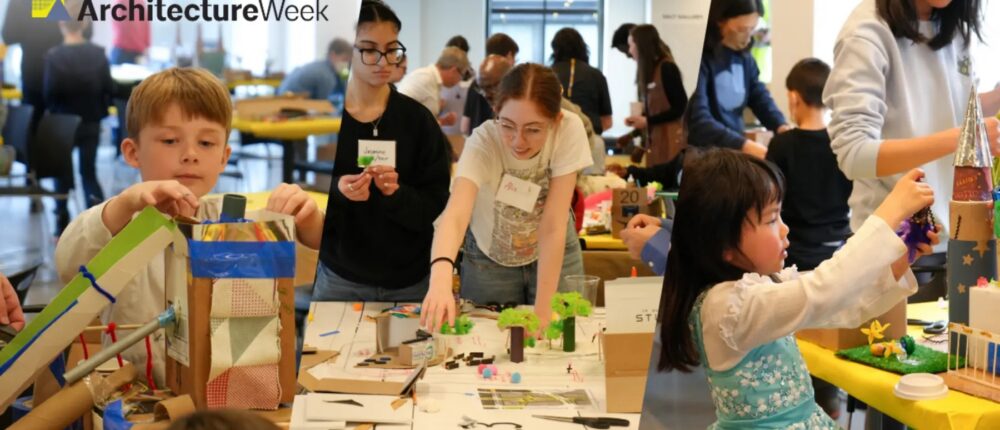
Architecture Week, which was launched in 1982, is now an annual nationwide invitation for design professionals to visit schools and show students what this profession does and why it matters. It’s not about recruiting pitches or portfolio reviews. It’s real conversations about how the built environment shapes the way people live, work, learn, and heal. It’s also an opportunity for architects and design professionals to share their expertise and demonstrate how design shapes communities and enhances lives.
The goal isn’t to help fill the profession’s pipeline—though that matters, too. The deeper objective is to put design literacy into the minds of people who will never become architects but will spend their careers making decisions that architects have to deal with. They include the retail developer who understands spatial experience; the school board member who knows what good daylighting does for student performance; the hospital administrator who grasps the connection between building layout and patient outcomes. These clients and patrons are formed early, and right now, most of them are being formed without architects in the room. The strengthening of our profession’s future is not incidental.
A recent AIA study found that children without early exposure to architecture or design thinking are significantly less likely to develop any meaningful interest in the field. The return on this investment won’t show up in next year’s Architecture Billings Index; it may not show up for a decade. But the profession’s long-term health depends on a public that understands architecture’s value, not just its aesthetics.
The 2025 numbers for Architecture Week suggest the momentum is real: participation by design professionals doubled to 505; firm involvement grew to 131 from 96; school programming expanded by 400%; and student engagement reached more than 20,000 pupils. It’s not a niche initiative anymore. That’s a movement that needs more of us behind it.
How to Get Involved
Architecture Week offers numerous opportunities for architects and design professionals to connect with K–12 educators and make a meaningful impact. Through local AIA chapters and partner organizations, you can contribute by:
- Donating to a local chapter’s wish list.
- Sharing resources with neighborhood schools.
- Volunteering time directly with students.
For those ready to take a deeper dive, AIA’s K–12 resource page provides a wealth of tools to spark creativity and introduce students to the possibilities of architecture. From suggested reading materials to hands-on lesson plans, these resources make it easier than ever to inspire young minds.
The AIA continues to develop new tools to enhance K–12 engagement. Upcoming initiatives include a grab-and-go classroom toolkit (created in collaboration with the American Society of Landscape Architects) and a guide for launching high school design competitions. These resources empower design professionals to educate and inspire with confidence.
The Honest Case
When you invest your time in educating young people about architecture, you do more than support the profession: you shape its future. Some of the students you engage with may be inspired to pursue a career in architecture. Others will gain a deeper appreciation for the spaces and environments crafted by design professionals. Every conversation you have—with a child, a teacher, with a community member—makes you a champion for architecture and its transformative power.
My son chose architecture because design was never abstract to him. It was the conversation at dinner, the problem on the whiteboard, the building going up down the street. He had context. He had vocabulary. He had someone who showed him what the work meant before he was old enough to choose it, and for better or for worse, he’s become quite opinionated on the subject.
Most students don’t have that. We can be that for them. Not every student you reach will become an architect, and that’s exactly the point. The ones who don’t will become something else, and what they understand about design when they get there will determine how well this profession is valued in the next generation. That’s worth an afternoon or two of your time.
Learn more about how you can get involved: AIA Architecture Week 2026.
Featured image vis the Boston Society of Architects.