
Why Is Poland Building Castles Again?
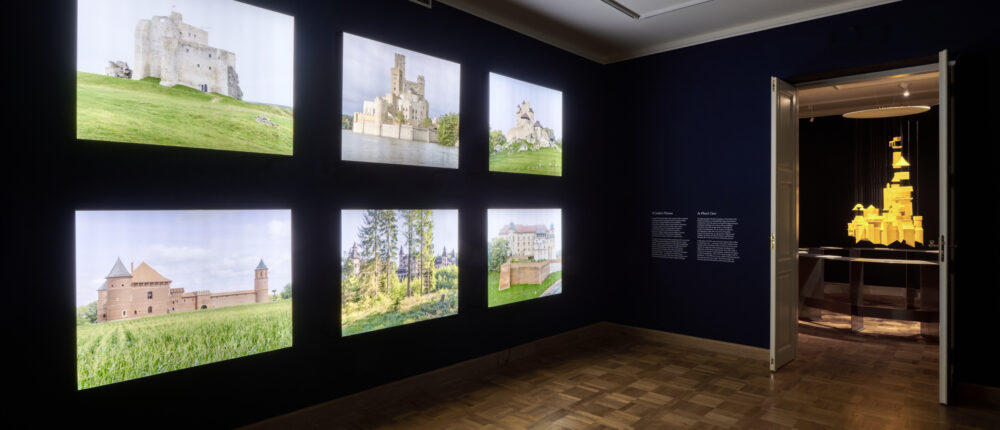
At a time when architecture is increasingly used to project national identity (see the much-discussed U.S. Triumphal Arch), contemporary Poland stands out with a particularly vivid case: the castle as a mass aesthetic. There, whole major residential developments are designed to look like castles, while merlons and turrets become motifs in the vernacular architecture of provincial wedding venues and ice cream parlors. A new exhibition at the Royal Castle in Warsaw, Last Castle. Polish Castle-ness: From Wawel to Stobnica, appears to be the first to examine what all of this could be about. In its visual research, the show employs everything from photography by Venice Golden Lion recipient Nicholas Grospierre to mixed-media deconstructionist artworks. A companion book gets at the phenomenon with newly commissioned writing by art historians, cultural critics, and social scientists, including celebrated voices on Polish cultural history such as Andrzej Leder.
Recently, I spoke with the exhibition’s curator, Kuba Snopek, a writer specializing in 20th and 21st century architecture theory, about nostalgic architecture as a vehicle for assumed historical greatness, the reduction of buildings to easily identifiable narratives, and making sense of real-time construction trends that no discipline claims as its own.
VI: Vlad Ilkevich
KS: Kuba Snopek
How did this project start? What was the catalyst?
I came to this from the perspective of contemporary architecture. Castles are usually treated as historical objects, yet in Poland they are actively built, expanded, and reconstructed today, at a surprising scale. There is a clear blind spot. Historians focus on authenticity, architects on vanguard trends. Meanwhile, dozens of castles and castle-like structures keep appearing across the country, publicly and privately funded, but rarely analysed as a contemporary phenomenon.
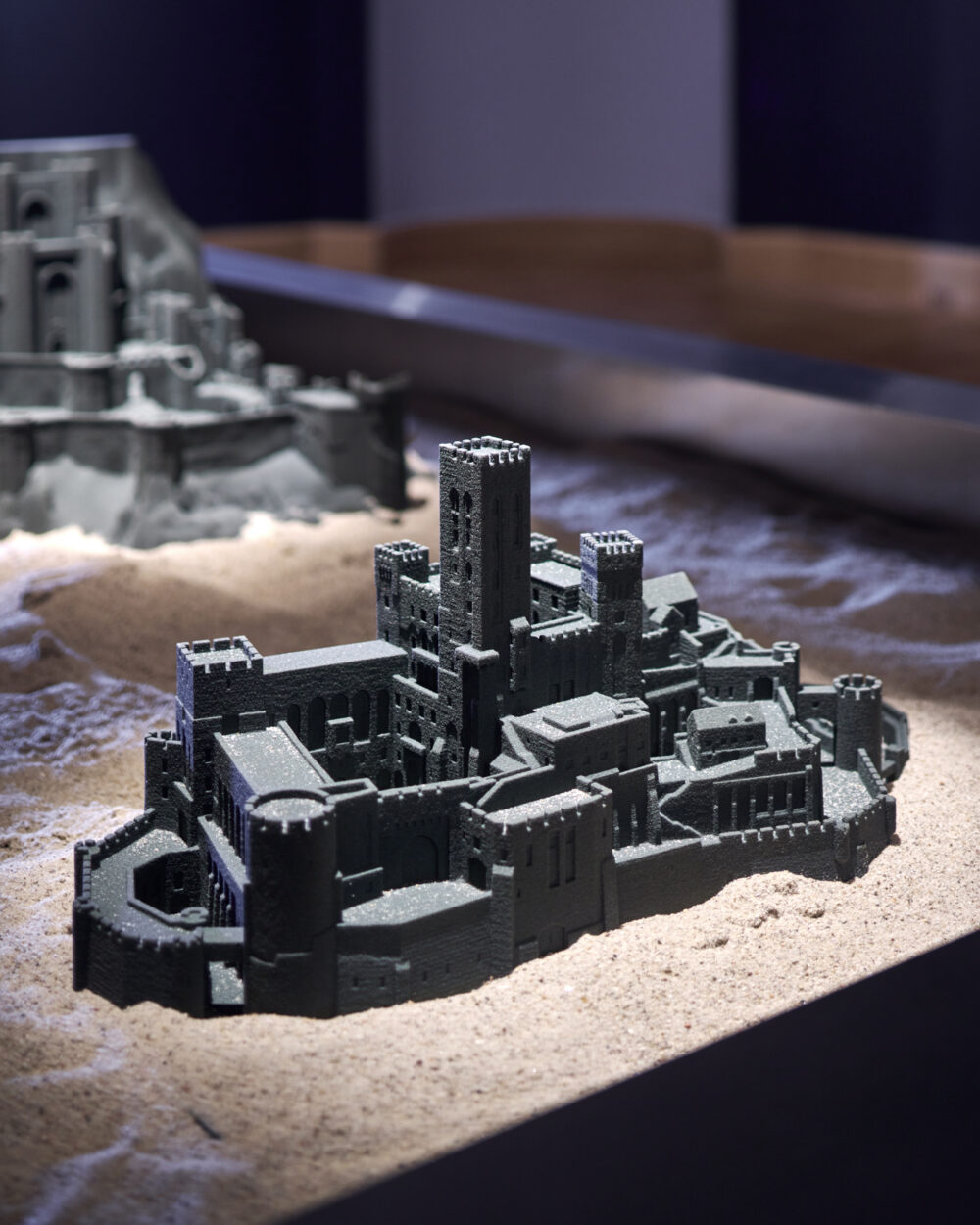
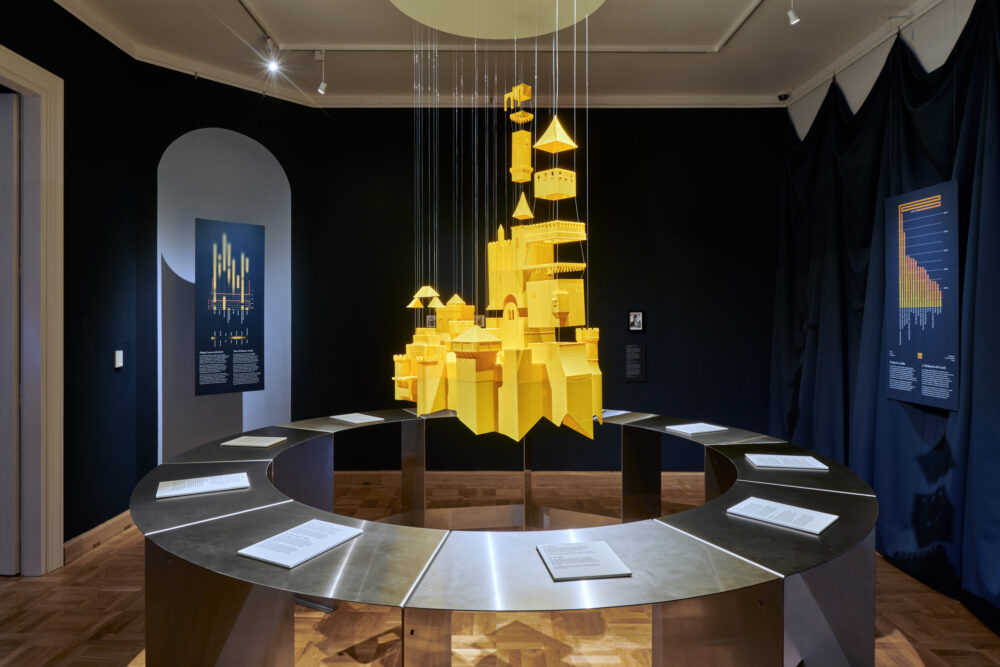
What interested me was why the castle remains so persistent and compelling. Today, castles have largely lost their original purpose. What remains is almost entirely their narrative role: they communicate ideas about history, identity, power. It is perhaps the only architectural typology where meaning and storytelling are so much more important than function. In the project, I look at castles not as buildings, but as images. What I call “castle-ness” is a set of visual features that make something recognizable as a castle, regardless of its history or use.
How many of the 40-something contemporary castles that the exhibition considers in its scope can be called real, authentic? Does it matter?
The distinction is not very useful. It belongs to the world of art and architectural history, where debates about authenticity can go on indefinitely. In reality, castles have been heavily transformed since the 19th century. What we often take for medieval architecture is already a 19th century redesign, shaped by romantic imagination, restoration doctrines, and national narratives. So even before looking at contemporary examples, we are dealing with projections rather than originals.
Very few of the projects in the exhibition would qualify as “authentic” in a strict sense. Some are partial reconstructions, others speculative completions, and some entirely new. Even the historically grounded ones continue this tradition of transformation. The image is ultimately what matters more. A castle is more “real” the more it activates that shared notion—if its form, setting, and details align with what we collectively read as a castle.
In her writing on the first Venice Architecture Biennale in 1980, which she calls a vital springboard for Postmodernism, architecture historian Léa-Catherine Szacka plays two notions against each other: communication, architecture again telling a story and being ironic after years of Modernism’s functionalism and abstraction; and historicism, the recreation of “authentic” traditional architecture. How do these play out in the trend you’re researching?
Getting back to Szacka’s distinction is interesting. What we see in Poland is neither historicism in the strict sense nor postmodern communication as framed in 1980. We’ve established that these castles are rarely about authenticity, but they are also not ironic, critical, or “double-coded.”
If anything, they radicalize the communicative turn. They rely almost entirely on the legibility of a clear visual message. The viewer doesn’t decode, they identify. There is no ambiguity. The result is a stable, literal narrative—architecture reduced to a single, highly effective story.
Poland underwent sharp simultaneous decommunization and turnaround to Catholicism after the 1980s. More recently, it is known as a paragon of economic development, with a growing middle class and ambitious, if often EU-funded, infrastructure projects, but still with wide social conservatism on issues like LGBTQ and reproductive rights. How is the castle-ness trend influenced by this sociopolitical context?
Polish castle-ness is not a post–Cold War phenomenon: it has been a persistent form in Polish culture across very different political systems. New castles and major reconstructions appeared in the interwar period, in the postwar Communist era, and today. What has happened since the 1980s is the shift mainly towards private investment. Earlier, castles were largely state-driven projects, from the reconstruction of the Royal Castle in Warsaw to the scientific restorations of the communist period. Today, many are initiated by private actors. Castles are clearly a conservative architectural form, but their use is diverse. Ujazdowski Castle, rebuilt in the late 20th century, has housed progressive contemporary art for decades. The Imperial Castle in Poznań now hosts LGBT organizations like Lokum Stonewall.
Why can this image of a castle be so powerful despite its clear associations with backwardness and hierarchical social order?
Because of constant repetition. Films, video games, children’s books, curricula—the castle is one of the most reinforced images in European culture, and has been for generations. What attaches is a dense cluster of associations: power, protection, permanence, status, but also childhood and joy. The uncomfortable associations might be drowned out because the image can feel familiar or safe. As a result, the castle functions almost like a logo: instantly legible, emotionally warm, and resistant to reinterpretation.
How does this trend relate to the prominence of the popular video game series The Witcher and the subsequent Netflix TV show, which are based on fantasy literature by contemporary Polish author Andrzej Sapkowski, or the 2023 Toronto International Film Festival–launched Polish animated historical drama The Peasants?
In films made primarily for a Polish audience, the castle is not treated as part of a genre backdrop. It functions more as a national symbol, a direct reference to history and identity. It is used seriously, almost literally, rather than as a stylized or fictional backdrop.
The Witcher is a different story. It is one of the few Polish contributions to global pop culture on that scale, and it’s set in a fully fictional world. But even there, the visual language remains tied to a version of the Middle Ages. Castles are still the dominant spatial form. This is telling. Even in fantasy, where anything is possible, we keep on reproducing the same past.
Nostalgic architecture has been in the news elsewhere, most notably in the U.S., with the Trump administration’s push for historicist federal buildings. How does Poland’s phenomenon connect with those in other countries?
There is a broader zeitgeist of reaching for architecture that expresses a kind of assumed historical greatness. It appears across the West but takes different forms depending on local traditions. In Germany, it often takes the form of large-scale reconstructions that symbolically return to a pre–20th century past, bypassing the difficult recent history. The same idea manifests in Poland. Here, it reaches out to the historical glory of our influential early modern sovereign state, Polish-Lithuanian Commonwealth, on top of that 19th century reimagining of castle forms across Europe.
There’s been, in recent years, a rise in nostalgic, identity-driven content, often rejecting Modernist and fetishizing pre-modern architecture, on social media that has been widely associated with xenophobic ideas like the Great Replacement conspiracy theory or otherwise categorized as reactionary. To what extent are the new Polish castles a physical manifestation of the same sentiment?
I don’t think there is a direct connection yet. This kind of nostalgic, identity-driven discourse is already present in the Polish internet, but architecture operates on a much longer time scale. Castles take years to design and build, so what we see today does not directly reflect current online debates. That said, I would expect these two trends to converge over time. It is quite possible that we will start seeing castles built with a more explicit, prescriptive intent—as physical arguments for what “correct traditional architecture” should look like.
The Royal Castle, where your exhibition is held, is a state-affiliated museum that has been at the heart of the country’s national identity. How does a critical show questioning such a recent trend in national identity-building end up here?
The Royal Castle is of course a very strong national symbol, with its main permanent exhibition focused on the history of Polish royal and parliamentary traditions. But under its current leadership, the institution has been developing a program of temporary exhibitions that engage more directly with contemporary questions. Many of these shows revolve around the idea of the castle itself and are often critical and exploratory in tone. Our exhibition is part of this direction.
All photos by Kuba Rodziewicz.