
Why Should We Care About Good Urbanism?
In a housing crisis, it’s easy to dismiss the aesthetics of buildings as superfluous “nice-to-haves” that are not really necessary. But new research by prominent researchers David Broockman, Chris Elmendorf, and Joshua Kalla shows it might be the opposite. There are real benefits to good design, and real consequences to bad design—and real science to back this up. Aesthetics and good design have a positive physiological effect on us: reducing our stress, stabilizing our heart rate, lowering our cortisol levels, helping us to relax. Good urbanism actually makes us want to stroll, shop, and linger in places that make us literally feel better. And in these well-designed neighborhoods, dining and retail play a critical role in enabling car-light living, which reduces the need for parking, further lowering the cost of construction while also lowering rents. Aesthetics also play a significant role in support for more housing: this new research shows that thoughtful, high-quality design can foster broad public support for housing, removing obstacles to achieve housing abundance and beautiful walkable cities.
The Science of Good Design
The science behind how our physical environment makes us feel is fascinating. Decades of research in fields like neuroscience and environmental psychology show that design engenders a response in humans—which, in turn, affects economic and political outcomes.
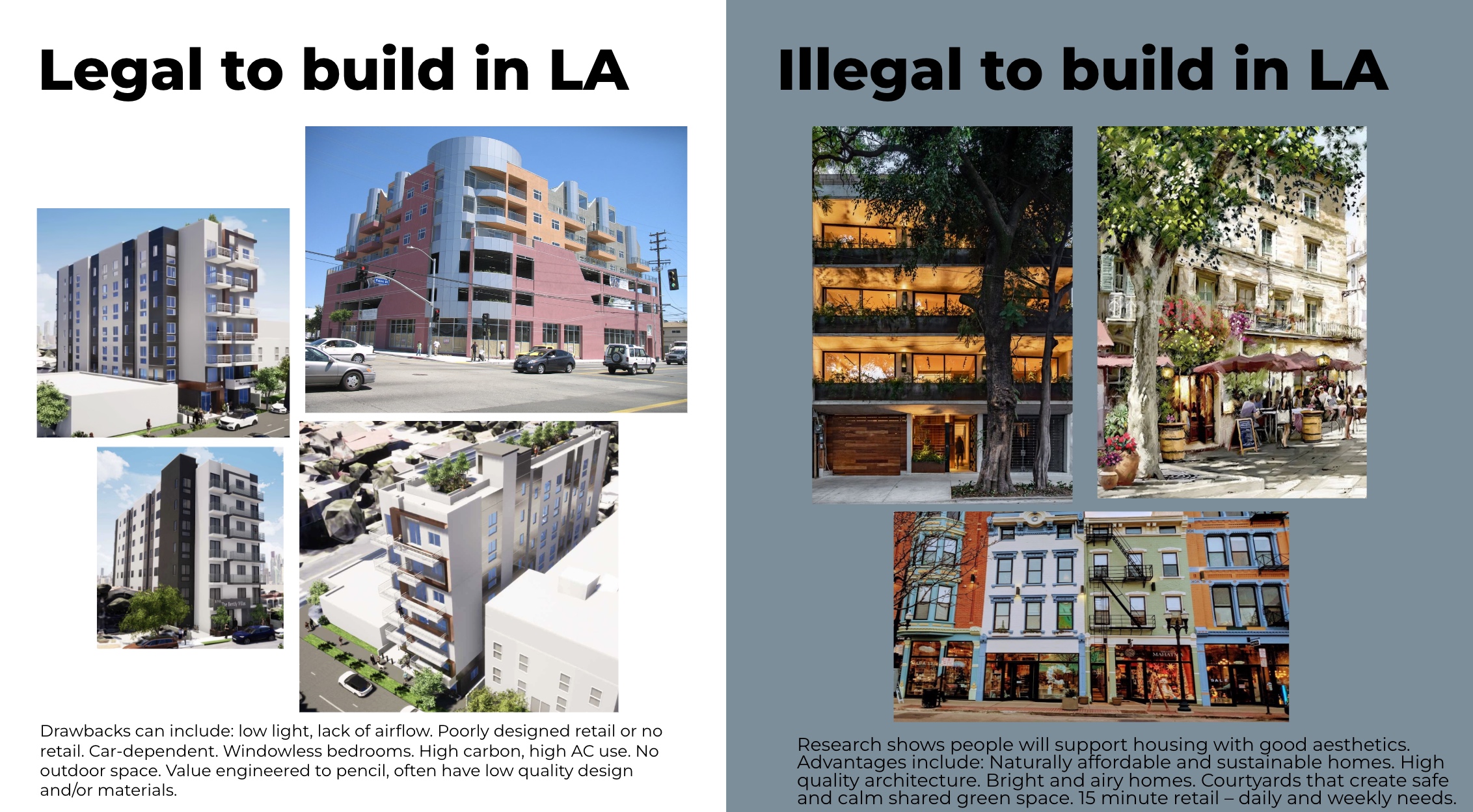
Height and Consistency: When a street consists of buildings with random heights and few trees, it feels exposed and unpredictable. As humans, we scan our surroundings for cues of safety and shelter, and streets that are more coherent and have a tree canopy allow us to relax. Visually disordered environments can be fatiguing. Streets that feel “exposed” or “chaotic” keep us on edge. A consistent human-scaled street makes us feel like we’re in a living room, and three- to five-story buildings allow us to visually process the entire street at once—think of looking at a row of townhouses—without having to focus on each building individually. Lining a street with trees can create a “canopy” that makes us feel protected and sheltered, giving us a sense of enclosure. It’s a preference called “prospect and refuge”: people prefer environments where they can see clearly (prospect) while also feeling protected (refuge). Additionally, exposure to greenery reduces stress, heart rate, and cortisol, and green views have been linked to faster recovery times in hospitals.
Order and Variety: Humans have a preference for order and variety: a consistent height, enough repetition that feels coherent, with architectural differences to engage us. Think of a charming street where the structures are varied in their usage and details but have a uniformity of materials and massing. It feels human and inviting. The repetition and rhythm of a series of shopfronts, doorways, and windows is comforting. When a space is inviting, we stay longer, spend more, and return more often.
Materials: When we look at a building with a blank facade made of materials like metal or glass, there is little for our eyes to rest on, but our brain is looking for a pattern—and this creates discomfort. We have evolved to interpret places by scanning them to understand them: looking for patterns, movement, signs of life or signs of danger. Alternately, textured materials like brick, stone and wood create patterns and repetitions, giving us something to “decode,” relaxing us.
Shapes: While we process square and rectilinear buildings neutrally, jagged, angular shapes and details trigger a threat response in the brain. We associate sharp edges with danger, putting us on low-grade alert. Curved and rounded edges (arches, rounded doorways, organic shapes) are consistently preferred, as we process them as safer and more inviting. We are drawn to fractal-like patterns, which are found throughout nature and have been reproduced in architectural styles for thousands of years.
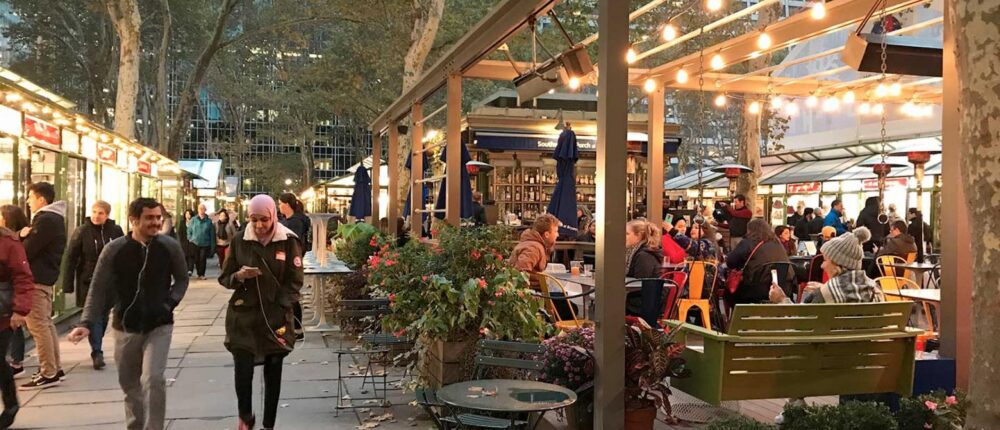
The Street: The design of the street also influences how we feel and whether we want to linger. Fast cars put us on high alert; we code them as large animals coming at us, and we want to flee. Narrow lane widths, cobblestone and pavers slow cars, making streets safer and more inviting. Small shops “activate” the street with big windows, awnings, and displays that draw our attention, relaxing us as we take it in. Outdoor seating and pedestrians create “eyes on the street,” making us feel safe. All of these things allow us to relax into the life of the street instead of constantly scanning it for risk.
The Politics of Good Design
Aesthetics can also have political implications for the housing movement. The report referenced earlier finds that aesthetic concerns causally affect support for development, regardless of whether someone rents or owns their home: both groups object to low-quality design. In experiments, showing people a more attractive building increased support, while showing an uglier one reduced it. A building that fits its surroundings generates support; one that doesn’t generates opposition. When researchers replaced an apartment building with an identically sized office building—which would have no residents at all, thereby removing the element of who might be moving into a neighborhood—opposition was actually greater, “suggesting that a broad class of explanations for opposition to development that are specific to housing—such as the demographics of its residents—are likely insufficient to explain opposition to new housing.” A 2025 study by political scientists Adrian Pietrzak and Tali Mendelberg finds that people object to mismatched height more than height itself. A taller building that fits its surroundings is more acceptable than a shorter one that doesn’t. And, interestingly, people objected to poor aesthetics even if the building was not in their neighborhood or a place they ever intended to visit. They simply did not want ugly architecture in their city.
Taken together, these studies suggest that opposition to housing can be mitigated or even eliminated with aesthetically-pleasing development. In our own outreach through the Livable Communities Initiative, we have found broad support for high-quality, human-scale buildings, and that support dropped by 90%–95% for low-quality, out-of-scale buildings. But what activated neighbors to actively ask for housing in their backyard was the combination of high-quality buildings and a walkable street. It was a holistic plan that appealed to people. A carefully designed program that would realistically result in a livable, walkable street that also focused on affordability converted housing skeptics to tacit supporters and even housing advocates.
The conventional wisdom has long held that entrenched political opposition means cities need to deprioritize aesthetics to achieve housing abundance. But the evidence from Los Angeles shows it is possible to flip the script: neighborhoods will embrace density and even lobby their elected leaders when it comes with good urbanism. Walkability is the most sought-after amenity in real estate, and there is broad support for creating shared public spaces—a local town square and a vibrant main street that build a sense of community. Housing advocates can form the broadest possible coalition to take on recalcitrant bureaucracies and bad public policy with a plan to create beautiful neighborhoods, and thereby get both good aesthetics as well as abundance.
Featured image: Bryant Park, New York City, via Creative Commons. Photo by Hazel Borys.