
Will AI Make Architectural Expertise Easier to Misprice?
Artificial intelligence is changing a familiar calculation in professional life. When software makes part of a job faster, clients, institutions, and the public often assume the service itself should now cost less. This reaction is easy to understand. In most fields, visible efficiency looks like reduced value: if a tool can generate options more quickly, automate part of an analysis, or compress a task that once took days into hours, the market tends to treat that gain as a discount.
But expertise rarely works that way.
In many professions, technology reduces the time spent on visible tasks without reducing the need for judgment. In some cases, it increases that need. The routine parts of the work become easier, while the interpretive and consequential parts remain. The labor outsiders can see shrinks, while the responsibility they cannot easily see stays in place. Work becomes easier to misprice precisely when expertise becomes more important.
The built environment offers a particularly clear example. AI is beginning to assist architects, planners, engineers, and landscape architects with feasibility studies, code analyses, zoning reviews, cost comparisons, design exploration, and performance testing. Some offices are embracing these tools quickly; others are using them more cautiously. But even at this early stage, one consequence is already coming into view: As software speeds up visible portions of design work, it becomes easier to assume that the underlying expertise has become cheaper as well.
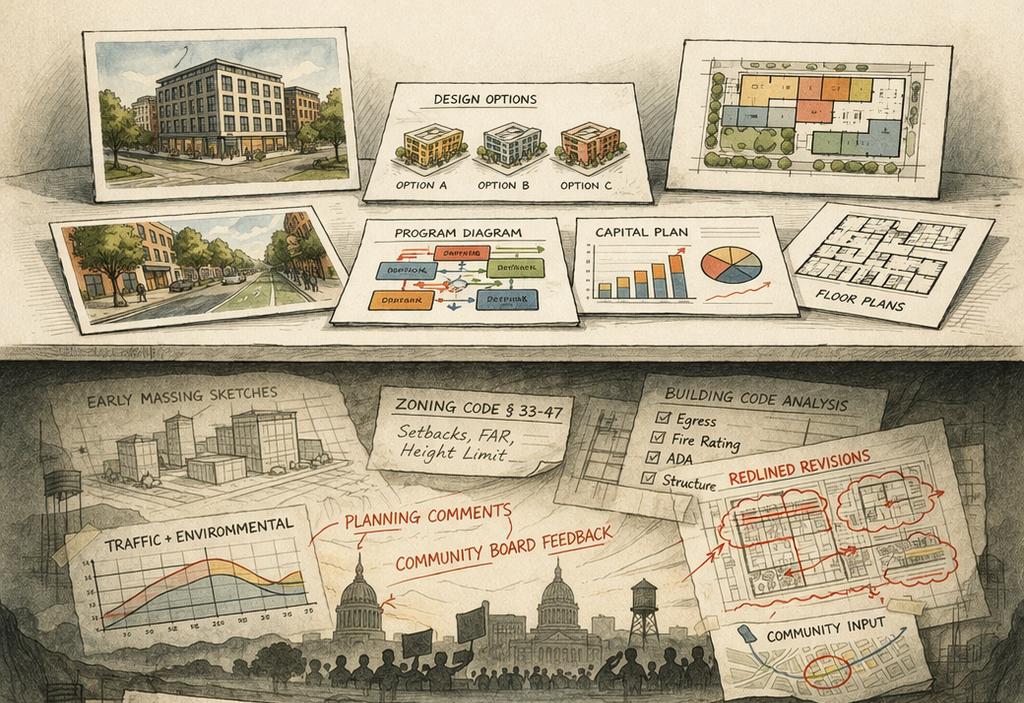
That conclusion is tempting because the visible products of design are easy to recognize. Drawings, renderings, diagrams, and simulations look like the work itself. When these things appear more quickly, it can seem as though the service has become easier and more standardized—and therefore less valuable. But in the design professions, as in many others, visible output is only part of the job. The larger task is deciding what matters, what conflicts with what, what risks are acceptable, what tradeoffs are defensible, and what consequences will follow once decisions leave the screen and enter the world.
That is where efficiency and commoditization part ways. Efficiency means using better tools to do work more effectively. Commoditization begins when a service is judged mainly by the speed or volume of its outputs rather than by the quality of judgment behind them. Once that shift takes hold, expertise becomes harder for the market to recognize.
This problem extends well beyond architecture. Technology can make routine work faster without reducing accountability. Tasks may take less time. Consequences do not.
In the built environment, those consequences are unusually public and durable. Buildings, landscapes, streets, and development decisions shape safety, access, maintenance, cost, environmental performance, and everyday experience. That is why the conversation about AI in design should not be limited to whether offices can produce more options more quickly. The more important question is how clients, institutions, and the public understand expertise once technology accelerates the visible parts of the work.
One argument now emerging from firms that are embracing these tools is that clients do not pay for hours; they pay for reduced risk, faster decisions, and better-informed outcomes. There is truth in this. Better tools can create real value. Earlier conflict detection, faster code analysis, and stronger early stage evaluation can save time and money. On large projects, even modest schedule gains can matter.
But there is also a trap in defining value too narrowly in those terms. If design professionals begin presenting themselves mainly as faster producers of technical and financial clarity, they may train the market to see their work as increasingly standardized and interchangeable.
This is where commoditization begins. The issue is not that AI improves efficiency, but that markets rarely stop there. They tend to convert efficiency into price pressure: time saved becomes a basis for fee reduction; expanded analytical capacity becomes an expectation rather than a differentiator. Firms may adopt increasingly sophisticated tools while finding themselves under greater pressure to compete on speed and cost.
And there is another complication. Even when firms change how they work, clients, lenders, and institutions often continue to pay in familiar ways. Their spreadsheets, pro formas, and approval structures are built around conventional fee categories. Technology can change practice faster than the market changes how it values practice.
Over time, this does more than compress fees—it alters how expertise is perceived. If design work is framed mainly as the rapid production of compliant, data-informed deliverables, then the professional contribution starts to look interchangeable with the systems that support it. Yet the most consequential parts of practice are often the least visible when services are being priced: anticipating downstream risk, interpreting regulations, reconciling competing priorities, recognizing when an optimized option is still the wrong civic or ethical answer, and documenting the reasoning behind decisions that may later be challenged.
This is one reason Phil Bernstein’s work is useful here. He has argued that the AI question in architecture is not just about tools, but about professional knowledge, judgment, responsibility, and risk. That is exactly why the economics of expertise deserve more scrutiny. The issue becomes more serious as automation moves from isolated tools into integrated systems. Expertise can increasingly be embedded in templates, rule sets, and standardized processes controlled by larger institutions, software platforms, or vertically integrated delivery models. In that environment, licensed professionals may still bear responsibility for outcomes while having less influence over the assumptions driving the process.
This creates a dangerous imbalance, and not just for architects. It affects planners, landscape architects, engineers, public officials, clients, and citizens who depend on expert judgment to mediate between technical possibility and public consequence. If markets come to believe that expertise resides only in what can be quickly produced, then the people making the most consequential decisions about the built environment will be judged by the wrong measure.
The challenge, then, is not whether the design professions should use new tools, but whether the market around them can resist confusing faster production with lower value. Artificial intelligence may help experts analyze more, compare more, and test more. But better tools alone will not stop the race to the bottom. That will require the professions to become clearer about what clients are actually paying for. Fees cannot be tied only to the speed of visible production when the most consequential parts of practice remain judgment, coordination, accountability, and risk. Contracts and scopes will have to distinguish automated assistance from professional responsibility. That may mean treating early risk analysis as a billable service, recording the reasoning behind key decisions as part of the professional deliverable, and defining scope around advisory judgment rather than drawing volume. Firms will have to explain more plainly where expert interpretation still governs outcomes, where liability still rests, and why faster output does not make those obligations disappear. Left to itself, the market will go on translating efficiency into discount.
This points to a larger challenge. The issue is not just whether the design professions adopt AI, but whether they can reposition themselves before the market defines their value too narrowly. Architects, planners, engineers, and landscape architects will need to describe their work in terms clients and institutions can understand without reducing it to software-enabled productivity. How services are framed, how fees are structured, how responsibility is assigned, and how expertise is communicated will all matter. The future of practice may depend not just on using AI well, but on preventing the market from confusing faster output with interchangeable judgment.
Featured image created by the author, using DALL.E prompts and refined through manual editing.