
Blair Kamin on the Obama Presidential Center: “A Huge Improvement to the Public Realm”
It’s hard to believe that it’s been five years now since Pulitzer Prize–winning Blair Kamin left the Chicago Tribune after 28 years as its esteemed architecture critic. For the past couple of weeks, dozens of critics have weighed in on the new Obama Presidential Center, which opened to the public in Chicago last week, and as I was reading through the reviews—many of them negative, most of them at least mixed—I thought: I wonder what Blair Kamin thinks of the finished building? This seemed especially relevant since he’d covered the center in its earliest stages, from the design competition onward. So I reached out, and he graciously agreed to an interview. Our edited talk is a sort of review in dialogue, and I’m thrilled to share it with you. (Kamin is the editor of the new edition of Gates of Harvard Yard, published by Harvard University Press.)
MCP: Martin C. Pedersen
BK: Blair Kamin
You were still architecture critic for the Chicago Tribune when this was initially rolled out in 2017. What was your reaction to those early renderings?
My initial reaction was summarized in the Tribune’s print-edition headline: “Promising, Populist, Not Yet Persuasive.” I applauded the center’s campus arrangement, the idea of breaking it into human-scaled pieces rather than it consisting of a single, overwhelming structure. I thought the idea of shutting down Cornell Drive, a six-lane stretch of asphalt that cut through the Olmsted and Vaux-designed Jackson Park, was a master stroke because it would create a new, larger campus between the Obama Center and the neighboring, City Beautiful–era institution that’s now called the Griffin Museum of Science and Industry. But I had deep reservations about the campus’s centerpiece, the museum tower. My initial review called it “too heavy, too funereal, too pharaonic, too pyramid-like.” Obviously, even though the design was tweaked over time, some recent reviews have had a similar take, even using similar language. The word “pharaonic” keeps popping up.
Have you been to the finished building yet?
Absolutely. I figured that it was important to go through with Tod and Billie and their team from TWBTA [Tod Williams Billie Tsien Architects], and to see the finished building through their eyes. And I figured that people might want to know what I thought about it, since I’d covered it from the beginning.
And so?
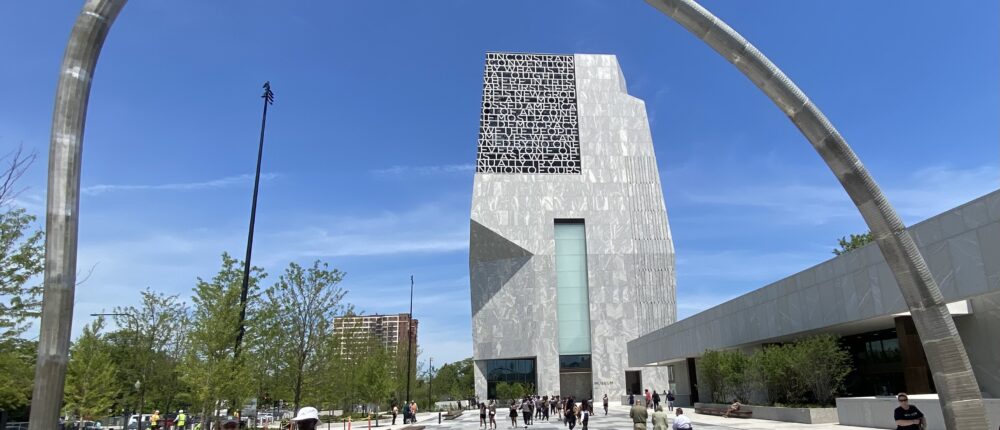
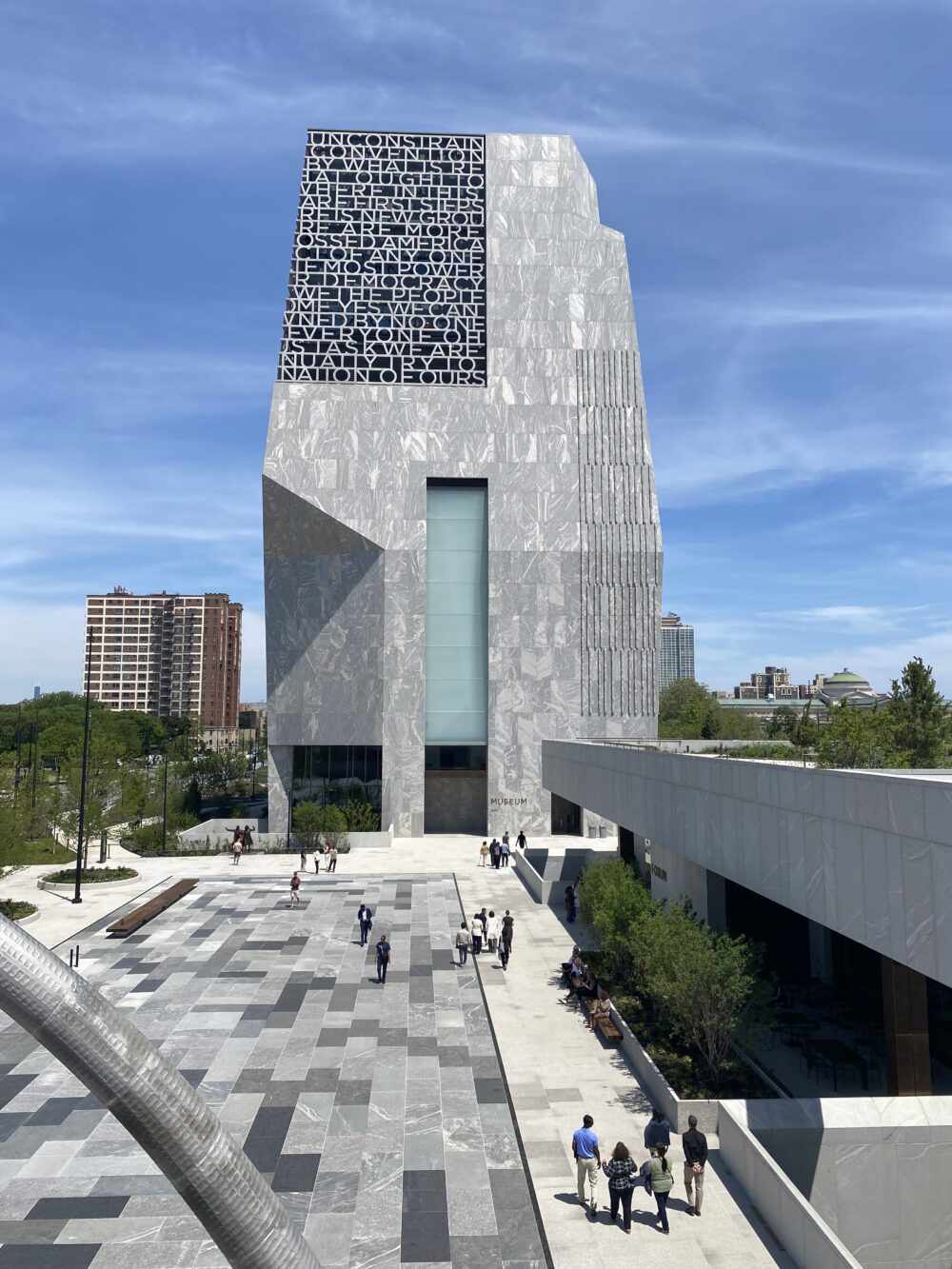
I’m still very mixed: delighted by some outcomes, disappointed by others. To cut to the chase on the museum tower, it is somewhat improved from the initial version. The entrance elevation has a monumental gravitas, a kind of carved, Brancusi-esque appearance that Obama sought from the architects. However—and this is a big however—the other elevations, with their squat proportions and stark, mostly-windowless expanses of stone, range from mediocre to cringeworthy. There’s a great irony in that. The Obama Center is all about teaching the virtues of good citizenship, but these elevations, particularly when seen in tandem, are not good architectural citizens. A building in a park, which is seen in the round, has an obligation to be appealing from all sides. Yet from several vantage points, this one is more Obamasoleum than Obamalisk.
In fairness, though, the tower is far from the only thing that matters here. The center has two other buildings by TWBTA: a small Chicago Public Library branch and a gathering place called the Forum, both low-rises that join with the tower to frame a welcoming plaza. At the complex’s southern end is a flashy indoor basketball court, dubbed Home Court and designed by Moody Nolan. The site is 19.3 acres, much of it revitalized parkland designed by Michael Van Valkenburgh Associates. It’s important to mention that all of these facilities, with the exception of the four-level exhibition space in the museum tower, which requires tickets, are free and open to the public.
And open fairly late. I noticed the hours were 9:00 p.m. for the grounds.
Correct. That accessibility and the porosity of the center—there are no gates, and you can enter the campus from many sides—blows away the early criticism that the center was an Obama land grab. It’s a huge improvement to the public realm, especially to the once-decrepit public realm of Chicago’s South Side lakefront. The center brings nearly $1 billion investment to the South Side: $850 million for the center itself, raised by the Obama Foundation, another $123 million from the city and state for road and other improvements. If we’re going to disparage the negative effects of disinvestment on communities of color, should we not celebrate massive infusions like this and the opportunities they create? To be sure, there are real concerns about displacement and gentrification, but the center may turn out to be Chicago’s most transformative project since Millennium Park, which opened in 2004.
That’s saying a lot.
Yes. However, I said may. We have yet to see how this public realm is received by both visitors and residents of the South Side. There are a lot of unanswered questions. Visitors to the neighboring science museum tend to use it like a shopping mall. They drive in, and then they drive out; they never really flow into the surrounding community. If that happens again at the Obama Center, hopes for revitalization are likely to be dashed.
It doesn’t look like it includes a parking lot.
Actually, there’s a 400-slot parking garage off Stony Island Avenue, the main north-south street bordering the center. It’s covered by parkland, just as the grass and trees of Millennium Park were built over a parking garage and commuter rail tracks. Similarly, the parkland runs over the roofs of the Chicago Public Library branch and the Forum. Unlike the tower, these green-roofed buildings are of the land, not on it. They’re also exquisitely detailed, as you would expect from TWBTA.
Putting the parking under parkland strikes me as a great urban design move.
Absolutely. In addition, the center deliberately located the parking garage so you have to walk outside, through the plaza, to get to the museum and the rest of the complex. Along the way, you’ll likely pass, or pass through, Bending the Arc, a Martin Puryear sculpture inspired by words attributed to Martin Luther King Jr. At once an object and a gateway, it’s one example of the center’s—and the Obamas’—deep commitment to public art. That commitment extends inside to pieces like Mark Bradford’s energetic City of the Big Shoulders in the museum tower’s atrium. The notion that some critics had—that the interior of this building was like a concrete bunker—is garbage. I don’t know what they were looking at.
The center’s public spaces, which include a fruit and vegetable garden, a sledding hill, and a playground, reveal a strong communitarian streak, as opposed to the grand statement about democracy that the tower makes. They’re designed to be part of everyday life, part of the real city, not just the representational city you see in online tourist ads or old-fashioned postcards. In other words, they’re more Jane Addams, the social activist who co-founded Hull House, than Daniel Burnham, the maker of big plans. That’s the community organizer side of Obama—he’s returning to the South Side that gave him his start. Michelle Obama, of course, grew up not far from the center. To their credit, the Obamas haven’t forgotten where they came from, even if the different bearings of the museum tower and its low-rise companions evince an unresolved tension between the center’s bottom-up and top-down impulses.
You talked earlier about the critical reaction. I have not seen the building, but in reading more than a dozen or so reviews, I began to suspect that some of the harsh response was tied up in distinctly less architectural ideas. The building was being made to carry extra baggage. It was tied up in the 10-year long Trump era that directly followed the Obamas, a degree of disappointment that the Obamas haven’t been more politically active, all kinds of things that were somewhat separate from the building. What do you think?
Agreed. A lot of buried frustration surfaced. And a lot of sadness, too. Besides celebrating things like inclusion and legislation that combated climate change, the exhibition floors take us back to a time when the White House’s South Lawn hosted Girl Scout campouts instead of UFC cage fights. You can go through and weep, as many liberals have—the center has even placed tissue boxes in the museum spaces. Or you can go through and say, Oh yeah, Obama had all these hopey-changey things and Trump blew them out of the box, so he wasn’t really a transformative president. In all likelihood, he wasn’t. But that’s a separate issue from the center’s architecture and urban design.
You mentioned in an email about the closing of Cornell Drive, which will knit that site to the rest of Jackson Park in great ways. You said only a figure like Obama was powerful enough to do that. Talk about that.
It’s an obvious urban design move, one that should have been done decades ago; it surely helped to have someone of his stature to pull it off. The initial reaction of many commuters was, Oh my God! You’re going to lengthen my drive by 3.4 minutes! But the center and the city got around such objections by widening a portion of DuSable Lake Shore Drive and upgrading roads and intersections around the center. There has been no carmageddon.
Obama’s audacity cut two ways. On the one hand, closing Cornell improved Jackson Park, adding nearly 4 acres of parkland and replacing all that ugly asphalt with bike lanes and walking paths. On the other hand, it’s clear from a lecture that Tod and Billie gave at MIT several years ago that Obama was the shadow architect of this building. He insisted upon a bold statement, he wanted the tower taller, he wanted it to be Brancusi-like. This created a real struggle for the architects, who typically work from the inside out. Obama looked at the museum tower from the outside in. It’s often said that good architecture is impossible without good clients. But Obama, who wanted to be an architect when he was a kid, may have been too good—or, more precisely, too involved.
Nitty-gritty factors also undercut the tower. Renderings presented in 2019 showed a white marble exterior, which made the tower look less earthbound than the original design. But contractors refused to build with marble because it had failed as the exterior cladding of Chicago’s Aon Center, a 1973 Edward Durell Stone skyscraper, and had to be replaced with granite at great cost. So the architects switched to a gray New Hampshire granite. It’s variegated and veined, it has a nice variety to it, but it does accentuate the heaviness of the building. The proportions are worth mentioning, too. The aspect ratio of this building, height to width, is only 2.4 to 1. Combine those squat proportions and the relative darkness of the granite with the absence of windows, which the exhibition designers demanded, and you have a toxic trio that makes for an often-forbidding exterior.
Or … maybe Chicagoans will get used to it.
That’s an interesting point that Lee Bey raised in your interview with him. Will Chicago make this building their own? There’s a chance that that will happen, much as it happened with the enigmatic Picasso sculpture in Daley Plaza that attracted such controversy when it was unveiled in 1967. It’s possible that people will not only get used to the tower, but take it into their hearts. African Americans, in particular, may see this building as a beacon of hope, an inspiring example of ascension.
When I went through with Tod and Billie, I mentioned a similarity I observed between the museum tower and the National African American Museum. At the building in Washington, you ascend from the dark depths of slavery to triumphant examples of African Americans integrating themselves into, and succeeding in, American culture. Then you view the National Mall through that filigree of bronze-tinted medal that David Adjaye placed on the building, and you see the Mall through a different lens, a lens of African American history.
Similarly, in Chicago, you start in the museum tower with the shoulders that the Obamas stood on—the civil rights movement, the New Deal, etc.—and you ascend to his presidency and then to the top floor’s pyramidal Sky Room. Here, too, you look out through a filigree: the high-strength concrete letters of the Obama speech, “You Are America,” that adorn the top of the south and west corners of the building. Frustratingly unintelligible when seen from street level, they’re easier to understand from this vantage point, thanks to exhibition wall text. I think the view through them will stick with people. It’s a vision of hope, a view of the South and West Sides that people have never seen before. But as we know from Obama’s presidency, hope alone isn’t enough to create transformative change.
So the big, unanswered question is: Now that the center is finally here, what happens in its aftermath? Will the city of Chicago just let things unfold, laissez-faire, and repeat the mixed legacy of the 606 Trail, which led to a wave of high-end development that drove out working families? Or will the city manage change so redevelopment isn’t accompanied by displacement? Already, warning signs are flashing: rising rents and property taxes; apartments being turned into Airbnb rentals, decreasing the affordable housing supply.
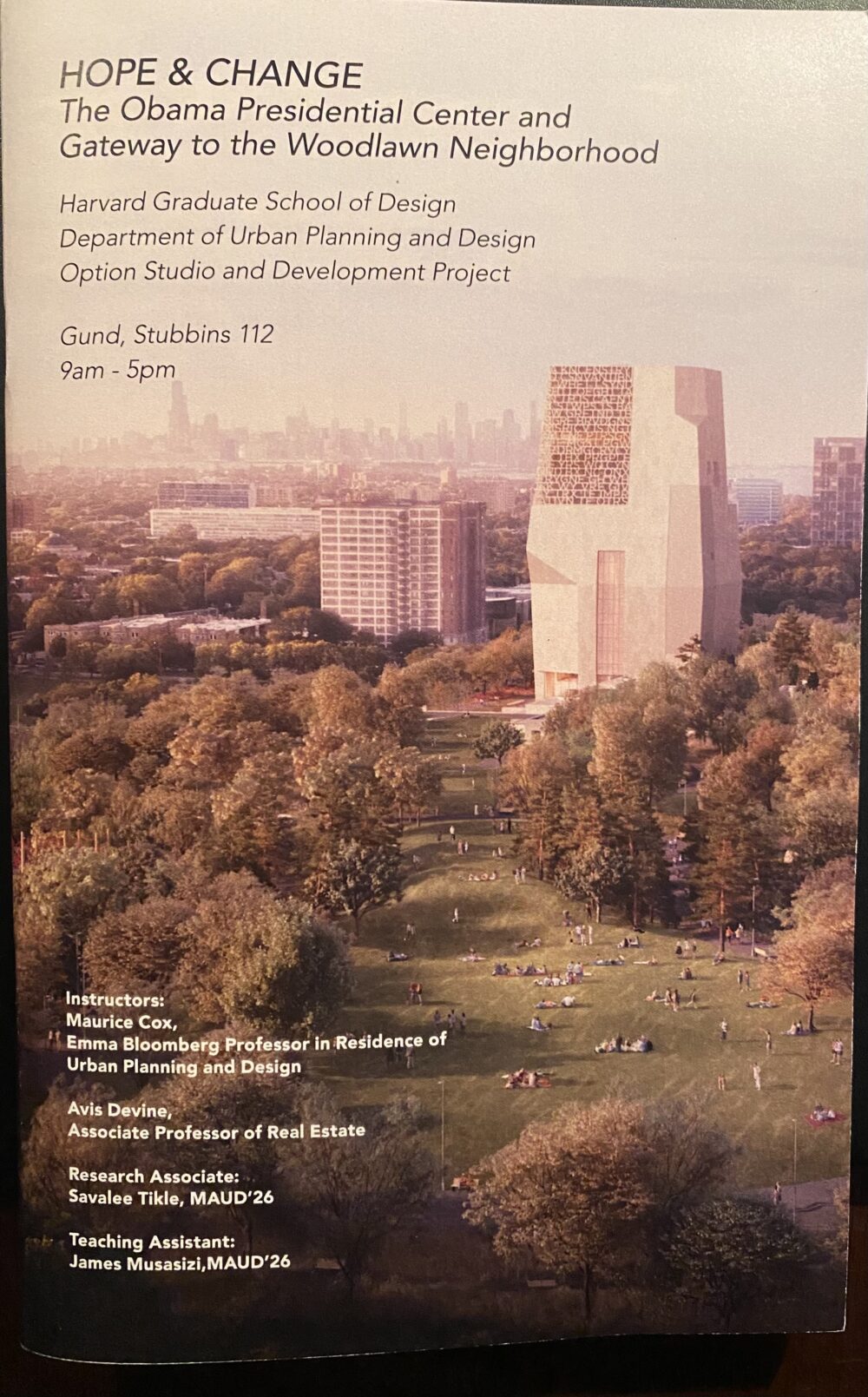
Fortunately, smart people are thinking about these issues. Maurice Cox, the former planning commissioner of Chicago, just ran an urban design studio at the Harvard Graduate School of Design about this very subject. I was on the jury. The students had a range of creative proposals for turning the Woodlawn neighborhood that adjoins the center into a mixed-income, mixed-use, transit- and pedestrian-friendly area. Maurice, to his credit, is looking ahead rather than being reactive. Chances are he’ll make some of the students’ proposals public in the coming months. That’s good. Now that the Obama Center is open, it’s clear that equitable growth must come to the neighborhood it borders. Otherwise, in spite of the center’s vast infusion of capital and uplifting of the public realm, its greatest promise will remain unfulfilled.
All photos by Blair Kamin.