
Build Neighborhoods Around People Instead of Cars
I grew up in a small town in Macedonia where nobody calculated how long it would take to get somewhere. You walked to school without your parents, went to the store on foot, stopped to talk to your neighbors on the way back. The distances were short enough that daily life just happened: spontaneously, continuously, without a plan. People were close to each other because the place was built in a way that made closeness inevitable.
When I moved to the western suburbs of Chicago, something shifted that I didn’t have words for yet. Every time I stepped outside my apartment door, my first thought was: How long will this take to drive? My daily life reorganized itself around the commute. Home to car to destination, destination to car to home. The street outside wasn’t a place to be; it was a corridor to move through as efficiently as possible. I barely knew my neighbors—not because any of us were unfriendly, but because the design of the place made spontaneous human contact nearly impossible. You don’t run into people when you’re inside a vehicle. You don’t stop to talk when there’s nowhere to stop. That’s the quiet price of the American suburb that nobody puts in the brochure: the address is real, the community isn’t.
The craving for something different eventually won. I moved to downtown Fort Lauderdale, and within weeks I recognized something I hadn’t felt since Macedonia: the day organizing itself around proximity instead of the car. The grocery store is a block away; I walk there with a shopping cart. I run into people on the street without planning to. Daily interactions happen naturally, the way they’re supposed to—not because I scheduled them, but because the distances are short enough that life overflows into the sidewalk.
These three places—a small Macedonian town, a Chicago suburb, a South Florida downtown—taught me the same thing from three different angles. The quality of daily life is not mostly a function of income, taste, or personality, but one of distance. How far is the store? How far is your friend? How far do you have to go before you interact with people? Those numbers, more than almost anything else, determine whether a community feels like a community or a collection of addresses.
So my question is a simple, but profound, one: What if we built neighborhoods around people instead of cars? Not as a thought experiment, but as an actual design proposal.
What would a suburb look like if it rejected the standard American grid, organized itself around organic growth patterns, and placed human connection at the center of every design decision instead of at the margins?
In the 1980s, urban researcher Donald Appleyard did something deceptively simple. He studied streets with different levels of traffic and measured the social lives of the people who lived on them. On a street heavy with traffic, residents averaged 0.9 close friends. On a low-traffic, quiet street, they averaged 3+.
The volume of cars moving past your front door determines how many close friends you have. Not your personality. Not your schedule. The infrastructure.
Jeff Speck made the extension explicit in his 2012 book Walkable City: we’ve deliberately designed the useful walk out of American communities. When walking doesn’t serve a practical purpose, people stop doing it. When they stop walking, they stop moving. The health consequences of this are not abstract: a third of people born after 2000 are projected to develop diabetes, not because of personal choices, but because their built environment quietly removed the daily physical activity that had been embedded in the lives of previous generations.
The researchers behind Ikigai, a study of the world’s six Blue Zones—regions where people routinely live past 100—found 10 shared traits. Staying active was the first. Belonging to a tight community was the fourth. In a walkable neighborhood, both of these things happen on their own, without optimization. You go outside. You run into people.
We built suburbs that make both of them structurally impossible. The suburb was not always a bad idea. Before the car, it worked differently. Lewis Mumford observed that as long as railroad stops and walking distances controlled suburban growth, the suburb had form. Homes were close enough to the station to walk to. The neighborhood organized itself around the distance a person could travel on foot.
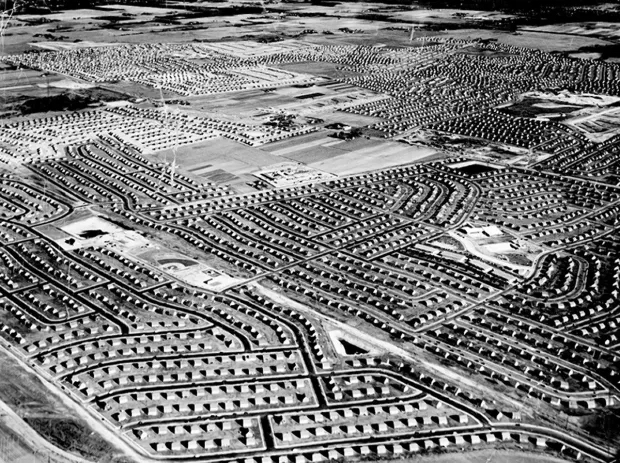
Then came Levittown, built after World War II in 27 assembly-line steps, extraordinarily affordable, and exactly what a housing-starved nation needed in 1947. The homes faced the backyard. The street belonged to traffic. Walkability wasn’t the point.
This wasn’t a design error. It was a postwar response to a housing crisis. The error was deciding it should be permanent.
To understand how deep this problem runs, consider what happens when researchers try to identify America’s best suburbs. Niche, a data-driven research company, ranks the country’s most liveable suburbs every year, rating each across cost of living, school quality, crime rates, employment opportunities, and amenity accessibility. The suburb that topped its best-place-to-raise-a-family list, Clarendon Hills, Illinois, scores high on every metric we say matters: safe, affordable, excellent schools. It is, by every conventional measure, exactly where you’d want to live.
Its historic center scores 75 on Walk Score—genuinely walkable—but the suburb as a whole scores 20. The walkability is real, but confined to a small core; the residential neighborhoods where most people actually live remain entirely car-dependent. One of the best suburbs in America is only walkable in the few blocks where almost no one lives.
What I call the New Suburb, by contrast, rejects the grid. Instead of the standard American suburban pattern—rectangular blocks, arterial roads, cul-de-sacs—it grows organically, using a Voronoi framework that mirrors how communities actually form: around natural corridors, water systems, and shared gathering points. The town expands in phases, with ecological infrastructure laid first and density growing around it, rather than roads laid first and everything else squeezed in afterward.
The formula is People + Nature − Cars, applied at three scales.
At the town scale, no private cars enter the neighborhood. Path infrastructure serves pedestrians and cyclists only; cars remain at the perimeter. A two-tier street network replaces the standard road hierarchy: a primary transit spine with tram service connecting the major districts, and a green mobility corridor at the neighborhood level—wide enough for cycling and walking, lined with trees, dimensioned for people rather than vehicles.
At the sustainability scale, the site I choose to study is Pinecrest, Florida, a top-rated South Florida suburb that is also, per NASA flood projections, at serious risk from sea level rise by 2050. The design I propose relocates it 6 miles inland and rebuilds around the principles of the new suburb, with solar integration on every rooftop, hydroponic food systems that double as public market infrastructure, and homes elevated on adjustable stilts to adapt to changing flood conditions.
At the community scale, homes are built around functional needs rather than real estate aesthetics: curved forms that reduce wind loads, living walls that grow food and insulate as well, open interior layouts that adapt rather than fix how a family uses space. Short paths between homes create conditions for casual human connection. Green corridors between residential blocks function as parks and cycling lanes. Farmers market, town hall, day care, entertainment center—all within walking distance of every front door, all connected by paths instead of roads.
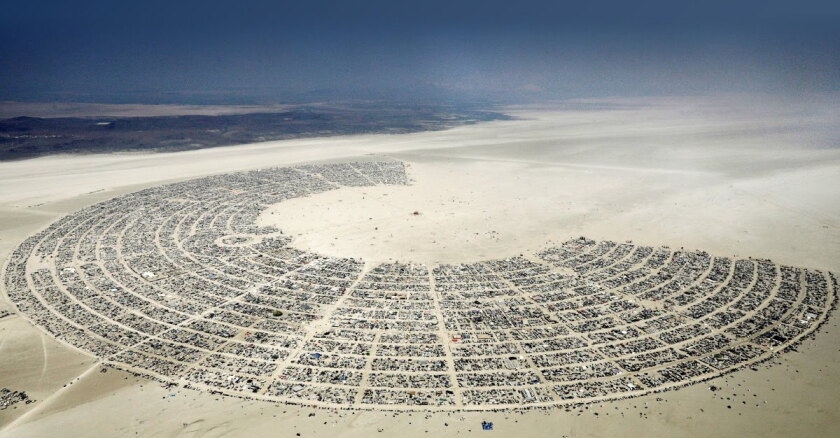
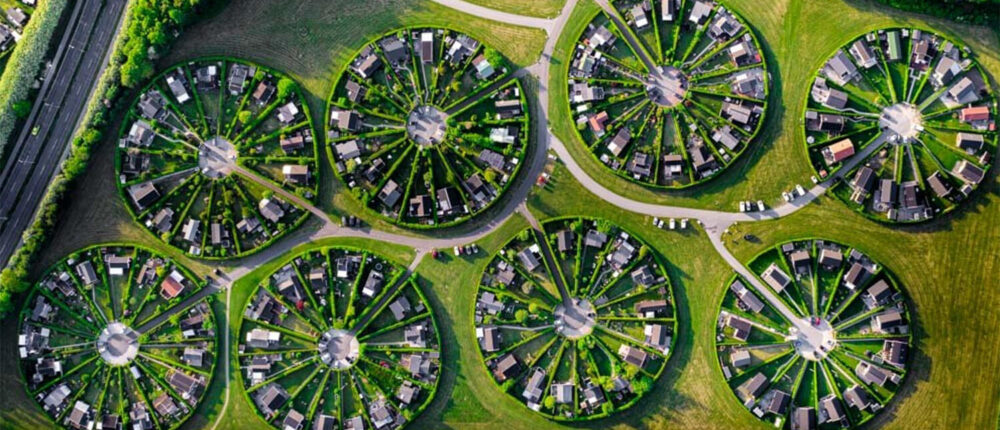
I didn’t design my study without looking for proof that it works. Three existing communities had already made this choice, in three different contexts. Brondby Garden City, outside Copenhagen, has organized single-family homes in circles around shared communal hubs since the 1960s—the circular design was intentional, built to encourage neighborhood interactions—and still functions as a real community. Black Rock City, the temporary Nevada settlement built annually for the Burning Man festival, bans driving within its boundaries and hosts 50,000 people across 4 square miles entirely on foot and by bike. And Pontevedra, a Spanish city of roughly 80,000, pedestrianized its entire center starting in 1999—with measurable results that should end the debate: carbon emissions down nearly 70%, no traffic deaths since 2011, and 80% of children aged 6 to 12 walking to school on their own. Its population grew while comparable cities in the region shrank. One built from scratch in the 1960s. One temporary and annual. One a real, midsize city that simply decided to take its streets back. All three made the same decision: people—not cars—organize the community.
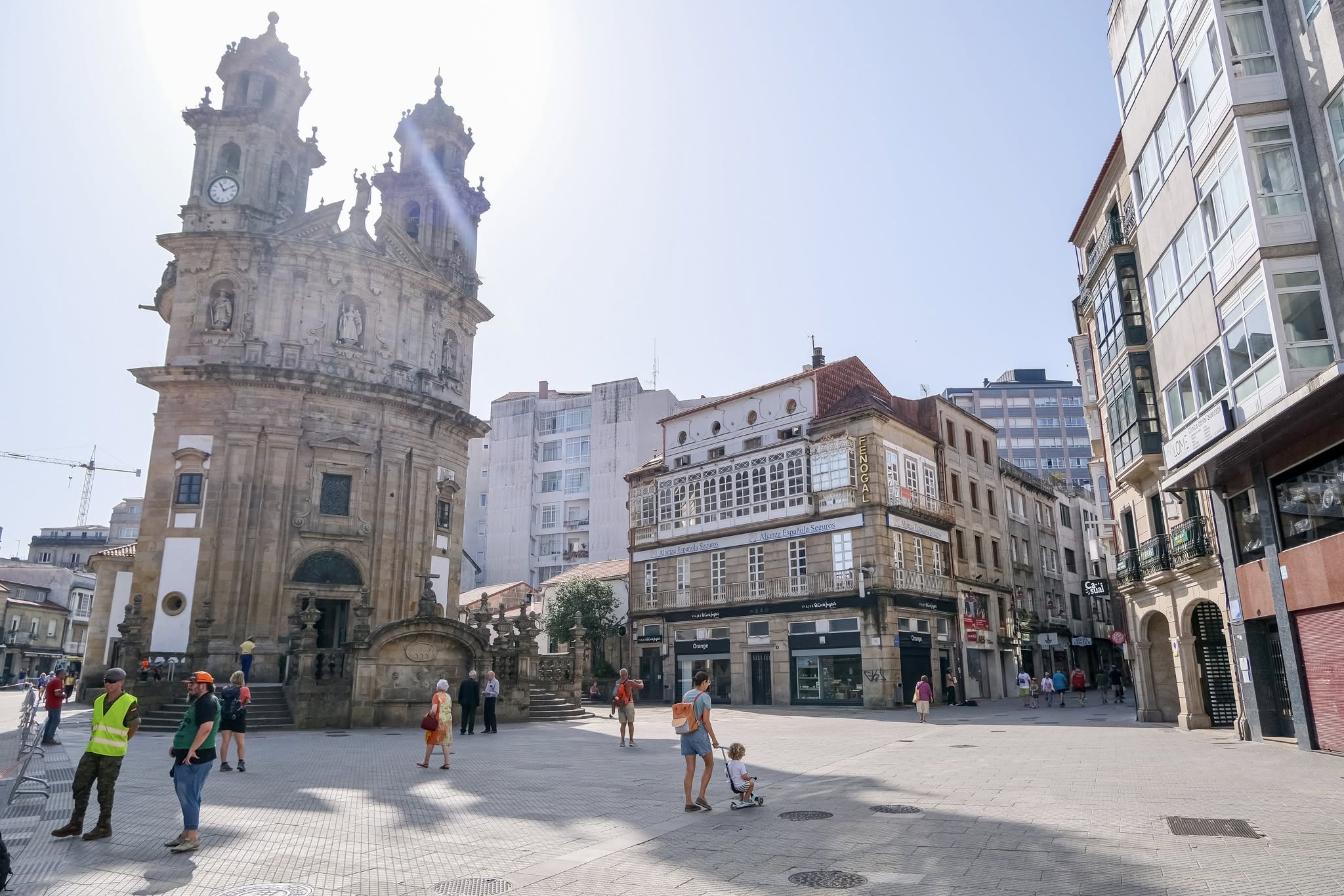 Pontevedra, in Spain, pedestrianized its entire city center in 1999 and saw its population rise while carbon emissions declined. Photo by Chris & Melissa Bruntlett (@moacitylife).
The argument for rethinking how we design suburbs is usually made on environmental grounds: sprawl is wasteful, carbon-intensive, land-hungry. This argument is correct, but it keeps the stakes at a distance, somewhere abstract.
The stakes that aren’t abstract are the ones at the scale of a single life: the commute that eats two hours a day for decades; the neighbor three doors down you’ve never spoken to because you’ve never been in the same place at the same time without a car between you; the kid who can’t go anywhere alone because every destination is a 30-minute drive. The design of a place doesn’t just shape how you get around—it shapes how many friends you have, how much you move, how connected you feel to the people around you.
Appleyard proved this in the 1980s, and the numbers haven’t changed, because the suburbs haven’t changed. A street heavy with traffic produces fewer friendships, less movement, and more isolation. This is a design outcome, produced by design decisions, and it can be reversed by making different ones.
South Florida sharpens the urgency. The coastline is already losing ground to sea level rise, and the inland redevelopment that will follow isn’t a distant scenario, but an active planning question. The land that gets built next can be built as more of what already exists, or it can be built as something that genuinely works for the people who will live in it for the next hundred years.
A child should be able to walk to school, not as a metaphor, not as a policy aspiration, but as the default condition of every neighborhood we design from this point forward. That kind of daily life—spontaneous, connected, carless—is not a European luxury or a small-town memory. It’s a design decision. We just keep making the wrong one.
Featured image: Brøndby’s Circular Garden (Brøndby Haveby), Copenhagen, Denmark. Photograph by Henry Do