
Coastal Adaptation Is at a Carbon-Intensive Crossroads
As coastal communities across the U.S. accelerate investments in climate-adaptation infrastructure, a critical question has emerged: Are we inadvertently worsening the climate crisis through the very solutions designed to address it? A groundbreaking new study from Harvard’s Salata Institute, “The Carbon Cost of Coastal Adaptation,” reveals that traditional “gray” infrastructure—concrete seawalls, steel bulkheads, and engineered fills—often carries a massive embodied carbon footprint that undermines long-term resilience goals, while nature-based alternatives can deliver superior performance at a lower cost and with dramatically reduced emissions.
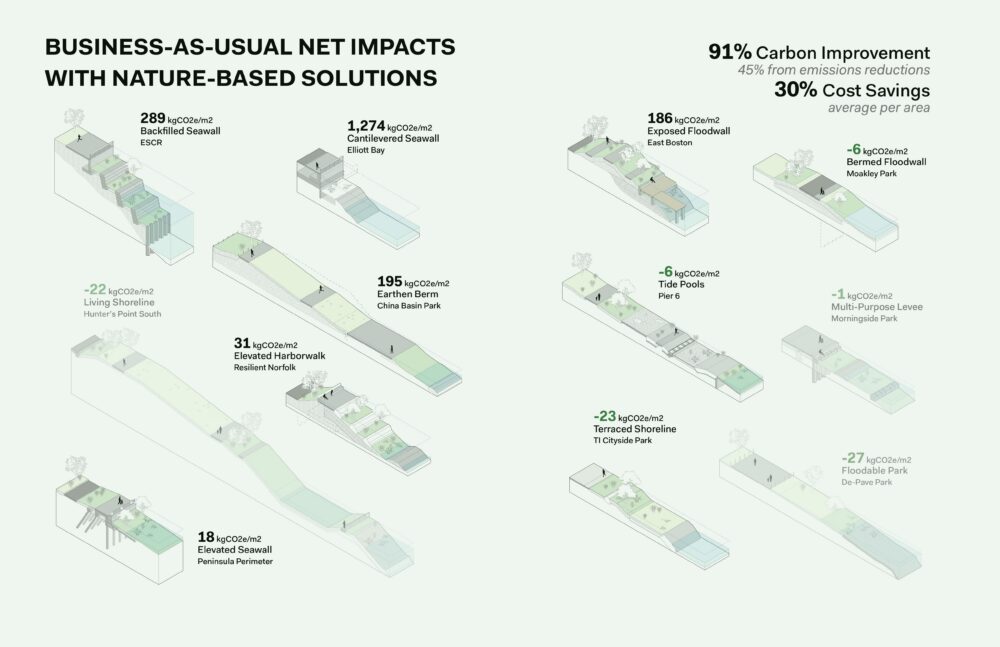
Architecture 2030 senior fellow and founder of the Climate Positive Design consultancy Pamela Conrad led the research behind the study, which analyzed over a dozen U.S. coastal projects using a new performance-based methodology. The findings are striking: nature-based solutions delivered up to 91% lower embodied carbon and averaged 30% cost savings compared with conventional approaches. I sat down recently with Conrad to discuss what this means for designers, policymakers, and coastal communities navigating the urgent need for adaptation that protects both people and the planet.
VM: Vincent Martinez
PC: Pamela Conrad
The new Harvard study challenges some prevailing assumptions about resilience. What prompted this research?
Coastal adaptation is accelerating across the U.S., but we rarely account for the carbon footprint of the solutions themselves. Traditional “gray” infrastructure—seawalls, bulkheads, revetments—relies heavily on concrete, steel, and large-scale fill, which can carry enormous embodied carbon. Through this research, prompted by my work on coastal adaptation projects as a landscape architect over the last decade, we wanted to quantify that impact and test whether lower-carbon approaches could also be cost-competitive. The answer, encouragingly, is yes.
What were the most surprising findings?
Two things stood out. First, lightweight fills—often assumed to be efficient—can be disproportionately carbon intensive. While they help reduce settlement on shorelines, they are often composed of materials like cellular concrete and synthetic geofoam made from hydrocarbons which carry a significant emissions burden. Second, Nature-based Solutions consistently outperformed conventional systems in both carbon and cost metrics. Across the case studies analyzed, nature-based approaches delivered up to 91% lower embodied carbon and were, on average, about 30% less expensive. That reframes the resilience conversation entirely.
How did the team measure these impacts?
We developed a performance-based methodology that integrates life-cycle assessment using Pathfinder with cost analysis, applied to more than a dozen built or proposed U.S. coastal projects. Instead of looking at carbon or cost in isolation, we evaluated tradeoffs holistically: materials, construction, long-term performance, and ecosystem benefits. This provides decisionmakers with clear, comparable data at the project scale.
How does this methodology work in practice? If we were to evaluate a proposed seawall project versus a living shoreline alternative, what might that comparison reveal?
The earlier the analysis begins, the more impact it can have. During planning, interdisciplinary teams—landscape architects, engineers, ecologists, and architects—should work with communities and clients to clarify priorities: what must be protected, and what can adapt or evolve. From there, the team can develop multiple adaptation typologies and evaluate their carbon, cost, and performance outcomes before selecting a final design.
When comparing a seawall to a living shoreline, the results can be revealing. In some contexts, a seawall may still be necessary. Even then, its carbon footprint can be significantly reduced through cement substitutions, recycled steel, and lower-carbon fill alternatives. The methodology doesn’t dictate a single solution; it quantifies tradeoffs so decisions are intentional rather than assumed.
The study compared gray infrastructure with nature-based alternatives across multiple projects. Which comparison was most revealing, and what did it show about the real-world tradeoffs communities face?
Practitioners know that Nature-based Solutions [NbS] often require more space. The question is: how much, and is it truly prohibitive? On average, the study found that just 12 additional feet of width enabled substantial carbon and cost savings. In some places, that may feel significant; in others, it’s negligible. Either way, it’s rarely a deal-breaker. The findings suggest NbS should be rigorously evaluated as a first option, rather than dismissed early due to assumed spatial constraints.
Why does embodied carbon matter so much in adaptation work?
Adaptation is meant to reduce climate risk, but if we build high-carbon infrastructure to do it, we exacerbate the problem we’re trying to solve. Embodied carbon is front-loaded: it happens now, when we most urgently need to reduce emissions. Coastal projects are often massive in scale, so their material choices have outsized climate implications.
What role do nature-based solutions play in shifting the paradigm?
Nature-based Solutions—living shorelines, restored wetlands, hybrid systems—work with ecological processes rather than against them. They can attenuate wave energy, build sediment, and adapt over time. But equally important, they use fewer carbon-intensive materials and provide co-benefits: habitat, water quality improvements, recreation, and community well-being. When we account for all that value, they’re not just environmentally preferable—they’re economically compelling.
What practical changes should designers and policymakers make tomorrow? Are there specific policy mechanisms, procurement requirements, or design standards that would accelerate this shift?
First: Require embodied carbon analysis in coastal adaptation planning. Second: Prioritize material efficiency and low-carbon alternatives at the earliest design stages. Third: Treat Nature-based Solutions as the default starting point, not the add-on. At the policy level, municipalities could adopt carbon caps or infrastructure carbon codes, similar to emerging building performance standards. Procurement requirements that mandate life-cycle assessment would further accelerate change. This study provides a credible foundation for establishing those limits.

What are the biggest barriers you’ve encountered in getting these changes adopted, and how can they be overcome?
The first barrier is awareness. For decades, the U.S. has relied on heavily engineered hydrologic systems. These approaches are familiar, codified, and extensively quantified, which makes alternatives seem uncertain by comparison. Although Nature-based Solutions are well-established, they are not yet widely understood across the full design and engineering community. Today, we have the analytical tools to close that knowledge gap.
The second barrier is timing. Landscape architects—who are trained to design with ecological systems—are often brought in too late to influence core infrastructure decisions. Involving them early can reframe the problem from the outset, avoiding costly redesign and opening the door to lower-carbon, higher-performing solutions.
What gives you optimism?
The data. Once you quantify performance, the case becomes clear: We don’t have to choose between protection and planetary health. We can design coastal infrastructure that safeguards communities while dramatically reducing emissions—and often save money in the process. That alignment is powerful.
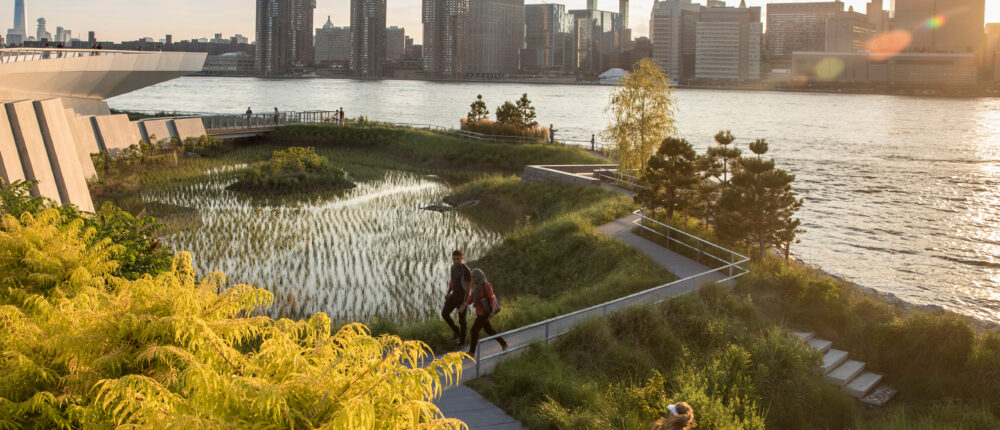
Featured image: Hunters Point Park South, Queens, New York. Designed by SWA/Balsley. Photo: David Lloyd.