
Learning to Reject the Transactional City
Thirty-five years ago, I graduated from the Massachusetts Institute of Technology (MIT) as part of a small cohort of Mexican American students. We were few in number, but we carried big questions about identity, belonging, and our responsibility to the communities that shaped us. That cohort has stayed connected. Today, we organize through Avanza, an all-volunteer nonprofit founded in 2011 by Mexican-American alumni of MIT and their friends. The organization promotes higher education in underserved communities. Each year, we visit Latino communities to speak with high school students about the power of education not just as a pathway to income, but as a pathway to agency.
This year, we were in Salinas, California, the lettuce capital of the country, which is sustained largely by Mexican farmworkers. Many of the students we spoke with are first-generation Americans, college-bound, preparing to embark on a lifelong journey similar to the one I began more than three decades ago. They will be asking many of the same questions and grappling with the same feelings of belonging.
Here’s my story: I decided to study city planning at MIT because I liked cities, not because I wanted to fix them, as many of my cohort did. Nor did I have strong opinions about cities or a clear understanding of how they worked. That naivete allowed me to take a different path. Instead of focusing on policy, data, and maps, I chose to study my feelings toward cities.
In Professor Gary Hack’s introductory urban design class, he spoke about the “good city” and the “bad city,” drawing examples from across the globe. But he never mentioned Latino communities in the U.S.—or, if he did, it was only in a negative light.
That was the moment I decided to examine my own community and, more important, myself as a product of it. I was fortunate to be studying in the late 1980s, when there were still vestiges of more radical planning ideas lingering in the halls of academia. Professor Lisa Peattie, an anthropologist who had lived and worked in Latin America, had written critically about the failures of American urban planning in South America. She was also interested in Latinos living in the U.S.
We worked closely together, and she guided me through my thesis-writing journey. She would often say, “Write what you know.” I was not fully prepared for the academic rigor of graduate school, but her approach gave me the confidence I needed to trust my own voice, even if it began as what I called my “chicken-scratch journal.”
For reference, I turned to a body of research that emerged in response to postwar America’s rapid suburban expansion. Scholars and writers were trying to understand and describe the feeling of places that were being lost to a more rational, transactional city, one that was steadily consuming the American landscape and emptying out the urban core (and, to some extent, still is).
With this support, I was able to examine Latino uses of space and situate them within U.S. planning practice. I began to see that there were two fundamentally different ways of understanding the city: one relational and lived, the other regulatory and transactional. A conventional planning analysis of East Los Angeles would focus on maps, census tracts, income levels, housing conditions, gang activity, and violence, producing a narrative of deficiency and decline.
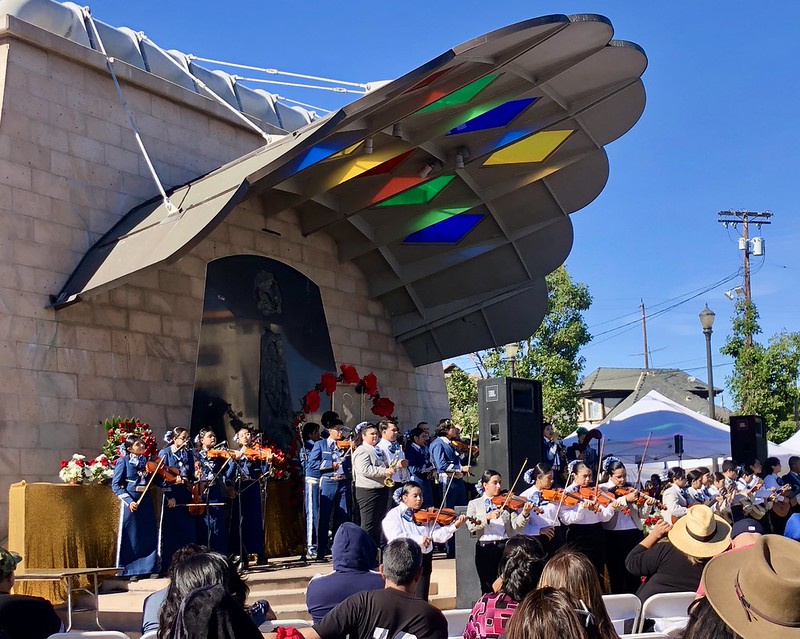
But that was not the city I experienced. I lived in a place filled with social life, neighbors talking across fences, front yards doubling as living rooms, informal economies unfolding on sidewalks, music spilling into the streets, and constant acts of care and adaptation. What looked like disorder through a regulatory lens felt like vitality from within. The data might describe what was lacking, but it failed to capture what was present: resilience, creativity, and a deep sense of belonging. I wanted to tell that story not to deny the challenges, but to insist on a fuller, more human account of the place I called home.
During my time at MIT, I also witnessed how data could be shaped and interpreted in different ways, often reinforcing the regulatory view of the city while overlooking lived experience. After two years of making observations, drawing diagrams, and taking photos, I completed my thesis: The Enacted Environment: The Creation of Place by Mexican and Mexican Americans in East Los Angeles. Latino communities create meaning through proximity, improvisation, art, ritual, and storytelling. These spatial practices are rarely captured in zoning codes or general plans, yet they are central to how neighborhoods actually function and feel. From that foundation, I developed an alternative approach to urban planning grounded in relationship-building rather than “highest and best use.” Instead of treating land as a commodity to be optimized, this approach treats place as a social and emotional ecosystem.
By observing the creative strengths of Latino communities—their art, memory, narratives, and collective gatherings—I developed a largely nonverbal method for examining how a place feels. Participants use their hands to build models of memory, belonging, fear, aspiration, and joy. Through making rather than debating, they reveal emotional truths about space that conventional public meetings rarely surface.
This work evolved into a replicable methodology and is explored in my book with John Kamp, Dream Play Build (Island Press, 2022), which documents how tactile storytelling can reshape community engagement and urban planning practice. Rather than asking, What should be built here?, the deeper question becomes, How should this place feel, and who does it allow us to become? Education gave me the space to formalize and develop this alternative approach to city planning. It gave me the confidence to ask that question and to build a career around answering it.
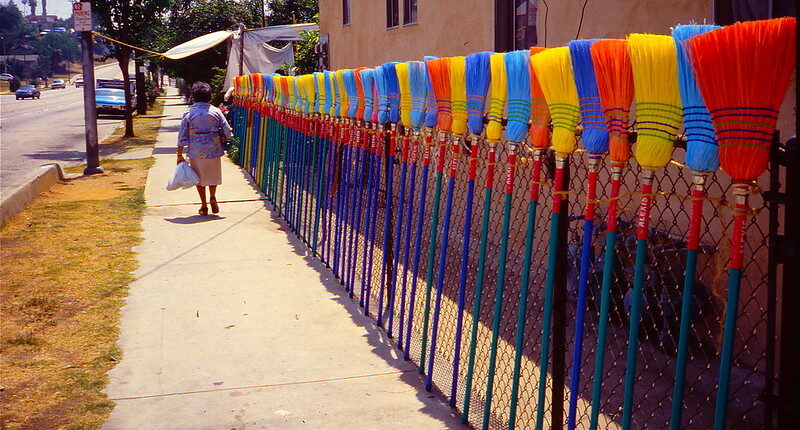
A note by the author on the featured image: “For years, a woman artistically arranged and sold her brooms on the corner near my grandmother’s house in Boyle Heights. What might appear as a simple act of street vending was, in fact, a form of informal urban design; her presence softened the street, created watchfulness, and made the public realm feel safer and more humane.” All photos by the author.