
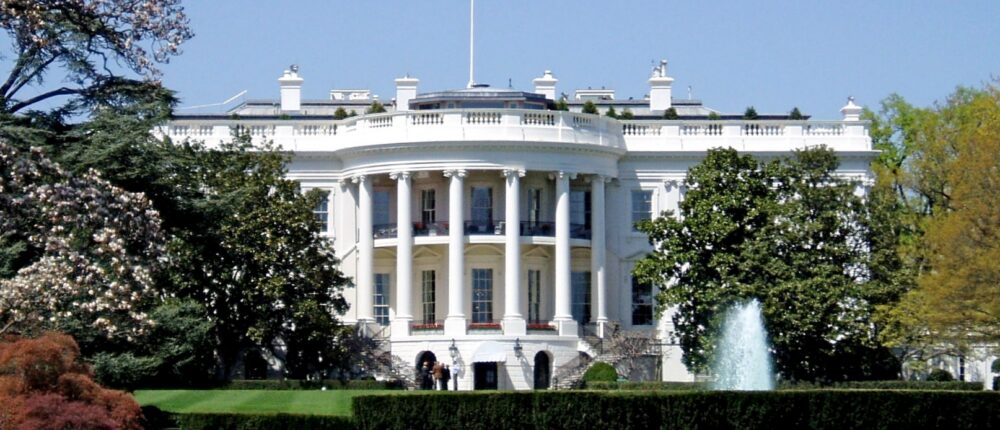
Trump’s Proposed White House Expansion Debases Classical Architecture
Architecture critic Paul Goldberger is one of many who have raised their voices in alarm at the way President Trump is proposing to alter and add to the White House. There is much to agree with in his recent op-ed in the New York Times offering a robust critique of Trump’s attitudes toward architecture and the city. Goldberger—rather too glibly, I would say—compares the current administration to the Italian dictator Benito Mussolini (ruled 1922–1943), another megalomaniac who was determined to alter the face of the greatest of all cities in the name of a distorted classical ideal. Mussolini demolished entire medieval neighborhoods (displacing hundreds of residents) to expose the ruins of ancient Roman forums and constructed massive new buildings projecting the power of the regime. We can imagine with Goldberger that the current U.S. president may look upon such irresponsible destruction with pure envy.
There are, of course, some important differences: Mussolini, unlike Trump, had the advantage of a contemporary building culture that could raise new buildings and neighborhoods of exceptional quality, including social housing that is now the envy of rich Romans, who pay handsomely for apartments their grandparents would have been grateful to receive from the state. Mussolini’s taste preferred the modern, not the classical (and “historical styles” were prohibited by a government decree in 1938), and he was not fond of gilding but instead preferred local marble, brick, and travertine. His architects were master designers who made hundreds of fine buildings, excellent urban design, and even the initial line of the Roman subway. (A recent book illustrating the architecture of the time is The Other Rome: Building the Modern Metropolis 1870-1960 ) As the late Italian art historian Philippe Daverio noted, art and architecture were the only good things to come from the fascist era in Italy. Will we be able to say the same for the period we are living through now?
The “official” architecture we have seen so far—the ballroom, a proposed triumphal arch, and suggested modifications to the original White House—reveal an adolescent’s enthusiasm for the classical that is clearly not backed up by actual knowledge or even competence.
I fear not, for the simple reason that the “official” architecture we have seen so far—the ballroom, a proposed triumphal arch, and suggested modifications to the original White House—reveal an adolescent’s enthusiasm for the classical that is clearly not backed up by actual knowledge or even competence. One need only look closely at the current design for the ballroom project to see not just an out-of-scale mass plunked down with indifference to the elegant preexisting landscape, but a building whose Corinthian columns seem to have been placed with no other criterion than “the more the better.” The faults of this building’s design have been pointed out in a detailed presentation created by the National Trust for Historic Preservation, so I will not enumerate them here. Truthfully, there is no excuse for these lapses, given the presence in Washington, D.C., of exemplary projects that might have shown the current architects how to do it. In addition to an extensive literature spanning centuries, I could also suggest my book, The Architecture of the Classical Interior (2004), as a useful guide.
While architecture is less important than world peace and the survival of humankind (though these are also threatened by this president and his followers), it, too, is in danger, and the consequences could be quite serious for our historic monuments and for our discipline. To those of you who consider yourselves classical architects and who are working directly or indirectly for the Trump administration, I say: Some of you are esteemed professional acquaintances of mine of many years’ standing; some of you are my former colleagues or students. Whatever your academic or professional status and whatever your political alignments, I appeal to you to distance yourself now from the federal government, as long as it continues to threaten our architectural heritage and promote a false version of classical architecture.
If you do not act now to defend the values of democracy and heritage conservation, classical art and architecture will be associated with the evils of this administration long after it has left the stage.
I am asking you to step aside now because if you continue to be associated with the current government, you risk not only irreparably damaging your professional career and personal credibility, but you also risk destroying historic monuments and the classical culture that has seen a resurgence over the last several decades. If you do not act now to defend the values of democracy and heritage conservation, classical art and architecture will be associated with the evils of this administration long after it has left the stage, setting back all the progress we have made.
Those of you who love and have worked to create beautiful buildings and cities, make sure that you are building justice at the same time, by which I mean promoting the rights and dignity of all people, ensuring their equality under the law, and working for the health of the institutions that articulate, mediate, and coordinate the powers of the state. If we do not want to see classical buildings equated with authoritarianism, then surely it is up to us to see that they do not serve authoritarian interests in our own time. The same is true with the environmental dimension: Promote sustainability in the built world because climate change is real, whatever some politicians may say. The best way for architects to oppose it is to build buildings that will stand for centuries, not just decades. The new Vitruvian trinity that defines good building is beauty, sustainability, and justice, and these are the values that we should be defending.
And to those of you who have remained uninvolved with the current administration, it is time for you to join me in speaking out and letting everyone know that classical architecture is not owned by any one political party or set of policies. Nor is it a matter of sticking columns onto bland boxy buildings or switching capitals of one order for another on a national monument. The classical way of building is an art form and a discipline thousands of years old, and it deserves respect. I call on all of you to defend the classical as the architecture of democracy and traditional urbanism as the means to create a public realm worthy of a free people. Do not remain silent. Take back classical architecture now.
Returning to Goldberger’s essay: We need to stop the cliches about classical architecture and slavery, autocracy, and other ills. It’s not the fault of classical design that dictators, slaveholders, and war criminals have used it. What style have they not used? And what about the progressive and democratic societies that chose the classical as the vehicle for building according to their values? All styles of architecture have been patronized by political powers of all kinds, some with blood on their hands, and others with more benign motives, even if the realization of higher ideals has been mostly incomplete at best. Insofar as it was created by and is used by people, classical architecture is subject to the same capacity to advance either good or evil as any other human construct. And please do not suggest that modernism is immune from associations with nefarious regimes or disregard how its global model of development fuels climate change and legitimizes repressive ruling elites around the world.
Rather than looking into the past and condemning art forms because of who used them, why don’t we simply reclaim what is beautiful, useful, and decent in historical experience, making new associations and striving to fulfill the promise of the ideals of classical humanism that we find, inchoate and wounded as they may be, in our artistic traditions. What should matter to us is not what someone in the past did with columns and arches, but what we can do with them to build a more beautiful, sustainable, and just society. At the same time, let’s use the classical language with taste, tact, and restraint, paying respect to the work of those who left behind the classical monuments we now cherish.
Featured image: south facade of the White House, via Wikipedia Commons.