
UVA’s Dean Search: A Chance to Restore a Lost Education
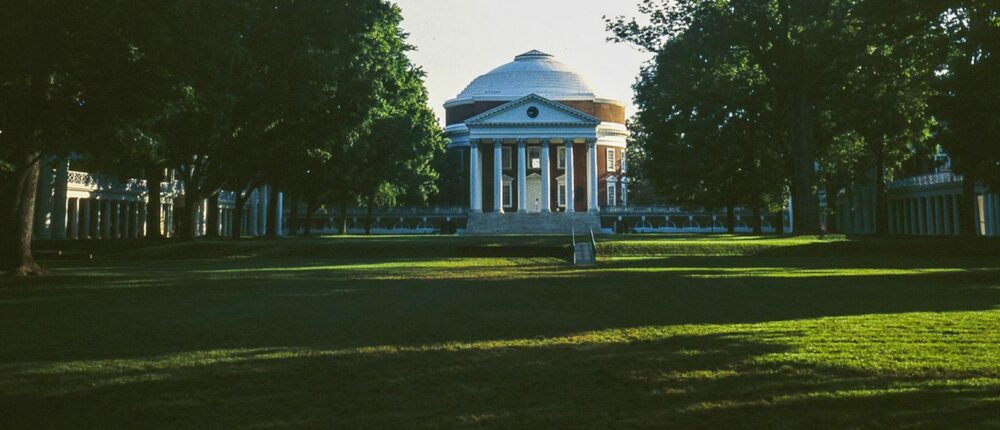
In the summer before my senior year of high school, I walked the Lawn at the University of Virginia (UVA) for the first time. Like tens of thousands of students before me, I was captivated by the Rotunda. More than two centuries after its construction, the Lawn continues to inspire and uplift the spirits of students, attract international visitors, and serve as the symbol of the university.
Standing there, I felt connected to generations of UVA students and the builders, craftsmen, and enslaved laborers whose work made the university possible. This experience changed the course of my life. I decided that I wanted to create buildings that could inspire people across generations in the same way Thomas Jefferson’s design for the Lawn inspired me.
Naturally, the UVA School of Architecture became my first choice. When I finally arrived there, I expected to learn the principles of design used in the Lawn, which continues to resonate with people, and how architects throughout history built upon the work of those who came before them. Instead, I discovered a tension I had not anticipated.
Almost all students enter architecture school without a predetermined design philosophy, but I arrived with one. I was fascinated with traditional architecture because I wanted to understand why certain buildings, streets, and cities are loved for centuries while others fall out of favor.
By “traditional architecture,” I mean the broad building culture that shaped cities and towns before the Industrial Age. This is a culture rooted in local materials, craftsmanship, and accumulated wisdom passed down over generations. Architectural theorist Léon Krier, winner of the Thomas Jefferson Foundation Medal Award, divided traditional architecture into two mutually dependant parts: vernacular architecture, the ordinary houses, shops, and streets shaped by local custom; and classical architecture, the more formal civic and public buildings governed by proportional ratios found in nature and the human body.
For my final project of my first semester, I designed a small building inspired by historical precedent. When I presented it, my professor told me that the school was fundamentally a modernist institution and that my proposal was “going against the grain.” To her immense credit, she added that she admired students willing to do so. Nevertheless, I found myself encouraged to make the design more unconventional.
The following semester, I encountered similar reactions. One professor, upon seeing columns on my project, suggested that classical architecture “represents whiteness” and “lacks creativity.” Another compared designing classical buildings today to asking people to read Mesopotamian cuneiform instead of a printed book. At an event outside the school, I was told by an architect with the University Office of the Architect, in charge of new buildings, that people no longer identify with the architecture of the Lawn because of the historical realities surrounding its construction.
I did not share these views, but neither did I want to dismiss them. Instead, I wanted to understand where they came from. So I began reading. I read about the rise of modernist architecture in the 20th century and the educational reforms that accompanied it. I learned how a generation of architects both taught and sought to break from historic precedent in order to express new technologies, new materials, and social ideals. I appreciate many aspects of this tradition, especially innovation and experimentation.
Yet I still found myself asking a simple question: Why should innovation require forgetting the accumulated design wisdom of the last 5,000 years of architectural history?
In the stacks of the Fiske Kimball Fine Arts Library, I discovered a different story about architectural education at UVA. I learned about Fiske Kimball, the school’s founding dean, a classical architect, and an influential architectural historian. I learned about the late UVA professor Mario di Valmarana, whose family owns Palladio’s Villa Rotonda and who famously challenged a student by asking, “What would Bernini do?” I learned about former dean Jaquelin Robertson, who encouraged and taught students to engage historic precedent as a living design resource rather than a dead artifact.
Most important, I learned that for much of the architecture school’s history, precedent and innovation had existed together.
More recently, I came across a 2005 letter signed by 24 members of the architecture school faculty criticizing the construction of new classical buildings at the university and warning against turning UVA into what they called a “theme park of nostalgia.” I was struck by how similar they sounded to arguments I hear today.
Advocates of traditional architecture disagree among themselves on many questions, but most share a belief that historical precedent should be studied seriously rather than appropriated as a blunt illiterate political emblem divorced from the intellectual, artistic, and civic traditions from which it emerged. Many also reject the notion that an architectural tradition spanning thousands of years can be reduced to the actions of any single political regime, social system, or historical injustice. Studying historical precedent does not require celebrating every aspect of the societies that produced it. It requires understanding the past honestly enough to learn from both its achievements and its failures.
The debate has never changed, but the world around it has. Today, a growing number of students are actively seeking educational opportunities that combine contemporary design with the study of traditional architecture. Universities, summer schools, and programs on six continents have responded. Students who wish to engage with historic precedent simply choose schools other than UVA.
This is important, because the buildings being designed today will shape the lives of future generations. They will influence energy consumption, transportation patterns, social interaction, cultural identity, and the character of entire communities.
I am not asking the school to stop teaching modernist architecture. I am asking it to teach more architecture. The university exists today not because Jefferson rejected history, but because he understood it enough to build upon it. “This institution will be based on the illimitable freedom of the human mind. For here we are not afraid to follow truth wherever it may lead, nor to tolerate any error so long as reason is left free to combat it,” wrote Jefferson in an 1820 letter to William Roscoe, expressing his foundational philosophy for the university.
The architecture school’s current search for a new dean offers a rare opportunity to restore that Jeffersonian balance.
Featured image of the Rotunda, at the University of Virginia, via the Cultural Landscape Foundation.